Defective wire harness analysize - 8D report
8D Report Introduction
The 8D report is a highly effective and widely used problem-solving methodology that has become an indispensable tool in various industries. It is also known as the Eight Disciplines report, owing to the eight steps or disciplines involved in the process. This powerful approach enables organizations to identify, analyze, and resolve complex issues or non-conformities with remarkable efficiency and accuracy. By following a structured and systematic approach, businesses can effectively address problems of all kinds - from minor glitches to major crises.
The 8D report involves a rigorous process that requires careful planning, analysis, and execution. The first step involves establishing a team of experts who will be responsible for investigating the issue at hand. This team then proceeds to gather data on the problem by conducting thorough research and analysis. Once sufficient data has been collected, the team moves on to identify potential root causes of the issue. They then develop an action plan aimed at addressing these root causes through corrective actions that are both practical and sustainable. Throughout this process, communication plays a critical role in ensuring that everyone involved remains informed about progress towards resolving the issue. Regular updates are provided to stakeholders so they can stay abreast of developments as they unfold.
The purpose of an 8D report is to provide a structured approach for teams to investigate and address problems, prevent their recurrence, and improve overall quality. It is commonly used in fields such as manufacturing, engineering, automotive, and other sectors where systematic problem-solving is crucial.
Here are the eight disciplines or steps typically followed in an 8D report:
-
D1: Establish the Team - Form a cross-functional team with members who possess the necessary expertise and knowledge to address the problem effectively.
-
D2: Describe the Problem - Clearly define the problem statement, including its nature, location, occurrence frequency, and any relevant details. Use factual information and data to describe the problem accurately.
-
D3: Implement Containment Actions - Identify and implement immediate actions to contain the problem and prevent further issues or damages. These actions aim to isolate the problem from affecting other processes or products.
-
D4: Identify the Root Cause - Analyze the problem to determine its root cause(s). Employ techniques such as cause-and-effect analysis, the 5 Whys, fishbone diagrams, or other problem-solving tools to identify the underlying factors that led to the issue.
-
D5: Develop Corrective Actions - Define and implement corrective actions to address the root cause(s) identified in the previous step. These actions are designed to eliminate the problem and prevent its recurrence.
-
D6: Verify the Effectiveness - Validate the effectiveness of the corrective actions implemented in the previous step. Collect and analyze data to ensure that the problem has been resolved and the desired results have been achieved.
-
D7: Prevent Recurrence - Develop preventive measures to ensure that the problem does not reoccur in the future. This may involve process changes, training programs, revised procedures, or other actions aimed at improving the overall system.
-
D8: Recognize the Team - Acknowledge the efforts of the team members involved in the problem-solving process. Celebrate their contributions and provide feedback on their performance.
Throughout the 8D process, documentation plays a pivotal role in ensuring that all aspects of the problem-solving journey are recorded and analyzed. The 8D report serves as an essential record of the issue at hand, detailing every step taken to investigate and resolve it. This comprehensive document not only facilitates communication between team members but also promotes knowledge sharing and continuous improvement within the organization.
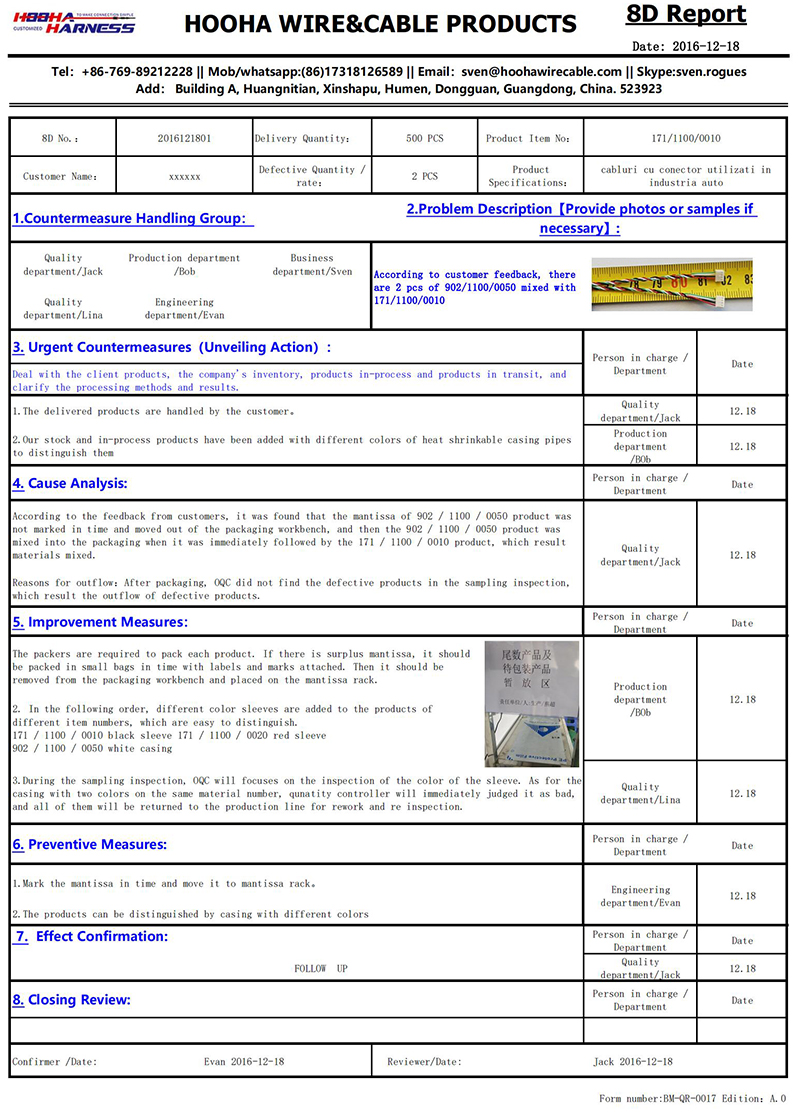
As a example, let us see how our company tackled a defective wire harness issue that was brought to our attention by one of our valued customers. Through diligent investigation and analysis, we were able to identify the root cause of the problem and take swift action to rectify it.
Our team worked tirelessly to implement effective solutions that would address every aspect of this complex issue. We documented each step along the way in meticulous detail so that we could learn from our experiences and improve upon them in future endeavors. Thanks to our commitment to thorough documentation throughout the entire 8D process, we were able to achieve outstanding outcomes for both ourselves and our customer. By leveraging this powerful tool effectively, we have been able to drive significant improvements across all areas of our business - from product design through production processes - ultimately leading us towards greater success than ever before!
Summary
It is crucial to emphasize that the 8D report offers a well-organized and systematic approach to problem-solving. However, it is essential to understand that this methodology can be tailored and customized according to the unique requirements of an organization. This flexibility allows for greater adaptability in addressing complex issues and challenges. Moreover, by modifying the 8D report, organizations can incorporate their own problem-solving methodologies into the process. This integration ensures that teams are utilizing familiar techniques while still adhering to a structured framework. Furthermore, adapting the 8D report enables organizations to address specific needs or variations within their industry or sector. By doing so, they can develop more effective solutions that are better suited to their particular circumstances. In summary, while the 8D report provides a solid foundation for problem-solving, its versatility allows organizations to tailor it as needed. This customization results in more comprehensive and efficient approaches to resolving complex issues within any given context.
