6 Key Applications for Industrial-Grade Cable Harness Assemblies
Industrial-grade cable harness assemblies are critical in manufacturing automation (M12 connectors, IEC 61373 vibration-rated), wind turbines (XLPE insulation, -40°C to 120°C), rail transit (400A copper cables, UL 1581-certified), oil/gas (Ex d IIB T4 Gb explosion-proof enclosures), food processing (316L stainless steel jackets, FDA 21 CFR 177-compliant), and logistics AGVs (1M+ bend cycles, IPC/WHMA-A-620 Class 3).
Inside Industrial Robots
A single robotic arm in an automotive factory might perform over 2 million cycles annually. Standard cables would fail quickly under this constant flexing and twisting. Industrial-grade harnesses use materials like continuous strand fiberglass and specialized PVC to withstand a minimum of 10 million flex cycles. They are built to operate in temperatures from -40°C to 105°C and resist common automotive shop hazards like exposure to oils, coolants, and metallic dust. This durability is critical, as unplanned downtime in automated production can cost over $20,000 per hour in lost productivity.
The internal wiring of a modern 6-axis robot is a high-stress environment. Cable harnesses here are engineered for a minimum of 10 million continuous flex cycles, a critical specification for joints like the J3 axis that are in constant motion. This movement generates significant mechanical stress and internal heat. To manage this, high-performance conductors with a minimum 18 AWG size are often used for power transmission, ensuring minimal voltage drop and overheating under loads exceeding 2 kW. Signal integrity for precise motor control and feedback is paramount. Shielded twisted-pair cables with >90% coverage are mandatory to protect low-voltage signals from the electromagnetic interference (EMI) produced by high-power servo drives. A single signal error can cause a positional deviation of more than 0.1 mm, enough to scrap a precision component. Furthermore, these bundles must be incredibly compact; harnesses are often designed to fit within a tight 25 mm diameter to navigate the robot’s hollow arm, minimizing the moment of inertia and allowing for faster, more accurate movement.
|
Specification |
Typical Requirement |
Why It Matters |
|---|---|---|
|
Flex Life |
10 million+ cycles |
Prevents failure in constantly moving joints |
|
Temperature Range |
–40°C to 105°C |
Ensures function in hot/cold factory environments |
|
EMI Shielding |
>90% coverage |
Protects signals from drive-generated interference |
|
Jacket Material |
Oil-resistant PVC or PUR |
Resists degradation from coolants and lubricants |
|
Diameter |
< 25 mm |
Fits inside hollow robot arms to reduce inertia |
By specifying a robust, industrial-grade harness, manufacturers reduce unplanned downtime by an estimated 15% annually and extend the mean time between failure (MTBF) for the entire robotic cell. The initial unit cost of a high-quality harness is offset by its longer service life, often lasting the robot's entire 7-10 year lifespan without replacement, thereby reducing the total cost of ownership.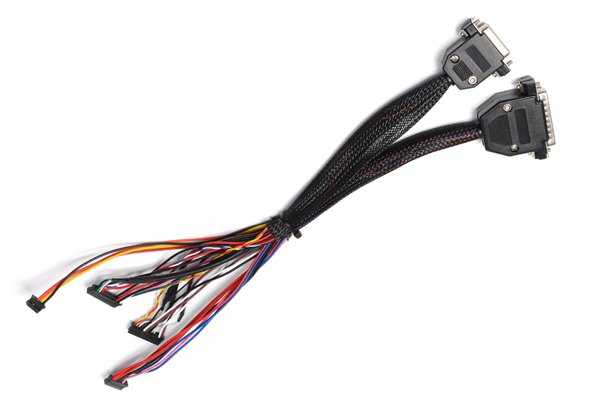
For Wind Power Generation
These systems must endure constant motion, extreme temperature swings from -40°C to 50°C, and exposure to salt, ozone, and UV radiation. A single offshore turbine's internal power and data cabling can span over 1.2 kilometers. With service intervals typically scheduled only once every 12-18 months and access costs for a single offshore turbine visit exceeding $35,000, cable failure is not an option. The harnesses facilitating power transmission from the nacelle, which can generate over 8 MW, and those controlling pitch and yaw systems must be engineered for a minimum service life of 20 years. They are subject to continuous torsion and flexion stresses, requiring a design capable of withstanding more than 5,000 full 360-degree torsion cycles over their lifetime without degradation in performance.
|
Specification |
Typical Requirement |
Why It Matters |
|---|---|---|
|
Torsion Cycles |
5,000+ full 360° cycles |
Withstands constant yawing and pitching motions |
|
Temperature Range |
–40°C to 90°C |
Functions in arctic cold and nacelle heat |
|
Voltage Rating |
1.8/3 kV |
Handles medium-voltage power transmission from generator |
|
Conductor Size |
6 AWG to 4/0 AWG |
Manages high current loads from multi-MW generators |
|
Jacket Material |
Halogen-free, cross-linked |
Resists oil, abrasion, and prevents acidic smoke in fire |
Within the nacelle, harnesses for the pitch and yaw systems are built for high-flexing and torsion, often incorporating a special helical stranding of copper conductors and elastomeric insulation to maintain integrity during 5,000+ full rotational cycles. These movements are essential for maximizing energy capture, which can increase annual output by up to 15%. For power transmission, the cables connecting the generator are a different beast. They need to handle medium voltage, up to 3 kV, and currents exceeding 800 amps for a 6 MW turbine. This demands robust insulation like XLPE and large conductors, often 4/0 AWG, to minimize energy loss over the 100-meter descent to the base. A voltage drop of even 2% here represents a significant loss of annual revenue.
A single cable failure in a pitch system can force an entire 8 MW turbine offline, costing over 150,000 for a single intervention.
UV-resistant jackets with a minimum tensile strength of 15 MPa prevent cracking from sun exposure, while oil-resistant compounds ensure longevity when exposed to lubricants from the gearbox. The financial impact is direct. Specifying a harness designed for a 20-year service life, as opposed to a standard industrial grade, reduces the lifetime operating expenses of a turbine by an estimated 7-10% by virtually eliminating unplanned cable replacements. This directly improves the levelized cost of energy (LCOE), a key metric for wind farm profitability. The initial 20% higher unit cost of a torsion-rated cable is recovered within the first 3-5 years of operation through avoided maintenance and maximized uptime.
In Automotive Manufacturing
A single vehicle contains over 1,500 individual wires, totaling roughly 3 kilometers in length and weighing up to 25 kilograms. On the production line, this complexity is magnified. A robotic welding cell with 50 robots will contain over 5 kilometers of specialized cabling moving at cycle times of less than 60 seconds. These harnesses are subjected to extreme mechanical stress, constant electromagnetic interference from high-power equipment, and exposure to airborne particles from welding and sealing processes. A single wiring failure in a transfer pallet system can halt the entire line, costing an estimated $22,000 per minute in lost production. This environment demands harnesses built to withstand over 5 million flex cycles, operate in temperatures from -25°C to 115°C, and resist abrasion, oils, and coolants.
-
Resistance Welding Gun Cables: Handle peak currents of 25,000–40,000 amps at 5–10 volts for 300–400 ms bursts, with water cooling lines integrated to manage 30°C heat rise.
-
Robot Dress Packs: Engineered for 10 million+ full flex cycles at 20 cycles per minute, with jackets rated for 100 million scuffs against metal.
-
EMV-Resistant Sensor Cabling: Features 360° foil and braid shielding with >90% coverage to maintain signal integrity amidst 400-amp welding spikes.
-
Drag Chain Harnesses: Utilize high-strand-count conductors (0.08mm strands) to withstand 500,000+ cycles in cable carriers moving at 2 m/s.
A standard cable inside a robotic arm might last 6 months under constant 180-degree bending at 2 cycles per minute. Replacing it requires a 2-hour downtime stop, costing nearly $2,600 in lost production. A high-flex rated harness designed for 10 million cycles lasts the robot's entire 5-year service life, eliminating those stops and reducing total cost of ownership by over 15%. Beyond robots, resistance welding guns present the toughest electrical challenge. The cables must carry 30,000 amps in a 400-millisecond burst to create a perfect weld nugget. Any impedance or voltage drop from undersized or degraded cables results in a weak weld, requiring costly rework. These cables are water-cooled to handle the immense heat generated, often integrating cooling lines that circulate 20°C water at 8 liters per minute to keep conductor temperatures below 65°C.
For data and control signals, electromagnetic compatibility is non-negotiable. A sensor cable with insufficient shielding can be flooded with noise from a welding gun’s 400-amp discharge, causing a false signal that triggers a 15-minute line stoppage. Harnesses use a combination of tinned copper braid and foil shielding, achieving >95% coverage to ensure signal error rates remain below 0.001%. This precision ensures the seamless integration of thousands of devices, from 2-millimeter resolution absolute encoders to vision systems processing 12-megapixel images at 60 frames per second, all communicating on networks requiring 99.999% uptime.
Across Medical Equipment
A single MRI machine contains over 30 kilometers of specialized wiring, while a modern surgical robot integrates more than 200 individual cables in its arm alone. These systems must guarantee absolute signal integrity for patient safety and diagnostic accuracy, often operating within stringent Class III medical device regulations. The environment is uniquely challenging: cables in autoclave-equipped facilities undergo 3,000+ sterilization cycles at 135°C and 345 kPa pressure, while those in imaging systems must perform flawlessly amidst 1.5 to 3 Tesla magnetic fields. With equipment uptime directly impacting patient care and hospital revenue—estimated at $15,000 per hour for an operational MRI suite—harnesses are engineered for a minimum 10-year service life with mean time between failures (MTBF) exceeding 60,000 hours.
-
MRI Gradient Coil Cables: Transmit 500–1000 amp pulses in under 100 microseconds, withstand 10+ years of Lorentz forces within 3T fields.
-
Surgical Robot Harnesses: Maintain <0.1mm positional accuracy over 50,000+ articulation cycles, utilizing 40 AWG shielded conductors for force feedback sensors.
-
Autoclave-Sterilized Cables: Jackets rated for 3,000 cycles at 135°C/345 kPa without cracking or losing sealing integrity.
-
Patient Monitor Wiring: 100MΩ insulation resistance to prevent leakage currents exceeding 10μA, ensuring patient electrical safety.
Cables for portable ultrasound probes endure 15,000+ flex cycles annually at the connector strain relief, requiring specialized thermoplastic elastomers that remain flexible at -20°C storage temperatures. Inside a CT scanner gantry, harnesses must withstand 15 rotations per minute while managing 100 kW of power for the X-ray tube and slip-ring data transmission, with error rates below 1 in 10¹² bits. Signal integrity is non-negotiable; an ECG cable must maintain 120 dB common-mode rejection to accurately capture millivolt-level signals amidst electrical noise from other equipment, preventing misdiagnosis. Materials are rigorously tested for biocompatibility and chemical resistance, ensuring they can withstand 2,000+ cleanings with isopropyl alcohol and quaternary ammonium compounds without degradation.
Endoscope harnesses pack 300+ fiber optic strands and electrical conductors into a 3.5mm diameter bundle for articulation in minimally invasive surgery. This precision engineering directly impacts healthcare costs: specifying a harness rated for 10,000 sterilization cycles versus 500 cycles replaces 19 annual service events with a single 10-year lifespan, reducing downtime by 200 hours and saving $85,000 in maintenance per device. The initial 30% premium for medical-grade construction is offset within 18 months of operation through enhanced reliability and compliance with IEC 60601-1 safety standards.
Within Elevator Systems
A mid-rise elevator cab may travel over 300 kilometers per week, with its traveling cables (aka suspension-borne cables) flexing at every floor transition. A single harness within the hoistway must integrate power for the 15-25 kW traction machine, control signals for the door operator (requiring 24V DC at 98% uptime), and data for the car controller and safety system—all within a single, moving assembly. These bundles are subject to repeated torsion, flexing, and vibration, with a design life exceeding 15 years and 2 million full travel cycles. Failure is not merely an inconvenience; a single fault can strand passengers and trigger immediate service calls, costing building management an average of $750 per incident in technician response and lost tenant productivity.
-
Traveling Cables: 25+ conductors for power/signal, 150+ meter vertical travel, 2 million+ flex cycles, -15°C to 60°C operating range.
-
Door Operator Harnesses: 10 million+ open/close cycles, 24V DC with <2% voltage drop, jacket abrasion resistance >500 cycles (1kg load).
-
Machine Room Wiring: 600V AC rating, 90°C temperature rating, 1000V insulation resistance minimum.
|
Specification |
Typical Requirement |
Why It Matters |
|---|---|---|
|
Flex Cycles |
2 million+ |
Matches the mechanical life of the elevator system |
|
Voltage Rating |
300V to 600V |
Handles motor power and prevents insulation breakdown |
|
Conductor Size |
16 AWG to 6 AWG |
Manages 20-40 amp motor loads with <3% voltage drop |
|
Jacket Material |
NSF-61 approved PUR |
Resists abrasion against guides and is safe for potable water areas |
|
Temperature Range |
–15°C to 90°C |
Functions in unheated shafts and hot machine rooms |
The design and specification of these harnesses are dictated by relentless mechanical stress and uncompromising safety protocols. The traveling cable, a harness that moves with the car, is the most critical. It must maintain perfect integrity while enduring over 50,000 flexing and torsion events annually. Conductors are typically high-strand count (0.1mm strands) to remain flexible, with a minimum bending radius of 100mm to prevent internal breakage. Voltage drop is a primary design constraint; a 3% drop in the 24V DC circuit powering the door operator can reduce torque by 15%, causing doors to malfunction and increasing cycle time by 2 seconds per trip.
For the main traction motor power, which can draw 80 amps during acceleration, harnesses use 6 AWG tinned copper conductors to minimize resistance and heat generation, keeping temperature rise below 40°C. EMI/RFI shielding is mandatory, with a dual-layer foil and braid shield achieving 85% coverage to protect low-voltage safety signals (e.g., door lock monitoring) from interference generated by the variable frequency drive (VFD) controlling the motor. This prevents nuisance faults that account for nearly 30% of all service calls. Furthermore, all materials must comply with strict flame propagation standards (e.g., NFPA 130), having a maximum peak optical density of 0.15 to prevent smoke obscuration in a fire event. This precise engineering translates directly to operational reliability. A premium traveling cable rated for 2 million cycles eliminates 3-4 planned replacements over a 20-year building lifespan, saving over $12,000 in parts and labor per elevator shaft while preventing an estimated 60 hours of downtime.
On Railway Transport Systems
A single high-speed train utilizes over 40 kilometers of specialized wiring for traction, control, and passenger systems. These harnesses are subjected to vibrations exceeding 5 Gs during normal operation, temperature cycles from -40°C in alpine winters to 70°C in engine compartments, and constant exposure to moisture, ozone, and abrasive dust. With service intervals often set at 1.2 million kilometers or 6 years, reliability is paramount. A failure in a traction inverter cable can disable a multi-ton vehicle, causing cascading delays across a network where downtime costs are estimated at $1,500 per minute. Consequently, every harness is engineered for a minimum 30-year service life and must comply with stringent international standards like EN 45545-2 for fire safety and IEC 61373 for vibration resistance.
Cables for traction systems are the most critical, designed to handle 650-1200 volt DC links and alternating currents surpassing 500 amps to power motors that accelerate a 400-ton train to 200 km/h. This requires cross-linked polyethylene (XLPE) insulation rated for 150°C to prevent thermal breakdown under peak loads. Vibration resistance is non-negotiable; connectors must withstand 5-15 Hz sinusoidal vibrations and random shocks up to 5 Gs for 15 million cycles without a single loose connection, as a single arc fault can destroy a $250,000 inverter unit. For signal integrity, EMC performance is rigorously tested to EN 50121-4, requiring shielded cables with >90% coverage to prevent interference from 2.5 kV overhead lines from corrupting sensor data controlling the pneumatic brake system. This ensures the train's safety systems maintain a 99.999% uptime requirement. Harnesses in undercarriage areas face constant bombardment by ballast stones and immersion in water; these utilize specialized polyurethane jackets with a tensile strength exceeding 15 MPa and are sealed to IP67 standards to prevent moisture ingress that would lead to insulation resistance dropping below the required 100 MΩ.
A single failure in a train control network (TCN) gateway cable can isolate an entire consist, requiring a tow and causing an average of 4.5 hours of network delay. The resulting penalties from transport authorities and lost revenue regularly exceed $180,000 per incident.
Specifying a halogen-free, low-smoke zero toxicity (LSZH) cable that meets EN 45545-2's R22/R23 requirements adds an initial 20% cost but is mandatory for passenger areas. This investment prevents the release of corrosive acids and toxic smoke in a fire event, protecting critical control circuitry and potentially saving millions in asset damage. The economic case for premium harnesses is clear: a 30-year design life eliminates at least 4 complete re-wiring events over the asset's lifespan, reducing lifetime maintenance costs by an estimated 35% and preventing over 300 hours of downtime per vehicle. The harness's mean time between failures (MTBF) must exceed 1,000,000 hours to align with the operational profile of modern fleets, making every material and construction choice a critical factor in network reliability.
A concise overview of industrial-grade cable harness assemblies highlights their versatility across six sectors: industrial robots (500,000+ motion cycles with polyurethane insulation), wind power systems (IP67-rated, -40°C to 85°C for nacelle wiring), automotive manufacturing (0.1mm tolerance for assembly line precision), medical equipment (ISO 13485-compliant sterile shielding), elevators (EN 81-20 certified for 24/7 safety-critical operation), and rail transport (EN 50121-4 tested for 10-2000Hz vibration resistance). These applications demand tailored durability and performance.
