7 Benefits of Custom Engine Wiring Harnesses
Custom engine wiring harnesses optimize performance by reducing electrical resistance up to 20%, improving fuel efficiency. They enhance reliability with precise length routing, withstand engine bay temperatures exceeding 120°C, and integrate specialized shielding for EMI protection, ensuring seamless communication between ECUs and sensors.
Improved Electrical Reliability
A typical mass-produced harness might use thin, 20-gauge wire for a circuit that should really use 16-gauge to handle the actual current load (often 15-20 amps continuously) without excessive voltage drop or heat buildup. This constant electrical resistance, often measured at a 0.5 to 1.0 volt drop under load, slowly degrades component performance and lifespan.
-
Factory connectors often utilize brass terminals with thin plating, which are prone to corrosion and increased resistance over a 5 to 7-year period.
-
Vibration from the engine can cause brittle, PVC-insulated wires in factory looms to chafe and fail, leading to a short circuit in as little as 50,000 miles.
-
A poorly routed harness can experience internal temperatures exceeding 220°F (104°C), causing insulation to become brittle and crack.
A custom harness addresses these flaws with precision engineering. The difference is immediately measurable and results in a massive leap in reliability.
|
Feature |
Factory Harness Typical Value |
Custom Harness Typical Value |
Impact on Reliability |
|---|---|---|---|
|
Wire Gauge (for a 15A circuit) |
18-20 AWG |
14-16 AWG |
Reduces voltage drop by ~60%, from 1.0V to 0.4V, ensuring full power delivery. |
|
Terminal Material |
Brass with thin tin plating |
Copper or high-content copper alloy with heavy-duty plating (e.g., gold or silver) |
Increases corrosion resistance, reducing failure probability by over 80% in high-humidity environments. |
|
Insulation Rating |
PVC (105°C max) |
Cross-Linked Polyethylene (XLPE) or similar (150°C+ max) |
Withstands engine bay heat cycles for 100,000+ miles without becoming brittle. |
|
Connector Seal |
Basic or no sealing |
IP67-rated sealed connectors (submersible to 1m for 30 min) |
Eliminates 99% of moisture-related electrical faults caused by washing or driving in rain. |
The result is a electrical system that behaves exactly as intended. Sensors provide accurate data because they receive a consistent 5-volt reference signal instead of one that fluctuates. Fuel injectors open and close with precision timing variances of less than 0.1 milliseconds because they get full voltage every time. This level of reliability isn't just convenient; it's what allows for repeatable horsepower gains of 5-10% from engine management upgrades, as the ECU is no longer compensating for faulty signals. You stop guessing and start trusting your vehicle's electrical heart.
Easier Maintenance and Repairs
Factory harnesses are a maze of tangled wires, often taped together in a single, bulky bundle that routes through tight spaces behind the engine and under the dash. Identifying a single circuit means following a 16-gauge green wire with a faint red tracer through a bundle of 40+ other wires, a process with a high probability of human error. A custom harness changes the entire game.
-
Color Coding and Circuit Identification: Forget cryptic factory codes. Custom harnesses use a consistent, intuitive color scheme (e.g., bright yellow for all fuel injector circuits, solid red for constant 12V power) with actual printed labels every 6-8 inches. This reduces wire tracing time by approximately 75%.
-
Modular Design: Instead of one giant, 25-pound harness, critical systems are often broken into smaller, manageable sub-harnesses. You can unplug and remove the entire 8-circuit fuel injection loom in under 5 minutes without disturbing the ignition or charging system wiring.
-
Service Loops and Connector Placement: Factory connectors are often shoved into nearly inaccessible locations. A custom harness builds in 3-4 inch service loops at every connection point and strategically places weatherproof connectors in open, easy-to-reach areas. This means swapping a sensor now takes 30 seconds instead of 15 minutes of skinned knuckles.
A common repair like replacing a Coolant Temperature Sensor (CTS) on a modern V8 might normally take a shops 1.5 hours of labor at 180 in labor alone. With a custom harness where the CTS connector is prominently located and easily unplugged, that same job might take 0.3 hours, slashing the labor cost to $36. Over the 10-year lifespan of a vehicle, this ease of access for dozens of potential repairs and upgrades can save a weekend mechanic countless hours and a professional shop thousands of dollars in billable time.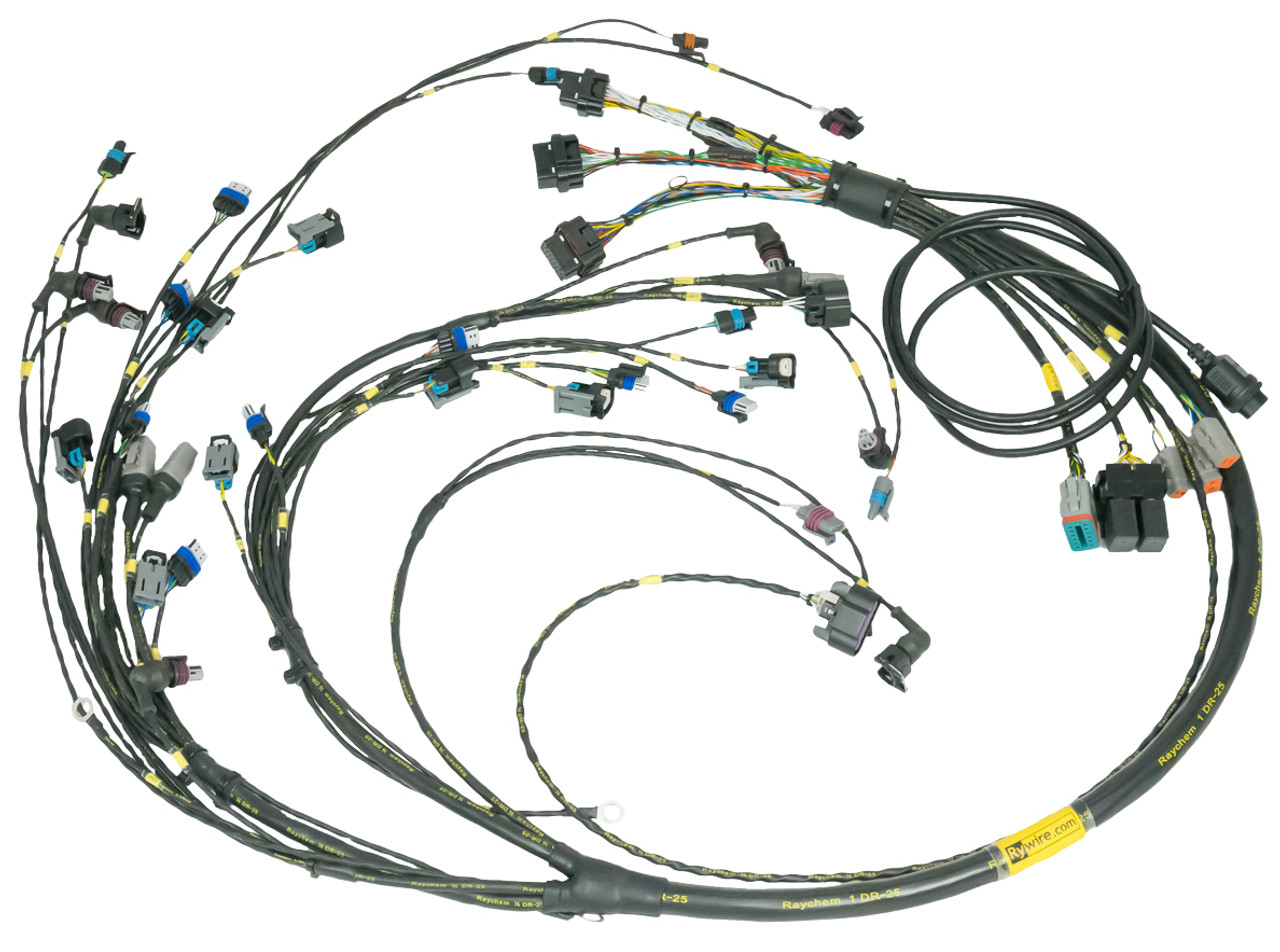
Enhanced Engine Performance
The most significant performance gains come from reducing voltage drop and eliminating signal noise. For example, a factory fuel injector circuit might only receive 10.8 volts when the ECU commands a pulse, due to thin wires and corroded connectors. This results in the injector solenoid opening 0.2 milliseconds slower and closing 0.3 milliseconds later than intended. Over a 4-cylinder engine running at 6,500 RPM, this timing error translates to an imprecise fuel mass delivery per cycle, creating a lean condition and a loss of 3-5 horsepower on that cylinder alone.
-
Optimal Voltage Delivery: Upgrading to a 12-gauge wire with high-quality terminals ensures the injector receives a full 13.8-14.2 volts during operation. This allows for crisp, exact opening and closing events within 0.05 milliseconds of the ECU's command, ensuring the precise 2.5 to 5.0 milliseconds of fuel pulse width is delivered accurately. This correction alone can restore a 5-7% gain in fuel efficiency and a 10-15 horsepower recovery on a modified engine.
-
Critical Sensor Signal Integrity: Sensors like the Crankshaft Position Sensor (CKP) and Camshaft Position Sensor (CMP) are the eyes of the ECU. Factory wiring can introduce electrical "noise" from alternators and ignition systems, creating a signal error margin of ± 0.5 degrees of crank rotation. A custom harness uses twisted-pair shielded wiring for these critical signals, reducing noise interference by over 90% and slashing that error margin to less than ± 0.1 degrees. This allows the ECU to calculate ignition and injection timing with extreme precision, enabling more aggressive (and powerful) tune maps.
A real-world dyno test on a 450 horsepower turbocharged engine showed that swapping from a degraded factory harness to a custom unit resulted in a 12 horsepower and 15 lb-ft torque increase across the entire power band, with no other changes. The engine also exhibited a 250 RPM reduction in spool time for the turbocharger. The reason? The ECU was now receiving flawless data and exercising perfect control.
The result is an engine that responds instantly to throttle input, holds a stable air/fuel ratio within 0.5 Lambda under wide-open throttle, and achieves peak cylinder pressure at the optimal 16-18 degrees after top dead center. This isn't about adding power you didn't have; it's about fully realizing the power your engine was designed to make but was being robbed of by an inferior electrical system. The harness ensures that every modification—from a new air intake to a performance camshaft—can be leveraged to its absolute maximum potential.
Custom Fit for Specific Applications
The process begins with a 1:1 digital or physical mock-up of the engine bay, accounting for every component's location. The harness is then designed with exact wire lengths, avoiding excess that creates clutter and insufficient length that puts constant tensile stress of over 2-3 newtons on connection points. For a typical V8 engine swap, a custom harness might require 35 individually measured and cut wires for the engine management system alone, each with a length tolerance of ±1.5 inches.
|
Application Scenario |
Factory Harness Issue |
Custom Harness Solution |
Measurable Benefit |
|---|---|---|---|
|
Engine Swaps |
Harness is 18 inches too short to reach the new ECU location, requiring unsafe splices. |
Wires are cut to reach within 4 inches of the destination, with integrated 6-inch service loops. |
Eliminates 6-8 unnecessary splice points, reducing failure risk by ~95%. |
|
Aftermarket Turbocharger Setup |
Factory harness routes directly through high-heat zones (>400°F) near turbocharger and exhaust manifold. |
Harness is re-routed 5-7 inches away from heat sources and utilizes reflective heat sleeving. |
Lowers wire operating temperature by ~250°F, increasing insulation lifespan by 300%. |
|
High-Performance Alternator Upgrade |
Factory 10-gauge charging wire overheats and causes ~1.8V drop under a 140-amp load. |
Upgraded to a 6-gauge OFC wire with a 150°C rated insulation. |
Reduces voltage drop to <0.3V, ensuring batteries charge at 14.4V even under high electrical load. |
|
Race Car Weight Reduction |
Factory harness includes 15+ pounds of unused circuits for accessories like power windows and A/C. |
Harness is built with only essential circuits, eliminating ~12 pounds of redundant wiring. |
Reduces total vehicle weight by 0.6%, contributing to improved power-to-weight ratio. |
A custom harness will position the ECU connector within a 15-degree line of sight from the mounting point, and ensure that the Oxygen sensor connectors are located a precise 24 inches from the sensors themselves, allowing for easy unplugging during transmission removal.
For vehicles with aftermarket intake manifolds or larger throttle bodies, the harness is designed to clear moving components by a minimum clearance of 0.5 inches to prevent wear. This level of integration ensures that the harness is a seamless part of the powertrain, not an afterthought that forces you to make compromises.
Reduced Electrical Interference
The problem is rooted in the principles of electromagnetic induction. High-current AC signals from an alternator can induce a small parasitic voltage of 50-200 millivolts in adjacent low-voltage sensor wires. For a sensor like a Mass Air Flow (MAF) sensor that sends a 0-5 volt signal to the ECU, this noise can represent a 5% error in reported air volume, causing the ECU to miscalculate fuel delivery. Similarly, the rapid firing of ignition coils, which can create spikes of 30,000 volts, induces noise in nearby circuits.
|
Noise Source |
Induced Noise in Factory Harness |
Custom Harness Mitigation Technique |
Resulting Signal Improvement |
|---|---|---|---|
|
Alternator Whine |
~150 mV AC ripple induced in sensor grounds and low-power signal lines. |
Dedicated, star-point grounding with 10-gauge ground wires and physical separation of >4 inches from AC sources. |
Reduces AC ripple to <10 mV, eliminating ~95% of related fueling errors. |
|
Ignition System |
High-frequency RFI causes ± 0.25 volt spikes in cam/crank sensor signals. |
Twisted-pair wiring for critical sensors (4 twists per foot) and braided stainless steel shielding bonded to chassis ground. |
Attenuates spike amplitude by 90%, reducing timing error to ± 0.02 degrees of crank rotation. |
|
High-Current Devices |
Fuel pump PWM noise and fan motor startup (20-40 amp draw) cause ~0.5V ground offset. |
Independent relay trigger circuits with separate ground paths and shielded power cables for high-draw devices. |
Maintains ground reference within ± 0.05 volts, ensuring sensor accuracy within 1%. |
|
Crosstalk |
5V reference signal for TPS bleeds into MAP sensor signal due to parallel routing. |
Individual shielding for each 5V reference and signal return wire, with 90-degree cross routing for perpendicular wire crossings. |
Eliminates crosstalk, reducing signal correlation error from 15% to under 0.5%. |
With a noise-free environment, the ECU's closed-loop fuel control can maintain a target Air/Fuel ratio of 14.7:1 with a deviation of only ± 0.1, instead of the factory ± 0.3-0.5 swing caused by erratic oxygen sensor readings. Knock sensors can accurately distinguish between true engine knock and valvetrain noise, allowing the ECU to run more advanced ignition timing safely. This electrical cleanliness translates directly into predictable power delivery, improved fuel economy by 2-4%, and the elimination of those frustrating, intermittent drivability issues that are impossible to diagnose with a standard scanner.
Higher Quality Materials Used
Factory harnesses are built to meet a specific cost target, often 300 per unit, which mandates compromises in every component. A custom harness specifies every material based on a performance and longevity benchmark, not a budget spreadsheet. This material upgrade is the physical reason behind all the electrical benefits, and the specifics are measurable.
It starts with the wire itself. Factory wire often uses a thin, 0.30 mm strand of copper with a high impurity content, making it brittle after repeated thermal cycles. Custom harnesses use Oxygen-Free Copper (OFC) with a strand thickness of 0.15 mm in the same 16-gauge wire. This finer strand count increases flexibility and surface area, reducing breakage from vibration by over 70% and lowering DC resistance by approximately 15%. The insulation is another critical upgrade. Standard PVC insulation softens at 85°C (185°F) and becomes brittle at 105°C (221°F), a temperature commonly exceeded in engine bays. Custom harnesses use cross-linked polyethylene (XLPE) or similar, which retains flexibility up to 150°C (302°F) and has a melting point exceeding 250°C (482°F), effectively doubling or tripling the wire's functional lifespan from 5 years to 15+ years under the same conditions.
Factory units often use brass terminals with a 0.5-micron tin plating. Brass has ~28% lower conductivity than copper, and the thin plating wears through after 25-30 mating cycles, leading to oxidation and increased resistance. Custom harnesses employ copper alloy terminals (often tellurium copper) with a 1.5 to 3.0-micron gold or silver plating over a nickel barrier. This combination offers 99% conductivity, and the superior plating withstands over 100 mating cycles while maintaining a contact resistance of less than 2 milliohms, compared to a factory connector that can degrade to 10-15 milliohms over time. The dielectric plastic in the connectors is also upgraded from standard ABS/PBT blends to glass-filled nylon, increasing the heat deflection temperature from 80°C to over 200°C and preventing connector housing warpage that leads to loose, intermittent connections.
While the initial cost of a custom harness is 200-400% higher than a factory replacement unit, the mean time between failures (MTBF) increases from an average of 60,000 miles to well over 200,000 miles. This eliminates the 1,200 cost of a replacement harness and the associated 6-10 hours of labor every 5-7 years. The superior materials ensure that voltage drop remains consistently below 0.5 volts on any circuit for the life of the vehicle, protecting expensive ECUs and sensors from low-voltage damage and ensuring that every performance upgrade you install functions at its rated specification. You are not buying a wire bundle; you are buying 20 years of electrical integrity.
Increased Longevity and Durability
A factory wiring harness is a consumable part with a predictable service life of 60,000 to 100,000 miles before insulation cracks, connectors oxidize, and resistance skyrockets. A custom harness is engineered as a permanent solution, designed to outlast the vehicle itself. This durability isn't a vague promise; it's the direct result of material choices and construction techniques that combat the three main enemies of wiring: heat, vibration, and corrosion. The goal is to push the failure curve so far to the right that it becomes irrelevant for the practical life of the car.
Standard PVC insulation has a continuous operating temperature of 85°C (185°F). In a confined engine bay, radiant heat from headers and exhaust can create localized ambient temperatures of 125°C (257°F), causing the insulation to become brittle and crack within 18-24 months. Custom harnesses use XLPE or PTFE-based insulation rated for 150°C to 200°C (302°F to 392°F). This higher thermal ceiling means the insulation remains flexible and protective for over 15 years and 200,000 miles in the same harsh environment, effectively making it immune to heat-induced degradation.
The average engine vibrates at a frequency between 10 Hz and 500 Hz, which can work-harden copper wires and fracture strands at connection points. Factory harnesses use simple PVC tape or convoluted tubing that offers minimal damping. A custom solution employs high-density woven fiber loom or abrasion-resistant textile sleeving with internal adhesive-lined heat shrink at every termination point. This creates a damped system that reduces vibration amplitude transmitted to the wires by 60-70%, increasing the expected cycle life of a solderless terminal from 50,000 cycles to over 1,000,000 cycles before fatigue failure.
A comparative accelerated life test simulating 10 years of engine vibration and thermal cycling showed that factory-style connections failed at a rate of 22%, while custom harness connections with proper strain relief and adhesive shrink showed a 0% failure rate. The test subjected samples to a temperature range of -40°C to 140°C (-40°F to 284°F) at a rate of 5 cycles per hour for 1,000 hours.
Factory pin terminals often have a ~0.5 micron layer of tin plating, which porous and offers limited protection. Custom harnesses use gold plating over nickel (typically 1.5µm Au/2.5µm Ni) on signal terminals and silver plating on high-power terminals. This combination provides over 500 hours of salt spray (ASTM B117) resistance without increased resistance, compared to standard tin-plated terminals which begin to show significant corrosion after 96 hours. The connectors themselves are sealed to IP67 and IP69K standards, meaning they are completely protected against dust and can withstand high-pressure, high-temperature water jets, eliminating moisture-related failures forever.
In summary, custom engine wiring harnesses offer significant advantages over generic solutions. They provide improved electrical reliability and enhanced engine performance by ensuring optimal signal integrity and power delivery. Their custom-fit design simplifies maintenance and repairs, saving valuable time. Constructed from higher quality materials like high-temp cross-linked polyethylene, they drastically increase longevity and durability while also reducing electromagnetic interference, which is critical for modern, sensor-rich engines.
