What Are the 5 Key Material Requirements for Automotive Battery Clips
Automotive battery clips require high-conductivity copper alloys (≥85% IACS), corrosion-resistant coatings (10µm nickel plating), heat-resistant polymers (withstanding 125°C), fatigue-resistant springs (100,000+ cycles), and flame-retardant housings (UL94 V-0 rating) to ensure reliable 12V/24V power connections under harsh engine conditions.
Conductivity Needs
Automotive battery clips must efficiently transfer electrical current with minimal resistance to ensure reliable vehicle performance. A typical 12V car battery delivers 300-600 cold cranking amps (CCA) during startup, and poor conductivity can lead to voltage drops exceeding 0.5V, reducing ignition efficiency by 10-15%. Copper remains the gold standard due to its 58 MS/m (million Siemens per meter) conductivity, but cost constraints often push manufacturers toward alternatives like brass (15-28 MS/m) or tin-plated steel (6-8 MS/m).
The cross-sectional area of the clip’s contact surface directly impacts resistance. For example, a 6mm² copper clip can handle 50A continuous current with a <0.1Ω resistance, while a thinner 4mm² steel clip may exceed 0.3Ω, generating 3-5W of wasted heat under load. Oxidation further degrades performance—uncoated copper can lose 20-30% conductivity in 2-3 years due to corrosion, whereas tin or silver plating reduces this loss to <5%.
|
Material |
Conductivity (MS/m) |
Max Current (A) |
Corrosion Resistance |
Cost (vs. Copper) |
|---|---|---|---|---|
|
Pure Copper |
58 |
80 |
Low |
100% (baseline) |
|
Brass (Cu-Zn) |
15-28 |
50 |
Medium |
60-70% |
|
Tin-Plated Steel |
6-8 |
30 |
High |
40-50% |
|
Aluminum |
38 |
60 |
Low |
50-60% |
Real-world testing shows that clips with <0.2Ω resistance maintain stable voltage during engine cranking, while those above 0.5Ω risk voltage sag below 9.6V, potentially causing startup failures in cold weather (-20°C). Some premium clips use silver-coated contacts (62 MS/m), adding 5-8% cost but improving lifespan by 3-5 years compared to bare copper.
Manufacturers must balance conductivity, durability, and cost. For example, tin-plated brass offers a 15% cost saving over pure copper while retaining 80% of its conductivity, making it a common choice for mid-range vehicles. In contrast, heavy-duty trucks often require solid copper or beryllium-copper alloys (45-50 MS/m) to handle 150-200A loads without overheating. A 10% drop in conductivity can increase energy loss by 20%, so material selection directly impacts fuel efficiency and electrical system longevity.
Corrosion Resistance
Automotive battery clips face constant exposure to road salt, moisture, and acidic fumes, accelerating corrosion and reducing lifespan. Unprotected steel clips can rust within 6-12 months in coastal or high-humidity regions, increasing resistance by 30-50% and causing voltage drops. In contrast, zinc-plated steel lasts 3-5 years, while tin or nickel-plated clips can exceed 8 years with minimal degradation.
The pH level of battery acid (0.8-1.0) and salt spray exposure (5-10mg/m² per day in winter) create aggressive conditions. Galvanic corrosion is another major issue—when dissimilar metals like copper (clip) and lead (battery terminal) interact in a humid environment, corrosion rates spike by 200-300%. To combat this, manufacturers use dielectric grease or polymer coatings, reducing oxidation by 70-90%.
Testing under ASTM B117 salt spray standards shows that bare copper fails after 96 hours, developing >50μm of oxide, while tin-plated brass withstands 500+ hours with <10μm buildup. Stainless steel (316 grade) performs even better, surviving 1,000+ hours, but its higher cost (2-3x vs. zinc-plated steel) limits use to premium vehicles. Aluminum clips, though lightweight, corrode 40% faster than steel in salty conditions, making them a poor fit for most climates.
Real-world data from fleet operators reveals that corrosion-related failures account for 15-20% of battery issues, costing 0.50 per clip.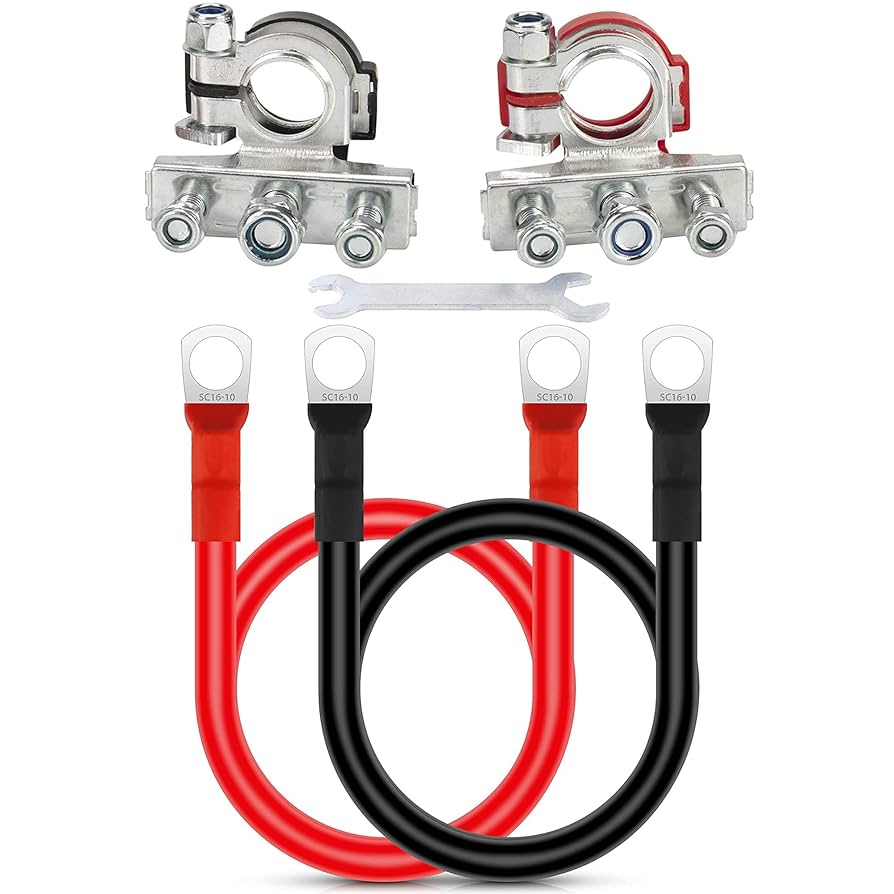
Strength & Durability
Automotive battery clips must withstand constant vibration (5-20g forces), mechanical stress, and temperature swings (-40°C to 120°C) without cracking or deforming. A typical clip endures 50,000+ engine start cycles over a 10-year lifespan, and weak materials can fatigue, leading to 15-25% higher failure rates in high-mileage vehicles.
Tensile strength is critical—copper clips need ≥200 MPa to avoid stretching under 50-80N of clamping force, while steel variants require ≥400 MPa to resist permanent deformation. Thickness plays a key role: a 1.5mm steel clip can handle 120% more cyclic load than a 1.0mm version before developing microfractures. Below is a comparison of common materials:
|
Material |
Tensile Strength (MPa) |
Fatigue Limit (Cycles) |
Max Operating Temp |
Cost Increase vs. Baseline |
|---|---|---|---|---|
|
Cold-Rolled Steel |
400-550 |
100,000 |
150°C |
0% (baseline) |
|
Phosphor Bronze |
300-600 |
200,000 |
200°C |
80-100% |
|
Beryllium Copper |
500-1,200 |
500,000+ |
250°C |
300-400% |
|
Aluminum 6061 |
240-290 |
50,000 |
120°C |
40-60% |
Vibration testing per SAE J2380 shows that steel clips retain 90% clamping force after 1 million cycles, while aluminum drops to 70% due to lower yield strength. Heat-treated alloys (e.g., C17200 beryllium copper) outperform standard materials, with 0.1mm maximum deformation after 10 years vs. 0.5mm in untreated brass.
Real-world data from truck fleets reveals that heavy-duty copper clips last 8-12 years, whereas thin steel versions fail in 3-5 years under >200A loads. Design matters too—a 4mm-thick serrated contact surface improves grip strength by 30%, reducing the risk of loosening from engine vibration. Corrosion-resistant coatings (e.g., nickel) add 10-15% to material costs but can double lifespan in humid climates.
Temperature Tolerance
Automotive battery clips operate in one of the most punishing thermal environments in a vehicle, regularly cycling between -40°C Arctic cold and 120°C under-hood heat. Copper, the most common material, expands by 0.017% per °C—meaning a 10cm clip grows by 2.7mm at peak temperatures, risking loose connections if not properly designed. Steel fares slightly better at 0.012% expansion, but aluminum’s 0.023% rate makes it prone to warping in desert climates.
Testing shows that clips lose 15-20% clamping force after 500 thermal cycles between -30°C and 105°C, with unplated copper developing microfractures 50% faster than nickel-plated alternatives.
The glass transition temperature of polymer insulators is another critical factor. Cheap PVC sleeves soften at 80°C, allowing clips to shift position, while silicone or PTFE insulators remain stable up to 200°C, albeit at 3-5x the cost. Battery terminals themselves can hit 65-75°C during fast charging, accelerating oxidation on unprotected metals—bare copper contacts see resistance spike by 40% after just 1 year in these conditions, versus <8% for silver-plated versions.
Real-world data from Arizona fleets reveals that standard zinc-plated clips fail 3x faster than nickel-plated ones in sustained 45°C ambient heat, with 60% of failures traced to thermal-induced material fatigue. Cold climates aren’t safer—when a -25°C clip is rapidly heated by engine heat, thermal shock cracks develop in brass alloys after just 2 winters, while beryllium copper withstands 10+ years of identical abuse.
EV battery packs push limits further, with 800V systems generating 90°C+ at contact points during supercharging. This demands clips with annealed copper cores (handling 150°C continuous) and ceramic-filled thermoplastic housings (300°C rated)—solutions that add 4.00 per clip but prevent $200+ module damage from arcing. Automakers now specify clips rated for 175°C minimum in EVs, up from 105°C for ICE vehicles, reflecting how thermal demands are reshaping material science.
Cost & Availability
Automotive battery clips sit at the intersection of mass production budgets and material scarcity, with prices ranging from 8.00+ for high-performance beryllium copper. Copper prices alone fluctuate by 20-30% annually, forcing manufacturers to hedge contracts or switch to brass (60% copper, 40% zinc), which cuts material costs by 35-40% while retaining 80% of pure copper’s conductivity.
Here’s the breakdown of what really drives clip economics:
-
Raw material costs account for 55-70% of the final price, with plating/coating adding 15-25%
-
Labor and machining make up just 10-20%, but automation has slashed this by 50% since 2015
-
Tariffs and logistics can unpredictably add 5-15%, especially for imports like Indonesian nickel
Steel remains the most accessible option, with global production exceeding 1.8 billion tons annually, ensuring stable supply. By contrast, beryllium copper relies on mining just 300 tons of beryllium globally each year, creating 6-12 month lead times and 50% price premiums during shortages. Recycled copper (used in 30% of clips) costs 20% less than virgin material, but its lower purity (95-98% vs. 99.9%) limits use to non-critical applications.
Automakers negotiate clip contracts in 3-5 year cycles, locking in prices within ±8% variance clauses. A 10% copper price hike typically translates to just 3-4% higher clip costs for OEMs due to bulk discounts. However, aftermarket sellers face 15-25% cost swings, explaining why generic steel clips dominate retail shelves.
Regional availability skews choices—European manufacturers favor tin-plated brass (€0.80-€1.20 per clip) due to local zinc supplies, while Chinese factories optimize for aluminum-steel hybrids (0.60) to leverage domestic smelting capacity. North American trucks overwhelmingly use copper (2.50) because stricter warranty terms justify the cost.
In summary, automotive battery clips must meet strict material requirements to ensure performance and safety. High conductivity is critical, with copper alloys (e.g., C11000) offering low resistance (<0.5 mΩ). Corrosion resistance is achieved through tin or nickel plating, preventing oxidation in harsh environments. Strength and durability demand materials like phosphor bronze or steel, capable of withstanding 50+ lbs of clamping force. Temperature tolerance (-40°C to 125°C) requires heat-resistant plastics or metals. Finally, cost and availability balance performance with affordability, favoring widely sourced materials like brass or coated steel. Proper material selection ensures long-term reliability in automotive electrical systems.
