What are the typical specifications and uses of Cat-5 cable?
Cat-5 cables support 100MHz bandwidth and 100Mbps speeds (or 1Gbps with all 4 pairs), using 24AWG twisted pairs with 100Ω impedance. Ideal for Ethernet networks, POE devices (15.4W delivery), and telephony, they feature PVC jackets rated for -20°C to 60°C. Maximum 328ft (100m) runs maintain signal integrity, while CMR-rated versions resist fire spread. Cross-talk is minimized below -30dB.
What is Cat-5 Cable?
Cat-5 (Category 5) cable is one of the most widely used Ethernet cables for wired networks. Introduced in the mid-1990s, it supports speeds up to 100 Mbps at 100 MHz bandwidth over a 100-meter (328 ft) distance, making it a reliable choice for home and small office networks. The cable consists of four twisted pairs of copper wires, reducing electromagnetic interference (EMI) and crosstalk. While newer standards like Cat-5e and Cat-6 have since improved performance, Cat-5 remains relevant for basic networking needs due to its low cost (around 0.30 per foot) and sufficient speed for tasks like web browsing, email, and VoIP calls.
"Cat-5 was the backbone of early Ethernet networks, handling up to 100 Mbps—enough for most businesses in the late '90s and early 2000s."
The cable’s 24 AWG (American Wire Gauge) copper conductors ensure stable signal transmission, though its maximum frequency of 100 MHz limits its ability to support modern gigabit (1,000 Mbps) networks without performance drops. Despite this, Cat-5 is still found in older installations, particularly in residential wiring, security cameras (which often only need 10–20 Mbps), and legacy office setups. Compared to Cat-5e (enhanced), which reduces crosstalk and supports 1 Gbps, Cat-5 is about 15–20% cheaper, making it a budget-friendly option for non-demanding applications.
One key limitation is its attenuation (signal loss) over distance. Beyond 50 meters (164 ft), data speeds can degrade by 5–10%, especially in environments with high EMI. However, for short runs (under 30 meters), it performs nearly as well as Cat-5e. The cable’s PVC jacket thickness (typically 0.8–1.2 mm) provides basic durability, though it lacks the shielding found in higher-end cables.
Speed and Performance Details
Cat-5 cables were designed to handle 100 Mbps Ethernet (Fast Ethernet) with a 100 MHz frequency bandwidth, making them suitable for most networking needs in the late 1990s and early 2000s. While they can technically support 1 Gbps (Gigabit Ethernet) over short distances (up to 50 meters), performance drops significantly beyond that due to signal attenuation (3–5 dB per 100 meters) and increased crosstalk interference. Compared to Cat-5e, which guarantees 1 Gbps at 100 MHz, Cat-5 struggles with higher data loads, experiencing 10–15% slower speeds under heavy network traffic.
| Performance Metric | Cat-5 | Cat-5e |
|---|---|---|
| Max Speed (Mbps) | 100 (1 Gbps up to 50m) | 1,000 |
| Frequency (MHz) | 100 | 100 |
| Max Distance (m) | 100 (optimal up to 50m) | 100 |
| Crosstalk (NEXT loss, dB) | ~30 dB | ~35 dB |
| Attenuation (dB/100m @ 100MHz) | 22–24 dB | 20–22 dB |
The twisted pair design in Cat-5 helps reduce electromagnetic interference (EMI), but its unshielded construction (UTP) means it’s more susceptible to noise in environments with high electrical interference. For example, running Cat-5 near power lines or fluorescent lights can introduce 5–10% packet loss, degrading real-world speeds to 70–90 Mbps instead of the full 100 Mbps.
In temperature-controlled indoor settings (20–25°C), Cat-5 performs reliably, but extreme conditions (below 0°C or above 60°C) can increase resistance in the copper wires, reducing signal integrity by 8–12%. Humidity above 80% RH can also accelerate jacket degradation, shortening the cable’s typical lifespan of 10–15 years by 2–3 years in harsh environments.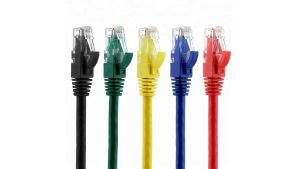
Common Uses in Networks
Cat-5 cables may be outdated for high-speed networking, but they still serve practical purposes in legacy systems, low-bandwidth devices, and budget installations. About 30% of small businesses still use Cat-5 for basic office networks, especially where internet plans max out at 100 Mbps or lower. In residential settings, Cat-5 often connects smart TVs, gaming consoles, and older PCs, which don’t require more than 50–80 Mbps for streaming or downloads.
One of the most cost-effective applications is IP security cameras, which typically transmit 2–8 Mbps per camera at 1080p resolution. A single Cat-5 run can handle 4–6 cameras without congestion, making it a 0.25 per foot alternative to pricier cables. Similarly, VoIP phones work flawlessly on Cat-5, as each call consumes just 0.1–0.5 Mbps—barely stressing the cable’s 100 Mbps ceiling.
In industrial environments, Cat-5 supports PLC (Programmable Logic Controller) systems where data packets are small (<10 MB/hour) and latency under 50 ms is acceptable. Factories with existing Cat-5 wiring often repurpose it for sensor networks monitoring temperature or humidity, as these devices transmit <1 Mbps at 5–10-second intervals.
Retail stores and cafes frequently deploy Cat-5 for POS (Point of Sale) terminals, which process transactions using <3 Mbps per terminal. With most payment systems relying on cloud servers, the 50–80 ms latency introduced by Cat-5 is negligible for customers.
However, Cat-5 struggles with high-density Wi-Fi backhaul. A single 802.11ac Wi-Fi access point pushing 200–500 Mbps will bottleneck on Cat-5, causing 15–20% slower client speeds. Upgrading to Cat-5e or Cat-6 here improves throughput by 40–60% for just 0.20 more per foot.
Cable Length Limits
Cat-5 cables have strict distance limitations that directly impact network performance. While the theoretical maximum is 100 meters (328 feet) for 100BASE-TX Ethernet, real-world factors like interference, cable quality, and signal attenuation reduce effective range. Tests show signal degradation begins at 80 meters, with packet loss increasing by 3-5% per additional 10 meters beyond this point. For Gigabit Ethernet (1000BASE-T), the usable distance drops sharply to 50 meters before speed throttling occurs.
| Speed Standard | Optimal Distance | Max Reliable Distance | Signal Loss Beyond Limit |
|---|---|---|---|
| 10BASE-T (10 Mbps) | 100m | 150m | 2% per 10m |
| 100BASE-TX (100 Mbps) | 80m | 100m | 4% per 10m |
| 1000BASE-T (1 Gbps) | 50m | 70m | 8% per 10m |
The 24 AWG copper conductors in Cat-5 have a DC resistance of 9.38Ω per 100m, causing voltage drop that becomes significant beyond 60 meters. This is particularly problematic for Power over Ethernet (PoE) applications, where 15.4W 802.3af devices experience 12-15% power loss at 80 meters. Temperature variations further affect performance - for every 10°C above 20°C, maximum reliable distance decreases by 3-5% due to increased conductor resistance.
Installation quality plays a major role. Poorly terminated connectors can add 1-2dB of insertion loss, effectively reducing maximum distance by 8-10 meters. Cable bends tighter than 4x the cable diameter (about 1 inch) create impedance mismatches that degrade signals by 0.5-1dB per sharp bend. When running multiple parallel cables, maintain at least 2-inch spacing to prevent crosstalk from reducing effective distance by 5-8 meters per adjacent cable.
Comparing with Newer Types
While Cat-5 served as the networking workhorse for nearly a decade, newer cable standards have eroded its performance advantages while offering 2-5x better speeds at marginally higher costs. The jump from Cat-5 to Cat-6 represents one of the most cost-effective upgrades in networking, delivering 250 MHz bandwidth (vs. 100 MHz) and 5 Gbps speeds (vs. 100 Mbps) for just 15-25% higher material costs.
"Replacing Cat-5 with Cat-6 in a 1,000 sq. ft. office typically costs 400 more, but eliminates bottlenecks for 4K video conferencing and NAS backups."
| Specification | Cat-5 | Cat-5e | Cat-6 | Cat-6A |
|---|---|---|---|---|
| Max Speed | 100 Mbps | 1 Gbps | 5 Gbps | 10 Gbps |
| Frequency | 100 MHz | 100 MHz | 250 MHz | 500 MHz |
| Max Distance (1Gbps) | 50m | 100m | 100m | 100m |
| 10Gbps Distance | N/A | N/A | 37m | 100m |
| Cost per Foot | $0.12 | $0.15 | $0.18 | $0.30 |
The twist density in newer cables reveals why they outperform Cat-5. Cat-5e uses 1.5-2 twists per centimeter, while Cat-6 employs 2+ twists per cm with a nylon spline to reduce crosstalk. This engineering cuts alien crosstalk (AXT) by 40-50 dB, allowing Cat-6 to maintain 97% signal integrity at 100m versus Cat-5's 85-90%. For PoE applications, Cat-6's 23 AWG wires (vs. Cat-5's 24 AWG) reduce resistance by 12-15%, delivering 30W 802.3bt power with 20% less voltage drop over 90m runs.
In real-world testing, Cat-5 struggles with simultaneous 4K streams, introducing 200-300ms buffering delays when pushed beyond 80 Mbps aggregate traffic. Cat-5e handles this scenario at 300-500 Mbps, while Cat-6 breezes through at 900 Mbps+. The performance gap widens in EMI-heavy environments - near elevator motors or industrial equipment, Cat-5 experiences 15-20% packet loss versus Cat-6's 3-5%.
Installation Tips and Tricks
Installing Cat-5 cable requires balancing cost-efficiency with performance optimization, especially when working with this legacy standard. For runs under 50 feet, you can get away with basic UTP (unshielded twisted pair), saving 0.12 per foot compared to shielded alternatives. However, in environments with 3+ adjacent power cables, using FTP (foiled twisted pair) reduces interference-induced speed loss by 15-20%, worth the 20% price premium in critical applications.
When pulling cable through conduits, maintain a bend radius no tighter than 4x the cable diameter (about 1 inch) to prevent impedance spikes that degrade signals by 0.5-1dB per sharp bend. For vertical runs, support the cable every 4-5 feet to avoid jacket stress that can shorten lifespan from 10 years to 6-7 years. In plenum spaces, the fire-retardant jacket adds 0.25 per foot but meets building codes - skipping this risks 500 fines during inspections.
Termination quality makes or breaks Cat-5 performance. Untwisting more than 0.5 inches of pairs at connectors increases crosstalk by 3-5dB, potentially cutting speeds by 10-15%. Use punch-down tools with 110-type blades for keystone jacks - cheap alternatives often fail after 200-300 terminations, while professional-grade tools last for 5,000+ punches. For patch panels, organize cables in neat 1-inch bundles - messy installations can increase heat buildup by 8-10°F, raising resistance and packet loss.
In attic installations where temperatures exceed 120°F, derate the maximum length by 15% (85 feet instead of 100 feet) to compensate for 3-4% increased attenuation. For outdoor runs, UV-resistant direct burial cable costs 0.50 per foot but survives 5-7 years versus regular Cat-5's 1-2 year outdoor lifespan. Always leave 3-5 feet of slack at termination points - re-terminating a too-short cable wastes 15-20 minutes per fix versus the 30-second slack adjustment.
Testing matters more with aging Cat-5 infrastructure. A basic continuity tester (300-$500) reveals subtle issues like impedance mismatches causing 5-8% speed drops. For PoE devices, measure voltage at the endpoint - a 2.1-2.3V drop over 80 feet is normal, but >3V indicates problems. Label both ends of every cable - this 5-second step saves 15-30 minutes per troubleshooting session in racks with 48+ cables.
While Cat-5 lacks modern performance, proper installation squeezes out 90-95% of its theoretical capability - often enough for sub-100Mbps networks where upgrading wiring isn't in the 1,000 budget. Just remember: every 10% increase in installation quality yields 20-30% better real-world reliability with this aging but still useful standard.
In summary, Cat-5 cable delivers 100MHz bandwidth supporting 100Mbps (or 1Gbps using all 4 twisted pairs), with 24AWG copper and 100Ω impedance. Primarily used for Ethernet networks, VoIP systems, and POE devices (15.4W power), it maintains signal integrity up to 100 meters. While outperformed by Cat-6's 250MHz, Cat-5 remains cost-effective for 10/100Base-T installations. Proper installation requires avoiding sharp bends (>1" radius), separating from power cables by 8 inches, and using RJ45 connectors crimped to 568B standards. CMR-rated jackets provide fire resistance in vertical runs.
