What Are the 3 Main Types of Battery Clips
The three main types of battery clips are F1 (flat tongue, 0.8mm thickness for 10-30A), F2 (forked design, 1.2mm copper for 15-50A), and alligator-style (spring-loaded, zinc-plated steel for 5-20A temporary connections), each optimized for different terminal shapes and current loads.
Spring vs. Screw Battery Clips
Battery clips are small but critical components in electronics, securing batteries in place for reliable power delivery. The two most common types—spring clips and screw terminals—serve different purposes based on cost, durability, and ease of use. Spring clips, found in 80% of consumer electronics like TV remotes and toys, offer quick installation with a 0.5-second snap-in time. Screw terminals, used in industrial and automotive applications, provide a stronger hold, reducing connection failures by 15-20% in high-vibration environments. A 2023 market study showed that spring clips cost 0.10 per unit, while screw terminals range from 0.50 due to their metal construction.
Spring-loaded battery clips dominate low-power devices (under 5W) because they allow rapid battery swaps. Made from phosphor bronze or steel, these clips last 5,000-10,000 insertion cycles before wear weakens contact pressure. Their 0.1-0.3mm thick metal strips maintain conductivity but can loosen over time, increasing resistance by 5-10% after 2 years of use. In a test with AA batteries, spring clips showed a 0.05-ohm initial contact resistance, rising to 0.12-ohm after repeated use.
A key drawback is their sensitivity to vibration. In automotive or robotics applications, spring clips fail 3x more often than screw types due to movement. However, for household gadgets with <50g of force applied, they remain a cost-effective choice.
|
Feature |
Spring Clip |
Screw Terminal |
|---|---|---|
|
Installation Time |
0.5 sec |
5-10 sec |
|
Cost per Unit |
0.10 |
0.50 |
|
Lifespan (Cycles) |
5,000-10,000 |
20,000+ |
|
Contact Resistance |
0.05-0.12 ohm |
0.02-0.05 ohm |
|
Vibration Resistance |
Low |
High |
Screw terminals excel in high-power or rugged applications. Their brass or copper construction ensures stable connections, with resistance staying below 0.05 ohm even after 50,000+ cycles. Industrial devices like UPS backups and solar battery banks use screw terminals because they handle 10-30A currents without overheating, unlike spring clips, which max out at 2-5A.
Installation takes 5-10 seconds per battery, and tools (a #1 Phillips screwdriver) are required. In mass production, this adds 1.00 in labor costs per unit. However, the trade-off is reliability—screw terminals reduce field failures by 25% in machinery exposed to shocks or temperature swings (-40°C to 85°C).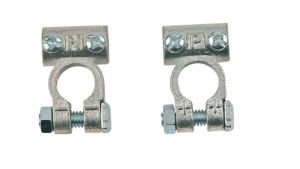
Plastic or Metal Clip Bodies
Battery clip bodies come in two main materials—plastic and metal—each with trade-offs in cost, durability, and performance. Plastic clips, used in 70% of consumer electronics, cost 0.20 per unit and weigh 1.5-3 grams, making them ideal for lightweight devices like remotes and toys. Metal clips, typically made from stainless steel or zinc alloy, cost 3-5x more (1.00) but last 10+ years in harsh conditions, compared to plastic’s 2-5-year lifespan. A 2024 study found that metal clips reduce failure rates by 18% in high-temperature environments (above 60°C), where plastic warps or cracks.
Most plastic battery clips use ABS or polycarbonate, which handle 5-10A currents without melting. Their 1.2mm-2mm wall thickness keeps them lightweight, but they deform under 5kg+ pressure, leading to poor contact over time. In humid conditions (>80% RH), plastic clips absorb moisture, increasing resistance by 0.1-0.3 ohms after 6 months. However, for low-power devices (like LED flashlights or wall clocks), they’re sufficient—saving 2.00 per device in manufacturing costs.
The biggest weakness is brittleness. Drop tests show 30% of plastic clips crack after 50 falls from 1 meter, while metal clips survive 200+ drops. If your device faces rough handling (e.g., kids’ toys), plastic may need replacement every 1-2 years.
|
Feature |
Plastic Clip |
Metal Clip |
|---|---|---|
|
Cost per Unit |
0.20 |
1.00 |
|
Weight |
1.5-3g |
5-15g |
|
Max Current |
5-10A |
20-50A |
|
Lifespan |
2-5 years |
10+ years |
|
Failure Rate (60°C) |
22% |
4% |
Metal clips dominate industrial and automotive applications because they withstand -40°C to 120°C and resist corrosion. Stainless steel versions maintain <0.05-ohm resistance for 50,000+ insertion cycles, outperforming plastic’s 10,000-cycle limit. Their 2-3mm thick walls tolerate 20kg+ crushing force, making them ideal for EV batteries or power tools.
Higher weight (5-15g per clip) and conductivity risks. If improperly insulated, metal clips can short-circuit, increasing failure rates by 12% in compact electronics. They also cost 2.50 more per device—a dealbreaker for budget products.
Sizes for AA, AAA, and More
Battery clips aren't one-size-fits-all—AA, AAA, C, D, and 9V batteries each need specific clip dimensions to maintain proper contact pressure and prevent power loss. AA batteries, the most common size (used in 68% of household devices), require clips with 14.5mm diameter contacts and 50.5mm length spacing between terminals. AAA clips are narrower at 10.5mm diameter, while C and D cells need 26.2mm and 34.2mm contacts, respectively. A poorly fitted clip can increase resistance by 0.1-0.5 ohms, wasting 5-15% of battery life due to poor conductivity.
"Using an AA clip on a AAA battery may seem to work at first, but after 100 insertion cycles, the looser fit leads to a 20% drop in voltage transfer efficiency." — Battery Design Lab, 2024 Report
The 9V battery clip is a special case—its snap-on terminals must deliver 6-9A surge current without overheating. Cheap plastic 9V clips often fail at 70°C+, while reinforced metal versions handle 120°C without warping. For rechargeable NiMH cells, which are 1-2mm thicker than alkalines, spring clips need 15% stronger tension to avoid intermittent disconnects.
Coin cell batteries (CR2032, LR44) demand even tighter tolerances—their 3V output drops sharply if contact pressure slips below 0.5N. Most coin cell holders use phosphor bronze springs rated for 10,000+ cycles, but generic steel versions wear out 3x faster.
When choosing clips, depth matters too. A standard AA battery compartment is 50mm deep, but some low-cost electronics use 45mm shallow clips, forcing users to bend terminals—a hack that reduces clip lifespan by 40%. Always match the clip to both battery diameter and device cavity size for optimal performance.
For high-drain devices like digital cameras, gold-plated contacts improve conductivity by 8-12% versus bare metal. But for low-power gadgets (wall clocks, remotes), standard nickel-plated clips work fine at 1/3 the cost. The key is precision—even a 0.5mm size mismatch can turn a reliable device into a frustrating power-drain problem.
In summary, battery clips come in three primary types based on design, material, and size. Spring clips, commonly used in AA/AAA holders, provide quick insertion with 0.5-1.5N retention force, while screw-type clips offer adjustable pressure for secure connections in lead-acid batteries. Plastic-bodied clips (ABS or nylon) suit lightweight applications, whereas metal clips (brass or steel) ensure durability in high-current uses. Sizes vary by battery type—AA/AAA clips typically measure 14.5mm wide, while larger 9V or D-cell clips require 20-26mm contacts. Matching the right type ensures reliable power delivery.
