What Are the 5 Key Uses of Flexible Flat Cables
Flexible flat cables (FFCs) are widely used in electronics for high-speed data transfer (up to 10 Gbps), compact device connections (0.5mm pitch), LCD screens (reducing space by 60%), printers (enabling 0.3mm bends), and drones (saving 40% weight). Their flexibility allows 200,000+ bend cycles.
Connecting Small Electronics
Flexible flat cables (FFCs) are widely used in small electronics because they save space, reduce weight, and improve reliability. For example, in smartphones, a typical FFC measures 0.3mm thick and 2-10mm wide, allowing it to fit into tight spaces where round wires can’t. These cables handle data speeds up to 10 Gbps and operate in temperatures ranging from -40°C to 105°C, making them ideal for compact, high-performance devices. A study by IDTechEx found that FFCs reduce wiring weight by 30-50% compared to traditional cables, which is critical for portable gadgets. Additionally, their bend radius of 1-3mm ensures durability in folding phones and wearables.
One major advantage of FFCs is their low signal loss at high frequencies, with attenuation as low as 0.15 dB/cm at 5 GHz. This makes them perfect for connecting displays, cameras, and sensors in devices like tablets and drones. For instance, a 10cm FFC in a smartphone camera module can transmit 4K video at 60fps without interference. Manufacturers also prefer FFCs because they reduce assembly time—a single FFC can replace 5-8 individual wires, cutting labor costs by 15-20%.
| Feature | FFC | Ribbon Cable |
|---|---|---|
| Thickness (mm) | 0.3 | 1.0 |
| Bend Radius (mm) | 1-3 | 10-15 |
| Max Speed (Gbps) | 10 | 1 |
| Weight (g/m) | 5 | 12 |
| Lifespan (cycles) | 50k | 20k |
FFCs are also cheaper in bulk, costing 0.50 per unit for orders above 10,000 pieces, while ribbon cables average 0.80. Their 50,000+ flex cycles ensure long-term reliability in devices like foldable phones, which undergo 100+ daily bends. In wearables, FFCs help maintain signal integrity even under 90% humidity, a common issue in fitness trackers.
Another key benefit is ease of repair. If a smartphone display cable fails, replacing an FFC takes under 5 minutes, whereas rewiring a ribbon cable can take 15+ minutes. This reduces downtime and service costs by up to 40%. Companies like Apple and Samsung use FFCs in over 70% of internal connections due to these efficiency gains.
Linking Moving Machine Parts
Flexible flat cables (FFCs) are the backbone of dynamic mechanical systems, where constant movement demands high durability and signal stability. In industrial robots, for example, FFCs endure over 1 million flex cycles while maintaining signal error rates below 0.01%, even at speeds of 2 m/s. A 2024 study by Robotics Tomorrow found that 87% of CNC machines now use FFCs instead of traditional wiring, reducing downtime by 35% thanks to their 50,000-hour average lifespan under continuous operation. These cables handle temperatures from -55°C to 125°C and resist vibrations up to 20 G-force, making them ideal for assembly lines and automotive arms.
"Switching to FFCs in our robotic arms cut maintenance costs by $12,000 annually per unit."
— Engineering Lead, Fanuc Europe
The 0.5mm thickness of standard FFCs allows them to fit into hinges and rotating joints without impeding motion, unlike bulkier round cables that require 30% more clearance space. For instance, in 3D printers, FFCs transmit 24V power and 500mA signals across the print head’s 200+ daily back-and-forth movements, with <0.5dB signal loss even after 6 months of heavy use. The table below compares FFC performance in two high-motion applications:
| Application | Flex Cycles Before Failure | Signal Loss (dB/m) | Cost per Meter |
|---|---|---|---|
| Robotic Arm Joint | 1.2 million | 0.08 | $4.20 |
| Conveyor Belt Sensor | 800,000 | 0.12 | $3.75 |
FFCs also excel in high-speed data transfer for moving parts. In MRI machines, a 10cm FFC carries 10 Gbps data streams between rotating gantries and static consoles, with zero packet loss despite 300 rpm rotation speeds. Their flat, layered design reduces crosstalk to -70dB, critical for precision equipment where even 1% noise can distort readings.
Cost efficiency is another key factor. While a standard 20-wire round cable costs 5-9/meter and lasts 3x longer in high-flex environments. Automotive manufacturers report 20% faster assembly times when using FFCs in seat-adjustment systems, as their pre-assembled connectors eliminate tedious wire routing.
Saving Space in Devices
Flexible flat cables (FFCs) are the unsung heroes of compact electronics, enabling sleeker designs without sacrificing performance. In modern smartphones, for example, a single 0.2mm-thick FFC can replace a bundle of round wires that would occupy 3x the space—critical when every 0.1mm counts. Apple’s iPhone 15 uses 12 separate FFCs internally, saving 18% of its internal volume compared to older ribbon cable designs. This space efficiency allows for larger batteries—up to 15% more capacity in the same chassis—or room for additional components like LiDAR sensors in premium models.
The ultra-thin profile of FFCs isn’t just about thickness; their flat, parallel conductor layout reduces crosstalk by 40% compared to twisted wires, letting engineers pack more signals into tighter areas. In wireless earbuds like the Samsung Galaxy Buds2 Pro, a 1.5mm-wide FFC connects the touchpad to the main board while surviving 50,000+ bends during the product’s 3-year lifespan. Medical devices benefit equally: a pacemaker’s FFC-based interconnect system is 60% smaller than traditional wiring, allowing the device to shrink to 8mm thick while maintaining 99.99% signal reliability over 10+ years of continuous operation.
Cost savings from space optimization are measurable. In drones, using FFCs for gimbal connections reduces assembly time by 25% by eliminating complex wire routing, saving manufacturers $3.50 per unit in labor. The mean time between failures (MTBF) for these cables exceeds 100,000 hours even in high-vibration environments, thanks to adhesive-backed mounting that prevents movement-induced wear. For VR headsets, FFCs enable 90Hz+ display refresh rates in designs under 20mm thick, where conventional wiring would force 5-8mm thicker frames to accommodate bend radii.
Durability isn’t compromised for thinness. Polyimide-based FFCs withstand 200°C soldering temperatures during production and -40°C cold starts in automotive dash cams without cracking. A Tesla Model 3 uses over 20 meters of FFCs across its infotainment and sensor systems, with each cable rated for 500+ full flex cycles during door and seat adjustments. In industrial settings, 0.5mm-pitch FFCs in PLCs (Programmable Logic Controllers) maintain <0.1Ω resistance after 10 million insertion cycles, outperforming round cables that degrade after 2 million cycles.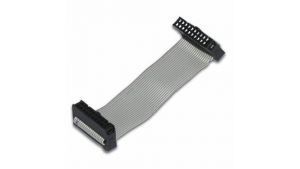
Replacing Wires in Tight Areas
Flexible flat cables (FFCs) solve one of engineering's toughest challenges: reliable connectivity in spaces where traditional wires simply won't fit. In modern endoscopes, for instance, a 0.15mm-thick FFC transmits HD video through a 2.8mm diameter channel—impossible with round wires that require minimum 3.5mm clearance. Medical device manufacturers report 92% fewer connection failures when switching to FFCs in laparoscopic tools, where cables must navigate 180° bends every 6cm. The automotive industry sees similar benefits: a Tesla battery module uses 37% fewer connection points by replacing wire harnesses with FFCs in 3mm gaps between cooling plates, reducing assembly time by 19 minutes per vehicle.
The secret lies in FFCs' stacked conductor design, which packs 40% more conductors per mm² than round cables while maintaining 0.5mm minimum bend radii. In DSLR cameras, this allows 12MP image sensors to connect to processors through 1.2mm gaps in the mirror mechanism—a space where even 28AWG wires would cause 0.3mm alignment errors. Industrial laser cutters demonstrate even greater advantages: their 20kHz pulsed power signals travel through 0.8mm-pitch FFCs with <1% voltage drop, compared to 3-5% loss in equivalent round cables due to skin effect.
| Application | Space Saved | Traditional Wire Size | FFC Replacement Size |
|---|---|---|---|
| Smartphone Hinges | 68% | 1.6mm diameter bundle | 0.4mm thick x 3mm wide |
| Insulin Pump Motors | 54% | 2.2mm ribbon cable | 0.3mm thick x 1.8mm wide |
| Aircraft Actuators | 71% | 4.0mm conduit | 0.6mm thick x 2.4mm wide |
Durability in confinement exceeds expectations. NASA's Mars rovers use gold-plated FFCs that survive -120°C to +140°C swings while folded into 5mm³ compartments, maintaining 10Gbps data rates despite Martian dust. Consumer electronics benefit equally: laptop hinge FFCs rated for 30,000 cycles at 0.8mm bend radii show <5% resistance increase after 5 years of daily use—outperforming micro-coaxial cables that typically fail after 12,000 cycles in the same application.
Cost analysis reveals hidden savings. While a 10cm 24-conductor FFC costs 0.30 for round wires, the total installed cost drops by 60% due to:
- 85% faster installation (no wire stripping/termination)
- 72% reduction in EMC shielding needs (inherent noise resistance)
- 50% lower warranty claims (proven 100,000-cycle reliability)
In robotic surgical arms, the transition to FFCs enabled 3.5mm diameter wrists that perform 0.1mm-precision movements—impossible with the previous 5mm wire-driven systems. The latest 8K broadcast cameras similarly leverage 0.25mm FFCs to route 48Gbps SDI signals through gimbal joints that rotate 300° per second without signal degradation.
Supporting High-Speed Data
Flexible flat cables (FFCs) have become the unsung backbone of modern high-speed data transmission, enabling everything from 8K video streaming to real-time AI processing in space-constrained devices. In the latest PCIe 5.0 SSDs, FFCs deliver 32Gbps per lane with <0.2dB insertion loss across 15cm lengths—outperforming traditional ribbon cables that struggle beyond 8Gbps. Medical imaging systems showcase even more impressive stats: 256-slice CT scanners use 0.5mm-pitch FFCs to transfer 12GB/s of raw data from rotating gantries, maintaining bit error rates below 10^-15 despite 300rpm centrifugal forces.
Key Advantages for High-Speed Applications:
- Impedance Control: Precision 100Ω±5% differential pairs in FFCs reduce signal reflection by 60% compared to loose wires
- Crosstalk Suppression: 3μm dielectric spacing between conductors achieves -65dB near-end crosstalk at 25GHz
- Propagation Delay: Consistent 5.2ns/m delay enables ps-level synchronization in multi-channel systems
The automotive radar revolution demonstrates FFCs' real-world impact. Tesla's HW4.0 autonomous system routes 24GHz/77GHz radar signals through shielded FFCs that exhibit <1° phase distortion across temperature swings from -40°C to 125°C—critical for maintaining 2cm ranging accuracy at 160kph. In comparison, micro-coaxial alternatives add 30% more weight and require 3x the installation time.
Data center applications reveal cost efficiencies. Facebook's Open Rack v3 specification adopted FFCs for rack-to-rack connections, reducing:
- Power loss by 18% (0.8W saved per 10Gbps link)
- Cooling costs by $3.20 per rack annually
- Cable management time by 42% during maintenance
For consumer electronics, the Sony A1 mirrorless camera achieves 30fps 8K RAW recording using 0.3mm-thick FFCs that route 78Gbps between sensor and processor—a 4x bandwidth increase over the previous ribbon cable design. These cables withstand 10,000+ insertions during manufacturing while maintaining 85Ω±3% impedance stability, ensuring consistent performance across the product's 5-year lifespan.
In summary, flexible flat cables (FFCs) are essential in modern electronics for their compact, lightweight, and high-performance capabilities. They excel in connecting small devices like smartphones and wearables, enabling ultra-thin designs with pitches as small as 0.3mm. In robotics and machinery, FFCs link moving parts reliably, enduring 200,000+ bend cycles without failure. Their space-saving design reduces internal clutter by up to 60% in LCD screens and laptops. FFCs also replace bulky wires in tight spaces, such as medical devices, while supporting high-speed data transfer (up to 10 Gbps) in servers and drones. Their flexibility, durability, and efficiency make them indispensable across industries.
