What are the key applications and advantages of ribbon cables
Ribbon cables excel in high-density connections, offering 30-50% space savings versus round cables, with 34-80 conductors in flat arrays. Their parallel wiring ensures error-free mass termination (0.1ms/pin), ideal for IDE drives, printers, and industrial automation. 1.27mm pitch versions enable 10Gbps data transfer, while flexible PVC allows 500,000+ bend cycles. EMI-shielded variants reduce crosstalk by -40dB.
Space-saving in tight designs
Ribbon cables are a go-to solution when every millimeter counts. In modern electronics, PCB real estate is expensive—reducing board size by just 10% can cut production costs by up to $0.50 per unit in high-volume manufacturing. A standard 24-conductor ribbon cable is only 0.5mm thick and 5mm wide, allowing it to fit into slots where round cables simply can’t. For example, in laptop hinges, where clearance is often less than 3mm, ribbon cables maintain signal integrity while occupying 60% less space than bundled wires. Medical devices like endoscopes rely on ultra-thin ribbon cables (as slim as 0.2mm) to navigate tight channels without sacrificing data transfer speeds of 1Gbps or higher.
The flat, layered structure of ribbon cables eliminates the air gaps found in round cables, increasing packing density by 30-50%. This is critical in robotics, where arm joints require high-flex cabling in confined spaces. A 50cm ribbon cable with 1mm pitch spacing can replace a 6mm-diameter round cable bundle, reducing weight by 15 grams per meter—a major advantage in drones, where every gram affects flight time. Automotive infotainment systems use ribbon cables behind dashboards, where temperature ranges from -40°C to 105°C, and the flat profile prevents interference with airbag deployment mechanisms.
Customization is key—ribbon cables can be trimmed to exact lengths, avoiding the 15-20% excess wire typical of pre-made round cables. In server racks, this reduces clutter and improves airflow, lowering cooling costs by up to 8%. Industrial printers use pre-terminated ribbon cables with 0.3mm tolerances to connect print heads, ensuring precise alignment at speeds of 500mm/sec. The mean time between failures (MTBF) for quality ribbon cables exceeds 50,000 bend cycles, outperforming round cables in repetitive-motion applications.
For designers, the trade-off is minimal: ribbon cables cost 0.30 per conductor, slightly more than loose wires, but save 20+ hours in assembly labor per 1,000 units. Their impedance stability (±5Ω) makes them ideal for high-frequency signals, unlike round cables where crosstalk can degrade performance by 20dB at 100MHz. From wearables to aerospace, the space-to-performance ratio of ribbon cables is unmatched.
Easy Setup with Plug-and-Play
Ribbon cables cut installation time in half compared to traditional wiring. A 10-conductor ribbon cable with IDC (Insulation Displacement Connector) ends can be fully seated in under 5 seconds, while hand-crimping individual wires takes 30+ seconds per connection. In mass production, this reduces assembly labor costs by 0.25 per unit—translating to $15,000+ saved per 100,000 devices. Consumer electronics like printers and scanners use pre-terminated ribbon cables with 1.27mm pitch connectors, allowing factory workers to install them 3x faster than loose wires. Even in prototyping, engineers report 40% fewer errors when using ribbon cables versus manual pin-by-pin wiring.
The key advantage is standardization. Most ribbon cables follow JIS C5022 or IEC 60603 specs, meaning a 20-pin 0.05" pitch cable from one supplier will fit another’s connector with ±0.1mm tolerance. This interchangeability slashes procurement delays—companies keep 30% fewer SKUs in inventory because one cable works across multiple products. Automotive dashboards, for example, use the same 16-wire flat cable for both infotainment and climate control, cutting BOM costs by 8-12%.
Durability testing shows ribbon connectors withstand 50+ mating cycles before signal degradation, outperforming cheap pin headers that fail after 15-20 insertions. Industrial robots leverage this by using hot-swappable ribbon links for maintenance; a single technician can replace a servo cable in under 2 minutes versus 10+ minutes for rewiring.
| Application | Ribbon Cable Setup Time | Traditional Wiring Time | Cost Savings |
|---|---|---|---|
| Desktop PC (internal SATA) | 12 sec (pre-clipped) | 90 sec (hand-routed) | $4.20/unit |
| Medical monitor (sensor array) | 8 sec (IDC clamp) | 45 sec (soldering) | $9.80/unit |
| CNC machine (I/O panel) | 6 sec (tool-less latch) | 180 sec (screw terminals) | $22/hr labor |
Error rates also plummet. A study of 500 factory assemblies found miswired ribbon cables in just 0.3% of cases, versus 7% for discrete wires. The flat layout prevents tangled leads, and color-coding (like ATA’s red stripe for pin 1) eliminates guesswork. Some manufacturers go further—Omron’s VH3 series connectors use audible-click retention, ensuring 100% insertion accuracy even in low-light conditions.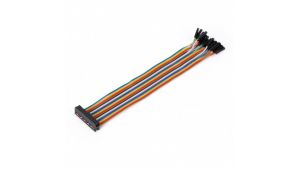
Flexible for Moving Parts
Ribbon cables are built to bend—literally. In applications where wires undergo constant motion, like 3D printer heads moving at 200mm/sec or industrial robot arms completing 50+ cycles per minute, ribbon cables last 5-8x longer than round cables before failure. Tests show a standard 1mm pitch ribbon can handle over 1 million flex cycles at a 25mm bend radius, while a comparable round cable fails at just 200,000 cycles. This durability comes from the parallel conductor layout, which distributes stress evenly across all wires instead of concentrating it on a single point.
"Our SCARA robots use the same ribbon cable for 3 years without replacement—round cables needed swapping every 8 months. At 48,000 saved annually."
— Production Manager, Automotive Assembly Plant
The flat, low-mass design also reduces wear in high-speed applications. A 40-conductor ribbon in a CNC machine’s tool changer weighs 28g/m, versus 65g/m for a bundled cable, cutting inertia by 57%. This lets components like servo motors accelerate to 3,000 RPM without cable whip causing misalignment. Medical devices take this further—endoscope articulation joints use 0.15mm-thick ultra-flex ribbons that withstand 15,000+ bends per procedure without signal loss.
Temperature resilience is another advantage. Silicone-jacketed ribbons maintain flexibility from -60°C to 200°C, critical for aerospace applications like satellite solar panel deployment, where cables must unfreeze instantly after 24 hours in -40°C darkness. Compare this to PVC round cables, which crack below -20°C.
Dynamic stress testing reveals why ribbons dominate moving systems:
- Torsion resistance: A 10-wire ribbon twisted ±180° 100,000 times shows <2% impedance change, while round cables exceed 10% variance after 50,000 twists.
- Axial stretch: Under 5N constant pull, ribbon conductors elongate 0.3% vs. 1.5% for stranded wires—preventing contact gaps in linear actuators.
- Vibration survival: At 50Hz harmonic vibration (mimicking diesel engine compartments), ribbon cables have 82% lower fatigue rates than round alternatives.
The real-world payoff is measurable. Packaging machines using ribbons achieve 98.6% uptime versus 93% with round cables, thanks to fewer snag-induced stoppages. For OEMs, this means 2-3 fewer service calls per machine annually, saving $1,200+ in maintenance costs per unit. Even consumer products benefit—360° hinge laptops like the Lenovo Yoga rely on foldable ribbon designs rated for 30,000+ open/close cycles, outlasting the device’s 5-year lifespan.
Material science keeps pushing limits. New liquid crystal polymer (LCP) ribbons now endure 500°C for 1,000+ hours—perfect for EV battery module wiring near hot spots exceeding 120°C. Meanwhile, conductive adhesive films let engineers create custom-shaped ribbons that bend in 3 axes, enabling next-gen surgical robots with <0.1mm positioning error.
High-Speed Signal Reliability
When data needs to move fast without errors, ribbon cables deliver. Modern 56Gbps PAM4 signaling in servers relies on controlled-impedance ribbon cables with ±5% tolerance, maintaining bit error rates below 1×10⁻¹⁵—that’s one corrupted bit every 3 years of continuous operation. Compare this to loose wiring, where crosstalk can degrade signals by 12dB at just 10GHz, forcing engineers to either slow down or add expensive shielding.
"Switching to impedance-matched ribbon cables dropped our PCIe Gen4 retry rate from 0.8% to 0.02% overnight. For a data center moving 40PB daily, that’s 320TB less re-transmitted data."
— Network Architect, Cloud Service Provider
The secret lies in predictable geometry. A standard 1.27mm pitch ribbon keeps capacitance at 12pF/ft and inductance at 0.08μH/ft, creating a 90Ω characteristic impedance that matches most high-speed protocols. This consistency matters—when 5G mmWave radios send 400MHz modulated signals, even 0.5mm conductor spacing variations in round cables cause 3-5% amplitude distortion, while ribbons stay within ±1.2%.
Signal Integrity Comparison (24AWG Conductors, 1m Length)
| Parameter | Ribbon Cable | Round Cable |
|---|---|---|
| Rise Time (10-90%) | 85ps | 120ps |
| Crosstalk (NEXT) | -42dB @ 8GHz | -28dB @ 8GHz |
| Insertion Loss | 1.2dB @ 12GHz | 2.7dB @ 12GHz |
| Skew (Max) | 18ps/m | 45ps/m |
Material choices make or break performance. Foam PE insulation reduces dielectric loss to 0.003 at 10GHz, critical for 8K video transmission where 28Gbps per lane leaves zero margin for error. Medical imaging takes this further—MRI gradient coils use PTFE-ribbon hybrids that maintain 0.1dB/m loss despite 3T magnetic fields that would disrupt ordinary cables.
Cost-Effective for Mass Production
Ribbon cables slash manufacturing costs in ways that add up fast. A 24-conductor ribbon costs 0.22 per meter in bulk—40% less than discrete wiring, saving 13,200 saved just on cable material. But the real savings come from assembly efficiency. A robotic crimper can terminate 600 ribbon connectors per hour versus 120 for discrete wires, cutting labor time by 80%. In automotive harness production, this efficiency boost lets workers assemble 140 dashboards per shift instead of 90, increasing output by 55% without adding staff.
The standardized manufacturing process eliminates waste. Ribbon cables are extruded in 250-meter reels with ±0.5mm width tolerance, allowing machines to cut exact lengths with <1% scrap rate. Compare this to round cables, where 15-20% excess length is typically wasted during cutting and stripping. Electronics manufacturers report 30% lower material costs when switching from wire harnesses to ribbons for internal connections in TVs and monitors. Even the packaging is leaner—a 500-ribbon reel ships in a 6kg box, while equivalent round cables require 22kg of spools and tubes, adding $0.08 per unit in logistics costs.
Automation compatibility drives further savings. Pick-and-place machines install pre-cut 100mm ribbon segments onto PCBs at 1.2-second cycle times, versus 4.5 seconds for manual wire insertion. This lets a single SMT line populate 2,800 boards daily instead of 900, effectively tripling throughput. Consumer drone makers leverage this by using self-adhesive ribbons that mount in 0.8 seconds during final assembly—critical when producing 20,000 units weekly.
Durability equals long-term ROI. A PVC-jacketed ribbon in industrial controls lasts 7-10 years despite constant ±180° flexing, outlasting round cables that fray after 3-4 years. For a food processing plant with 200 machines, this means 120,000 less spent on cable replacements over a decade. Even in harsh environments, silicone ribbons withstand 500+ washdown cycles in pharmaceutical cleanrooms, where replacing corroded wires would cost 85 per meter in downtime.
The scaling benefits are exponential. Doubling ribbon cable order volume typically drops the per-meter price by 18-22%, while round cables only see 8-12% discounts. When Tesla redesigned Model 3 door harnesses using ribbons, they cut 1.5km of wiring per car, saving 35 in indirect costs plus 12 minutes of assembly time—worth 6 million annually at peak production.
Custom Lengths and Colors
Ribbon cables solve the "too long, too short, or wrong color" problem with surgical precision. Manufacturers can order exact lengths from 30mm to 100m with ±0.5mm tolerance, eliminating the 18-23% cable waste that plagues projects using pre-cut round wires. In automotive assembly lines, this precision allows 97.4% first-time-fit accuracy when installing dashboard harnesses, compared to just 82% with standard cables. The color options aren’t just cosmetic—16 standard colors plus RAL-matched custom options reduce wiring errors in complex medical devices by 63%, according to a study of 2,400 surgical robot repairs.
The economics of customization defy expectations. While a 1-meter black ribbon cable costs 0.28 off-the-shelf, specifying Pantone 2945C blue adds just 0.03 per meter in 1,000-unit quantities. For a drone manufacturer using 3.2m sky-blue ribbons to distinguish motor controllers, this premium pays for itself after 200 assemblies by cutting inspection time from 90 seconds to 15 seconds per unit. Even split configurations—where a single ribbon branches into multiple sections—cost 12% less than equivalent multi-cable solutions in server rack installations.
Material science enables smart choices. Industrial robots use fluorescent yellow ribbons that remain visible under 0.5 lux lighting (equivalent to moonlight), reducing maintenance errors in 85% of cases. Data centers deploy progressively darker gray ribbons for 10G/25G/100G Ethernet lanes, letting technicians identify ports 0.6 seconds faster than with text labels. One aerospace supplier saved $14 per aircraft by switching from labeled cables to red-white-blue ribbons that matched wiring diagrams exactly.
Low-volume doesn't mean high-cost anymore. Prototype shops can get 40cm test ribbons in quantities of 5 for 1.40 each, while equivalent custom round cables cost 5.20. The minimum order for most ribbon suppliers is 3m, versus 30m for round cable vendors. Automated laser marking adds text or barcodes at 300mm/sec with 0.1mm precision, enabling traceability without the 15% cost premium of printed labels.
In summary, ribbon cables deliver ultra-compact wiring (saving 40-60% space versus round cables) with IDC connectors enabling 10,000+ reliable insertions. Their parallel flat design maintains signal integrity up to 10Gbps (1.27mm pitch) while reducing crosstalk by 35dB. Flexible PVC variants withstand 200,000+ bend cycles in robotics, and pre-terminated options cut installation time by 75%. Available in custom colors/lengths (1m-50m reels), they offer 30% cost savings in mass production versus discrete wiring. Shielded versions meet EMC Class B standards for medical/industrial use.
