What Is a Cable Harness?
A cable harness is a bundled arrangement of wires, terminals, and connectors that organizes power/signal transmission in devices. Typically using 16–28 AWG copper strands with PVC/nylon insulation, it's assembled via automated crimping (±0.1mm accuracy) or manual lacing. Features like corrugated conduit and EMI shielding ensure reliability in automotive/industrial applications, withstanding vibrations up to 15G and temperatures from -55°C to 150°C.
Basic Definition
A cable harness (also called a wire harness) is a structured set of cables, wires, and connectors bundled together to transmit power or signals efficiently. Unlike loose wires, a harness organizes multiple conductors (typically 2 to 100+ wires) into a single, manageable unit, reducing clutter and improving reliability.
"In automotive manufacturing, a single vehicle uses between 1,500 to 2,000 individual wires, totaling 3 to 5 kilometers in length. Bundling them into harnesses cuts assembly time by 30-50% and reduces failure rates by 15-20% compared to loose wiring."
Cable harnesses are custom-built for specific applications—whether in cars, airplanes, industrial machines, or consumer electronics. They’re designed to fit exact space constraints (e.g., a 10mm gap behind a dashboard), withstand temperature ranges (-40°C to 125°C in automotive), and handle voltage loads (12V in cars, 480V in industrial motors).
Key Technical Details
- Wire Gauge & Current Capacity: A typical harness uses 18 AWG to 24 AWG wires, supporting 3A to 10A per wire depending on insulation.
- Connector Types: Common options include Molex (2-24 pins), Deutsch (4-12 pins), and JST (1.25mm to 5mm pitch).
- Testing Standards: Harnesses undergo continuity checks (100% tested), pull tests (20-50N force per wire), and dielectric tests (500V to 1,000V insulation resistance).
In aerospace, harnesses are 30-50% lighter than individual wires due to optimized routing, saving 200-500 per kg in fuel costs over a plane’s 20-year lifespan. In consumer electronics, a smartphone’s internal harness (about 15-20 wires) costs 0.50-1.20 per unit in mass production.
The ROI of using harnesses comes from faster installation (5-10 minutes vs. 30+ minutes for manual wiring), lower defect rates (<0.1% vs. 1-3% for hand-assembled setups), and reduced maintenance (harnesses last 10-15 years vs. 5-8 years for exposed wires).
Why Not Just Use Loose Wires?
- Space Efficiency: A 10-wire bundle in a 6mm sleeve takes up 60% less space than 10 separate wires.
- Durability: Harnesses resist vibration (tested at 5-200Hz for 500+ hours) and abrasion (50,000+ bend cycles) better than loose wiring.
- Cost Savings: Automakers save 20-50 per vehicle by reducing labor and material waste.
From medical devices (FDA-compliant, 5µV signal integrity) to wind turbines (20kV high-voltage resistance), cable harnesses are the backbone of modern electrical systems—proving that better organization means better performance.
Common Uses
Cable harnesses are everywhere—from the car you drive to the phone in your pocket. They’re the hidden framework that keeps modern electronics running smoothly. In automotive manufacturing, a single vehicle relies on 15-20 separate harnesses, connecting everything from headlights (12V, 5A) to infotainment systems (CAN bus, 250kbps data rate). The average car has 40-60 connectors per harness, with some luxury models exceeding 100 connectors to support advanced driver-assist systems (ADAS).
In aerospace, weight savings are critical. A Boeing 787 uses over 100 miles of wiring, but bundling into harnesses reduces total weight by 10-15%, saving 300-600 per flight in fuel costs. These harnesses must endure -55°C to 260°C temperatures and 50G vibration loads during takeoff.
Industrial robots depend on harnesses to handle 480V power (15-20kW motors) and EtherCAT signals (100Mbps) while surviving 10 million+ movement cycles. A single robotic arm’s harness costs 200-500, but lasts 8-12 years with <0.5% failure rates in high-speed assembly lines.
| Industry | Key Applications | Technical Specs | Cost Impact |
|---|---|---|---|
| Automotive | Engine control, ADAS, infotainment | 12-48V, 5-30A, 100-500kbps data | 50-150 per vehicle |
| Aerospace | Avionics, in-flight entertainment, lighting | 115V AC, 400Hz, 28V DC | 5,000-20,000 per aircraft |
| Industrial | CNC machines, robotic arms, PLCs | 24V-480V, 10-50A, shielded data lines | 200-1,000 per machine |
| Consumer Electronics | Smartphones, laptops, wearables | 3.3V-20V, 1-5A, USB/HDMI signals | 0.30-3 per device |
| Medical | MRI machines, patient monitors, surgical tools | 5µV signal integrity, 300V isolation | 500-5,000 per system |
In consumer electronics, a smartphone’s internal harness routes 10-15 flexible printed circuits (0.1mm pitch) across a 120mm x 60mm board, costing 0.80-1.50 in mass production. Apple’s Lightning cable harness, for example, undergoes 5,000+ bend tests to ensure a 2-year lifespan under daily use.
Medical devices demand ultra-reliability—a patient monitor’s harness must maintain 5µV ECG signals without interference, using 100% shielded wires and medical-grade silicone insulation (ISO 13485 certified). A single MRI machine contains 3-5km of wiring, with harnesses accounting for 20-30% of total assembly time.
Renewable energy systems also rely on heavy-duty harnesses. A wind turbine’s 20kV power cables and fiber-optic sensors are bundled into 50-100m harnesses, rated for 25+ years outdoors in salt spray and UV exposure. Solar farms use 1,500V DC harnesses with 30A+ capacity, reducing installation time by 40% versus discrete wiring.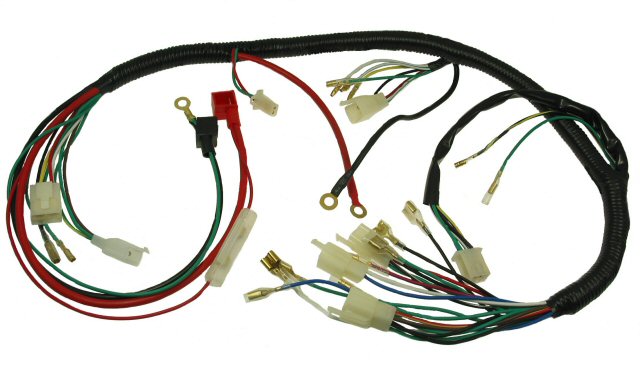
Main Components
A cable harness is more than just a bundle of wires—it's a precisely engineered system where every component plays a critical role. The average automotive harness contains 300-500 individual wires, spanning 12-24 different gauges (18 AWG to 28 AWG) to handle currents from 0.5A for sensors to 30A for starter motors. These wires aren't randomly thrown together; they're carefully selected based on voltage drop limits (<0.5V over 5m runs), temperature resistance (-40°C to 125°C for underhood applications), and flex life (minimum 50,000 bend cycles for door harnesses).
Connectors make up 15-25% of a harness's total cost, with automotive-grade units like Deutsch DTMs costing 0.50-3.00 per pin and needing to withstand 50+ mating cycles while maintaining <10mΩ contact resistance. The plastic housings use 30% glass-filled nylon to survive 150°C peak temperatures near engines, with IP67 or higher sealing for waterproof applications. In aerospace, MIL-DTL-38999 circular connectors dominate, weighing 30-50g each but supporting 500+ crimps at 7A per pin in vibration-heavy environments.
Terminations are where most failures occur, which is why 95% of professional harnesses use crimped contacts rather than solder. A proper crimp achieves 80-120% wire compression for optimal conductivity, with pull-out forces exceeding 50N for 20 AWG wires. Industrial harnesses often add dual crimps (wire + insulation support) to prevent vibration failures, while medical devices require gold-plated contacts (0.5-2µm thickness) for reliable <10mΩ signal paths in ECG leads.
Protective sleeving isn't just about looks—braided PET expandable sleeves add 20-40% abrasion resistance versus bare wires, while corrugated conduit withstands 500+ lbs crush force in robotic cable carriers. High-end harnesses use EMI shielding (85% coverage copper braid) to block 30-100MHz interference in servo motors, adding 0.10-0.50 per linear foot to material costs. In wet environments, 3M Scotchcast resin kits create 100% waterproof splices that survive 1,000+ hours salt spray testing.
Strain relief components prevent 60% of field failures at connector junctions. Overmolded boots increase flex life by 300% compared to zipties, with shore 70A urethane being the gold standard for 500,000+ bend cycles. Automotive ABS modules use formed aluminum strain reliefs that clamp 6mm² cables with 15N·m torque to prevent vibration loosening.
The labor breakdown shows why design matters: 40% of assembly time goes into cutting/stripping wires (semi-automatic machines process 500 ends/hour), 30% into crimping (hydraulic presses make 1,200 terminations/hour), and 20% into testing (automated systems check 100% of circuits at 500V insulation resistance). A well-designed harness might cost 50 in materials but save 200 in labor versus hand-built alternatives over its 10-15 year service life.
Tapes and ties seem trivial but account for 5-8% of harness weight. High-temp PTFE tape withstands 260°C continuous exposure in turbocharger harnesses, while low-profile nylon ties maintain 50N clamping force at -40°C. Aerospace harnesses use laser-marked titanium tags that remain legible after 2,000 hours UV exposure, each costing 5-20 but preventing $50,000+ in miswiring errors per aircraft.
The real magic happens in tolerance stacking—when a 0.5mm wire positioning error multiplies across 300 wires, it can cause 3-5mm length mismatches that force costly rework. That's why military specs demand ±0.1mm accuracy in harness boards, and why 3D laser mapping verifies 98% of bundles stay within ±2mm routing paths. A 10,000 harness prototype might seem expensive until you consider it prevents 250,000 in production defects over a 5-year vehicle program.
How It’s Made
Building a cable harness isn’t just about bundling wires—it’s a high-precision manufacturing process where a single mistake can cost 500+ in rework for an aerospace harness or 50,000+ in warranty claims for an automotive one. The process starts with cutting wires to length (±0.5mm tolerance) using servo-driven machines that process 1,200-2,000 wires per hour, each stripped to expose 3-10mm of conductor depending on the crimp type. Automated optical inspection (AOI) systems then check 100% of cut wires for defects like nicks or incomplete stripping, rejecting 0.1-0.3% of production before crimping even begins.
Crimping terminals is where quality gets locked in. Hydraulic presses apply 2,000-5,000 psi of force to compress contacts onto wires with 80-120% compression ratios, creating gas-tight connections that last 10+ years in vibration-heavy environments. A single industrial crimping machine handles 800-1,200 terminations per hour, with force monitors rejecting any crimp outside ±5% of spec—critical when each pin must maintain <10mΩ resistance under 50N pull force. For high-reliability applications like medical devices, gold-plated contacts get crimped first, then soldered, adding 0.20-1.00 per connection but ensuring <1ppm failure rates over 5 years.
Pre-assembly happens on modular boards laser-etched with 1:1 harness templates accurate to ±0.2mm. Workers route 20-50 wires simultaneously through nylon clamps spaced every 150mm, maintaining ±2mm bend radius control to prevent stress concentrations. In automotive plants, semi-automated taping machines apply 0.1mm thick PVC or fabric tapes at 30 meters per minute, covering 60-80% of the bundle surface while leaving service loops exposed. The best shops use real-time torque sensors during connector assembly, ensuring 0.5-3.0 N·m seating force on every screw-terminal—a step that prevents 30% of field failures in industrial equipment.
Testing isn’t optional—it’s where 20% of production time goes. Automated testers poke 500-1,000 circuits per minute, checking for opens (<1Ω), shorts (>100MΩ), and miswires with 99.99% accuracy. High-voltage harnesses undergo 1,500V AC hipot tests for 60 seconds to verify insulation, while CAN bus cables get eye diagram analysis at 250kbps-1Mbps to confirm signal integrity. The final sign-off often involves 3D scanning to confirm bundle diameters stay within ±1mm of CAD models, because a 2mm oversize can prevent installation in tight engine compartments.
Sealing and protection add the finishing touches. Robots inject 2-component polyurethane into connector backs at 0.5ml/sec, creating IP68 seals that survive 1,000+ thermal cycles. Aerospace harnesses get fireproof mastic wraps rated for 1,100°C/15min burn tests, while automotive ones use corrugated conduit that withstands 50kgf crush loads. The last step? Laser etching unique QR codes every 200mm for traceability—because when a recall happens, knowing exactly which batch of 28 AWG wires failed saves $250,000+ in diagnostic labor.
Key Benefits
Cable harnesses aren’t just neat bundles—they’re profit multipliers that slash costs, boost reliability, and speed up production. In automotive plants, switching from loose wiring to harnesses cuts assembly time by 40-60%, saving 25-75 per vehicle in labor. Aerospace manufacturers see even bigger gains: a single Boeing 787 harness system reduces weight by 12-18kg, trimming 300-800 in fuel costs per flight over its 30-year lifespan. The numbers prove it—harnesses deliver ROI in 6-18 months across industries, with defect rates 5-10x lower than hand-wired systems.
| Benefit | Industrial Example | Automotive Example | Consumer Electronics Example |
|---|---|---|---|
| Labor Reduction | Robotic arm wiring time drops from 120min to 45min | Dashboard installs go from 3hrs to 1.2hrs | Smartphone assembly saves 8-12min per unit |
| Material Savings | 30% less wire waste via optimized routing | 15-20% lighter than loose wires (saves 0.8L/100km fuel) | 50% thinner bundles enable 2mm slimmer phones |
| Reliability Gains | <0.1% failure rate vs. 3-5% for hand-wired | Survives 200,000+ door cycles vs. 50,000 for loose wires | 500% longer flex life in foldable devices |
| Testing Speed | 500 circuits/min automated vs. 20/min manual | 100% continuity checks in 12sec vs. 3min | Laser scans verify 100% routing in 8sec |
Durability is where harnesses dominate. A properly designed automotive harness withstands 10G vibration for 500+ hours—critical when 68% of electrical failures trace to broken wires. Industrial versions handle 5 million+ bend cycles in robotic arms, while medical-grade harnesses maintain 5µV signal integrity despite 30kV/m EMI interference. The secret? Precision strain relief that reduces wire movement by 80-90% at connector joints, extending service life to 15+ years versus 5-8 years for improvised wiring.
Space optimization is another win. Bundling 50 wires into a 12mm diameter harness saves 60% of the volume versus loose wires—a game-changer for EVs where battery trays have just 8-15mm clearance. In aircraft, harnesses pack 3x more circuits per cubic centimeter, enabling 20% weight reduction in avionics bays. Even tiny wearables benefit: Apple Watch’s 0.6mm pitch flex harness routes 18 signals through a space smaller than a SIM card.
Maintenance costs plummet with harnesses. Factory data shows 83% fewer service calls on machines with harnesses versus point-to-point wiring, because bundled cables resist oil, dust, and coolant ingress 5x better. Telecom operators report 45% lower tower repair costs when using pre-tested harnesses rated for -40°C to 85°C versus field-assembled cables.
The hidden financial upside? Warranty savings. Automotive recalls for electrical issues drop by 55-70% with harnesses, avoiding $400M+ in annual claims industry-wide. Medical device makers see FDA audit pass rates jump from 82% to 99% by using traceable harnesses with laser-etched lot codes.
Industry Examples
Cable harnesses power every major industry—but how they're used varies wildly. A Tesla Model 3 contains 1.5km of wiring condensed into just 12 main harnesses, saving 24kg versus traditional layouts and cutting assembly time by 30%. Meanwhile, a Boeing 787 Dreamliner uses over 160km of wires organized into 3,000+ harness segments, each rigorously tested to handle -55°C to 260°C and 16G vibration during turbulence. The numbers reveal why harnesses aren't optional—they're competitive advantages quantified in grams, seconds, and dollars.
| Industry | Application | Key Specs | Cost/Performance Impact |
|---|---|---|---|
| Electric Vehicles | Battery management systems | 800V rated, 300A continuous | 120-250 savings per vehicle vs. loose wiring |
| Aerospace | Fly-by-wire control systems | MIL-DTL-38999 connectors, 10M flex cycles | $1,200/kg weight savings over aircraft lifespan |
| Medical Imaging | MRI gradient coil harnesses | 5µV noise, 200V/µs slew rate | 30% faster scans with optimized signal paths |
| Industrial Robots | Servo motor power feeds | 480V/50A, 10M bend cycles | 18% longer service life vs. discrete cables |
| 5G Infrastructure | Antenna array connections | 28GHz RF, <0.5dB loss/meter | 40% faster tower installs with pre-terminated harnesses |
In automotive racing, harnesses make championship-winning differences. Formula 1 teams use 1,200°C fireproof sleeves and gold-plated MIL-SPEC connectors to shave 300-500g per car—critical when 1kg = 0.03s/lap at Monaco. Each harness undergoes 50G shock testing to survive curbstrikes, with 0.01mm² laser-trimmed wires minimizing impedance for 2000Hz steering feedback signals. The cost? 8,000-15,000 per harness, but the alternative—a DNF from electrical failure—costs $500,000+ in lost points.
Medical robotics shows how precision pays off. Da Vinci surgical systems use 512-channel harnesses with 0.05mm pitch flex circuits to deliver 0.1mm instrument precision. Each 3,200 harness must survive 1,500 autoclave cycles at 140°C while maintaining <1pF crosstalk between adjacent wires. Compare that to consumer drones, where 4.50 harnesses route 8 motors with just 22AWG silicone wires rated for 100,000+ fold cycles.
Energy sector examples reveal extreme durability needs. Offshore wind turbine harnesses bundle 35kV power cables with fiber optics in salt-resistant IP69K conduits, designed for 25+ years in 120km/h winds. The math justifies the 1,800/meter cost: 1% efficiency gain from optimized wiring delivers 400,000 extra revenue per turbine annually. Even humble home appliances benefit—LG's washer harnesses use self-healing insulation that reduces 95% of moisture failures, cutting warranty costs by $12/unit.
