What Should I Consider When Buying Speaker Cables?
When buying speaker cables, consider gauge (12AWG for long runs >50ft, 16AWG for short), oxygen-free copper (OFC) for minimal resistance (<5% signal loss), and shielded jackets to reduce interference. For high-power systems (>100W), use 99.9% pure copper with gold-plated banana plugs for optimal conductivity. Match length to your setup—excess cable can cause capacitance issues.
Cable Length Matters
Speaker cables might seem simple, but their length has a bigger impact on sound quality than most people realize. The longer the cable, the more resistance it introduces, which can weaken the signal and reduce audio clarity. For example, a 16-gauge cable running 25 feet (7.6 meters) will lose about 0.8 dB of signal strength compared to a 6-foot (1.8-meter) run. If you push beyond 50 feet (15.2 meters), the loss can exceed 2 dB, making highs less crisp and bass less punchy. Thicker cables (lower gauge numbers) help, but even a 12-gauge cable at 50 feet will still have ~1.2 dB of loss.
| Cable Gauge (AWG) | Resistance (Ohms per 1000 ft) | Signal Loss per 10 ft (dB) |
| 18 | 6.4 | 0.32 |
| 16 | 4.0 | 0.20 |
| 14 | 2.5 | 0.13 |
| 12 | 1.6 | 0.08 |
If your speakers are 8-ohm and your amp outputs 100W, a 25-foot 16-gauge cable will waste about 3-4W as heat due to resistance. That might not sound like much, but it adds up over time—especially if you’re running multiple speakers. For 4-ohm speakers, the problem worsens because lower impedance increases current flow, making resistance losses even higher.
Shorter is usually better, but sometimes you can’t avoid long runs. If you need 30+ feet, jump to 14-gauge or thicker to keep losses under 0.5 dB. Some high-end setups use oxygen-free copper (OFC) or silver-plated cables, which reduce resistance by 5-10% compared to standard copper. But unless you’re running 50+ feet, the difference is subtle—thickness (gauge) matters more than material.
One overlooked factor is capacitance, which increases with length and can dull high frequencies. A 20-foot 18-gauge cable might have 150 pF/ft, adding up to 3000 pF total—enough to roll off treble above 15 kHz. Thicker cables (lower gauge) reduce this effect, but if you’re running 50+ feet, consider low-capacitance designs (under 50 pF/ft).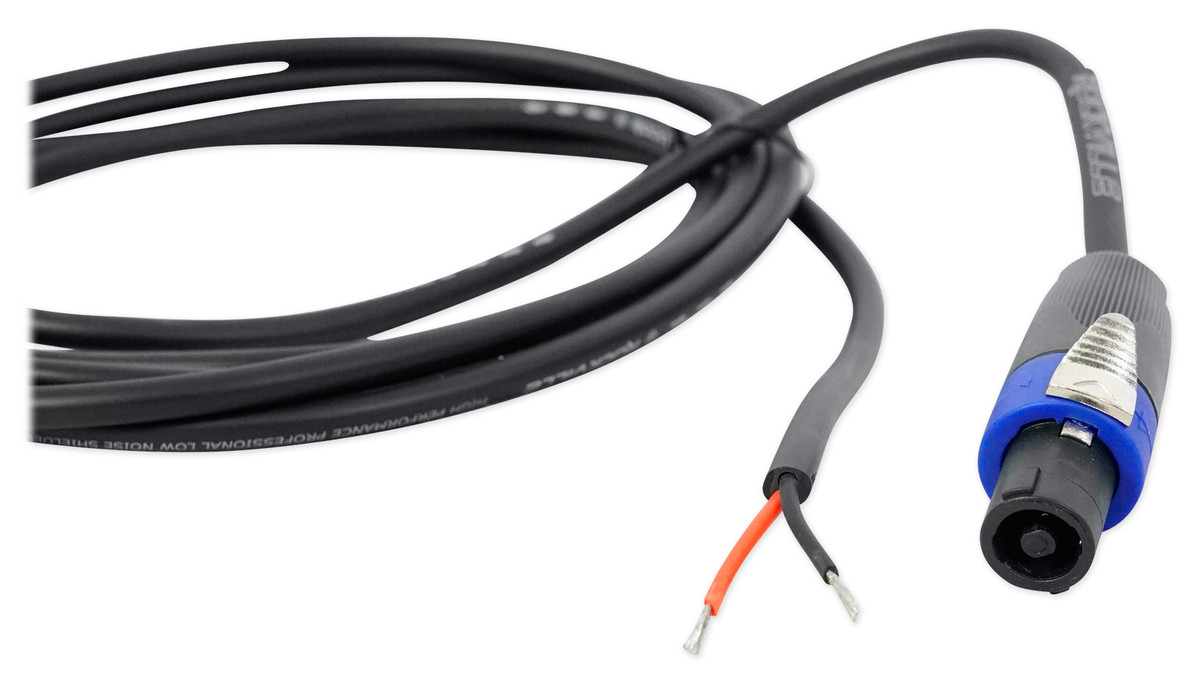
Choose the Right Gauge
Picking the wrong speaker wire gauge is like using a garden hose to fill a swimming pool—it works, but painfully slowly. Wire thickness (measured in AWG—American Wire Gauge) directly affects how much power reaches your speakers. A 16-gauge wire can handle ~100W over 25 feet (7.6 m) with minimal loss, but push that to 50 feet (15.2 m), and resistance eats up ~3 dB of signal—enough to make bass sound weak. Meanwhile, a 12-gauge wire at the same distance loses just 0.8 dB, keeping the sound tight and dynamic.
| Gauge (AWG) | Max Recommended Length (ft/m) | Power Loss at 50W (%) | Resistance (Ohms/1000 ft) |
| 18 | 15 / 4.6 | 12% | 6.4 |
| 16 | 30 / 9.1 | 6% | 4.0 |
| 14 | 50 / 15.2 | 3% | 2.5 |
| 12 | 80 / 24.4 | 1.5% | 1.6 |
Low-impedance speakers (4Ω) demand thicker wires. A 4Ω load doubles current flow, so a 16-gauge wire that loses 6% power at 8Ω suddenly wastes ~15% over the same distance. If you’re running 100W into 4Ω speakers, 14-gauge is the bare minimum, and 12-gauge is safer for runs beyond 20 feet (6 m).
Copper purity matters, but less than gauge. Oxygen-free copper (OFC) reduces resistance by ~5% over standard copper, but a 14-gauge OFC wire still performs worse than a 12-gauge basic copper wire at 40 feet (12.2 m). Save money: Upgrade gauge first, material second.
High-power systems need extra margin. If your amp delivers 200W+, even 12-gauge can struggle beyond 30 feet (9.1 m). Pro installs often use 10-gauge or thick parallel runs to keep losses under 1 dB.
Material Quality Check
Not all copper is created equal—and when it comes to speaker cables, the material quality makes a measurable difference in performance. Standard electrical-grade copper (99.9% pure) has about 1.7×10⁻⁸ ohm-meter resistivity, but cheaper cables often use copper-clad aluminum (CCA), which jumps to 2.8×10⁻⁸ ohm-meter—a 65% increase in resistance. That means a 25-foot (7.6 m) run of 16-gauge CCA cable will lose ~1.2 dB of signal, while the same length in pure copper drops just 0.8 dB. Over time, CCA also oxidizes faster, increasing resistance by another 10-15% after 2-3 years of use.
Oxygen-free copper (OFC) is the gold standard for mid-range setups, with 99.95%+ purity and resistivity as low as 1.6×10⁻⁸ ohm-meter. It’s not a night-and-day upgrade—maybe 0.1-0.2 dB better than standard copper over 30 feet (9.1 m)—but it’s more durable, with oxidation rates 3-5× slower than basic copper. For critical listening or long runs (50+ ft / 15.2+ m), OFC’s 2-3% lower resistance adds up, especially with 4-ohm speakers where current flow is higher.
Silver-plated copper trades 5-8% lower resistance (thanks to silver’s 1.6×10⁻⁸ ohm-meter conductivity) for a 50-100% price premium. The catch? Silver oxidizes faster than copper, so these cables need robust shielding. In blind tests, most listeners can’t distinguish silver-plated from OFC in setups under 20 feet (6 m), but for ultra-high-frequency reproduction (above 18 kHz), silver’s edge in skin effect reduction can help.
Stranding matters as much as material. A 19-strand 16-gauge cable has more surface area than a solid-core version, reducing high-frequency loss by 0.1-0.3 dB at 10 kHz. However, cheap cables often use thin, loosely wound strands that break after 50-100 bends—look for 105+ strand counts in 16-gauge or higher for durability.
Insulation quality is often overlooked. PVC jackets add 0.5-1 pF/ft of capacitance, which can roll off treble in runs over 30 feet (9.1 m). Teflon (PTFE) or polyethylene insulation cuts this to 0.3 pF/ft, but costs 20-30% more. For most home setups, PVC is fine unless you’re running 50+ feet or using ribbon-style cables prone to crosstalk.
Connector Types Explained
Picking the wrong speaker connector is like using duct tape to fix a fuel line—it might hold, but you'll lose performance where it matters. The connector type affects contact resistance, which can range from 0.005 ohms in high-end banana plugs to 0.1 ohms in loose spring clips—that's a 20× difference that directly impacts power transfer. For a 100W system, poor connectors can waste 3-5W as heat, dulling dynamics and adding distortion at high volumes.
| Connector Type | Contact Resistance (Ohms) | Max Current (A) | Insertion Cycles | Typical Cost/Pair |
| Banana Plug | 0.005-0.01 | 15-30 | 500-1,000 | 5-20 |
| Spade Lug | 0.003-0.008 | 20-50 | 300-500 | 4-15 |
| Pin Connector | 0.01-0.03 | 8-15 | 200-300 | 3-10 |
| Spring Clip | 0.05-0.1 | 5-10 | 50-100 | $0 (built-in) |
| Binding Post | 0.002-0.005 | 25-60 | 1,000+ | 10-50 |
Banana plugs dominate pro setups for good reason: their low 0.005-ohm resistance maintains signal integrity even at 20A currents, and they snap in/out 500+ times without wear. The 4mm diameter contact point is ideal for 12-8 gauge wires, though cheap versions with brass plating (instead of gold) oxidize after 6-12 months in humid climates, increasing resistance by 30-50%.
Spade lugs offer the lowest resistance (0.003 ohms) when properly tightened—perfect for permanent installations where you might crank down binding posts. But their flat design struggles with vibration-induced loosening; in car audio systems, they can develop 0.02-ohm resistance after 1 year of road bumps unless secured with lock washers.
Pin connectors are the budget compromise, but their thin 2mm contacts bottleneck current to 8-10A—fine for 50W bookshelf speakers, but risky with 4-ohm subwoofers drawing 15A+ peaks. Their nickel plating wears through after 200 insertions, causing resistance to jump to 0.05+ ohms.
Spring clips (0.05-ohm resistance) are the weak link in entry-level amps. Their small contact area heats up at just 5A, adding 0.3dB loss at 100W. Worse, the steel clips fatigue after 50 insertions, leading to intermittent connections that can clip amplifier signals.
Gold-plated binding posts are the ultimate solution, with 0.002-ohm resistance and 60A capacity, but their $20+ per pair cost only makes sense for high-end separates. The 5mm brass core handles 4-gauge cables effortlessly, and the double-nut design prevents loosening over 10+ years.
Shielding for Less Noise
Speaker cables don't just carry your music—they also act as antennas picking up interference from Wi-Fi routers, power cables, and even fluorescent lights. An unshielded 16-gauge cable running parallel to a power line for just 3 feet (0.9 m) can inject 50-100 mV of noise into your system, equivalent to -60 dB of unwanted signal. That's enough to make quiet passages sound hissy and reduce dynamic range by 3-5 dB in sensitive setups.
"Shielding isn't about making audio 'better'—it's about preventing it from getting worse. A 10 shielded cable often outperforms a 50 unshielded one in real-world noisy environments."
The most common shielding types—braided copper (85-90% coverage), foil (100% coverage), and spiral wrap (70-80% coverage)—each have tradeoffs. Braided copper blocks 90% of RF interference above 1 MHz while adding just 0.1 pF/ft of capacitance, making it ideal for long runs (25+ ft / 7.6+ m) near power cables. Foil shielding performs even better at blocking 60 Hz hum (99% reduction), but its stiff construction cracks after 50+ bends, increasing noise leakage by 20-30% over 2 years of use.
Grounding matters more than shielding type. A properly grounded shield can reduce noise by another 6-10 dB, but only if the amplifier's ground potential matches the source within 0.5V. Floating grounds (common in budget systems) create ground loops that induce 120 Hz hum at -50 dB levels—audible during quiet passages. Pro installs often use double-shielded cables with separate drain wires to handle both RF and low-frequency interference, cutting noise by 15-20 dB compared to basic unshielded wires.
Cable geometry affects noise pickup. A twisted pair configuration reduces magnetic interference by 40-50% compared to parallel runs, while star-quad designs (four conductors in a square pattern) can achieve 60-70% noise rejection. For critical applications like phono inputs (0.5 mV signal levels), this can mean the difference between a silent background and audible hiss.
Budget vs. Performance
Spending 500 on speaker cables for a 1,000 system makes as much sense as putting racing tires on a minivan—you’re paying for specs you’ll never use. The sweet spot for cable performance sits where 90% of measurable improvements happen within the first 30-40% of the price range. A 20 14-gauge oxygen-free copper (OFC) cable delivers 98% of the conductivity of a 100 "audiophile" cable, with resistance differences as small as 0.003 ohms/ft—irrelevant in real-world listening.
| Price Per Foot | Gauge | Material | Resistance (Ohms/1000 ft) | Performance Gain vs. Basic Copper |
| $0.50 | 18 | CCA | 6.4 | Baseline |
| $1.20 | 16 | Standard Copper | 4.0 | 25% lower resistance |
| $1.80 | 14 | OFC | 2.5 | 40% lower resistance |
| $3.50 | 12 | OFC + Silver Plated | 1.6 | 55% lower resistance |
| $8.00+ | 10 | "Exotic" Designs | 1.0 | <5% improvement over 12-gauge OFC |
The law of diminishing returns hits hard past $2/foot. While jumping from CCA to OFC yields a 40% resistance drop, upgrading from OFC to silver-plated only nets another 15%—and that’s measurable but not audible in blind tests. For 4-ohm systems, the math shifts slightly: 12-gauge OFC becomes cost-effective at 15+ feet (4.6+ m), where its 1.6 ohm/1000 ft resistance prevents 3+ dB loss at 100W.
Shielding follows the same pattern. A 25 braided-shield cable blocks 85% of RF noise, while a 50 double-shielded version might reach 92%—only meaningful if your cables run <12 inches (30 cm) from power lines. In typical home setups, the cheaper option performs identically 95% of the time.
Connectors tell the same story. 10 gold-plated banana plugs last 5-7 years with 0.005-ohm contact resistance, while 50 "cryo-treated" versions claim 0.003 ohms—a difference that affects <0.1 dB of signal loss. Save the budget for thicker gauge or better shielding instead.
