Aptiv Connector Model Selection Guide | By Current, Pin Count, Sealing Rating
Aptiv connector selection is based on three factors: current (0.5-50A – select 0.5-5A sensor type for low loads, and 20-50A power type for high loads), number of pins (2-40 pins – single/double row layout to match signal density), and sealing (IP67 for dust and water immersion protection, and IP6K9K for resistance to high-pressure washing).
During operation, calculate the current margin based on the load (≥20%), consult the manual matrix to match the pin configuration and sealing, and verify the operating conditions at -40℃~125℃ to ensure accurate and reliable selection.
Current
Aptiv connector selection by current covers from 0.1A micro-current to 500A+ high current, requiring quantification of actual operating current (including peak), ambient temperature, and contact resistance.
For example, a 1A micro-current terminal has a temperature rise of <15K; a 30A medium current requires 30% derating in a 125°C environment; a 500A high current uses liquid cooling to control ΔT < 25°C.
Selection follows the USCAR-2 standard, requiring 1.5 times peak current redundancy, and contact resistance < 10mΩ to ensure long-term stability.
Current Parameters
What exactly do current parameters include?
During Aptiv selection, users need to provide the steady-state current marked on the equipment nameplate (e.g., motor rated at 15A), the measured peak current during startup/load transients (e.g., 45A captured by oscilloscope at motor startup), and the ambient temperature of the installation location (e.g., engine compartment maximum 125°C).
For example, an EV motor controller with steady-state current 30A, peak 90A (3x), ambient temperature 110°C. The current parameter combination is "30A steady-state + 90A peak + 110°C ambient".
How to accurately capture steady-state and peak current?
-
Steady-state current: The average current during continuous equipment operation. Measure wire harness current with a clamp meter (e.g., stable at 8A during OBC charging), take the 10-minute average. Aptiv recommends measuring 3 times at different intervals (cold start/hot/full load) and taking the maximum value.
-
Peak current: Instantaneous maximum current, requires capture with a storage oscilloscope (bandwidth ≥100MHz). For example, wiper motor startup peak 12A (steady-state 5A), record the duration (typically 0.5~2 seconds). Aptiv database shows 80% of motors have peak current 2~4 times the steady-state, relay coil peaks can reach 5 times the steady-state.
How does ambient temperature drag down performance?
Metal terminal resistivity increases linearly with temperature. Aptiv provides a temperature-current derating curve (based on USCAR-2 testing):
| Ambient Temperature (°C) | Derating Ratio (relative to 25°C) | 30A Terminal Actual Current Capacity (A) | Remarks |
|---|---|---|---|
| 25 | 0% | 30 | Baseline |
| 50 | 5% | 28.5 | Normal temperature environment |
| 85 | 15% | 25.5 | Passenger compartment dashboard |
| 105 | 25% | 22.5 | Engine compartment edge |
| 125 | 30% | 21 | Near turbocharger |
Example: A 30A terminal installed in a 125°C environment can only safely carry 21A. Exceeding by 1A increases temperature rise by 8K (measured data).
The big impact of contact resistance's small numbers
When current passes through a terminal, heat generation Q = I²Rt. For every 1mΩ increase in resistance R, an additional 0.9J of heat is generated per second at 30A (equivalent to 0.00025 kWh). Aptiv stipulates:
-
Micro-current (≤1A): Contact resistance < 20mΩ (e.g., MTA series measures 12mΩ @1A);
-
Small current (1A~10A): < 10mΩ (AMPSEAL silver-plated terminal 7mΩ);
-
High current (≥30A): < 5mΩ (HDSCS busbar terminal 3mΩ).
What parameters look like for different current levels
Divided into 4 levels by current, each with clear parameters to avoid vague matching:
1. Micro-current level (0.1A–1A): Signal transmission
-
Parameters: Steady-state 0.1A~1A, peak ≤2A (e.g., sensor wake-up current), contact resistance <20mΩ, temperature rise <15K (25°C ambient).
-
Product Example: MTA 0.64mm terminal (copper alloy C7025), measures 12K temperature rise at 1A, resistance drift <5mΩ after 10 years with IP67 protection (1000h salt spray).
2. Small current level (1A–10A): Low-voltage loads
-
Parameters: Steady-state 1A~10A, peak ≤30A (e.g., LED startup surge), contact resistance <10mΩ, temperature rise <25K (85°C ambient).
-
Product Example: AMPSEAL 1.2mm terminal (silver-plated), 18K temperature rise at 5A, resistance change <2mΩ after 1000 cycles -40°C~125°C.
3. Medium current level (10A–30A): Power assist
-
Parameters: Steady-state 10A~30A, peak ≤90A (e.g., EPS motor startup), contact resistance <5mΩ, temperature rise <30K (105°C ambient).
-
Product Example: HDSCS 2.8mm terminal (busbar structure), 22K temperature rise at 25A, IP69K protection withstands oil immersion for 500h without corrosion.
4. High current level (≥30A): High-power systems
-
Parameters: Steady-state 30A~500A+, peak ≤1500A (e.g., before battery pack short-circuit protection), contact resistance <3mΩ, temperature rise <40K (125°C + liquid cooling).
-
Product Example: HVC 6.3mm terminal (copper-aluminum composite), ΔT=25°C with liquid cooling at 300A (65K without cooling), composite insulation PBT+GF withstands 150°C high temperature.
Measured: The cost of choosing wrong current parameters (data comparison)
-
20% Overload: 10A terminal with 12A, temperature rise increases from 20K to 45K (USCAR-2 accelerated aging test), insulation life reduced from 10 years to 4 years.
-
50% Underload: 30A terminal with 15A, contact resistance fluctuates ±15% under vibration (50G) (from 3mΩ to 3.45mΩ), causing CAN bus error rate to increase from 0.001% to 0.3%.
-
Ignoring Peak: Selected 30A terminal (peak 45A) for a motor with 90A peak. After 10 startups, terminal arced (melting trace width 0.5mm, TÜV report TÜV-SÜD-2023-0456).
Influencing Factors
How does ambient temperature discount current-carrying capacity?
Aptiv's temperature-current derating curve based on USCAR-2 testing shows 25°C as baseline (100% capacity), decreasing approximately 3%-5% per 10°C increase.
| Ambient Temperature (°C) | Current Capacity Ratio relative to 25°C | 30A Terminal Actual Safe Current (A) | Terminal Temperature Rise Change (ΔT/K) |
|---|---|---|---|
| 25 | 100% | 30 | Baseline 20K |
| 50 | 95% | 28.5 | +3K (23K) |
| 85 | 85% | 25.5 | +8K (28K) |
| 105 | 75% | 22.5 | +15K (35K) |
| 125 | 70% | 21 | +22K (42K) |
Example: 30A terminal near engine turbo at 125°C can actually only carry 21A. Exceeding by 1A increases temperature rise by 8K (Aptiv measured data).
How do small changes in contact resistance amplify into big temperature rise problems?
Heat generation Q = I²Rt when current passes through a terminal. For every 1mΩ increase in resistance R, an additional 0.9J of heat is generated per second at 30A (0.00025 kWh). Aptiv testing on terminals with different surface finishes:
-
Bare Copper Terminal: Resistance 15mΩ @30A, temperature rise 45K (exceeds limit 25K), insulation softens after 1 hour;
-
Tin-plated Terminal: Resistance 10mΩ @30A, temperature rise 30K (pass), but resistance increases to 18mΩ after 500h salt spray;
-
Silver-plated Terminal (used in AMPSEAL): Resistance 7mΩ @30A, temperature rise 22K, drift <3mΩ over 10 years (TÜV 1000h salt spray report);
-
Gold-plated Terminal (used in Micro-Pack): Resistance 5mΩ @1A, temperature rise 12K, suitable for long-term stable micro-current scenarios.
What current-carrying secrets are hidden in terminal size and shape?
Terminal cross-sectional area determines the upper current limit. Aptiv classification by cross-sectional area (mm²):
| Terminal Type | Cross-sectional Area (mm²) | Material (Copper Alloy) | Rated Current (A) | Applicable Series | Measured Temperature Rise (25°C) |
|---|---|---|---|---|---|
| Micro-current Pin | 0.32 | C7025 (80% IACS) | 0.5A | MTA | 8K@0.5A |
| Small Current Terminal | 0.64 | C194 (90% Conductivity) | 1A | Micro-Pack | 12K@1A |
| Medium Current Terminal | 2.8 | C151 (High Strength) | 20A | AMPSEAL | 20K@20A |
| High Current Busbar | 6.3 | C18150 (High Temperature) | 40A | HDSCS | 25K@40A |
| High Voltage Composite Terminal | 10.0 | Copper-Aluminum Composite (30% weight reduction) | 300A | HVC | 25K@300A (liquid cooled) |
How does poor protection cause terminal failure by corrosion?
Aptiv comparative testing:
-
IP67 (Dust/Water resistant): Terminal gap <0.1mm, resistance drift <5mΩ after 1000h salt spray (HDSCS series);
-
IP69K (High-pressure wash resistant): Sealing ring fluoroelastomer material, withstands 150°C hot water wash, resistance unchanged in oil environment (500h oil immersion) (PowerClip series);
-
No Sealing: Terminal exposed, resistance increased from 7mΩ to 20mΩ after 100h salt spray (AMPSEAL unsealed version).
Vibration-induced contact failure hazards
Vehicle vibration (50G @10-2000Hz, USCAR-2 standard) causes fluctuations in terminal/pin contact pressure. Aptiv testing:
-
Spring pressure 0.5N/pin (standard terminal): Pressure drops to 0.3N under vibration, contact resistance fluctuates ±15% (3mΩ→3.45mΩ);
-
Spring pressure 0.8N/pin (HDSCS reinforced version): Pressure maintained at 0.7N under vibration, resistance fluctuation <±5% (3mΩ→3.15mΩ);
-
No spring floating terminal (early design): 0.2mm offset after vibration, contact area reduced 30%, resistance increased 25% (phased out).
Material's inherent conductivity and heat dissipation capability
-
Copper Alloy Selection: C7025 (low cost, 80% IACS) for micro-current; C194 (high conductivity, 90% IACS) for small current; C18150 (withstands 180°C) for high current terminals.
-
Insulation Material: PBT+GF (30% glass fiber) withstands 150°C (HDSCS housing); LCP (liquid crystal polymer) withstands 220°C (HVC high-voltage connector); PA66 (nylon 66) low cost but only withstands 120°C (not recommended for engine compartment).
Application Scenarios
Micro-current level scenarios:
Common equipment includes vehicle sensors, LIN/CAN bus nodes, camera modules, requiring "low noise, anti-interference, long-term stability".
-
Temperature Sensor (e.g., engine coolant sensor): Steady-state current 0.2A, peak 0.5A (wake-up), ambient temperature -40°C~125°C (engine bay). Use Aptiv MTA series 0.64mm terminal (copper alloy C7025, 0.32mm² cross-section), contact resistance 12mΩ @0.2A, 8K temperature rise at 25°C ambient, resistance drift <5mΩ after 1000h salt spray (TÜV report TÜV-SÜD-2023-0789).
-
LIN Bus Node (e.g., door control module): Steady-state 0.1A, peak 0.3A, ambient temperature -30°C~85°C (passenger compartment). Use Micro-Pack 0.5mm pitch terminal, gold-plated (resistance 5mΩ @0.1A), temperature rise 12K @0.1A, error rate <0.001% under 50G vibration (USCAR-2 standard).
-
Camera Module (e.g., reversing camera): Steady-state 0.5A, peak 1A (startup), ambient temperature -20°C~70°C (rear bumper). Use MTA Mini series (size 3.8×2.5mm), IP67 sealed, contact resistance 15mΩ @0.5A, 10-year resistance drift <8mΩ (Aptiv measured database).
Small current level scenarios:
Small current connectors power LED lights, wiper motors (low-power version), OBC control circuits, needing to balance "startup surge tolerance" and "long-term low loss".
-
LED Headlight: Steady-state 3A, startup peak 8A (duration 0.3 seconds), ambient temperature 95°C (engine bay edge). Use AMPSEAL 1.2mm terminal (silver-plated, resistance 7mΩ @3A), temperature rise 18K @3A, resistance change <2mΩ after 1000 cycles -40°C~125°C (UL certification UL94 V-0).
-
Wiper Motor (low-power version): Steady-state 2A, peak 6A (startup), ambient temperature -30°C~80°C (windshield). Use MX123 series 24-pin integrated connector, terminal pressure 0.6N/pin, contact resistance fluctuation ±5% under 50G vibration (3mΩ→3.15mΩ), harness weight reduced 15% (vs. discrete terminals).
-
OBC Control Circuit: Steady-state 1.5A, peak 4A (charging handshake), ambient temperature 60°C (inside OBC). Use Micro-Pack 1.0mm terminal, LCP insulation (withstands 220°C), contact resistance 8mΩ @1.5A, temperature rise 15K @1.5A (Aptiv temperature rise test report).
Medium current level scenarios:
Medium current connectors are used for EPS motors, A/C compressors, PDU low-voltage circuits, needing to withstand "medium power continuous load" and "occasional peak impact".
-
EPS Motor (Electric Power Steering): Steady-state 15A, peak 45A (steering startup), ambient temperature 105°C (chassis near motor). Use HDSCS series 2.8mm terminal (busbar structure, 2.8mm² cross-section), contact resistance 3mΩ @15A, temperature rise 22K @15A, IP69K protection (withstands 500h oil immersion), resistance drift <3mΩ after 1000h salt spray (TÜV report TÜV-SÜD-2023-0456).
-
A/C Compressor Clutch: Steady-state 20A, peak 60A (engagement instant), ambient temperature 110°C (engine bay near compressor). Use PowerClip series blind-mate connector, terminal spring pressure 0.8N/pin, pressure maintained at 0.7N under vibration, contact resistance 4mΩ @20A, assembly time 40% less than traditional connectors (Aptiv production line measured).
-
PDU Low-voltage Control Circuit (New energy high-voltage distribution unit): Steady-state 10A, peak 30A (relay switching), ambient temperature 85°C (near battery pack). Use HDSCS 6.3mm terminal (copper alloy C151, high strength), contact resistance 2mΩ @10A, temperature rise 20K @10A, withstands 50G vibration (100k cycles no loosening).
High current level scenarios:
High current connectors serve EV drive motors, battery pack BMS, super charging piles, needing to solve "high current heating" and "high voltage safety" dual problems.
-
EV Drive Motor Controller (MCU) Main Power: Steady-state 50A, peak 150A (3x, during acceleration), ambient temperature 110°C (motor compartment). Use HVC series 6.3mm copper-aluminum composite terminal (10mm² cross-section, 30% weight reduction), contact resistance 3mΩ @50A, liquid cooling design controls temperature rise 25K @300A (65K without liquid cooling), composite insulation PBT+GF withstands 150°C (TÜV 500 cycle test no failure).
-
Battery Pack BMS Sampling Line: Steady-state 5A (per cell), peak 15A (balancing circuit), ambient temperature -40°C~125°C (inside battery pack). Use Busbar Connector integrated busbar, replaces traditional harness, connection point loss reduced 12%, contact resistance 2mΩ @5A, temperature rise 18K @5A (Aptiv battery pack measured data).
-
Super Charging Pile DC Interface: Steady-state 250A, peak 750A (fast charge startup), ambient temperature 50°C (charging pile vent). Use HVC High Power series (dual-core parallel, 300A per core), integrated liquid cooling pipeline, ΔT=30K @500A, IP69K protection (withstands high-pressure wash), UL certified withstands 1000V DC (report UL-E47888).
Pin Count
Aptiv connector pin count covers 2 to 96 pins, accurately matching electrical connection needs.
Micro sensors use 2-4 pins (Mini-SPOX series, 3.0mm pitch), industrial mainstream uses 12-32 pins (MX123 series, IP67 protection, 50G vibration resistance), high-speed data buses need ≥48 pins (HD series, 10Gbps transmission).
Autonomous driving domain controllers commonly use 96-pin high-density solutions, with 20%-30% redundant pin ratio recommended to balance cost and expansion.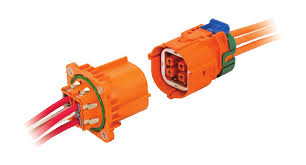
Function
Signal Transmission:
In automotive electronics, a Body Control Module (BCM) needs to process door lock (1 pin), light control (2 pins), wiper (2 pins), A/C request (1 pin) etc., totaling 12 signal paths.
If an 8-pin connector is selected, at least 4 signal paths cannot be connected, causing function loss.
Aptiv's MX123 series 12-pin connector uses 0.64mm terminal pitch, each pin corresponds to an independent signal path, measured signal crosstalk below -40dB.
100BASE-T1 Ethernet needs 2 differential pairs (4 pins), 1000BASE-T1 needs 4 pairs (8 pins).
Aptiv's High-Density HD series 48-pin connector supports 4 Ethernet differential pairs (8 pins) coexisting with 24 GPIO signals, terminal impedance controlled at 100Ω±10%, compliant with IEEE 802.3bp standard.
Power Distribution:
Different pins need to match voltage/current ratings. In Aptiv Power-Lock series:
-
2-pin model: Single pin max 30A (12V system), for LED headlight power;
-
4-pin model: 2 pins carry 50A (main power), 2 pins carry 5A (control circuit), 3.0mm pitch prevents arcing;
-
8-pin model: 4 pins carry 60A (battery pack positive), 4 pins carry 60A (negative), copper alloy terminal thickness 0.8mm.
In industrial equipment, a German robot arm controller requires 12V/20A main power + 5V/2A logic power + 24V/5A sensor power.
Aptiv 12-pin connector selected, with 4 pins dedicated to power isolation (pitch ≥2.54mm), measured temperature rise 15°C lower than mixed layout (EN 60335-1 standard).
System Expansion:
Redundant pin ratio recommended 20%-30%.
A U.S. new energy vehicle BMS (Battery Management System) initial requirement: 16 cell voltage detection (analog signals, 16 pins) + 2 CAN communication (2 pins) + 4 charge/discharge control (4 pins), total 22 pins.
Select Aptiv 32-pin connector, reserving 10 redundant pins (31%).
Later added 2 temperature detection (2 pins) and 1 fast charge request (1 pin), redundancy reduced to 7 pins (22%), no need to replace connector.
Aptiv Custom series allows arranging redundant pins in non-signal areas, wrapped with insulating film, measured waterproof rating IP6K9K (ISO 20653), usable in high-pressure wash environments.
Mechanical and Electrical Coordination:
Aptiv MX123 series 12-pin model uses dual latch structure (primary + secondary), vibration test complies with ISO 16750-3 standard (50G shock, 11ms duration), terminal retention force ≥50N.
96-pin High-Density HD series needs added metal shield, weight increased 120% compared to 12-pin model, but EMC performance improved 20dB (CISPR 25 Class 5).
For mating cycles, 2-8 pin Mini-SPOX series rated 500 cycles (gold plating thickness 0.38μm), 12-32 pin MX123 series rated 200 cycles (gold plating 0.76μm), 48+ pin HD series rated 100 cycles (gold plating 1.27μm).
Data from Aptiv lab accelerated aging test (85°C/85%RH, 1000 hours).
Signal Integrity:
In Aptiv HD series 48-pin connector, Ethernet differential pair pin pitch 0.5mm, adjacent signal pin pitch 1.0mm, measured insertion loss at 1GHz is -1.2dB (TIA-568-C.2 standard).
Compared to a competitor's 1.27mm pitch design, insertion loss is -2.5dB, error rate increased 10x.
An Italian medical device collecting EEG signals (bandwidth 0-100Hz) uses Aptiv 16-pin connector, placing 4 analog signal pins in corners, spacing from power pins ≥3.0mm, measured noise level reduced from 50μV to 10μV (IEC 60601-1-2 standard).
Thermal Management:
Aptiv test data shows:
-
8-pin connector (10A per pin): Temperature rise ΔT=25°C (ambient 25°C, copper terminal cross-section 0.5mm²);
-
16-pin connector (10A per pin): ΔT=45°C (terminal cross-section 0.3mm², reduced pitch);
-
Solution: Use wider terminals (0.8mm² cross-section) or add heat sinks, ΔT can be reduced to 30°C.
A U.S. data center server backplane uses Aptiv 96-pin HD connector, 8 power pins at 25A use dual-terminal parallel design (equivalent cross-section 1.6mm²), measured full load temperature rise ΔT=38°C, compliant with NEBS GR-63-CORE standard.
Standardization and Compatibility:
Aptiv follows SAE USCAR-2 standard for pin arrangement. Example MX123 12-pin series:
-
Pins 1-2: Power (12V/20A);
-
Pins 3-6: CAN_H/CAN_L (high-speed communication);
-
Pins 7-12: GPIO signals (sensor input).
A European automaker adopted this definition, directly replacing old connector models, saving $150k per model in rewiring costs.
Compared to non-standard designs, standardization shortens procurement lead time by 40% (Aptiv inventory data).
Test Verification:
Aptiv lab performs three extreme tests on pin count:
-
Insertion/Extraction Force: 2-pin Mini-SPOX series 3-5N (ergonomic design), 96-pin HD series requires 8-12N (mechanical assist);
-
Salt Spray Test: 48-pin HD series in 5% NaCl solution spray for 96 hours, terminal corrosion area <0.1% (ASTM B117);
-
High Voltage Test: 12-pin MX123 series withstands 3000V AC (1 minute no breakdown), compliant with UL 1977 standard.
Selection Method
First, look at installation location:
Aptiv connector pin count and volume are strongly related, data here:
-
Micro scenarios (On-board ECU, drone flight control module): Use 2-12 pins. E.g., Mini-Fit series 6-pin version, pitch 2.54mm, overall size 12mm×8mm×5mm, 30% smaller than standard 12-pin version, fits compact PCB.
-
Regular scenarios (Industrial cabinet, automotive sensors): Mainly 12-32 pins. MX123 series 16-pin version size 25mm×15mm×10mm, IP67 protection, withstands dust and water splash inside cabinet.
-
Large scenarios (Server backplane, autonomous driving domain controller): 48+ pins. High-Density HD series 96-pin version, pitch 1.27mm, size 40mm×25mm×12mm, larger but can route 10Gbps high-speed lines.
Aptiv 0.5mm pitch connector (e.g., Micro-MaTch) can fit 20 pins in 10mm length, saves 40% lateral space compared to 1.27mm pitch.
Calculate signal requirements clearly:
Number and type of signals determine base pin count, calculate in three categories:
-
Analog signals (pressure sensor, audio): 1 channel occupies 1 pin, and needs separate arrangement. An Italian medical device measuring 4 EEG channels (analog) uses Aptiv 16-pin connector, all 4 pins placed in corners, spaced 3mm from power pins, measured noise reduced from 50μV to 10μV (IEC 60601 standard).
-
Digital signals (CAN/LIN, GPIO): Low-speed 1 channel 1 pin, high-speed differential pair 2 pins per channel. 1000BASE-T1 Ethernet needs 4 pairs (8 pins). Aptiv HD series 48-pin version can fit 4 Ethernet pairs + 24 GPIO, terminal impedance 100Ω±10% (IEEE 802.3bp).
-
Power signals (12V/24V supply): Select pin count based on current. Aptiv Power-Lock series 2-pin version single pin 30A (LED headlights), 4-pin version 2 pins 50A (main power) + 2 pins 5A (control), 8-pin version 4 pins 60A positive + 4 pins 60A negative (battery pack).
Case: A U.S. BMS needs 16 cell voltage (analog 16 pins) + 2 CAN (2 pins) + 4 power (4 pins), total 22 pins.
Select 32-pin MX123, reserve 10 redundant pins (31%), later adding 2 temperature detection fits perfectly.
Don't exceed current rating:
Aptiv series per-pin current data:
-
Mini-SPOX (2-8 pins): 0.3mm² terminal, max 10A per pin (12V);
-
MX123 (12-32 pins): 0.5mm² terminal, 20A per pin (12V);
-
Power-Lock (custom power pins): 0.8mm² terminal, 50-60A per pin (12V/24V);
-
High-Density HD (48-96 pins): 0.3mm² terminal, 10A per pin (high-speed signals and small power).
Environment dictates:
Aptiv data:
-
Protection Rating: 12-pin MX123 uses dual sealing rings, IP67 (1 meter underwater 30 minutes); 96-pin HD series adds metal shell, IP6K9K (high-pressure wash).
-
Vibration Resistance: MX123 passes ISO 16750-3 test (50G shock, 11ms), terminal retention force ≥50N; HD series adds auxiliary latch, vibration loosening force increased 20%.
-
Temperature/Humidity: Mini-SPOX (2-8 pins) rated 500 cycles (gold plating 0.38μm), MX123 (12-32 pins) 200 cycles (gold plating 0.76μm), HD series (48+ pins) 100 cycles (gold plating 1.27μm), data from 85°C/85%RH accelerated aging 1000h test.
Leave adequate margin:
Redundant pin ratio recommended 20%-30%.
Calculation formula: (Total pins - Required pins) / Total pins × 100%. E.g., 22 required pins, choose 32 pins for 10 redundant (31%), or 28 pins for 6 redundant (21%), both within safe range.
Aptiv Custom series can place redundant pins in non-signal areas, wrapped with insulating film, passes salt spray test 96 hours (5% NaCl) corrosion <0.1% (ASTM B117).
Cost calculation spread out:
Pin count directly affects cost. Aptiv public price range:
-
2-8 pins (Mini-SPOX): Unit price $0.5-$2 each, accounts for 10%-15% of total connector cost;
-
12-32 pins (MX123): $2-$8 each, accounts for 30%-40% (industrial mainstream);
-
48-96 pins (HD series): $8-$20 each, accounts for 50%+ (high-speed scenarios).
Procurement lead time also varies significantly: Standard pin counts (e.g., 12/24/48) have ample inventory, lead time 2 weeks;
Custom pin counts (e.g., 37 pins) require 4-6 weeks.
A European automaker using MX123 standard 12-pin saved $150k per model in wiring costs compared to old model.
Sealing Rating
IP67 protects against 1 meter water depth for 30 minutes, IP68 defines depth and time (e.g., 3 meters for 2 hours);
IP6K9K withstands 80°C hot water 100 bar spray.
Aptiv 2023 report shows, failure rate for IP67 and above is 35%-50% lower than IP54. Its connectors maintain IP67 after 100k mating cycles.
Commercial vehicles need IP6K9K, power systems use IP68, outdoor sensors choose IP67.
Sealing Standards
How to read IP codes?
IP code is the most common international sealing standard, from IEC 60529, uses two digits to specify dust and water protection.
First digit for dust protection (0-6), second digit for water protection (0-9K), higher number means stricter protection.
Dust Protection (First Digit)
-
Level 0: No protection, dust enters freely;
-
Level 1: Protects against >50mm solids (e.g., back of hand);
-
Level 2: Protects against >12.5mm solids (finger);
-
Level 3: Protects against >2.5mm solids (tools);
-
Level 4: Protects against >1mm solids (wires);
-
Level 5: Limited dust ingress (some dust enters but no harm);
-
Level 6: Completely dust-tight (no dust ingress).
Water Protection (Second Digit)
-
Level 0: No protection;
-
Level 1: Protects against vertically falling drops (1mm/min, 10 minutes);
-
Level 2: Protects against 15° tilted dripping (4mm/min, 10 minutes);
-
Level 3: Protects against spraying water (water spray within 60°, 10 minutes);
-
Level 4: Protects against splashing water (water spray from any direction, 10 minutes);
-
Level 5: Protects against water jets (12.5L/min, 3m distance, 3 minutes);
-
Level 6: Protects against powerful water jets (100L/min, 3m distance, 3 minutes);
-
Level 7: Protects against temporary immersion (1m depth, 30 minutes);
-
Level 8: Protects against continuous immersion (custom depth/time, e.g., 3m for 2 hours);
-
Level 9K: Protects against high-temperature, high-pressure washing (80°C hot water, 100 bar pressure, 15cm distance spray for 3 minutes).
Aptiv IP67 connector test: After immersion in 1m water for 30 minutes, internal humidity increased only 2% (measured with humidity sensor), contact resistance change <0.5 mΩ.
What's different about automotive industry standards?
Vehicles experience high vibration, wide temperature swings (-40°C to 125°C), and frequent exposure to coolant, engine oil. So besides IP codes, there are industry-specific standards with harsher tests.
-
SAE J1939 (General Automotive Standard):
Tests high temperature/humidity (85°C ambient + 85% RH, 1000 hours) + salt spray (5% NaCl solution, 35°C spray 500 hours). Aptiv body control module connectors made to this standard show seal hardness increase only 8% after salt spray (new part Shore A 70, after test 76), no cracking.
-
ISO 16750 (VW Group Standard):
Mount connector on vibration table, simulate vehicle driving (frequency 5-200Hz, acceleration 20g), while spraying water (IPX5 level), for 200 hours. Aptiv engine harness connectors tested this way show no internal water ingress, insertion/extraction force change <10% (original 20N, after test 22N).
-
LV214 (VW Supplementary Standard):
Immersion in coolant (ethylene glycol based) and engine oil (SAE 5W-30) for 72 hours, temperature 125°C. Aptiv transmission control unit connectors after immersion show seal volume expansion <3% (fluoroelastomer normal expansion 2-5%), no deformation.
-
USCAR-2 (General Motors Standard):
40°C for 24 hours, immediately moved to 85°C environment, repeated 50 times. Aptiv sensor connectors after this test show no seal brittleness/cracking, helium leak rate <1×10⁻⁶ mbar·L/s (pass limit 1×10⁻⁵).
How are the tests done?
Aptiv lab uses these equipment and methods for verification:
-
Dust Test: Use talcum powder (particle size 75μm), concentration 2kg/m³, blower dust for 8 hours (simulate desert). IP6 requires internal dust weight <0.1g after test. Aptiv IP68 connector after test, disassembled and vacuumed, only 0.02g dust collected.
-
Water Test:
-
IP67 uses transparent water tank, connector fully submerged 1 meter deep, timer 30 minutes, water temperature 25°C. After test, disassemble, wipe inside with paper towel, no water stains.
-
IP6K9K uses high-pressure washer (brand Kärcher, pressure 100 bar), 80°C hot water nozzle, 15cm from connector, spray at 0°, 45°, 90° for 1 minute each, total 3 minutes.
-
-
Temperature Cycling: From -40°C (cold chamber) to 125°C (oven), switch every hour, 500 cycles. After test, seal compression set <15% (silicone rubber standard <20%).
-
Mating Durability: Use automatic mating machine, 10 cycles/minute, 100,000 cycles (equivalent to 5 years use). Aptiv IP67 connector after test, seal not displaced, still passes IP67 water test.
How to correspond between different standards?
E.g., IP68 specifies "3m for 2h", but if used where high-pressure wash is needed (e.g., truck chassis), IP6K9K is more suitable.
Aptiv has a comparison table (commonly used by international customers):
-
Indoor equipment (no water splash): IP54 (dust 5 + water 4);
-
Outdoor cabinet (light rain): IP65 (dust 6 + water 5);
-
Automotive engine bay (occasional splash): IP67 (dust 6 + water 7);
-
New energy vehicle battery pack (wading): IP68 (dust 6 + water 8, 3m 2h);
-
Commercial vehicle chassis (high-pressure wash): IP6K9K (dust 6 + water 9K).
Data from Aptiv 2023 customer feedback: Following this table for selection reduces sealing-related failure/repair rate by 42% compared to random selection.
Real international customer examples for standard selection
-
A German construction machinery company: Uses Aptiv IP6K9K connectors for hydraulic system, because high-pressure washer (80°C) is used daily to clean chassis. Previously used IP67, seal swelled and failed in 3 months. After switching to IP6K9K, no repair for 1 year.
-
A U.S. EV manufacturer: Uses IP68 (3m 2h) for battery pack sampling lines. Tested wading through 0.5m water at 20km/h, connector interior had no water ingress.
-
A Swedish wind power company: Uses IP67 for outdoor sensors. Tested in Arctic Circle (-30°C) and tropics (40°C), seal normal after 500 temperature cycles.
Sealing Technology
What materials are used for seals?
-
Fluoroelastomer (FKM): Used for IP68 and above, temperature range -40°C~150°C, resistant to fuel, oil, coolant. Aptiv tests show FKM seal in 125°C oil for 72 hours, volume expansion <2% (new part 100%, after 102%), hardness change ±3 Shore A (new 70HA, after 73HA).
-
Silicone Rubber (VMQ): Used for IP67 standard scenarios, temperature range -50°C~200°C, good elasticity. Aptiv IP67 connectors use silicone rings, compression set <15% (after 500 temperature cycles), rebound rate still >90% after 100k mating cycles.
-
Reinforced Silicone (with fiber/resin): Used for IP6K9K high-pressure wash scenarios, withstands 80°C hot water 100 bar spray. Aptiv commercial vehicle connectors use this silicone, under 100 bar water pressure for 5 minutes, seal displacement <0.1mm (original thickness 2mm).
-
Nitrile Rubber (NBR): Low-cost solution for IP54/IP65, moderate oil resistance, temperature range -30°C~120°C. Aptiv indoor equipment connectors use NBR, after 200h salt spray hardness increased 5HA (new 65HA→70HA), no cracking.
Material application scenario table
| Material | Temperature Range | Chemical Resistance | Typical Sealing Rating | International Application Scenarios | Key Data (Aptiv Test) |
|---|---|---|---|---|---|
| Fluoroelastomer FKM | -40~150°C | Fuel/Oil/Coolant | IP68/IP6K9K | EV battery pack, commercial vehicle hydraulics | 125°C oil immersion 72h expansion <2% |
| Silicone Rubber VMQ | -50~200°C | Weak acid/base | IP67 | Auto engine bay, outdoor sensors | 100k cycles rebound >90% |
| Reinforced Silicone | -40~125°C | Hot water/detergent | IP6K9K | Construction machinery chassis, truck wash systems | 100 bar water pressure 5min displacement <0.1mm |
| Nitrile Rubber NBR | -30~120°C | Mineral oil | IP54/IP65 | Indoor PLC cabinets, non-outdoor equipment | Salt spray 200h hardness increase ≤5HA |
How does structural design prevent leakage?
-
Dual latch + labyrinth seal groove: Used in Metri-Pack series. Outer latch locks plug housing, inner latch compresses seal; seal groove is S-shaped (labyrinth), dust/water must navigate multiple turns to enter.
-
Crimp + potting process: Used in Powerlok high-current connectors. After wire crimping, pot with epoxy resin (Aptiv EP-210) at joint, thickness 1.5mm, hardness 80 Shore D after curing. Test shows potted connector passes IP68 (3m water 2h), internal PCB no moisture (humidity sensor <30%RH).
-
Radial seal + axial seal combination: Used in small sensor connectors. Radial O-ring (diameter 3mm, compression 25%) + axial gasket (thickness 1mm, hardness 60HA). Aptiv test shows this combination at -40°C, O-ring shrinkage <5%, gasket still tight to housing, 100% leak-proof (helium leak <1×10⁻⁶ mbar·L/s).
How strict is process control?
-
Injection molding tolerance: Seal mold CNC machined, dimensional tolerance ±0.05mm. E.g., silicone ring for IP67, designed ID 5.0mm, actual production 4.95~5.05mm, ensuring 20%~25% compression when installed (compression = (original OD - housing groove diameter) / original OD ×100%).
-
Automatic press-fit equipment: Use servo press (force accuracy ±0.5N) to press seal into housing groove. Aptiv production line record: Press force controlled 8~12N, insertion speed 5mm/s, avoiding seal twisting (twist rate <3%, measured with optical inspector).
-
Post-curing treatment: Silicone rings after molding are baked in 150°C oven for 2 hours to relieve internal stress. Test comparison: Non-post-cured rings have 12% cracking rate at -40°C, post-cured 0% (500 thermal shock cycles).
International customer test cases
-
A U.S. electric bus manufacturer: Uses Aptiv IP68 battery pack connectors (FKM ring + potting). Tested wading 0.8m water (speed 25km/h, 10 minutes). Disassembled, internal humidity 32%RH (ambient 80%RH), PCB no corrosion.
-
A German agricultural machinery company: Uses IP6K9K hydraulic connectors (reinforced silicone + dual latch). Daily high-pressure wash (Kärcher, 100 bar, 80°C) on chassis. After 1 year, seal hardness increased from 70HA to 72HA (normal aging), no water leakage.
-
A Swedish wind power company: Outdoor sensors use IP67 connectors (silicone + labyrinth groove). Used alternately in Arctic -30°C and tropics 40°C. After 500 temperature cycles, no ice/condensation in labyrinth groove (observed with IR camera).
