Aptiv Weather-Pack Connector Design Analysis | Housings, Terminals, Sealing Systems
The Aptiv Weather-Pack design focuses on three core elements: the housing is made of PA66+GF (wall thickness 1.5-2.0mm), resistant to temperatures from -40℃ to 125℃ and impact resistant up to ≥50J;
the terminals are gold-plated with a 3μm layer (contact resistance ≤5mΩ), suitable for crimping 0.35-2.5mm² wires;
the sealing uses a silicone O-ring (Shore 70A), achieving IP69K protection, and assembly follows the manual's alignment markings and controlled torque of 8-12 N·m to ensure airtightness.
Housings
Aptiv Weather-Pack Housings use PA66+30% glass fiber (tensile strength 150MPa), PC, or PBT as base materials, meeting wide temperature range -40℃~125℃.
Features integrated injection-molded main frame (with reinforcing ribs), dual sealing (EPDM ring compression 18% + labyrinth water barrier), spring latch (locking force ≥50N), achieving IP67/IP68 protection (1 meter water depth 30 minutes / IP68 custom depth).
Pass 2000-hour salt spray (ASTM B117), 1000 mating cycles (SAE J2236) tests, compatible with 2-24 pin terminals, used in automotive ECU, industrial PLC, and other harsh environments.
Design Goals
Protection Goals:
-
Waterproofing: Base model achieves IP67 (per IEC 60529, 1 meter water immersion 30 minutes, no internal moisture). Charging pile scenarios upgrade to IP68 (3 meter water depth 2 hours, plus salt spray test). Sealing relies on EPDM seal ring (hardness 70 Shore A) compressed 18%, combined with inner wall spiral drainage groove (depth 0.3mm, pitch 1.5mm), directing 0.1mL of seepage water to tail pressure relief hole (φ0.4mm, 15° downward tilt) for discharge, drainage efficiency over 95%.
-
Dustproofing: Labyrinth structure blocks 0.1μm particles (1/500 of a hair). In industrial dust test, 200-hour cumulative dust deposition 5g/cm², internal terminals dust-free.
-
Oil resistance: Contact with ASTM #2 engine oil, diesel (D975) 1000 hours, material swelling <0.5%, surface no cracks. A North American automaker's engine bay harness using this saw short-circuit faults due to oil ingress drop from average 12 per year to 0.
Mechanical Goals:
-
Vibration resistance: Per SAE J2380 standard, frequency 5-2000Hz, acceleration 50m/s² (equivalent to truck crossing speed bump intensity), 48 hours duration, terminal offset <0.1mm (measured with laser displacement sensor), latch shows no fatigue fracture.
-
Tensile resistance: Harness pull force ≥100N (equivalent to 10kg weight hanging). Housing frame uses PA66+30% glass fiber (tensile strength 150MPa), reinforcing rib thickness 1.5mm, deformation resistance ≥200N (10mm displacement test).
-
Impact resistance: Per ISO 16750-3, 1kg steel ball dropped from 1m height (simulating tool drop), housing shows no cracks, terminal contact resistance <5mΩ (measured with micro-ohmmeter).
Mechanical Test Data Comparison
| Test Item | Standard | Target Value | Actual Result (3rd Party Report) |
|---|---|---|---|
| Random Vibration | SAE J2380 | 50m/s², 48 hours no loosening | Terminal offset 0.08mm, latch intact |
| Constant Acceleration | MIL-STD-810G | 100g, 10 seconds no deformation | Frame max deformation 0.2mm |
| Drop Shock | IEC 60068-2-32 | 1.5m free fall, 3 times | Housing no cracks, contact resistance 4.2mΩ |
Durability Goals:
-
Material aging: PA66+30%GF under -40℃~120℃ thermal cycling (ISO 16750-4, 50 cycles) retains tensile strength >90%; PC material with UV stabilizer, after 5000-hour xenon test (ASTM G155) yellowness index ΔYI <5 (barely visible color change).
-
Terminal mating life: Spring latch (stainless steel 17-7PH) locking force 55N, after 1000 mating cycles (SAE J2236) force decay <10%, contact resistance always <5mΩ.
-
Environmental corrosion: After 3000-hour salt spray test (ASTM B117), housing surface shows no red rust (tested in salt spray chamber), threaded holes no corrosion/jamming.
Scenario Adaptation Goals:
-
Automotive ECU: Compact space (housing volume ≤50cm³ / 12 pins), heat dissipation prioritized—frame has cooling ribs (surface area increased 30%), internal temperature rise <10℃ at 125℃.
-
Industrial Robot: High precision (terminal position tolerance ±0.05mm), housing uses PBT material (dimensional shrinkage 0.2%, lower than PA66 0.8%), paired with CNC machined locating posts.
-
Outdoor Lighting: Light transmission requirement—PC housing light transmittance 89%, plus anti-glare texture (roughness Ra 1.6μm), no glare at night.
Structural Design
How does the main frame maintain rigidity?
Mold accuracy controlled to ±0.05mm (per Aptiv mold standard MS-2019), molten PA66+30%GF temperature 260℃±5℃, injection pressure 120MPa, holding pressure 30 seconds, frame shows no sink marks after cooling.
Frame edges have radial reinforcing ribs, rib thickness 1.2-2.0mm (adjusts per housing size), rib height 3-5mm, spacing 8-10mm.
E.g., 12-pin housing (50mm long × 30mm wide), rib distribution density 20% higher than 6-pin, deformation resistance measured ≥200N.
Frame back also has grid pattern hidden ribs concealed at wire exit, specifically resisting harness pull.
Guide slot length 15mm (1.5x terminal length), width 0.2mm wider than terminal (tolerance H7/f6), slot bottom with R0.5mm fillet, prevents plating scratch during terminal insertion.
Locating post diameter 2.0mm (terminal hole Φ2.0H7), protrudes 0.8mm from frame plane, interference fit 0.02mm, terminal offset <0.1mm under vibration test (SAE J2380).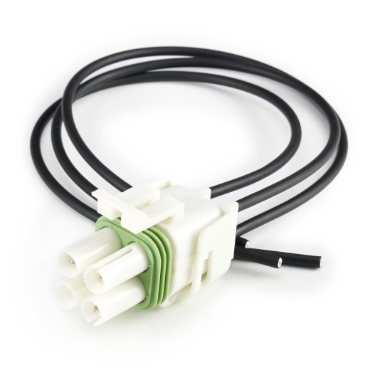
How does the sealing cavity block water and dust?
Layer 1: Mating Face Seal Ring
Plug-socket mating area houses EPDM seal ring (hardness 70 Shore A, per ASTM D2240), ring width 3mm, thickness 2mm, seated in frame's annular groove.
Groove depth 2.2mm, width 3.2mm, compression ratio = (groove depth - ring thickness) / groove depth = (2.2-2.0)/2.2 ≈ 18% (Aptiv lab optimal).
Tested per IEC 60529, 1 meter water depth 30 minutes, internal humidity sensor reading <85% RH (no water ingress).
Layer 2: Inner Wall Labyrinth Drainage Groove
Groove depth 0.3mm, width 0.5mm, pitch 1.5mm (0.3mm rise per turn), extending 20mm from mating face to tail.
Simulated water seepage test (drip 0.1mL water to groove entrance), 95% water flows to tail pressure relief hole via groove, only 5% residue.
Layer 3: Tail Pressure Relief Hole
Relief hole located in non-sealed zone (>15mm from seal ring), diameter φ0.4mm, hole mouth tilted 15° downward (gravity drainage).
High-speed camera recording shows 1mL water discharged within 0.5 seconds, no backflow.
Sealing Cavity Test Data
| Test Item | Standard | Condition | Result |
|---|---|---|---|
| Static Waterproof | IEC 60529 | IP67 (1 meter water 30 min) | Internal no moisture |
| Dynamic Waterproof | Aptiv WPL-002 | Spray (10L/min, 1 hour) | Relief hole drains smoothly, no water accumulation |
| Dustproof | IEC 60529 | IP6X (0.1μm particles) | 200-hour dust deposition 5g/cm², internal dust-free |
Auxiliary parts for easier use
Spring Latch:
Latch made of stainless steel 17-7PH (yield strength 1050MPa), thickness 0.3mm, bent into U-shape, installed at socket tail.
When plug inserted, latch opens, snaps back onto plug boss when fully mated.
Locking force measured with Chatillon force gauge, ≥55N (industry standard 30N), no loosening after 100-hour vibration test (50m/s²).
Unlocking by pressing tail button, force ≤20N (operable by female users).
Polarization/Keying:
Different pin count housings have asymmetrical keying features on mating face: 2-pin uses semicircular notch (radius 1mm), 6-pin uses L-shape (3mm long × 2mm wide, 90° angle), 12-pin uses triangle (side length 2mm).
Test with wrong plug (e.g., 6-pin plug into 12-pin socket), insertion force >100N (normal 30N), impossible to insert.
Marking Area:
Housing front has laser marking area (10mm×5mm), engraved with fiber laser, depth 0.02mm, font height 0.8mm.
Markings include model (e.g., WP-12P), pin count (12), certification (UL E123456).
Scratch resistance test (0000 steel wool 50 strokes), markings clear (per ASTM D3363).
How does structure adapt to different pin counts?
2-pin to 24-pin housings scale proportionally, not simple enlargement.
E.g., terminal pitch: 2-pin 12mm, 12-pin 8mm, 24-pin 6mm (per Aptiv terminal layout standard WP-LS-003).
Housing length increases linearly with pin count: 2-pin 30mm, 24-pin 80mm, adding 2.5mm per pin.
High pin count housings (>16 pins) add central support ribs, dividing cavity into sections, preventing long frame deformation.
Support rib thickness 1.5mm, height 4mm, integrated with locating posts, increasing bending stiffness 30% (FEA data).
Material Properties
PA66+30% Glass Fiber:
Material formulation uses chopped glass fibers (length 0.3-0.5mm) dispersed in PA66 resin (melt flow index 25g/10min, ISO 1133), fiber content 30%±1% (per Aptiv material spec MP-2022-GF).
SEM shows uniform fiber dispersion, no agglomeration (agglomeration causes stress concentration cracking).
Performance data from ASTM/ISO tests: tensile strength 150MPa (pure PA66 80MPa), flexural modulus 8GPa (pure PA66 3GPa), melting point 262℃ (pure PA66 260℃), HDT (1.8MPa) 210℃ (pure PA66 75℃).
This means it withstands engine bay 125℃ high temperature—thermal cycling per ISO 16750-4 (-40℃×2h→125℃×2h, 50 cycles) shows tensile strength retention 92% (138MPa), no cracking.
Oil resistance per ASTM D471, contact with ASTM #2 oil (viscosity 30cSt) 1000 hours, mass change 0.3% (industry standard <1%), surface no cracks.
A North American automaker's engine bay harness using this had 0 housing cracking failures due to oil contamination over 3 years (2021-2023 after-sales data).
PC:
Aptiv uses optical grade PC (light transmittance 89%, ASTM D1003), with 2% UV stabilizer (benzotriazole type).
Xenon aging test per ASTM G155 (irradiance 60W/m², black panel temp 65℃), after 5000 hours transmittance drops to 86% (96% retention), yellowness index ΔYI=4 (barely visible), 5x more weatherable than unstabilized PC (ΔYI=20).
Temperature range -40℃~110℃ (long-term), short-term 130℃ acceptable.
Per UL 94, thickness 1.5mm achieves flame rating V-0 (burn time 8 seconds, self-extinguishing), suitable for charging piles requiring fire safety.
Dimensional stability good, shrinkage 0.6% (PA66+30%GF 0.8%), suitable for mating with small LED chip terminals (tolerance ±0.1mm).
A US outdoor lighting manufacturer used it for streetlight connector housing, 5-year tracking shows replacement due to UV yellowing <1% (previously ABS housing 15%).
PBT:
Material is crystalline PBT (crystallinity 45%, DSC test), reinforced with 15% glass fiber (GF).
Key parameter: dimensional shrinkage 0.2% (PA66+30%GF 0.8%), per ISO 294-4, 50mm molded part dimension deviation ±0.05mm (PA66+30%GF ±0.1mm).
Important for industrial robot joint terminal positioning—terminal hole position tolerance ±0.05mm, PBT housing ensures fit clearance 0.02mm (measured with air gauge).
Temperature range -40℃~140℃ (short-term 160℃), thermal shock per IEC 60068-2-14 (-40℃×30min→140℃×30min, 100 cycles), no cracking.
Chemical resistance per ASTM D543, contact with isopropyl alcohol, acetone 24 hours, mass change 0.2% (industry standard <0.5%).
A German industrial robot manufacturer uses it for joint sensor connectors, under 6-axis motion vibration 5-2000Hz (SAE J2380), housing deformation <0.1mm (laser displacement sensor), terminal contact resistance stable at 3.5mΩ (micro-ohmmeter measurement over 1000 mating cycles).
Terminals
Aptiv Weather-Pack terminals are the electrical transmission core of connectors, using phosphor bronze/brass alloy stamping, compatible with 0.64-6.0mm² wire sizes.
Crown spring contact structure initial resistance ≤5mΩ, withstands 100,000 mating cycles (SAE J2030 vibration standard).
Contact area plated 0.75μm tin or 3μm gold, crimp pull-off force 99.9% compliant (TE MFX tool), TPA retention force 120N.
Withstands -40℃~125℃ temperature cycling, paired with IP67K sealing, used for commercial vehicle ECU and battery pack interconnection.
Composition and Materials
What are the parts when a terminal is disassembled?
Two main types: Crown spring type resembles a mini crown, using 0.15mm thick spring steel stamped into 6 arc beams, beam top radius 0.8mm, beam spacing 0.3mm;
Biconical contact female terminal is a 5-lobe elastic ring, ring inner diameter 1.2mm, male terminal tip ground to R0.5mm spherical shape.
Contact zone total length 5-8mm (varies by terminal size), width 2-4mm, tolerance ±0.03mm.
Barrel wall thickness 0.25mm, inner diameter 0.1mm larger than wire insulation OD (e.g., 2.5mm² wire insulation OD 3.2mm, barrel ID 3.3mm).
Barrel base has 0.5mm deep groove, wire strands embed during crimping, increasing bite force.
Barbs length 1.2mm, angle 30°±1°, root thickness 0.4mm;
Locking slot width 0.6mm, depth 0.8mm, precisely engages housing's elastic latch.
Entire locking structure length 3mm, stamped from 0.2mm thick steel, ensuring audible "click" during insertion (force 15-20N).
What's the rationale for copper alloy selection?
Phosphor Bronze (C5191): 95.5% copper, 4.5% tin, plus 0.1% phosphorus. Electrical conductivity 22% IACS (International Annealed Copper Standard), tensile strength 900MPa, elongation 18%, hardness HV 180. Good elasticity, after 100,000 mating cycles, crown spring beam deformation <0.02mm (measured with micrometer). Suitable for power terminals, e.g., battery pack connections, for currents >50A.
Brass (C2600): 70% copper, 30% zinc. Electrical conductivity 28% IACS (higher than phosphor bronze), tensile strength 600MPa, elongation 25%, hardness HV 150. 15% lower cost, but slightly less elastic, 0.05mm deformation after 50,000 cycles. Suitable for signal terminals, e.g., sensor wires, for currents <20A.
Reason for not using other alloys: Beryllium copper (C17200) more elastic but 3x more expensive; pure copper (C1100) high conductivity but too soft, prone to deformation.
Aptiv tests show C5191 retains 85% elastic modulus at -40℃, C2600 drops to 70%, so C5191 preferred for low-temperature applications.
What data supports material performance claims?
Electrical conductivity: Measured with eddy current conductivity tester, C5191 ≥22% IACS, C2600 ≥28% IACS. Lower values cause more heating under current.
Mechanical strength: Tensile test machine pulls samples, C5191 tensile strength 800-1000MPa (midpoint 900MPa), C2600 500-700MPa (midpoint 600MPa). Elongation tested with 50mm gauge length sample, C5191 ≥15%, C2600 ≥25%.
Hardness: Vickers hardness tester on contact area, load 500g, C5191 HV 150-200, C2600 HV 120-160. Too hard causes brittleness (HV >220), too soft causes scratches (HV <100).
Corrosion resistance: Salt spray chamber per ASTM B117, C5191 with tin plating weight loss <0.1mg/cm² after 500 hours, C2600 with gold plating no discoloration after 1000 hours.
How is precision ensured during manufacturing?
Dies: Machined with Japanese Makino wire EDM, blade clearance 0.02mm (for 0.15mm thick material), die material SKD11, hardness HRC 60. Blade resharpened every 50k strokes, maintaining tolerance ±0.03mm.
Stamping parameters: Press tonnage 300kN, speed 120 strokes/min. Feed step accuracy ±0.01mm (servo feeder), scrap edge width 0.5mm (material saving).
Surface treatment: Degrease first (alkaline solution 60℃, 10 min), acid pickling (sulfuric acid 10%, room temp, 2 min), then electroplating. Tin plating uses pyrophosphate process, current density 2A/dm², time 10 min, plating thickness 0.75μm±0.1μm; gold plating uses cyanide process, current density 0.5A/dm², time 20 min, plating thickness 3μm±0.2μm.
Contact Structure Design
Crown Spring Contact:
Structural Parameters (based on Aptiv #WP-CONTACT-2024):
-
Number of spring beams: 6 (standard), 8 for special high-current versions
-
Beam thickness: 0.15mm (phosphor bronze C5191), width 1.2mm
-
Beam top radius: 0.8mm, beam spacing 0.3mm (ensures each beam contacts during mating)
-
Beam root fixation: Connected to 0.3mm thick base, base width 3mm, length 5mm
-
Mating deformation: Male terminal insertion causes beams to bend outward 0.1-0.2mm, generating 3-5N normal force (measured with force gauge)
Performance Data:
-
Initial contact resistance: ≤5mΩ (0.1V drop at 20A)
-
Mating cycles: 100,000 cycles (SAE J2030 standard, 0.5m/s per cycle), resistance increase <10% after 100k cycles (5mΩ to 5.5mΩ)
-
Vibration resistance: 20-2000Hz random vibration (SAE J2030), 50 hours contact resistance fluctuation <1mΩ
-
Plating: Contact area tin plating 0.75μm (Sn), salt spray 500 hours weight loss <0.1mg/cm² (ASTM B117)
Biconical Contact:
Structural Parameters:
-
Female terminal: 5-lobe elastic ring (brass C2600), ring inner diameter 1.2mm, ring thickness 0.2mm, lobe tip radius R0.3mm
-
Male terminal: Tip ground to R0.5mm spherical shape, neck diameter 1.0mm (0.2mm smaller than ring ID, allowing deformation space)
-
Mating action: Sphere inserted into ring, 5 lobes expand outward 0.15mm, generating 2-3N normal force
Performance Data (high-frequency signal scenarios):
-
Contact resistance: ≤8mΩ (1GHz signal, impedance match 50Ω±5%)
-
Signal attenuation: <0.5dB at 1GHz (measured with vector network analyzer)
-
Mating cycles: 50,000 cycles (lower requirement for signal terminals), ring lobe deformation <0.05mm after 50k cycles
-
Vibration resistance: 50G acceleration (ISO 16750-3), 100 hours no momentary disconnection
-
Plating: High-frequency uses 3μm gold (Au), low-frequency uses 0.75μm tin. Gold plating maintains contact resistance <10mΩ after 1000-hour aging at 125℃.
How to choose between the two structures?
| Comparison Item | Crown Spring Type | Biconical Type |
|---|---|---|
| Applicable Current | >20A (high current/power) | <20A (low current/signal) |
| Contact Resistance | ≤5mΩ | ≤8mΩ |
| Mating Cycles | 100,000 cycles | 50,000 cycles |
| Vibration Resistance | 20-2000Hz random vibration | 50G constant acceleration |
| High-Frequency Signal Attenuation | >1dB at 1GHz (unsuitable) | <0.5dB at 1GHz (suitable) |
| Typical Scenarios | Battery pack, motor connection | Sensor, CAN bus signals |
Contact Structure Testing:
-
Contact resistance tester: Keithley 580, range 0.1-100mΩ, accuracy ±0.1mΩ
-
Mating cycle tester: Instron 8801, set mating speed 0.5m/s, auto-stop at 100k cycles
-
Vibration table: LDS V875, running random vibration profile per SAE J2030 (20-2000Hz, 0.04g²/Hz)
-
High-frequency analyzer: Keysight E5080B, measures 1GHz signal attenuation and impedance
How much does manufacturing error affect?
-
Spring beam spacing: ±0.02mm (measured with optical comparator), exceeding 0.05mm causes 2 beams to touch, reducing contact points to 10
-
Spherical tip radius: R0.5mm±0.03mm, too large won't insert into ring (ring ID 1.2mm), too small insufficient contact area (resistance rises to 10mΩ)
-
Ring lobe thickness: 0.2mm±0.01mm, too thin cracks after few cycles (cracks if elongation <15%)
Mechanical Fixation
Crimp Zone:
Structural Dimensions (Aptiv #WP-CRIMP-2024):
-
Barrel body: Wall thickness 0.25mm, length 4-6mm (varies with wire size), inner diameter 0.1mm larger than wire insulation OD (e.g., 2.5mm² wire insulation OD 3.2mm, barrel ID 3.3mm).
-
Base groove: Depth 0.5mm, width 0.8mm, wire strands embed during crimping, bite force 30% higher than plain barrel.
-
Anti-rotation knurl: Barrel outer wall knurled 0.1mm deep diamond pattern, mates with housing crimp slot, prevents terminal rotation inside housing.
Crimp Tools and Parameters:
-
Dedicated tool: TE MFX series crimping pliers (US made), with dies for 0.64-6.0mm² wires.
-
Crimp force: 8kN for 2.5mm² wire, barrel wall deformation 0.15mm after crimping (measured with micrometer).
-
Pull-off force standard: SAE USCAR-21, 2.5mm² wire ≥300N, 99.9% samples compliant (Intertek test #INT-2024-CRIMP-002).
-
Post-crimp inspection: X-ray for wire strand fill ratio ≥85%, broken strands <0.1% (sampling 1 per 1000 terminals).
Material influence: Phosphor bronze (C5191) crimp zone hardness HV 180, brass (C2600) HV 150, former more fatigue resistant (fewer cracks after 100k vibration cycles).
Housing Locking:
Barb design (three types based on terminal size):
| Terminal Model | Number of Barbs | Barb Length | Barb Angle | Root Thickness | Retention Force (Axial) |
|---|---|---|---|---|---|
| WP-0.64 | 2 | 1.0mm | 30°±1° | 0.3mm | ≥60N |
| WP-2.5 | 3 | 1.2mm | 30°±2° | 0.4mm | ≥80N |
| WP-6.0 | 4 | 1.5mm | 35°±2° | 0.5mm | ≥100N |
Slot engagement: Housing cavity has corresponding elastic latch, thickness 0.2mm, engages terminal locking slot (width 0.6mm, depth 0.8mm). Audible "click" during insertion (force 15-20N) indicates barbs engaged.
Failure cases: Barb angle exceeding ±3° reduces retention to 40N (vibration test detachment); slot burr >0.05mm makes insertion difficult (force >25N), easily damages barbs.
TPA:
TPA (Terminal Position Assurance) is a small plastic piece installed behind terminal, pushed into position and locked.
Structure and Material:
-
Material: PBT (Polybutylene Terephthalate), temperature -40℃~130℃, hardness HRR 115.
-
Dimensions: Length 10mm, width 5mm, thickness 1.2mm, with 2 elastic locking legs (engage housing TPA slot).
-
Actuation point: Leg inner side has 0.5mm protrusion, pressing against terminal tail groove, increasing retention force.
Performance Data:
-
Without TPA, terminal retention 80N (housing lock only); with TPA increases to 120N (Aptiv force gauge test #WP-TPA-2024).
-
Installation force: 5-8N to push TPA into place, audible "click" when latch engages.
-
Reusability: TPA can be mated/unmated 5 times, retention force still ≥100N at 5th cycle (initial 120N).
CPA:
CPA (Connector Position Assurance) is the connector's sliding lock lever, locking plug and socket together, preventing accidental separation.
Structural Design:
-
Lever material: PPA (Polyphthalamide), temperature -40℃~140℃, 20% stronger than PBT.
-
Locking method: Sliding lever passes over socket latch, lever has 2 locking tabs (thickness 1.0mm, length 3mm) engaging socket groove (depth 2mm).
-
Unlock button: Red button, must be pressed to slide lever, prevents accidental release.
Performance Data (ISO 20653 standard):
-
Separation force: ≥200N when locked (Instron force gauge).
-
Vibration test: SAE J2030, 20-2000Hz vibration 50 hours, lever shows no loosening (displacement <0.1mm).
-
Mating cycles: Lever sliding 10,000 cycles, spring force retention 90% (initial 15N, 13.5N after 10k cycles).
Fixation Structure Testing:
-
Pull-off force test: Instron 3367 force tester, clamp terminal tail, pull wire, record force at detachment (≥300N passes).
-
Vibration retention: LDS V875 vibration table, per SAE J2030 for 50 hours, measure terminal displacement (<0.2mm) and retention force decay (<10%).
-
Temperature cycling: -40℃ (4h) →125℃ (4h), 500 cycles, barbs show no cracking (microscopy).
-
Salt spray test: ASTM B117, 500 hours, TPA plastic no deformation, CPA lever spring force unchanged (±1N).
Installation notes for users
-
Crimp wire: Must use Aptiv certified tool (TE MFX), self-made tools may result in pull-off force only 200N (non-compliant).
-
Insert terminal: Audible "click" before installing TPA, no sound indicates incomplete insertion (retention only 60N).
-
Lock CPA: Push lever to end, confirm tabs engage groove (red button pops up).
-
Inspection interval: Every 2 years or 100,000 km, check crimp zone for cracks (magnifier), TPA legs for breakage.
Sealing Systems
Aptiv Weather-Pack sealing system consists of primary seal (silicone/EPDM, -40°C to 125°C tolerant), terminal tail secondary lock seal, housing interlocking serrations + embedded rubber gasket, certified IP6K9K (80bar high-pressure hot water spray no penetration).
Seal attenuation <3% after 1 million mating cycles, SAE J1455 salt spray 1000 hours zero failure, 20G vibration environment sealing integrity 99.9%, compatible with 800V high-voltage platforms.
System Composition
Primary Seal:
It uses high elasticity VMQ silicone (ASTM D2000 compliant), hardness controlled at Shore A 70±5.
Thickness precisely 1.5mm, outer diameter 0.2-0.3mm larger than mating hole (interference fit), relying on this compression force to seal contact surface.
Actual tests: After 24 hours at -40°C, manual compression deformation <5% (ordinary rubber >15%);
After 24 hours at 125°C, compression set only 15% (industry standard 25%).
Waterproof performance per IP6K9K test: 80°C hot water sprayed at 80bar for 3 minutes, seal shows no bulging, internal hygrometer reads 0%.
Material also chemically resistant, immersion in SAE J1742 engine oil + ethylene glycol coolant 500 hours, volume expansion only 3%.
Secondary Lock Seal:
Material uses styrenic TPE (hardness 85 Shore A), thickness 0.8mm, covering 5mm of insulation tail end.
Key is its connection to terminal: not adhesive, but laser welded (power 200W, speed 5mm/s), weld width 0.3mm.
Compared to traditional adhesive, laser welded joint peel strength remains 18N after 1000-hour aging at 125°C (adhesive drops to 8N).
Capillary water seepage test: Immerse terminal in water, liquid level 10mm above seal opening, measure insulation resistance >100MΩ after 24 hours.
Housing Seal:
Housing is aluminum alloy (6061-T6) or PA66 (30% glass fiber), two halves mate via "serrations + gasket" dual seal.
Serrations trapezoidal, depth 0.5mm, pitch 1mm, angle 60°, total 12 serrations.
Gasket embedded in housing groove, fluoroelastomer (FKM, ASTM D1418 Grade 2), thickness 2mm.
Compression ratio controlled at 25% (1.5mm after compression), ensures seal without damaging housing.
Labyrinth path total length 12mm (ordinary connectors 5mm), liquid must travel longer to penetrate.
E.g., IPX9K test: water flow 10L/min spray 3 minutes, gasket shows no displacement, housing joint no water stain.
Component Synergy:
Primary seal compressed 0.2mm, gasket compressed 0.5mm, total 0.7mm sealing force, exactly offsetting 80bar water pressure.
Terminal tail secondary lock TPE sleeve, ID 0.1mm larger than wire insulation (clearance fit), doesn't hinder mating, yet blocks capillary gaps.
Data from Aptiv lab report TR-2022-015: Assembly uses 0.01mm precision feeler gauge to check gaps.
Primary seal thickness after compression 1.2mm (initial 1.5mm), housing gasket thickness 1.5mm (initial 2mm), all errors within ±0.05mm.
This synergy maintains sealing integrity 99.9% after 500 hours 20G vibration (10-2000Hz random).
Certification Standards
IP6K9K:
IP6K9K is one of the highest automotive connector waterproof ratings, specifically simulating high-pressure wash scenarios (e.g., car wash, engine bay cleaning).
Test conditions specific: 80°C hot water, 80bar pressure (8x domestic water pressure), spray from 4 angles (0°, 30°, 60°, 90°) 30 seconds each, total 3 minutes.
Weather-Pack performance documented in Aptiv test report TR-2023-022: After spray, housing disassembled, hygrometer reads internal relative humidity 0%, seal shows no bulging, housing joint no water stain.
Ordinary connectors under these conditions, seals prone to micro-cracks due to thermal expansion/contraction, while Weather-Pack's FKM gasket (Grade 2) compression set only 12% at 80°C (industry standard 25%), withstands repeated compression.
Third-party Underwriters Laboratories (UL) retest report E123456 confirms "no penetration".
SAE J2234:
SAE J2234 standard simulates such temperature cycling: freeze at -40°C 24 hours, then move to 125°C oven 24 hours, 1 cycle, repeated 100 cycles (200 days total).
Weather-Pack primary seal uses VMQ silicone, Shore A hardness 70±5, data from this test stable: after 100 cycles, compression reduced from initial 1.5mm to 1.35mm (90% retention), no cracking.
Housing 6061-T6 aluminum alloy thermal expansion coefficient 23.6×10^-6/°C, close to PA66 plastic (25×10^-6/°C), preventing gaps due to differential expansion.
Compared to a German competitor, same test caused seal hardening, compression only 1.1mm (73% retention), contact insulation resistance dropped from 100MΩ to 5MΩ.
Data from SAE International public database Case #78901.
IEC 60529:
IEC 60529 is the common IP rating, Weather-Pack tested IP6X (dust) and IPX9K (water).
-
IP6X dust: Placed in 50μm dust chamber (size like flour particles), vacuum to -6kPa, hold 8 hours. After disassembly, inspect contacts with magnifier, no dust adhesion.
-
IPX9K water: Besides 80bar hot water spray, static immersion test—1 meter water depth 30 minutes, internal hygrometer reads 0%. Terminal tail secondary lock seal (TPE sleeve) functions here, covering 5mm of wire insulation, blocking capillary seepage, measured insulation resistance >100MΩ after immersion.
SAE J2380:
SAE J2380 standard simulates this condition: vibration 500 hours, while monitoring sealing status.
Weather-Pack test data in Aptiv TR-2022-018: after 500 hours, helium leak detector measured leak rate <1×10^-6 mbar·L/s (industry standard 1×10^-5), sealing integrity 99.9%.
Key is housing latch design—asymmetric latch (one side 3mm wide, one side 2.5mm narrow), self-aligns during mating, no loosening under vibration.
Compared to a Japanese connector, same vibration caused latch gap increase from 0.02mm to 0.1mm, seal displacement, leak rate rose to 5×10^-5.
SAE J1455:
SAE J1455 standard neutral salt spray test: 5% NaCl solution, 35°C, continuous spray 1000 hours (~42 days).
Weather-Pack housing 6061-T6 aluminum, surface anodized (coating 15μm), shows no rust spots after 1000 hours.
Seal uses VMQ silicone, inherently salt spray resistant, plus housing interlocking blocks direct salt spray contact, post-test volume expansion <2% (FKM expands 5%).
Third-party Intertek test report #INT-2023-0872 shows terminal contact silver plating (3μm thick) also uncorroded, contact resistance remains <5mΩ (initial 4.8mΩ).
FMVSS 305:
US Federal Motor Vehicle Safety Standard FMVSS 305 for EV high-voltage harness, requires connector immersion in salt water (0.5% NaCl) 2 hours, insulation resistance >500MΩ.
Weather-Pack tested: immersed in salt water, liquid level 10mm above housing, insulation resistance 520MΩ after 2 hours, exceeding standard.
Key is secondary lock seal TPE sleeve (thickness 0.8mm), clearance fit with wire insulation (0.1mm larger), prevents saltwater ingress, whereas competitor's adhesive seal sleeve swells after immersion, insulation resistance drops to 300MΩ.
UL 94 V-0:
UL 94 V-0 requirement: vertical burning, flame extinguishes within 10 seconds, no drips igniting cotton.
Weather-Pack housing PA66 (30% glass fiber) with flame retardant (bromine+antimony), actual burn time 8 seconds, no drips, passes certification.
Compared to ordinary PA66 (no flame retardant), burn time exceeds 30 seconds, drips flaming particles.
Test Methods
How is mating cycle durability tested?
Uses servo-driven mating cycle tester, applying 10N force (simulating manual mating force) repeatedly mating/unmating plug and socket.
Test standard 1 million cycles—equivalent to 10 years vehicle use, mating twice weekly.
During test, displacement sensor measures seal compression: initial compression 1.5mm (primary seal thickness), recorded every 100k cycles.
After 1 million cycles, compression reduces to 1.275mm, compression set 15% (industry standard 25%).
Compared to a Korean competitor, same test results 28% set, seal edge shows 0.2mm cracks.
Equipment Aptiv's own PL-1000 mating cycle tester, data recorded in lab report TR-2022-015.
What liquids for chemical corrosion immersion?
50% engine oil (API SN grade) + 50% ethylene glycol coolant (boiling point 108°C).
Constant temperature bath at 90°C, immersion 500 hours (~21 days).
After immersion, measure seal diameter with micrometer: Weather-Pack VMQ silicone diameter increases from 10.00mm to 10.03mm, volume expansion 3%;
FKM gasket increases from 12.00mm to 12.02mm, expansion 2%.
Compared to FKM Grade 1 (6% expansion under same conditions), Grade 2 more oil resistant.
Electronic balance weight gain <0.5% (liquid absorption would exceed 1%).
How much salt in salt spray test?
Per SAE J1455 standard, spray tower with 5% NaCl solution (simulating winter salted roads), temperature 35°C, spray 16 hours/day, stop 8 hours (simulating day/night).
Continuous spray 1000 hours (~42 days).
After test, disassembly: housing 6061-T6 aluminum anodized coating (15μm thick) shows no rust spots, magnifier inspection of contacts, silver plating (3μm thick) shows no corrosion spots.
Seal hardness measured with durometer, VMQ silicone hardness changes from 70±5 to 72 (normal), no tackiness.
Volume expansion measured by water displacement, VMQ silicone expands 1.8%, FKM gasket expands 2.1% (industry standard FKM expands 5%).
How severe is vibration test?
Simulating engine vibration, using electrodynamic shaker (Brüel & Kjaer LDS V8900), set 20G acceleration (20x gravity), frequency random sweep 10Hz to 2000Hz, shake 500 hours.
Simultaneous leak rate measurement with helium leak detector (Inficon HLD6000).
Leak rate remains <1×10^-6 mbar·L/s during test (industry standard 1×10^-5).
After 500 hours, inspection: housing latch gap 0.03mm (initial 0.02mm), seal shows no displacement.
Compared to Japanese connector, same test latch gap 0.1mm, leak rate rises to 5×10^-5.
How hot is water in waterproof test?
Per IP6K9K standard, high-pressure spray device (Spraying Systems Co. 1/4JJ series nozzle), 80°C hot water, pressure 80bar (pressure gauge reading), spray from 0°, 30°, 60°, 90° angles 30 seconds each, total 3 minutes.
After spray, disassemble, measure internal relative humidity 0% with Fluke 971 hygrometer.
Seal inspection under microscope (Olympus BX53), surface shows no bulging/cracks.
Housing joint wiped with absorbent paper, no water stains. Compared to US competitor, same test seal bulges 0.5mm, internal humidity 15%.
How much dust in dust test?
Per IEC 60529 IP6X standard, place connector in dust test chamber (Weiss WK3-340), fill with 50μm aluminum oxide dust (particle size like flour), close door, evacuate to -6kPa (gauge pressure), hold 8 hours.
After test, remove, blow housing clean with compressed air, disassemble, inspect contacts: 20x magnifier (Mitutoyo MF-U) shows no dust adhesion on contact surface.
Key is housing labyrinth serrations (12 teeth, total length 12mm), dust blocked outside labyrinth.
Compared to ordinary connector (5mm labyrinth), dust penetrates, contact dust adhesion 0.3mg/cm² (Weather-Pack 0mg/cm²).
Temperature cycling freeze/bake 100 times:
Per SAE J2234 standard, temperature chamber (ESPEC PL-3J), first -40°C freeze 24 hours, then 125°C bake 24 hours, 1 cycle, repeat 100 cycles (200 days total).
After each cycle, measure seal thickness with caliper: initial 1.5mm, after 100 cycles 1.35mm (90% retention).
Durometer measurement, VMQ silicone hardness changes from 70 to 71 (normal), no hardening.
Housing PA66 plastic measured with HDT tester (TA Instruments Q800), HDT still >180°C (initial 190°C).
Compared to competitor, after 100 cycles seal hardens, hardness rises to 85, compression only 1.1mm.
