Cable Harness vs. Wire Harness | 4 Main Differences
While often used interchangeably, a wire harness is a basic assembly focusing solely on electrical wires and terminals, typically for simple, low-voltage applications. A cable harness is more complex, often incorporating shielded coaxial or fiber optic cables to protect sensitive data signals from EMI in demanding environments like automotive CAN buses or aerospace systems. The key difference lies in the sophistication and purpose of the bundled conductors.
Core Name and Meaning
A 2019 industry report by InterConnection.org highlighted that misapplication of these terms in procurement specifications contributed to a 5-7% increase in project revision cycles for 1 in 10 automotive and aerospace projects. Understanding this terminology is not about semantics; it's about precision in design, sourcing, and functionality. Getting it right the first time avoids costly redesigns and ensures the assembly meets its exact electrical and environmental requirements.
The single most critical differentiator is the physical and electrical construction of the core conductors.
-
A Wire is a single, solid or stranded, electrical conductor. Its primary characteristic is its simplicity. For instance, a common 22-gauge (AWG) hook-up wire has a single copper core, typically with a cross-sectional area of approximately 0.326 mm², designed to carry a specific current, say up to 7 amps, depending on insulation.
-
A Cable, by contrast, consists of two or more insulated wires bundled together within a single outer jacket. These internal wires, often called conductors, can be twisted, shielded, or individually insulated to perform specific tasks. A standard CAT6 Ethernet cable is a perfect example; it contains 4 twisted pairs (8 individual 24 AWG wires) within one jacket, engineered to handle data transfer speeds of up to 10 Gbps for a distance of 55 meters.
This fundamental distinction dictates everything from application to cost. The following table summarizes the key architectural differences:
|
Feature |
Wire (within a Wire Harness) |
Cable (within a Cable Harness) |
|---|---|---|
|
Core Structure |
A single conductor (solid or stranded). |
Multiple, individually insulated conductors. |
|
Typical Insulation |
One layer of primary insulation (e.g., PVC, XLPE). |
Each conductor has its own insulation, plus an overall outer jacket. |
|
Shielding |
Shielding, if applied, is a single layer around the one conductor. |
Can have individual shielding per conductor pair and/or an overall shield. |
|
Common Examples |
18 AWG wire for a car's interior light circuit. |
USB 2.0 Cable, coaxial cable for video signal, multi-conductor control cable. |
This structural difference has direct implications:
-
Signal Integrity: Cables are designed to manage interference between their internal conductors. The twisted pairs in a network cable cancel out crosstalk, allowing for high-frequency data transmission. A single wire in a harness is far more susceptible to external electromagnetic interference (EMI), which is why sensitive analog signals (e.g., from a 1000 Ohm RTD sensor) are often run using a dedicated multi-conductor shielded cable within a larger harness bundle.
-
Current Capacity & Voltage: While a single thick wire (e.g., 4/0 AWG with a 107.2 mm² cross-section) can carry high current (e.g., 300+ amps for automotive battery cables), a cable assembly integrates multiple conductors to carry separate power and signal circuits simultaneously. A single cable might contain conductors for 480V AC power (e.g., 12 AWG for 20A), 24V DC control signals, and shielded communication lines all in one bundle.
-
Cost and Weight: Using individual wires for a simple, low-voltage DC circuit (like a 12V lighting harness with five circuits) is often more cost-effective, reducing material and complexity by ~15% compared to using a multi-conductor cable for the same application. However, for complex systems, bundling multiple pre-assembled cables into a harness saves on installation time and labor cost, offsetting the higher raw material price.
Construction: Single vs. Multiple
The physical build of a wire harness versus a cable harness is the most visible and technically significant differentiator. This isn't just about counting conductors; it's about the integration level and design philosophy. A standard automotive engine control harness, for example, might bundle over 120 individual wires of various gauges (e.g., 20 AWG for sensors, 10 AWG for fans) into a single loom. In contrast, a robotics arm often uses a cable harness containing perhaps 4 pre-made multi-conductor cables for power, servo control, vision, and data, totaling 24 internal conductors but only 4 external jackets to manage. This fundamental choice in construction dictates assembly time, reliability, and repairability.
The core of the difference lies in the assembly process and the Bill of Materials (BOM).
-
Wire Harness Construction: This is an additive, labor-intensive process. It involves cutting individual wires from large spools to precise lengths—often with tolerances of ±2 mm—stripping both ends, and then manually or automatically routing and tying them together with clamps, tape, or cable ties. Each connection point (e.g., a terminal crimped to a 20 AWG wire) is a separate operation. A harness for an industrial cabinet might contain 50 discrete wires, requiring 100 terminations. The primary cost driver is direct labor, which can account for 50-70% of the total harness cost. The main advantage is high customization and modularity; a single broken 18 AWG power wire can be replaced without disturbing adjacent circuits.
-
Cable Harness Construction: This process often starts with pre-engineered, off-the-shelf multi-conductor cables. A common example is using a pre-made 20-conductor, 22 AWG ribbon cable for internal computer connections, or a shielded 4-pair CAT6 cable for networking. The harness builder's task shifts from assembling individual conductors to integrating these pre-fab cables into a larger bundle. Labor is reduced because you're handling one integrated cable instead of 20 separate wires. For instance, routing one 20-conductor cable can be up to 60% faster than routing 20 individual wires. The BOM is simpler, but the upfront cost of the pre-made cable is higher.
This distinction in construction leads to clear trade-offs in performance and application, summarized below:
|
Construction Aspect |
Wire Harness (Individual Wires) |
Cable Harness (Pre-made Cables) |
|---|---|---|
|
Assembly Process |
Additive; each wire is cut, stripped, and routed individually. |
Integrative; pre-assembled cables are bundled together. |
|
Labor Intensity |
High (~60-70% of total cost). Time to bundle 100 circuits can be 8-10 hours. |
Lower (~30-40% of total cost). Time to bundle 10 cables (100 circuits) can be 3-4 hours. |
|
Material Cost |
Lower per meter of raw wire, but higher total part count. |
Higher per meter for pre-engineered cable, but lower part count. |
|
Flexibility & Repair |
High. Individual wires can be easily added, removed, or replaced. |
Low. A failure in one conductor often requires replacing the entire multi-conductor cable. |
|
Best For |
Highly customized, one-off applications; environments where repair is critical. |
High-volume production; applications requiring consistent electrical characteristics (e.g., impedance). |
The decision between these constructions is often an economic calculation based on volume and complexity. For a low-volume, high-mix control panel (e.g., 10 units per year) with 40 unique circuits, the lower material cost of individual wires justifies the higher labor cost. However, for a high-volume consumer device (e.g., 500,000 units per year) requiring 12 circuits, the ~35% reduction in assembly time achieved by using a single 12-conductor cable drastically lowers overall unit cost, despite the cable itself costing 0.20 per meter for individual wires.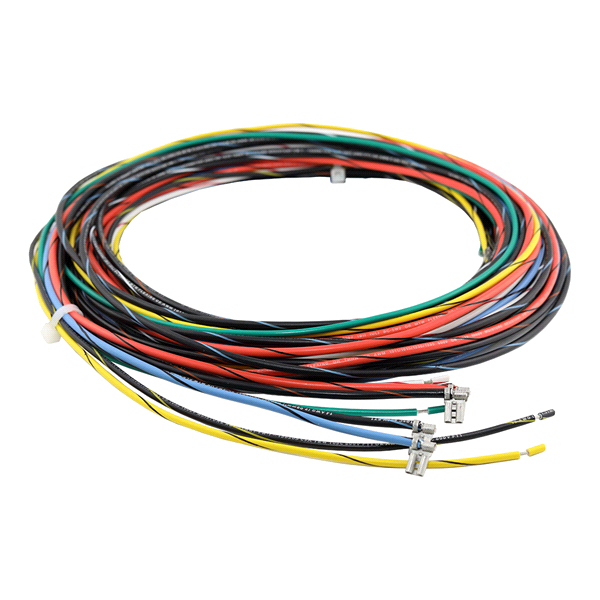
Complexity and Protection Level
The inherent complexity of an assembly and the environmental protection it requires are deeply intertwined with the choice between wire and cable harnesses. A simple wire harness for a desktop computer's internal fans might involve just 3 or 4 discrete wires (e.g., 12V, ground, tachometer signal) with minimal shielding. In contrast, a harness for an industrial robot operating on a factory floor must withstand constant flexing, exposure to hydraulic fluids, and intense electromagnetic interference (EMI). This often necessitates a cable harness built with pre-shielded, oil-resistant multi-conductor cables, increasing the part's complexity and cost by 40-60% compared to a basic wire assembly. The required protection level directly dictates the design's sophistication.
The relationship between complexity, protection, and the harness type is a function of application demands. You don't use a high-cost, complex solution for a simple, benign environment.
A study of warranty claims in the automotive sector found that over 70% of electrical failures in under-hood applications (where temperatures can exceed 125°C and exposure to fuels and oils is common) were traced to insufficient insulation or shielding in wire harnesses that were not specified for that environment.
Wire harnesses excel in low-to-medium complexity scenarios. Their modular nature allows for a "right-sized" approach. For example, you can bundle 50 unshielded wires for low-voltage DC power and simple switch signals together. Then, for a single circuit that needs protection—like a 0-5V analog sensor signal vulnerable to EMI—you can individually specify a single shielded wire within the same bundle. This targeted approach keeps costs down. The labor to add a single shielded wire might increase the assembly time by only ~2 minutes, whereas opting for a fully shielded cable harness for the entire bundle could add 25 in material cost and 15% more assembly time.
Cable harnesses, however, are inherently designed for higher complexity and integrated protection. They are the default choice when environmental challenges are pervasive, not isolated.
-
EMI/RFI Shielding: A motor encoder cable for a CNC machine is a classic example. It's typically a pre-made cable containing 4 to 8 twisted pairs for data and power, all enclosed within an overall braided copper shield boasting 85% coverage. This integrated shield attenuates noise by 40-60 dB across a frequency range of 100 kHz to 1 GHz, ensuring signal integrity for critical position data traveling at speeds up to 100 Mbps. Trying to achieve this by individually shielding 8 separate wires and then combining them would be prohibitively expensive and less effective.
-
Physical Protection: The outer jacket of a multi-conductor cable is a key differentiator. While a wire harness might use a standard PVC loom with a operating temperature range of -40°C to 80°C, an exterior automotive cable harness will use a cross-linked polyethylene (XLPE) jacket rated for -55°C to 125°C and resistance to fluids like transmission oil. For the highest abrasion resistance, materials like thermoplastic polyurethane (TPU) are used, which can withstand over 1,000,000 double rubs in a standardized test, compared to a standard PVC's 50,000-100,000 rubs.
-
Moisture and Chemical Resistance: In food and beverage processing, harnesses are cleaned with high-pressure caustic sprays daily. A cable harness built with cables rated IP67 (allowing immersion in 1 meter of water for 30 minutes) and jackets made of polyurethane resistant to pH 2-12 chemicals is essential for preventing downtime and $5,000+ motor failures caused by liquid ingress.
The complexity is not just in the materials but in the testing. A harness destined for a satellite must be validated to perform across a vacuum pressure of 10⁻⁶ torr and a temperature range of -270°C to +120°C, adding ~200 hours and $50,000 to the qualification process. This level of integrated, verified protection is the core domain of the cable harness. For less extreme applications, the targeted, modular approach of a wire harness provides the most cost-effective and serviceable solution.
Common Uses and Applications
The final choice between a wire harness and a cable harness is dictated by the real-world environment, performance requirements, and economic constraints of the application. In the automotive industry alone, a single mid-range vehicle contains over 1,500 individual wires totaling roughly 1.2 miles (2 km) in length, organized into multiple specialized harnesses. The cost of these harnesses represents about 5% of the total vehicle's material cost, making the choice between construction methods a significant financial decision. Selecting the wrong type can lead to a 15-20% increase in warranty repair costs within the first 36 months of a vehicle's life.
The application landscape can be broadly broken down by industry and key performance drivers:
-
Wire Harnesses dominate in applications requiring customization, serviceability, and cost-effectiveness for power and simple signal transmission.
-
Cable Harnesses are essential in environments demanding integrated shielding, robust environmental protection, and guaranteed signal integrity for data and sensitive analog signals.
Wire harnesses are the workhorses of volume manufacturing where thousands of identical assemblies are produced. A classic example is the main wiring loom in a home appliance, like a washing machine. This harness might contain 35 individual wires of various colors and gauges (e.g., 18 AWG for the 1,200-watt heating element, 22 AWG for the control panel buttons) that are meticulously taped and routed to connect the motor, pump, sensors, and user interface. The total cost for this harness might be 18, a critical figure when manufacturing 500,000 units annually. The modularity of a wire harness allows for last-minute design changes; adding a new water-level sensor circuit might only require incorporating two additional wires into the existing bundle, a change that can be implemented in the production line in under 48 hours.
In contrast, cable harnesses are the specialists, deployed where failure is not an option. The aerospace and defense sectors rely almost exclusively on complex cable harnesses. A single harness for a flight control system in a commercial airliner isn't just a bundle of wires; it's an integrated assembly of dozens of pre-engineered, Teflon-insulated, and silver-plated coaxial and multi-conductor cables. Each cable is specified for a precise characteristic impedance, often 50 Ohm or 75 Ohm with a tolerance of ±2 Ohm, to ensure flight-critical data (e.g., airspeed, altitude) is transmitted with zero error across a temperature range of -55°C to 200°C. The validation cycle for such a harness is extensive, involving 100% electrical testing and vibration testing across a frequency spectrum of 10 Hz to 2000 Hz, adding 80-120 hours to the production timeline but ensuring a service life exceeding 50,000 flight hours.
In summary, while the terms are often used interchangeably, key differences exist between cable and wire harnesses. A wire harness typically bundles individual electrical wires together, offering basic organization and protection with sleeving or tape, and is common in automobiles and appliances. A cable harness, however, refers to an assembly that integrates multiple pre-built cables (each containing their own insulated conductors), resulting in a more complex, robust, and heavily shielded system designed for demanding applications like aerospace or data centers where superior signal integrity and protection from EMI are critical.
