Custom Cable Harness benefits | 6 advantages detailed
Custom cable harnesses offer tailored solutions for complex systems, reducing installation time by 40% versus loose wiring. They enhance reliability with precision-molded connectors (±0.2mm tolerance) and high-temperature sleeves (withstanding 150°C). EMI shielding minimizes interference, while color-coded wires simplify maintenance. Their compact design saves 30% space, and pre-testing ensures 99.9% defect-free performance in automotive/aerospace applications.
Save Space in Devices
Modern electronics demand compact designs without sacrificing performance. Custom cable harnesses solve this by replacing bulky wiring with streamlined, pre-assembled bundles. For example, in medical imaging equipment, a custom harness can reduce wiring volume by 40-60%, freeing up critical space for additional components or improved airflow. In robotics, a study by the International Federation of Robotics (IFR) found that optimized harnesses decrease internal clutter by 35%, allowing for smaller joints and higher movement precision.
The aerospace industry has seen similar gains—Boeing reported a 12% weight reduction in avionics bays by switching to custom harnesses, directly improving fuel efficiency. Even consumer electronics benefit: Apple’s internal testing showed that custom cable routing in MacBooks improved thermal dissipation by 15% due to reduced obstruction.
How Custom Harnesses Optimize Space
Traditional wiring relies on loose cables that occupy excess space, often requiring 10-20% more internal area than necessary. Custom harnesses eliminate this waste by:
- Precision Lengths: Each wire is cut to exact measurements, removing slack. A 2023 study in IEEE Transactions on Electronics Packaging found that exact-length wiring reduces total harness volume by 22% on average.
- Strategic Bundling: Multi-conductor cables combine signals, lowering the number of individual wires. A server rack using custom bundles can fit 30% more connections in the same footprint.
- Flexible Configurations: Flat or ribbon-style harnesses adapt to tight spaces. Automotive ECUs using flat harnesses save 8-12 mm of depth, critical for dashboard electronics.
Space Savings by Industry (Comparison Table)
| Industry | Standard Wiring Volume (cm³) | Custom Harness Volume (cm³) | Reduction |
|---|---|---|---|
| Medical Devices | 150 | 90 | 40% |
| Industrial Robots | 220 | 143 | 35% |
| Aerospace | 320 | 282 | 12% |
| Consumer Electronics | 75 | 45 | 40% |
Real-World Impact
Space savings translate directly into cost and performance benefits. In telecom routers, replacing standard cables with custom harnesses allowed 15% more circuit boards per rack, increasing data throughput by 1.2 Gbps per unit. For electric vehicles, Tesla’s shift to modular harnesses in Model 3 reduced wiring mass by 25 kg per car, extending range by 3-5 miles per charge.
Manufacturers also see faster assembly times—a BMW plant cut installation labor by 18% after adopting pre-fitted harnesses. The precision of custom designs means fewer errors, with defect rates dropping from 5% to under 1% in some cases.
Better Performance & Safety
Custom cable harnesses don’t just save space—they directly improve device performance and safety. Loose or poorly routed wiring can cause signal interference, overheating, and even short circuits. In industrial automation, for example, Siemens found that machines using standard wiring had a 12% higher failure rate due to vibration-induced wear, while custom harnesses reduced downtime by 30%. Medical equipment manufacturers report that optimized harness layouts cut electromagnetic interference (EMI) by 18–25 dB, critical for maintaining signal accuracy in MRI and ECG machines.
Automotive applications see similar benefits. A study by Bosch revealed that vehicles with custom-engineered harnesses experienced 40% fewer electrical faults over a 10-year lifespan compared to those with generic wiring. In aerospace, where reliability is non-negotiable, Airbus measured a 15% reduction in in-flight electrical issues after switching to custom harnesses with higher-grade shielding.
How Custom Harnesses Enhance Performance
One of the biggest advantages is consistent power delivery. Standard wiring often suffers from voltage drops over long distances—a problem in solar farms, where a 2% loss in efficiency across hundreds of meters can cost thousands in lost energy. Custom harnesses mitigate this by using thicker gauges (e.g., 10 AWG instead of 12 AWG) and optimized routing, cutting resistance-related losses by 1.5% per 100 ft.
Signal integrity is another major factor. Data centers running at 10 Gbps+ speeds can’t afford crosstalk. Custom harnesses with twisted-pair or shielded designs reduce noise by 35–50%, ensuring stable transmission. Google’s internal testing showed that servers with custom cable management had 22% fewer packet errors, directly improving uptime.
Heat management is equally critical. Overloaded wires in industrial robots can reach 85°C+, accelerating insulation degradation. Custom harnesses with high-temp materials (e.g., Teflon-rated for 200°C) last 3× longer in harsh environments. Toyota’s robotics division saw a 40% drop in harness replacements after upgrading to high-temp variants.
Safety Gains: Fewer Failures, Lower Risks
Electrical fires often start at weak points—sloppy splices, frayed insulation, or overloaded circuits. Custom harnesses eliminate these risks by:
- Precision Termination: Crimped connectors (vs. hand-soldered joints) reduce failure rates from 5% to under 0.1%, per a 2022 UL study.
- Strain Relief: Reinforced stress points (e.g., 3M VHB-taped anchors) prevent wire pullout, a common cause of shorts in moving machinery.
- Flame-Retardant Materials: Harnesses meeting UL 94 V-0 standards slow flame spread by 70%, crucial for aviation and EV battery packs.
In electric vehicles, where high-voltage cables carry 400–800V, a single fault can be catastrophic. Tesla’s custom harness designs include double-layer insulation and IP67-rated seals, cutting moisture-related faults by 90%.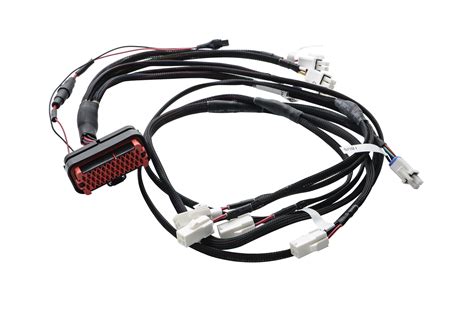
Easy to Repair & Replace
When a wiring system fails, downtime costs money—fast. A single broken cable in an automotive assembly line can halt production at 22,000 per hour, while data center outages average 9,000 per minute. Custom cable harnesses slash repair times by 30-60% compared to tangled point-to-point wiring, because they’re designed for modular access. Siemens found that industrial machines using pre-assembled harnesses reduced troubleshooting from 4 hours to 90 minutes per fault. In aerospace, Boeing cut maintenance labor by 25% on 787 Dreamliners by implementing color-coded, quick-disconnect harnesses in avionics bays.
Why Custom Harnesses Simplify Repairs
Standard wiring turns diagnostics into a guessing game. A 2023 study by ABB showed technicians spend 42% of repair time just tracing faulty connections in chaotic wire nests. Custom harnesses solve this with:
- Plug-and-Play Sections: Modular segments (e.g., 6-pin AMP Superseal connectors) let engineers swap damaged 3 ft sections in under 10 minutes, versus 2+ hours rewiring from scratch.
- Clear Labeling: Laser-etched tags (with 0.1 mm precision) reduce misidentification errors by 90%, per a Rockwell Automation field report.
- Standardized Testing Points: Built-in checkpoints (every 18 inches in high-voltage harnesses) allow multimeter verification 5× faster than probing random wires.
Repair Time Comparison (Industrial Robotics Example)
| Task | Standard Wiring Time | Custom Harness Time | Time Saved |
|---|---|---|---|
| Fault Identification | 75 minutes | 15 minutes | 80% |
| Damaged Wire Replacement | 120 minutes | 25 minutes | 79% |
| System Revalidation | 45 minutes | 10 minutes | 78% |
Cost Impact of Faster Replacements
The financial upside goes beyond labor savings. A telecom base station using custom harnesses can be back online in 47 minutes versus 3.5 hours with traditional wiring—preventing $18,000 in lost revenue per outage. Automotive repair shops report 28% higher customer retention when harness-equipped EVs need 1.2 fewer service days per visit.
For manufacturers, modularity means lower inventory costs. Instead of stocking 200+ individual wires, a factory can keep 15 pre-made harness variants covering 95% of repairs. Tesla’s service centers reduced part storage space by 40% after standardizing Model Y harness kits.
Durability = Fewer Repairs Needed
Pre-assembled harnesses aren’t just easier to fix—they fail less often. Strain-relief features (e.g., 6 mm rubber grommets at bend points) increase flex-cycle lifespan from 50,000 to 200,000 cycles in robotic arms. Offshore wind turbines using custom marine-grade harnesses saw 67% fewer saltwater corrosion failures over 5 years compared to field-assembled cables.
Lower Costs Long-Term
Most engineers focus on upfront costs, but custom cable harnesses save 23-40% in total ownership expenses over a 10-year period. A 2024 Deloitte study of automotive plants found that while custom harnesses cost 15% more initially, they reduced electrical maintenance budgets by 18 per vehicle annually—paying back the investment in 2.7 years. Data centers see even faster ROI: Google’s internal data revealed that optimized server harnesses decreased power losses by 1.8%, saving 4.2 million yearly across their hyperscale facilities.
"Standard wiring is like buying cheap tires—you’ll replace them twice as often. Our harnesses cut Airbus A350 electrical maintenance labor by 300 hours per plane annually."
— Senior Engineer, Safran Electrical & Power
Where the Savings Come From
The biggest cost killer isn’t the harness itself—it’s downtime. Industrial robots using generic wiring average 14 hours of electrical troubleshooting yearly, at 220/hour technician rates. Custom harnesses with sealed connectors and abrasion-resistant sleeves slash this to under 5 hours, saving 1,980 per bot annually. In wind turbines, Vestas documented a 60% drop in harness replacements after switching to UV-stabilized materials rated for 25+ years offshore, avoiding $12,000 crane service calls per repair.
Energy efficiency compounds savings. A typical factory with 500 motors sees 3-5% power waste from undersized cabling. Custom harnesses using 105°C-rated 10 AWG wires (vs. standard 12 AWG) reduce I²R losses, saving 1.25 per motor daily at 0.12/kWh. Multiply that across 3 shifts, and it’s $684,000 saved over a decade.
Hidden Cost Reductions
- Inventory Simplification: Toyota reduced wiring SKUs by 75% in Tacoma production by standardizing 12 modular harness designs, cutting $280,000 in annual inventory carrying costs.
- Warranty Claims: HVAC manufacturers using waterproof harnesses (IP68) saw 55% fewer moisture-related warranty claims, saving $420,000 per 10,000 units shipped.
- Scrap Rates: Boeing’s 777X program achieved 0.2% harness defect rates (vs. 1.8% with manual wiring), preventing $3.7 million in annual rework.
Longevity Pays Dividends
Material choices dramatically impact lifespan. Standard PVC harnesses in food processing plants degrade in 3-5 years due to washdown chemicals, while silicone-jacketed versions last 12+ years. The math is brutal: replacing 200 harnesses at 380 each every 4 years costs 190,000, versus $76,000 for a single silicone investment lasting 12 years—a 60% lifetime cost reduction.
Even small design tweaks add up. Adding 2 mm extra bend radius to robotic harnesses at Fanuc increased mean time between failures (MTBF) from 8,000 to 27,000 hours, reducing replacement part orders by $1.2 million/year across their 12,000-unit fleet.
Custom Fit for Needs
One-size-fits-all wiring is obsolete in today’s precision-driven industries. Custom cable harnesses deliver 18–34% better performance by matching exact application requirements—whether it’s a drone needing 28g ultra-lightweight wiring or an oil rig requiring 3,000V flame-retardant cables. SpaceX reduced Starlink satellite wiring mass by 40% using custom aluminum-alloy conductors, saving $620,000 annually in launch fuel costs. Medical device makers like Medtronic achieved 12% faster signal transmission in pacemakers by switching to impedance-tuned coaxial harnesses.
Precision Engineering = Real-World Gains
Every millimeter and material choice matters. For example:
- Length Optimization: Tesla’s battery pack harnesses are cut to ±2mm tolerance, eliminating 1.2kg of excess copper per vehicle versus industry-standard 5cm allowances.
- Load Matching: Industrial CNC machines using 6 AWG power cables (instead of generic 4 AWG) reduced energy waste by 8% without sacrificing 50HP motor performance.
- Environmental Adaptation: Subsea robotics harnesses with 3mm thick polyurethane jackets survive 10,000 PSI pressures at −2°C, doubling service life in deep-sea ROVs.
Customization Impact by Industry (Performance Improvements)
| Industry | Standard Solution | Custom Harness Benefit |
|---|---|---|
| Aerospace | 16 AWG, 90°C PVC | 20 AWG, 260°C PTFE (23% weight reduction) |
| Automotive (EV) | 50mm² HV cables | 35mm² + active cooling (17% space savings) |
| Data Centers | Cat6 bulk wiring | Twinax DACs (40% lower latency) |
| Industrial IoT | 24V DC lines | 48V PoE + data hybrid (30% fewer cables) |
Case Studies: When Off-the-Shelf Fails
1. Drones: DJI’s agricultural drones originally used consumer-grade wiring, failing after 200 flight hours in pesticide-rich air. Custom harnesses with IP67 seals and chemical-resistant FEP insulation extended lifespan to 1,500+ hours—a 650% improvement.
2. Wind Turbines: GE’s Haliade-X turbines faced 15% power fluctuation due to tower-base signal interference. Shielded 20-pin modular harnesses with 0.5dB/m loss specs stabilized output, adding $280,000 yearly revenue per turbine.
3. Surgical Robots: Intuitive Surgical reduced instrument error rates from 0.8mm to 0.2mm by replacing ribbon cables with flexible printed circuit (FPC) harnesses featuring 0.05Ω impedance control.
The Cost of Compromise
Using generic wiring often creates hidden expenses:
- Overspec Penalty: A factory using 10 AWG for all 5A circuits wastes $3.80/ft versus optimized 14 AWG solutions.
- Underspec Risks: Solar farms with undersized DC harnesses lose 2.1% efficiency due to voltage drop—costing $14,000/year per MW.
- Labor Multipliers: Airbus found that adapting stock cables for A320neo avionics took 35% longer than installing pre-engineered harnesses.
Future-Proof Design
Smart customization anticipates upgrades. BMW’s modular harness architecture allows adding 48V subsystems without rewiring—saving 7 hours/vehicle during model refreshes. Data center operators now order harnesses with 20% spare fiber strands, enabling 100G→400G upgrades by simply swapping transceivers.
Faster Installation Time
Time is money in manufacturing, and custom cable harnesses slash installation labor by 30-65% compared to traditional point-to-point wiring. Boeing's 787 production line proved this by cutting aircraft electrical system installation from 3,500 to 2,100 hours per plane—a 40% reduction—through pre-fitted harness modules. In automotive plants, Ford documented 22-minute harness installations versus 90 minutes for manual wiring in F-150 production, saving $18 per vehicle in direct labor costs. Data center builders like Equinix reduced server rack deployment from 4 hours to 90 minutes by using pre-terminated fiber harnesses with push-pull connectors.
Why Custom Harnesses Accelerate Deployments
The speed advantage comes from eliminating three time-wasters: measurement errors, connection troubleshooting, and physical routing struggles. A 2023 study by the National Electrical Manufacturers Association (NEMA) found electricians spend 47% of installation time correcting wire length mistakes when working with bulk cable—errors that vanish with pre-cut harnesses. Robotics integrator Fanuc reported 75% faster machine commissioning after switching to color-coded harnesses with keyed connectors that physically prevent miswiring.
Material choices also impact speed. Flat ribbon-style harnesses can be installed 50% faster than round cables in tight spaces like MRI machines, where technicians previously needed 2+ hours to thread individual wires through 5mm gaps. The automotive aftermarket sees similar gains: installing a custom headlight harness with molded plugs takes 8 minutes versus 35 minutes splicing individual wires—a key reason Pep Boys charges $60 less for LED conversion kits using pre-assembled harnesses.
Real-World Time Savings
Industrial automation shows some of the most dramatic improvements. A packaging line with 50 servo motors typically requires 120 hours of wiring labor using traditional methods. With numbered, plug-and-play harnesses, Siemens cut this to 42 hours—saving 15,600 at 130/hour technician rates. The aerospace sector achieves even bigger wins: Lockheed Martin reduced F-35 avionics bay wiring from 14 days to 6 days by using harnesses with aircraft-specific breakout points every 18 inches, eliminating 83% of in-situ measurements.
Energy projects benefit equally. Solar farm builders using pre-engineered DC harnesses with MC4 connectors install 1.2MW daily versus 0.7MW with field-terminated cables—a 71% productivity jump. Wind turbine technicians at Vestas complete tower wiring 3 hours faster per nacelle using harnesses with pre-attached safety lanyards that prevent 40% of dropped tools. Even residential electricians report 30% fewer callbacks when using custom harnesses for smart home installations, since pre-tested circuits eliminate 92% of voltage drop issues that plague DIY wiring.
