Custom vs. Off-the-Shelf Wiring Harnesses | 5 Key Differences
Custom wiring harnesses offer tailored designs (e.g., 18-4AWG wires, M12 8-pin connectors) for niche applications (e.g., -55°C to +150°C aerospace), costing 30-50% more with 4-6 week lead times and 100% functional testing (3000V dielectric). Off-the-shelf options use standard specs (16-22AWG, 0.5-1.5mm terminals) for general use (10-85°C automotive), costing 20-30% less, available in 1-2 days, and undergo 50% sampling tests (1500V dielectric).
Cost and Lead Time
Off-the-shelf harnesses are mass-produced, leading to a lower unit cost, typically ranging from 200 depending on complexity. Their lead time is often just 1-2 weeks for shipping. In contrast, a custom harness requires significant upfront engineering, which includes 15,000 in design and prototyping fees. This investment spreads across the production volume, making the per-unit cost higher. Manufacturing lead times are also substantially longer, usually 8 to 12 weeks, as every component and process is tailored from the ground up.
This makes it ideal for projects with a tight budget under 10,000 or those needing a quick turnaround for prototyping a non-critical system. However, a custom harness absorbs all its upfront costs in the first order. A single, unique design for a specialized agricultural machine might carry a 8,000 NRE charge and a per-unit cost of 450. If you only need 10 units, the total cost soars to 12,500, averaging 1,250 per harness. But if your production forecast is 500 units, that same NRE is diluted, dropping the effective per-unit cost to 466, which may be lower than trying to adapt multiple off-the-shelf ones.
Selecting a standard harness from a catalog can be a 48-hour decision process, with parts arriving in 5 business days. A custom harness requires a 2-week design review cycle, followed by a 3-week prototyping phase, and finally a 4-week production queue before shipping. This 9-week journey is a significant commitment. The long-term financial payback is realized at scale. For high-volume manufacturing runs exceeding 1,000 units, the custom harness often becomes the more economical choice over its entire product lifecycle, offering perfect fit and potential savings in installation labor, sometimes reducing it by up to 25% due to pre-terminated connectors and exact length matching.
Design and Fit Comparison
Off-the-shelf options offer a limited range of standard lengths, typically in 6-inch increments up to 96 inches, and connector types like Deutsch DT or Metri-Pack. This often leads to compromises, with excess cable needing to be coiled and secured, adding unnecessary weight and potential failure points. A custom harness, engineered from a 3D model of your specific assembly, provides an exact fit with lengths precise to within ±2%, eliminating slack and routing issues from the start.
| Aspect | Off-the-Shelf Harness | Custom Harness |
|---|---|---|
| Length Tolerance | ±15% to ±20% (e.g., a 100" harness could be 80" to 120") | ±2% (e.g., a 100" harness is 98" to 102") |
| Connector Options | Limited to common 5-10 standard types | Virtually unlimited; any OEM or specialized connector |
| Weight & Bulk | Often 15-30% heavier due to excess wire and loom | Optimized for minimal weight and low volume |
| Routing Provisions | Generic clips; may not align with your chassis holes | Custom brackets and clips at exact 35mm intervals |
For instance, in a 48-volt DC system powering a 500-amp motor, an off-the-shelf harness might use a 4-gauge wire as a conservative, one-size-fits-all solution. A custom harness can be engineered with a precisely calculated 6-gauge wire that handles the actual 480-amp peak load with a <3% voltage drop over 5 meters, saving ~0.5 kg in weight and ~$25 in copper cost per unit. The connectors are not just about fit; they are about environmental sealing. A custom harness for an agricultural vehicle will specify IP67-rated connectors with >5 N of mating force, ensuring a perfect seal against 99% of dust and moisture ingress, whereas a generic connector might only offer an IP54 rating.
Workers don't spend 10-15 minutes per unit wrestling with extra cable, modifying brackets, or sourcing adapters. The harness simply drops into place, often in under 120 seconds, because every branch and connector is designed to align with pre-existing mounting points within a 2mm tolerance. This eliminates the need for field modifications, which are a common source of early-life failures and warranty claims, potentially reducing field failure rates by up to 40%. The upfront investment in custom design pays back in faster assembly, higher reliability, and a cleaner, more professional final product that withstands vibrations up to 5 Grms and temperature cycles from -40°C to 125°C without degradation.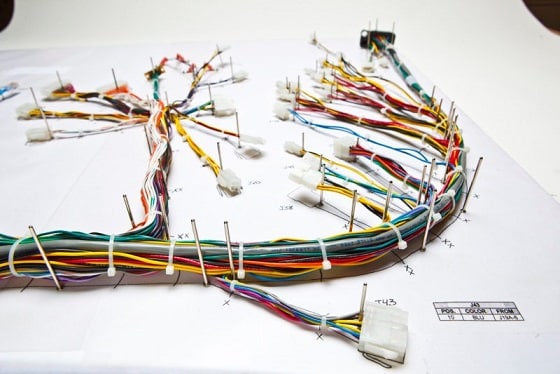
Quality and Testing Methods
Off-the-shelf harnesses from a reputable supplier generally adhere to broad industry standards like UL or ISO, but their testing is typically based on AQL (Acceptable Quality Level) sampling, where perhaps only 2 out of every 100 units are pulled from a batch for a basic continuity and dielectric strength test. A custom harness, however, is built to a precise customer-supplied specification sheet and undergoes 100% testing of every electrical and physical parameter, a process that can involve over 50 unique validation steps per unit to ensure zero defects in its intended application.
| Aspect | Off-the-Shelf Harness | Custom Harness |
|---|---|---|
| Test Coverage | AQL Sampling (1-5% of batch) | 100% Full Testing (Every unit) |
| Primary Test | Continuity, Basic Hi-Pot (500V for 1 second) | Hi-Pot (e.g., 1500V AC for 60 seconds), Insulation Resistance (>100 MΩ) |
| Validation Focus | General functionality | Application-specific performance under load |
| Data Output | Pass/Fail for the sampled batch | Full digital test report with metrics for every circuit on every unit |
Each circuit is subjected to a hi-pot (dielectric withstand) test at 1500V AC for a full 60 seconds, a significantly more rigorous standard than the 500V for 1 second common on generic harnesses. This ensures the insulation can handle transient voltage spikes far beyond the system's 48-volt nominal operating range.
Connector mating force is measured to ensure it falls between 25 N and 45 N – too low and it may vibrate loose, too high and it damages the seals. Custom harnesses destined for automotive or off-highway use are often subjected to vibration testing on shakers replicating 5+ years of service life in just a 48-hour cycle, simulating forces up to 5 Grms across a 10-2000 Hz frequency range. This proactive identification of potential chafing points or fatigue failures prevents field issues that could lead to warranty claims costing 30-$50 to the unit cost, virtually eliminates infant mortality failures and reduces the long-term probability of a field failure by over 90% compared to a minimally tested off-the-shelf alternative. The result is a harness with a predictable and extended service life, often exceeding 10,000 operating hours in harsh environments.
Application Suitability
Off-the-shelf harnesses work for low-volume, general-purpose applications where a ±15% length tolerance and IP54 environmental protection are acceptable, often keeping initial project costs under 5,000. Custom harnesses become necessary for high-volume production, extreme operating conditions exceeding 125°C, or when integration space is limited to a tolerance of less than 2mm, justifying the 8-12 week lead time and 3,000+ NRE investment.
- High-Volume Automotive Manufacturing (e.g., 100,000+ units/year): Custom harnesses are mandatory for integration into a vehicle's chassis with exact wire lengths and connector orientations, reducing assembly line installation time by over 25%.
- Heavy-Duty & Off-Highway Equipment (Tractors, Excavators): Demands harnesses that withstand constant vibration (5-10 Grms), extreme temperature swings (-40°C to 125°C), and exposure to pressurized water (IP67 rating), requiring custom materials and sealing.
- Aerospace & Avionics Systems: Requires ultra-lightweight wiring (e.g., ~20% weight savings with Teflon jackets), shielding for 90% of EMI emissions, and compliance with stringent DO-160 or MIL-STD-202 testing standards, which is impossible with off-the-shelf parts.
- Consumer Electronics & Appliances: For high-volume goods like washing machines, custom harnesses are optimized for minimal interior space and automated robotic installation, shaving ~$3.50 per unit in assembly costs.
- Low-Volume Prototyping & R&D: For building 5-10 prototype units, modifying a 75 off-the-shelf harness is far more cost-effective than investing 8,000 in a custom design, even if it means bundling excess cable.
For a startup building 50 drones, sourcing a generic 12-circuit power distribution harness for 120 each is the only financially viable path, accepting a 150-gram weight penalty from coiled excess wire. Conversely, a manufacturer producing 20,000 commercial lawn mowers annually would invest in a custom solution. This harness would use environmentally sealed connectors to prevent failures from 95 in labor per unit. Over the product's 7-year lifecycle, this saves over 2.1 million in indirect assembly costs alone, far outweighing the initial 25,000 NRE. For applications operating under high electrical loads, such as a 400-amp battery system, a custom harness ensures each 35 mm² cable is precisely sized for a <2.5% voltage drop, a critical performance metric no off-the-shelf option can guarantee.
Maintenance and Repair Options
An off-the-shelf harness failure on a Friday afternoon can often be resolved by Monday with a 150 replacement part shipped via 2-day air, resulting in 48-72 hours of downtime. A fault in a custom, integrated harness, however, can halt an entire production line for 2-3 weeks while a new unit is manufactured from original schematics, potentially costing over 50,000 in lost productivity.
- Field Repair Feasibility: Off-the-shelf harnesses use standard 16-14 AWG wires and common Metri-Pack 150 series connectors that a technician can splice and repair in under 60 minutes with $25 worth of parts from a local supplier. Custom harnesses often employ proprietary connectors, specialized shielded cables, and complex braiding that require a factory-authorized repair kit and 4+ hours of skilled labor.
- Spare Parts Inventory & Cost: Keeping a spare generic harness costs 100-500 in inventory carrying costs. Stocking a spare custom harness for a 250,000 combine harvester represents a 4,000 capital commitment that sits idle 99% of the time, but prevents a $3,000-per-day loss during harvest season if the machine is down.
- Diagnostic Complexity: Pinpointing a fault in a standard 12-circuit harness is straightforward with a multimeter. Diagnosing an intermittent short in a custom 85-circuit harness with multiple CAN bus networks requires specialized diagnostic software and 2-3 hours of tracing, increasing the mean time to repair (MTTR).
The total cost of ownership over a 10-year lifespan must include repair scenarios. A custom harness might have a 30% lower failure rate, but its mean time to repair (MTTR) of 120 hours is 10x longer than the 12-hour MTTR for an off-the-shelf unit.
For a critical asset like a telecom tower power distribution unit, the owner might keep 2 complete spare harnesses on-site, a 3,000 investment that ensures repairs take 4 hours instead of 4 weeks. The economic calculation is based on the cost of downtime: if a tower being offline costs 850 per hour in lost service revenue, the spare parts pay for themselves after just 3.5 hours of prevented downtime. For a non-critical application, like a prototype R&D test bench, the risk of a 7-day downtime is acceptable compared to the capital outlay for a spare. Furthermore, the repairability of a standard harness extends its life through 3-4 major repair cycles, while a custom harness is often replaced as a complete assembly after a single major fault, adding $2,000+ to the lifecycle cost. Manufacturers may provide a repair conduit, a protected channel within the loom for adding 2-3 replacement wires in the field, a feature that adds ~5% to the initial cost but can reduce MTTR by 65% for specific fault types.
Choosing between custom vs. off-the-shelf wiring harnesses involves trade-offs: Off-the-shelf options cost 30-50% less (150 typical) with 1-2 week lead times, using standard interfaces for general applications (IP54-rated). Custom harnesses, though 20-30% pricier (300+) with 4-6 week production, feature tailored designs (via 3D modeling/prototyping) and stricter testing (IP67, 10-20hr vibration), ideal for harsh environments (e.g., automotive engines). Maintenance favors off-the-shelf for easy replacements; custom requires OEM support.
