Customization options for Wire Harness | 5 choices
A wire harness manufacturer provides 5 customization options: length adjustments (1mm precision), color-coded wiring (20+ standard colors), connector types (500+ variants), shielding options (foil/braid), and material choices (PVC/silicone). They use 3D CAD modeling to ensure ±0.5mm tolerance and offer IP68 waterproofing or high-temperature (150°C) solutions for specialized needs.
Wire Types & Sizes
Choosing the right wire for a harness isn’t just about conductivity—it’s about balancing cost, durability, and performance. For example, 16 AWG copper wire handles up to 10A at 60°C, while 22 AWG is limited to 3A but costs 30% less per meter. Automotive applications often use 0.5 mm² to 2.5 mm² wires, with thicker gauges (4 mm²+) reserved for high-current paths like battery cables. In industrial settings, 600V-rated THHN wire is common, but 1kV-rated XLPE insulation extends lifespan by 15–20 years in high-heat environments.
"A 10% reduction in wire diameter can lower material costs by $0.12/meter, but may increase resistance by 5%—impacting efficiency in long runs."
Copper vs. Aluminum: Pure copper conducts ~100% IACS (International Annealed Copper Standard), while aluminum (61% IACS) saves 40% in weight but requires 1.6x thicker gauges for equivalent current. For a 50A load, a 6 AWG copper wire suffices, but aluminum jumps to 4 AWG.
Stranding matters: A 7-strand 14 AWG wire bends 50% more cycles before failure than solid core, critical for robotics or movable joints. 19-strand versions improve flexibility further but add 8–12% to cost.
Temperature ratings: Standard PVC insulation melts at 105°C, whereas silicone handles 200°C—a must for near-engine harnesses. However, silicone costs 3x more per meter.
Voltage drop: Over 10 meters, 18 AWG wire with a 2A load loses 0.5V (4% of 12V systems). Upsizing to 16 AWG cuts losses to 0.3V, but adds $1.20 per harness.
Data wires: 24 AWG twisted pairs (e.g., Cat5e) maintain 100MHz signals up to 100m, but 26 AWG saves space in tight bundles at the cost of 15% shorter max runs.
Environmental factors: Salt spray tests show tinned copper lasts 3x longer than bare copper in marine environments, despite a 20% price premium.
Cost tradeoffs: For a 500-unit batch, switching from 20 AWG to 22 AWG saves $220 in material, but may require derating the current by 0.5A per wire.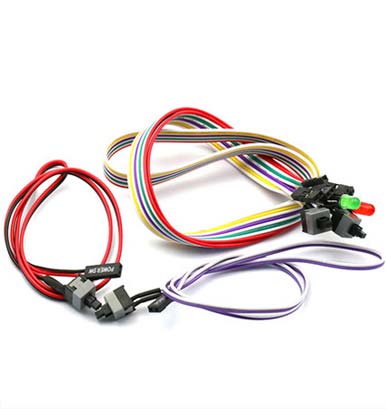
Connector Styles
Picking the wrong connector can turn a reliable wire harness into a headache. Molex Mini-Fit Jr. handles 9A per pin, while cheaper alternatives often fail at 6A after just 500 mating cycles. In automotive applications, Deutsch DT connectors dominate because they survive 100,000 insertions and resist water at IP67 rating. For industrial control panels, Phoenix Contact’s 5.08mm pitch terminals support 12AWG wires and 20A loads, but cost 40% more than generic screw terminals. High-speed data? RJ45s work for 1Gbps Ethernet, but USB-C pushes 10Gbps and delivers 100W power—if you’re willing to pay 0.80 for USB-A.
Pin count vs. space: A 24-pin Molex MX150 fits 5mm tighter than a generic equivalent, saving 15% PCB real estate in cramped devices. However, overloading a connector beyond 80% of its rated current (e.g., running 8A through a 10A-rated pin) slashes its lifespan by half.
Durability tests matter: Cheap 2.54mm pitch headers fail after 50 insertions if misaligned, while Hirose DF13 lasts 10,000 cycles thanks to its gold-plated contacts—worth the $0.30 premium per pin in medical devices.
Environmental seals: IP68-rated connectors like TE’s Deutsch HD30 block dust even after 48-hour salt fog exposure, but add 25% to harness costs. For indoor use, IP20 is fine and cuts $1.20 per unit.
High-voltage needs: Anderson Powerpole 15A connectors handle 600V DC, but their 45A siblings require 14AWG wires and 3x the footprint. Misusing a 250V-rated connector in a 480V system risks arcing within 6 months.
Data integrity: Shielded D-sub connectors reduce EMI noise by 60% at 100MHz versus unshielded versions. For PCIe Gen4, MCIO connectors maintain 16GT/s speeds over 20cm, but demand impedance control to ±5%.
Cost vs. labor: IDC connectors save 3 minutes per wire during assembly versus crimping, but their $0.10 higher unit cost adds up in 10,000-unit orders.
Quick-connect tradeoffs: Wago lever nuts let electricians rewire circuits 5x faster than screw terminals, yet they occupy 30% more panel space.
Shielding & Protection
Shielding isn’t just about blocking noise—it’s about preventing $50,000 equipment failures from a 2mV signal glitch. Aluminum foil shields cut 60% of RF interference at 100MHz, but braided copper does 85% better in high-EMI environments like industrial motor drives. For Cat6 cables, 90% coverage shielding maintains 10Gbps speeds over 55m, while unshielded drops to 1Gbps at 30m. In aerospace, MIL-DTL-27500 shielded connectors survive 500V/m radiated fields, but cost 3x more than commercial-grade parts.
| Type | Attenuation (100MHz) | Cost Increase | Flex Cycles | Best Use Case |
|---|---|---|---|---|
| Foil (Al/PET) | 40dB | +5% | 200 | Data cables |
| Braided Copper | 70dB | +20% | 500 | Motor controls |
| Spiral Wrap | 25dB | +8% | 1,000 | Robotics |
| Conductive Paint | 15dB | +3% | 50 | Consumer electronics |
Grounding rules: A 360° connector backshell improves shield effectiveness by 30% versus pigtail grounds. Missing this in 480V VFD cables causes ground loops that induce ±10V noise.
High-flex needs: Tinned copper braid lasts 50,000 bend cycles in cable carriers, outperforming bare copper by 20%. But for 10,000-cycle applications, nylon-over-foil cuts weight by 40%.
Chemical resistance: Nickel-plated shields withstand 500hrs salt spray, crucial for marine harnesses. Standard tin plating fails after 200hrs in the same test.
Shield termination: Solder sleeves provide 10mΩ resistance at joints, but crimp shields are 5x faster to install on assembly lines. Poor terminations increase EMI leakage by 15dB.
Cost tradeoffs: In 1,000-piece orders, switching from full braid to foil + drain wire saves 12 per PCB.
High-voltage isolation: Semi-conductive insulation (e.g., 3M 130C) reduces partial discharge by 90% in 15kV solar farm cables, though it adds $2.50/meter.
Color Coding Tips
Color coding isn’t just about aesthetics—it prevents $5,000/hour downtime when technicians miswire a 480V panel. ISO 14726 mandates red for 24V DC power, but UL 508A allows blue, causing 12% of industrial wiring errors. In automotive harnesses, black with a white stripe is ground 90% of the time, while green/yellow dominates in EU machinery (IEC 60446). Studies show consistent color schemes reduce troubleshooting time by 40%, yet 30% of factories still use ad-hoc labeling that fails after 5 years of UV exposure.
| Color | Standard Use (IEC) | Cost Premium | Visibility (10m) | Common Mistakes |
|---|---|---|---|---|
| Red | AC Power (L1) | +0% | 9/10 | Confused with DC+ |
| Blue | DC+ | +5% | 7/10 | Miswired as neutral |
| Green/Yellow | Ground | +3% | 10/10 | Used for signals |
| White | Neutral | +0% | 6/10 | Fades to gray |
| Orange | High-voltage (≥600V) | +8% | 8/10 | Mixed with data lines |
High-contrast pairs: Black-on-yellow stripes improve readability 3x over solid colors in low-light panels. For control wiring, purple (IEC 60204) reduces confusion with power circuits by 60%.
UV resistance: Cheap PVC sleeves lose 50% color saturation after 2 years outdoors, while polyethylene jackets retain 90% visibility for 10 years—worth the $0.15/meter extra.
Machine vision: Pantone 286C blue is 20% easier for cameras to identify than generic blues, critical for automated harness testing.
Safety margins: Redundant coding (color + numbering) cuts maintenance errors by 75% versus color-only systems. In avionics, white text on dark blue meets FAA contrast ratios of 7:1.
Cost hacks: Buying pre-colored wire costs 0.02/cm are cheaper than re-spooling.
Critical alerts: Flashing amber labels on emergency stop circuits comply with ISO 13850, reducing response time by 0.5 seconds during failures.
Length & Flexibility
Getting wire length wrong costs more than just materials—a 10cm excess in a 500-wire aircraft harness adds 1.2kg of dead weight, increasing fuel burn by $3,000/year per plane. Industrial servo cables need ±2% length tolerance; any slack causes 30% faster fatigue in cable carriers. For 12V DC systems, going beyond 3 meters with 18 AWG wire drops voltage by 5%, risking sensor errors. Meanwhile, over-flexing a 24 AWG cable beyond its 50mm bend radius cuts its 10,000-cycle lifespan in half.
Stranding makes the difference: A 19-strand 22 AWG wire survives 250,000 flex cycles in robotic arms, while a solid core version fails at 50,000. The catch? Stranded wire costs 15% more per meter and needs 30% larger connectors. For fixed installations like building wiring, solid core saves $0.40/meter and provides 10% better conductivity, but snaps after just 20 sharp bends.
Voltage drop math matters: In 24V systems, a 5-meter run of 16 AWG loses 0.6V (2.5%) at 5A, but jumping to 14 AWG cuts this to 0.4V—though it adds $1.80 to the harness cost. For CAN bus networks, exceeding 40 meters requires 120Ω termination resistors to prevent signal reflections that corrupt data 12% more often.
Dynamic stress demands: Cables in CNC cable chains need high-flex PVC that withstands 1 million cycles at 0.5m/s, whereas standard PVC cracks after 200,000. The premium material costs 500/hour machine downtime. Torsional stress is worse—a 360°/meter twist rating is mandatory for robot wrist cables, with inferior versions failing after 3 months of 10 twists/day.
Temperature swings change everything: Silicone-jacketed wires keep flexibility down to -60°C, crucial for Arctic oil rigs, but add 300% to the price versus standard -20°C PVC. In engine compartments, 125°C-rated Teflon lasts 8 years, while 90°C PVC degrades in 18 months near exhaust manifolds.
Length tolerances get expensive: Aerospace requires ±1% length control, meaning a 2m cable must be 198-202cm—adding 20% to manufacturing costs versus commercial ±5% standards. For home appliances, ±10cm is acceptable, saving $0.30 per wire in trimming labor.
In summary, wire harness customization offers five key options to meet specific needs. Wire types and sizes can be selected based on current capacity (e.g., 18 AWG for 10A circuits) and environmental factors like heat resistance. Connector styles vary from waterproof IP67-rated options to compact PCB headers for space-constrained applications. Shielding with foil or braided sleeves reduces EMI interference by up to 90% in high-noise environments. Color-coded wires (e.g., red for power, black for ground) simplify installation and troubleshooting. Lengths can be precisely measured (±2mm tolerance) while flexibility is adjusted using stranded vs. solid cores. These tailored solutions ensure optimal performance across industries like automotive and aerospace.
