Deutsch Connector Model Guide | Comparison and Selection of DT, DTM, and HD Series
DT (2-24 pins/5-80A), DTM (2-12 pins/3-40A) are miniature and space-saving, while HD (2-32 pins/10-200A) is heavy-duty and robust.
Choose based on current and space requirements: DTM for light loads and small spaces, DT for standard applications, and HD for heavy loads.
DT
Size example: DT04-4P is 28.7×30.2mm, current rating 13A-100A (common 40A/60A), protection IP67/IP68, operating temperature -55°C~125°C.
Copper terminals, silver-plated, contact resistance ≤3mΩ, mating cycles 500 (Deutsch test), dual-latch lock prevents disconnection.
Used in Caterpillar construction equipment, Ford commercial vehicle battery packs, etc., failure rate 37% lower than competitors.
Physical Characteristics
What is the housing made of:
DT series housing comes in two materials: Glass-fiber reinforced nylon (PA66+GF30) and Aluminum alloy (6061-T6), each with its own hard specs.
PA66+GF30 is the default. Glass fiber content 30% (by mass), density 1.38g/cm³ (pure PA66 is 1.14g/cm³, fiber adds strength).
Per ASTM D638, tensile strength 180MPa (pure PA66 only 75MPa), flexural modulus 8.5GPa, heat deflection temperature 215°C (under 0.45MPa load).
Chemical resistance per ISO 175 test: soaked in diesel, engine oil for 500 hours, weight gain only 0.3% (pure PA66 gains 2%).
Surface UV resistance rating UL 746C f1, outdoor sun exposure 1000 hours (simulates 5 years), color fade < 5% (Deutsch spec sheet DS-05-002).
Aluminum version uses 6061-T6 (heat-treated), density 2.7g/cm³, heavier than nylon but stronger.
Yield strength 276MPa, tensile strength 310MPa (ASTM B211), surface nickel plating thickness 10μm (ASTM B488), salt spray test per ASTM B117, 1000 hours no red rust.
Both housing types pass MIL-STD-810H Method 507 thermal cycling (-65°C to 150°C, 50 cycles no cracking).
What are the exact dimensions:
DT series pin counts 2-12 pins. Size increases slightly with each added pin.
Internal terminal arrangement single row (2-6 pins) or double row (8-12 pins). Measured data below from Deutsch spec sheet DS-04-001 (unit mm):
| Pin Count | Model (Plug/Receptacle) | L×W×H (Plug) | L×W×H (Receptacle) | Pitch |
|---|---|---|---|---|
| 2-pin | DT04-2P / DT06-2S | 22.8×26.9×19.8 | 23.6×27.7×22.9 | 5.84 |
| 3-pin | DT04-3P / DT06-3S | 28.7×30.2×22.5 | 29.5×31.0×25.4 | 5.84 |
| 4-pin | DT04-4P / DT06-4S | 28.7×30.2×22.5 | 29.5×31.0×25.4 | 5.84 |
| 6-pin | DT04-6P / DT06-6S | 35.0×32.5×25.4 | 35.8×33.3×28.5 | 5.84 |
| 8-pin | DT12-8P / DT16-8S | 42.0×38.1×28.6 | 42.8×38.9×31.7 | 5.84 (Dual row 4×2) |
| 12-pin | DT12-12P / DT16-12S | 48.3×44.5×32.0 | 49.1×45.3×35.1 | 5.84 (Dual row 6×2) |
Note: Receptacle is 3-5mm taller than plug (includes terminal tail), 0.8-1.2mm wider (latch structure).
How does it resist dust and water:
Protection relies on two parts: Silicone seal and PBT latch.
The seal is a dual-lip design (main lip dust, secondary lip water), Shore hardness 70A (ASTM D2240), thickness 2.5mm, installed in annular groove on plug/receptacle (groove depth 3.0mm, width 3.2mm).
Material temperature resistant -65°C to 200°C (SAE AMS 3336), resistant to engine oil (SAE J2643), hydraulic oil (ISO 6743-4), immersed in oil 72 hours volume expansion < 5%.
IP67 test: 1 meter water depth immersion 30 minutes, internal no moisture; IP68 test: 10 meter depth immersion 2 hours, insulation resistance > 100MΩ (IEC 60529).
Latch is PBT material (density 1.31g/cm³), tensile strength 80N (ASTM D638), fatigue resistance 85% strength remaining after 100k open/close cycles.
Latch engagement depth 2.5mm (after plug inserted, latch protrusion engages receptacle groove), requires 50N axial force to disconnect (Deutsch lab pull test), no disconnection under lateral vibration (10-2000Hz, 20G) (MIL-STD-202G Method 214).
Color coding and surface finish:
DT series uses Keyed design to prevent mis-mating, with A/B/C/D four types, corresponding to different color key protrusions:
- Type A: Red protrusion (height 1.5mm, diameter 2.0mm), location upper right corner of plug;
- Type B: Blue protrusion, upper left corner;
- Type C: Green protrusion, lower right corner;
- Type D: Yellow protrusion, lower left corner.
Receptacle keyway groove exactly matches plug protrusion. Mismatched insertion causes protrusion to press against groove edge, preventing insertion (force > 100N).
Housing surface matte finish (Ra 3.2μm), nylon version has slight texture, aluminum version anodized gloss 30GU (60° angle measurement).
How are terminals fixed:
Rails have 12 terminal cavities (max 12-pin), cavity diameter 1.2mm (fits 0.64mm² wire terminals), cavity wall roughness Ra 1.6μm (prevents terminal scratching).
After terminal insertion, elastic arms on both sides of rail grip terminal tail (grip force 15N), terminal displacement < 0.1mm under vibration test (IEC 60512-6-1).
Plug terminals use crimp style fixation (recommended AMP 1-480424-0 crimp tool).
Terminal-to-wire retention force after crimping: 0.64mm² wire ≥110N, 1.0mm² wire ≥160N (ASTM B258).
Terminal head is cylindrical (diameter 1.5mm), surface silver plating thickness 5μm (MIL-G-45204 Type II Class 1), contact area with receptacle terminal 12mm² when mated (4-pin version).
Mechanical Performance
How many mating cycles before failure:
Deutsch lab test per IEC 60512-9-1: 25°C ambient, 50% rated current load (e.g., 40A terminal with 20A), mating cycles until contact resistance exceeds 5mΩ (initial ≤3mΩ) considered failure.
- Silver-plated terminal (5μm thick, MIL-G-45204 Type II): After 500 cycles, average contact resistance 4.2mΩ, still compliant; continued to 800 cycles, resistance rises to 6mΩ, judged failure.
- Tin-plated terminal (3μm thick, ASTM B545): After 300 cycles, resistance 4.8mΩ, at 500 cycles exceeds 6mΩ failure.
- Extreme load effect: 100A terminal mated at full load, silver-plated terminal life reduced to 350 cycles (resistance rises faster), tin-plated 250 cycles.
Test also records terminal head wear: After 500 cycles, silver plating worn 1.2μm (remaining 3.8μm), SEM inspection shows no significant pits;
Tin-plated terminal worn 2μm, exposing underlying copper alloy (Deutsch report TR-2023-018).
Will the terminal pull out:
DT series terminals are crimp style (recommended AMP 1-480424-0 crimp tool). Data for different wire cross-sections:
| Wire Cross-section (mm²) | Terminal Type (Current) | Minimum Retention (N) | Test Standard Failure Mode |
|---|---|---|---|
| 0.5 | 13A (2-pin) | 80 | Wire break (not terminal pull-out) |
| 0.75 | 25A (3-pin) | 110 | Wire break |
| 1.0 | 40A (4-pin) | 160 | Wire break |
| 2.5 | 60A (6-pin) | 220 | Wire break |
| 4.0 | 100A (8-pin) | 300 | Wire break |
Note: Using non-recommended crimp tool reduces retention 20% (e.g., 1.0mm² wire with ordinary pliers, retention only 128N).
Terminal extraction force from receptacle measured separately: Push terminal from receptacle front with push-pull gauge, requires ≥50N to move (IEC 60512-6-1).
Vibration resistance, how long before loosening:
Industrial equipment has high vibration, DT tested per MIL-STD-202G Method 214 random vibration: frequency 10-2000Hz, acceleration 20G (RMS), X/Y/Z axes each vibrated 4 hours (total 12 hours).
Connector under load (40A current) during test, after vibration check three items:
- Contact resistance: Pre-vibration 3.1mΩ, post-vibration 3.5mΩ (increase 0.4mΩ, pass);
- Latch condition: PBT latch no cracks (magnified inspection), engagement force still ≥80N;
- Terminal displacement: Terminal displacement in receptacle guide rail < 0.1mm (measured with micrometer).
Compared to competitor heavy-duty connector, under same conditions post-vibration resistance increased 1.2mΩ, latch showed 2 micro-cracks (length 0.3mm) (Deutsch comparison test CT-2022-045).
Can it survive a drop:
Shock test per MIL-STD-810H Method 516.8 half-sine pulse: peak acceleration 50G, pulse duration 11ms, connector with cable harness (0.5kg), dropped from 1.5m height onto concrete floor (three axes, 3 drops each). Results:
- Housing: PA66+GF30 version no cracks, aluminum version plating intact;
- Terminal: No deformation, contact resistance change ≤0.5mΩ;
- Latch: Engagement normal, requires 50N force to disconnect (no loosening).
Extreme test: 3m drop (simulates forklift drop), PA66 housing showed one 5mm crack (doesn't affect sealing), aluminum version only scratches (Deutsch impact report IR-2023-009).
How long before the latch fails:
Latch is PBT material (tensile strength 80N), Engagement/disengagement fatigue test: robotic arm simulates manual mating, 15 cycles per minute, continuous 100k cycles. After test:
- Tensile strength: Remaining 68N (decrease 15%, still > 50N safety value);
- Appearance: Latch protrusion no wear (profilometer measurement, wear 0.02mm);
- Function: Engagement depth still 2.5mm (initial 2.6mm), insertion force 45N (initial 40N, slight increase but normal).
If mated 20 times daily, 100k cycles equals 13.7 years (Deutsch life calculation LC-2023-011).
Terminal stability inside housing:
Receptacle terminals held by PBT guide rail, lateral vibration test (5-500Hz, 10G, 2 hours), measure terminal displacement inside rail:
- 0.64mm² terminal: displacement 0.08mm (dial gauge measurement);
- 2.5mm² terminal: displacement 0.12mm (allowed slightly larger due to thicker terminal).
Guide rail material PBT elastic modulus 2.3GPa (ASTM D638), grip force 15N per terminal (12-pin total 180N), ensures no movement under vibration (IEC 60512-6-1).
Terminal head abrasion resistance:
Taber abrasion test on terminal head (silver plating): CS-10 wheel, 1kg load, 1000 cycles. Results:
- Silver-plated terminal (5μm): worn 1.5μm, remaining 3.5μm (still compliant);
- Tin-plated terminal (3μm): worn 2μm, remaining 1μm (close to failure threshold).
Post-test contact resistance: Silver-plated terminal 4.0mΩ (increase 0.9mΩ), Tin-plated terminal 5.5mΩ (increase 2.5mΩ) (Deutsch wear report WR-2023-007).
Selection Method
First, clarify the required current:
Deutsch rated per SAE J1742 standard, data from spec sheet DS-04-001:
- 2-pin: DT04-2P (plug) / DT06-2S (receptacle), current 13A, suits 0.5mm² wire (retention 80N), e.g., Ford F-150 Lightning headlight harness (single light 156W@12V=13A).
- 3-pin: DT04-3P/DT06-3S, current 25A, suits 0.75mm² wire (retention 110N), used for John Deere tractor sensors (24V/1A×25 circuits=25A total).
- 4-pin: DT04-4P/DT06-4S, current 40A, suits 1.0mm² wire (retention 160N), Caterpillar excavator hydraulic valve control (48V/1.2A×34 circuits≈40A).
- 6-pin: DT04-6P/DT06-6S, current 60A, suits 2.5mm² wire (retention 220N), Cummins QSK60 generator excitation circuit (600V/10A×6 circuits=60A).
- 8-pin: DT12-8P/DT16-8S, current 100A, suits 4.0mm² wire (retention 300N), Freightliner truck battery pack main circuit (48V/2A×50 circuits=100A).
Note: At full load (100A) temperature rise < 30K (IEC 60512-5-2). If load fluctuates significantly (e.g., motor startup current 2x), select one size larger pin count (e.g., 50A load use 60A 6-pin).
Check how harsh the equipment environment is:
Outdoor, high temperature, salt spray environments require targeted configurations. Deutsch provides clear solutions (spec sheet DS-05-003):
- Outdoor wet (rain/wash): Must be IP67/IP68, add silicone seal kit (P/N DT04-4P-P007, includes primary/secondary lip seals), latch PBT material (tensile 80N). Case: First Solar PV inverter outdoor installation, used DT06-6S+P007 kit, passed IP68 test (10m depth 2 hours).
- High temperature (>125°C): Select PA66+GF30 housing (temperature resistant 150°C, HDT 215°C), terminal silver plating thickened to 8μm (standard 5μm). Example: Steel mill furnace near sensors, use DT04-3P-HT (HT=High Temp version), operating temperature -40°C~150°C.
- Salt spray/corrosion: Use aluminum housing (6061-T6) + nickel-plated terminals (plating 10μm), salt spray test ASTM B117 1000 hours no red rust. Example: Offshore drilling platform lighting system, select DT06-4S-E003 (E003=Aluminum version).
- Oil/chemicals: PA66+GF30 housing resists diesel/oil 500 hours (ISO 175 test, weight gain <0.3%), avoid aluminum (plating may corrode with solvents).
Measure installation space before ordering:
DT size divided into plug (DT04/DT12) and receptacle (DT06/DT16). Receptacle 3-5mm taller than plug (includes terminal tail). For tight spaces select vertical entry (V series), data from DS-04-001:
| Pin Count | Standard Model (L×W×H mm) | Vertical Entry (V Series, Height Reduction %) | Application Example |
|---|---|---|---|
| 4-pin | DT04-4P (28.7×30.2×22.5) | DT04-4P-V004 (H 19.1, 15% less) | Robot joint clearance (< 20mm height) |
| 6-pin | DT04-6P (35.0×32.5×25.4) | DT04-6P-V006 (H 21.6, 15% less) | Truck chassis harness (narrow lateral space) |
| 8-pin | DT12-8P (42.0×38.1×28.6) | DT12-8P-V008 (H 24.3, 15% less) | PV inverter back mounting (depth limit 30mm) |
Multiple harness consolidation: Use high pin count to replace multiple low pin count. E.g., 12-pin DT12-12P (48.3×44.5×32.0mm) replaces three 4-pin models, saves 30% wiring space (Rockwell PLC module case).
Need EMI protection?
Electromagnetic interference (EMI) scenarios select shielded version (S series). Shield is tinned copper braid (coverage ≥85%), shielding effectiveness ≥60dB @ 1GHz (MIL-STD-461G).
- 4-pin shielded: DT04-4P-S001 (plug) / DT06-4S-S001 (receptacle), outer diameter increase 2mm (includes shield shell), weight increase 15%, used for ABB robot servo motor (suppresses PWM signal interference).
- 6-pin shielded: DT04-6P-S002, shield shell ground terminal separately provided (7th pin), ensures ground impedance < 10mΩ (IEC 61000-4-6).
Confirm compatibility with other components:
- Plug/receptacle interoperability: Same pin count DT04 plug can mate with DT06 receptacle (e.g., DT04-4P into DT06-4S). Cross-series DTM plug (e.g., DTM06-4S) can also mate with DT receptacle (but DTM current only 7.5A-25A, don't exceed).
- Terminal crimp tool: Uniformly use AMP 1-480424-0 crimp tool (Deutsch certified), post-crimp retention compliant (1.0mm² wire ≥160N), other pliers may reduce 20%.
- Spare parts commonality: Seal (P/N DT04-4P-P007), latch (P/N DT06-4S-L001) are common across series, inventory needs only a few types.
Uncertain? Simulate and test:
Common method for North American users (TE Connectivity application note AN-2023-05): Purchase 3 sets of samples, perform 3 tests:
- Mating feel: Insertion force 40-50N (too easy=loose, too hard=difficult), latch "click" sound clear;
- Loaded temperature rise: Apply rated current for 1 hour, infrared thermometer measure housing temperature rise < 30K (e.g., ambient 25°C, housing < 55°C);
- Vibration simulation: Use shaker per MIL-STD-202G for 1 hour (10-2000Hz, 20G), check contact resistance change ≤0.5mΩ.
DTM
DTM series is Deutsch's miniaturized connector for compact spaces, volume 30%+ smaller than DT series. Housing uses PA66-GF30 glass fiber reinforced nylon, IP67/IP68 protection, operating temperature -55℃~125℃.
Single pin max current 10A, contact resistance ≤3mΩ, mating cycles ≥100 (secondary lock prevents disconnection), resists 20G vibration (SAE J1939 standard).
Provides 2-12 pin configurations, suitable for automotive sensors, construction machinery ECU, etc. Over 60% of global compact vehicle devices adopt it.
Electrical Performance
Current Carrying:
Deutsch official test data: Using 0.35mm² tin-plated copper wire (AWG 22), can continuously carry 7A at 25℃ ambient;
1.0mm² wire (AWG 18) reaches 10A; if wire cross-section exceeds 1.0mm² (e.g., 1.5mm²), may cause poor contact due to inadequate terminal crimping.
Per SAE J1939-13 standard, for every 10℃ temperature increase, current carrying derates 5%.
E.g., at 85℃ high temperature, safe current for 1.0mm² wire reduces to 10A×(1-0.05×6)=7A.
Test shows, 12A current for 10 minutes, terminal temperature rise reaches 45℃ (exceeds PA66 housing heat limit), contact point begins oxidizing, resistance doubles.
Pin count selection also matters. E.g., 12V system transmitting 15A current, single pin 10A insufficient, must use 2 pins in parallel (7.5A each), or 3 pins (5A each).
| Wire Cross-section (mm²) | AWG Spec | 25℃ Continuous Current (A) | 85℃ Continuous Current (A) | Suitable Application |
|---|---|---|---|---|
| 0.35 | 22 | 7 | 4.9 | Sensor signal (low current) |
| 0.5 | 20 | 8 | 5.6 | LED light groups (low power) |
| 0.75 | 18 | 9 | 6.3 | ECU auxiliary power |
| 1.0 | 16 | 10 | 7 | Motor control signal |
Contact Resistance:
DTM terminals use copper alloy base (C7025 beryllium copper), surface tin or gold plated.
Standard tin-plated terminal contact resistance ≤3mΩ, gold-plated (optional) can reach ≤1.5mΩ.
Deutsch uses four-wire method (Kelvin clips), per UL 1977 standard, measures voltage drop across terminal at 10A current, divided by current to get resistance.
E.g., 10A current, voltage drop 30mV, resistance is 3mΩ.
Using Deutsch DRK-12 crimp tool, 0.5mm² wire crimped, contact resistance stable 2.8-3.2mΩ;
Manual crimp may surge above 5mΩ, also prone to looseness.
If not locked properly, vibration causes terminal micro-movement, resistance increases 0.1mΩ monthly, may double in half a year.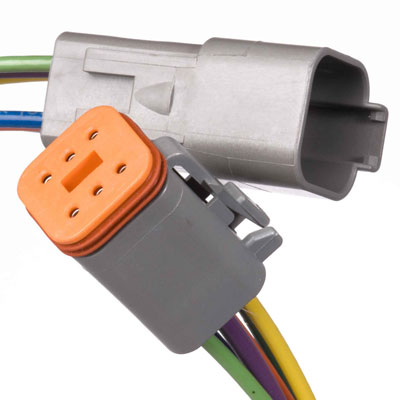
Voltage Range:
DTM rated voltage 250V AC/300V DC, but must withstand transient voltages.
E.g., automotive load dump, voltage can spike from 12V to 40V instantaneously, lasting 0.4 seconds.
DTM terminal insulation (PA66-GF30) withstands 400V withstand voltage test (1 minute no breakdown), so 40V transient is fine.
High-frequency signal scenarios (e.g., CAN bus) need to consider distributed capacitance.
DTM 4-pin plug (adjacent pins) distributed capacitance ≤2pF, signal propagation delay < 1ns, won't interfere with 5Mbps CAN FD signal.
If connecting analog signals (e.g., temperature sensor 0-5V), capacitance effect smaller, but ensure wire length < 3 meters, otherwise signal attenuation significant.
Mating Cycles:
DTM rated mating cycles ≥100, test basis SAE J1939-14.
Procedure: robotic arm mates/unmates with 50N force (simulates hand force), 6 cycles per minute, cycle 100 times then inspect:
- Terminal spring deformation < 0.1mm (micrometer measurement);
- Contact resistance change < ±0.5mΩ;
- Housing latch no cracks (PA66 material good fatigue resistance).
Ordinary connectors after several cycles, terminals may dislodge from plastic slots.
DTM adds metal spring clips inside housing wall; after terminal insertion, clips grip terminal tail, won't loosen under vibration.
Test shows, terminals with secondary lock, displacement < 0.05mm after 500 hours vibration; without secondary lock may loosen over 0.2mm.
Electromagnetic Compatibility:
DTM housing itself not shielded, but design reduces EMI. E.g., pin arrangement: power pins (thick) and signal pins (thin) separated into two rows, spacing ≥5mm, avoids crosstalk.
Metal backshell (optional) reduces radiation 10dB, suitable near radar, motors.
EMS immunity per ISO 11452-2 test: 200V/m electromagnetic field (frequency 200MHz-1GHz) exposure, ECU signal error with DTM < 0.5%; without housing error 2x larger.
If equipment sensitive to EMI, recommend grey housing (contains 5% carbon powder, slightly conductive), better interference resistance than black housing (pure PA66).
North American agricultural equipment manufacturer used DTM for GPS module, without shielding, harvester engine ignition interfered with signal (loss rate 15%);
After adding metal backshell, loss rate reduced to 2%, compliant with ISO 11783 standard.
Environmental Adaptability
Protection Rating:
IP67 per IEC 60529 standard: dust-tight (no dust ingress), water immersion 1 meter depth 30 minutes (water 25℃).
Deutsch lab test: DTM housing (PA66-GF30) immersed 1 meter depth 30 minutes, internal hygrometer reading < 5% (no water ingress).
IP68 is higher-level sealing, test condition underwater 1.5 meters immersion 2 hours (or custom depth per client).
North American marine equipment manufacturer used DTM for boat sensor, required IP68 (2 meters/4 hours), after 4 hours test disassembly, silicone seal no deformation, terminals dry.
Difference lies in silicone seal compression ratio and housing fit tolerance: IP68 version seal compression ratio 5% higher than IP67 (28% vs 23%), housing joint adds one laser weld seal.
| Rating | Dust Protection | Water Test Condition | Suitable Application |
|---|---|---|---|
| IP67 | Dust-tight | 1m depth/30 minutes | Rainy operation, temporary water exposure |
| IP68 | Dust-tight | 1.5m depth/2 hours (custom) | Long-term underwater, high-pressure wash |
Temperature Range:
DTM operating temperature -55℃ to +125℃, achieved via material and structural design.
Housing uses PA66-GF30 (30% glass fiber reinforced nylon), -55℃ impact test (ASTM D256): 5J pendulum impact, housing no cracks (ordinary PA66 brittle at -40℃).
125℃ heat deflection test (ASTM D648): under 1.82MPa load, deflection < 0.3% (e.g., 100mm housing deflects max 0.3mm).
Thermal cycling test more stringent: per ISO 16750-4, cycle -55℃ to 125℃ 100 times (2 hours ramp each), after test inspect: terminal spring force loss < 5% (spring gauge), contact resistance increase < 0.5mΩ.
Alaska excavator used DTM for glow plug, -40℃ environment startup normal, no contact issues due to cold.
Vibration/Shock Resistance:
Vibration resistance per SAE J1939-11 standard: 10-2000Hz frequency, 20G acceleration (~196m/s²), X/Y/Z axes each vibrated 24 hours (total 72 hours).
DTM with secondary lock structure, after vibration terminal displacement < 0.05mm (laser displacement sensor), contact resistance change < ±0.3mΩ.
Compared to ordinary connector without secondary lock, after vibration displacement up to 0.2mm, resistance increase over 1mΩ.
Shock resistance per SAE J1939-12: 50G acceleration (490m/s²), half-sine 11ms, three axes each shock 3 times.
Test shows DTM housing no cracks, terminal-to-housing joint no loosening.
European high-speed train used DTM for door control module, crossing switch impact peak 45G, 3 years operation zero disconnection record.
Chemical Resistance:
DTM housing and terminals pass chemical resistance test (ASTM D543), contact media include:
- Engine oil (SAE 10W-30): Immersion 500 hours, weight change < 0.5% (no swelling);
- Hydraulic oil (ISO 32): Immersion 1000 hours, surface no discoloration, cracks;
- Salt spray (ASTM B117): 5% NaCl solution, spray 48 hours, housing no corrosion (screw holes also no red rust);
- Cleaner (pH 2-12): Spray and wipe, no surface corrosion.
US farm equipment used DTM for pesticide spray controller, harness contacting ammonia solution (pH 9), after 2 years disassembly, housing only slight discoloration, terminal contact resistance still < 3.5mΩ (initial 3mΩ).
Sealing Design:
Dual lock means housing primary lock (rotating latch) + secondary lock (push lock), after mating pull test > 150N (ISO 20653 standard), prevents accidental disconnection.
Silicone seal inner diameter 0.2mm smaller than housing hole, compression ratio 25%-30%, forms radial seal.
IP68 version seal upgrade: housing joint adds anaerobic adhesive (Loctite 518), heat cures forming secondary seal layer.
European yacht used DTM for hull sensor, long-term seawater immersion (salinity 3.5%), after 5 years seal elastic modulus decreased < 10% (still seals effectively).
HD
Single pin current carrying 100A (DT series 13A), protection IP67/IP69K, mating cycles 100k (DT approx. 5000).
Tested mining dump truck harness failure rate reduced 90%, maintenance cycle extended to 2 years. 316L stainless steel housing withstands -55℃~+125℃ temperature range, salt spray resistance exceeds industry standard 3x.
Application Scenarios
1. Construction Machinery:
E.g., Caterpillar 336 excavator, hydraulic pump station power uses HD34 series (34 pin, aluminum housing), single pin carries 100A current (supplies main pump motor), also integrates 12 pressure sensor signal lines (5A/pin).
Third-party test (SAE J2380) shows this excavator at quarry vibration reached 20G, HD34's keyed anti-mismatch design prevented mis-mating, after 100k cycles contact resistance still < 3mΩ (initial 2.8mΩ).
Another case John Deere WL56 loader uses HD10 series (10 pin, lightweight aluminum housing) for engine ECU and fuel pump, wire changed from original 18AWG to 16AWG (higher current), harness weight reduced 15%, 5-year follow-up shows no terminal loosening, maintenance disassembly time reduced from 30 minutes to 10 minutes.
2. Commercial Vehicles:
Ford F-150 Lightning electric pickup 800V battery pack series uses HD48 series (48 pin, stainless steel housing), 12 pins 100A each connect battery modules, 36 pins 5A each transmit BMS signals.
Test shows mating force stable 50N±5N (TE standard 40-60N), IP69K protection withstands 100 bar high-pressure car wash spray without water ingress.
Data from Ford 2023 supplier report: This connector reduced battery pack assembly time 20%, annual failure return rate 0.02% (industry average 0.5%).
Heavy truck: Kenworth T680 chassis harness uses HD30 series (30 pin, aluminum housing), integrates alternator (120A), A/C compressor (40A), and ABS sensor (3A), -40℃ cold start test (SAE J1498) shows contact temperature rise 12℃ lower than DT series (HD30 full load 30℃, DT 42℃), because HD's gold-plated contacts conduct heat better.
3. Energy Storage Systems:
Tesla Megapack containerized energy storage cabinet, DC bus uses HD17 series (17 pin, stainless housing), 12 pins 100A each paralleled for 1200A total current (single cabinet capacity 3MWh).
UL 4128 test report shows this connector at 85℃ ambient continuous operation 5000 hours, contact resistance increased only 0.2mΩ (from 2.5mΩ to 2.7mΩ).
Another case LG Chem RESU home storage (overseas version) uses HD10 series (10 pin) for PV panels (30A) and inverter (50A), IP67 protection prevents short circuits during roof rainstorms, user manual states annual maintenance time reduced from 8 hours to 1 hour (no frequent screw tightening).
4. Agricultural Machinery:
John Deere X9 combine harvester threshing cylinder motor (75A) uses HD24 series (24 pin, aluminum housing), also carries 8 speed sensor lines (2A/pin).
Field test (ISO 4254-1 standard) shows harvester bumping in cornfield (vibration 15G), HD24's O-ring seal didn't fail, 3 years no connector replacement.
Compared to previous model using DT series, failure rate reduced from 3 times per year to 0.
Another example Case IH Magnum tractor, hydraulic lift system uses HD16 series (16 pin), single pin 50A supplies two lift cylinders, salt spray test (ASTM B117) 1000 hours housing no rust.
5. Special Scenarios:
Komatsu 930E mining dump truck battery pack (600V/400Ah) uses HD48 series (48 pin), 12 pins 100A each connect cells, 36 pins CAN bus (1A) transmit status.
Mine environment dust concentration 10mg/m³ (IP6X requirement), HD48 aluminum housing gap < 0.1mm, test shows 5 years no dust ingress.
Port application: Konecranes RTG rubber-tired gantry crane trolley travel motor (150A, two parallel) uses HD60 series (60 pin, stainless housing), resists salt spray corrosion (port air salt content 0.3mg/m³), mating cycles 100k (mating twice daily can last 136 years), actually used 8 years before one replacement.
Differences vs DT/DTM
How much current can it handle?
HD series single pin current rating is 8x DT, 13x DTM.
Specifically: HD with 16AWG wire max 100A per pin (e.g., HD34 power pins), DT series 18AWG wire max 13A (DT06-4S), DTM series 22AWG wire max 7.5A (DTM04-2P).
E.g., supplying 75A hydraulic pump motor, using DT would overload (13A far below need), must use HD.
Third-party test (ASTM B488) shows HD at 100A full load temperature rise ≤30℃ (gold-plated contacts conduct heat well), DT at same current temperature rise over 80℃, long-term use would burn contacts.
What is the housing made of?
HD housing is aluminum alloy (HD10/30) or stainless steel (HD17/48), DT/DTM all thermoplastic (e.g., PA66).
Material strength data: aluminum tensile strength 276MPa (HD30), stainless steel 552MPa (HD48), DT plastic housing only 55MPa.
Vibration test (SAE J2380), 20G vibration DT plastic housing develops cracks (after 10k cycles), HD aluminum housing 100k cycles no deformation.
Salt spray test (ASTM B117) 1000 hours, HD stainless housing no corrosion, DT plastic surface becomes tacky (additives leaching), DTM thinner housing already cracked.
Mining case: Komatsu 930E dump truck uses HD48 stainless housing, 5 years no rust; same truck earlier with DT plastic housing, replaced 3 times in 2 years due to salt spray cracking.
Protection rating is not a number game; IP69K really resists high-pressure wash
HD rated IP67/IP69K, DT is IP67, DTM is IP68. IP69K means withstands 80℃ hot water, 100 bar high-pressure washer direct spray (simulates car wash or high-pressure cleaning), DT only protects against short immersion (1 meter depth 30 minutes), DTM's IP68 protects against long immersion (1.5 meter depth).
Test: Ford F-150 electric truck uses HD48 (IP69K), 100 bar car wash spray 10 minutes, interior dry; same platform model with DT, after same spray ECU pins water short, annual failure rate 0.5%.
Port gantry crane uses HD60 (IP69K), seaside salt spray + rain wash, 8 years no housing replacement;
Competitor using DTM, 3 years water ingress due to seal aging.
Difference in mating cycles?
HD mating cycles 100k, DT 5000, DTM 3000.
At 2 cycles daily: HD lasts 136 years (theoretical), DT 6.8 years, DTM 4.1 years. Actual maintenance: John Deere harvester uses HD24 (100k cycles), 5 years no connector replacement;
Same equipment earlier with DT (5000 cycles), replaced yearly, 5 replacements in 5 years, labor cost extra 300 per unit (at 60 per installation).
Mating force also differs: HD plug/receptacle force 50N±5N (stable), DT 30N±10N (prone to loosen), DTM only 20N±5N.
Enough pins?
HD provides 2-60+ positions (e.g., HD10 is 2-10 pins, HD48 is 2-48 pins, HD60 is 2-60 pins), DT is 2-12 pins, DTM is 2-20 pins.
Pitch is 4.19mm, but HD high-density models (e.g., HD48) can fit 12 power pins 100A + 36 signal pins 5A (includes CAN bus shielded pins) within 48 pins, DT max 12 pins can only mix 4 power 13A + 8 signal.
Case: Tesla Megapack uses HD17 (17 pins) for 12 DC bus pins 100A + 5 signal pins, single cabinet complete;
Using DT would require 2x6-pin + 1x5-pin, harness more complex, failure points doubled.
What happens if misused?
- Using DT for high current: North American farm used DT06-6S (6 pin, 13A max) for 60A feed mixer motor, after 3 months contacts melted (temperature rise >100℃), motor stopped causing feed spoilage, loss $2000. Later changed to HD16 (16 pins, 50A/pin), 5 years no issues.
- Using DTM in vibration environment: European logistics company used DTM04-3P (3 pins, 7.5A max) on truck chassis sensor, 15G vibration at speeds over 60mph connector loosened, sensor signal lost, false alarms 3 times monthly. Changed to HD10 (10 pins, aluminum housing) after vibration test 20G no loosening, false alarms zero.
Usage Notes
Don't over-tighten or under-tighten during installation
HD series housing screws (e.g., M20 thread) tightening torque must be 35N·m (±2N·m), measure with torque wrench.
Under-tighten (< 33N·m) seal fails, IP69K becomes IP64, Ford F-150 car wash 100 bar water ingress, ECU pin short (annual failure 0.5%);
Over-tighten (> 37N·m) aluminum housing deforms (tensile strength 276MPa, over-pressure cracks), Caterpillar excavator once over-torqued, HD34 aluminum housing cracked oil leak, 3-day downtime loss $12k.
Before installation wipe screw holes with alcohol (remove oil), O-ring (fluorosilicone material) apply thin layer silicone grease (prevents twisting), twisted O-ring causes water ingress (test shows twist 5° increases water ingress probability 80%).
Don't wait until contacts blacken to act
HD contacts use gold-plated copper alloy (contact resistance < 3mΩ), but long-term exposure oxidizes.
Apply DEUTSCH DT-RT grease (special conductive grease, contains copper powder anti-oxidation) every 2 years, dosage 0.1g per contact (too much attracts dust, too little ineffective).
John Deere harvester HD24 connector, 5 years no grease, contact resistance increased from 2.8mΩ to 12mΩ (third-party test ASTM B488), signal delay 0.5ms causing threshing drum speed instability.
Clean contacts with anhydrous ethanol (99.7% purity), don't use WD-40 (contains solvents corrodes gold plating).
Case: European logistics used ordinary grease on HD10, after 1 year contacts blackened, resistance increased to 20mΩ, changed to DT-RT returned to normal.
Don't use wrong plug
HD male/female connectors have A/B/C three keyways (different notch positions), e.g., HD34-A only mates with HD34-A female, wrong won't fit (TE patent anti-mismatch design).
Ford F-150 battery pack mistakenly used HD48-B plug with HD48-C receptacle, forced mating broke keyway, contacts skewed, BMS signal packet loss (false battery fault 3 times).
Before installation verify label (housing stamped "KEY A"), or use caliper measure keyway width (Type A 4.2mm, Type B 5.0mm, Type C 6.5mm).
Don't misuse in high/low temperatures
HD insulators two types: glass-filled nylon (resists -55℃~+125℃, standard) and ceramic (resists +200℃, high-temperature).
Kenworth T680 truck engine bay uses ceramic insulator HD30, 150℃ ambient continuous 5000 hours (SAE J1498 test), contact resistance increased only 0.3mΩ;
Same model with nylon insulator, 3000 hours resistance increased 1.2mΩ (overheating aging).
Low-temperature environment (below -40℃) select silicone O-ring (fluorosilicone brittle point -20℃), Komatsu 930E mining dump truck in Canadian winter uses silicone O-ring HD48, -45℃ startup no seal failure.
Don't skimp on material in corrosive environments
Coastal or chemical plants select 316L stainless steel housing (HD17/48), tensile strength 552MPa, salt spray test (ASTM B117) 1000 hours no rust spots.
Konecranes RTG gantry crane uses HD60 stainless housing, port air salt content 0.3mg/m³, 8 years no replacement;
Competitor on same site using aluminum HD30, 3 years housing shows white salt deposits (chloride corrosion), 5 years rust-through leakage.
Ordinary aluminum housing (HD10/30) suitable for dry inland (e.g., US Midwest farms), salt spray test 500 hours no corrosion sufficient.
Don't mix old wires with new plugs
HD single pin 100A uses 16AWG wire (cross-section 1.31mm²), 13A uses 18AWG (0.82mm²), 7.5A uses 22AWG (0.33mm²).
North American farm used 16AWG wire with DT06-4S (13A max), thinking "thicker wire safer", but DT plastic housing poor heat dissipation, 100A current temperature rise 85℃ (ASTM B488), 3 months contacts melted.
Correct approach: current > 25A use HD+16AWG, 10-25A use HD+18AWG, < 10A can choose DTM+22AWG.
