How Aptiv Connectors Power Smart Cockpits | Systems, Displays, Control Modules
Aptiv connectors feature 32-64 pins (including differential pairs), 10Gbps high-speed transmission (supporting LVDS/Ethernet), and a 25-30A current carrying capacity. They are used for multi-screen linkage in smart cockpits (center console + passenger + rear seats), HUD head-up displays, and power supply for domain controllers (DCUs). They offer IP67 sealing, vibration resistance from 5-2000Hz (-40℃~125℃), and ensure zero latency in interaction through load-matched parameters.
Systems
ADAS systems process over 10+ Gbps radar point cloud per second, relying on connectors with Gbps-level SerDes channels;
Infotainment multi-screen independent display requires 8K@60Hz transmission, supported by connectors with DisplayPort interfaces;
Body Control Modules (BCMs) operate stably in -40℃~125℃ environments, due to connectors with IP6K9K sealing.
Response Foundation
How does sensor data quickly reach the computer?
Aptiv connectors first convert the sensor's raw signal into a high-speed format.
For example, images captured by an 8-megapixel camera are transmitted via a 5 Gbps SerDes channel, nearly 2x faster than standard USB 3.0;
A LiDAR scanning 2 million points per second sends the generated point cloud data over 10 Gbps Ethernet, from the vehicle front to the domain controller beside the driver, with a delay of less than 5ms.
How do connectors withstand vehicle stresses?
Aptiv connector housings use fluoroelastomer seals, and internal terminals are gold-plated (3μm thick), able to withstand -40℃ to 150℃ temperature swings.
Connectors in the chassis area have undergone 50G vibration testing and 1000-hour salt spray (ASTM B117) without rusting.
A US automaker's 2023 pickup truck ran 200,000 km in the Arizona desert with no connector loosening due to high temperatures.
How do multiple sensors fit in one interface?
Terminal pitch is only 0.4mm, finer than a human hair, but arranged neatly to avoid mutual interference.
This design allows a single connector to do the work of 3 previous wires, reducing total harness weight by 18%.
For example, the ADAS module of a German automaker's 2024 sedan originally used 6 connectors; now replaced with 2 Aptiv connectors, freeing up space for other components.
What do connectors do when a user presses a button?
The LIN bus (19.2 kbps) inside Aptiv connectors manages radar on/off, and the CAN FD line (5 Mbps) transmits "vehicle approaching" signals to the instrument cluster.
Aptiv performed 200,000 mating cycle tests (USCAR-2 standard), with mating force consistently maintained at 8±2N, as smooth as clicking a ballpoint pen, neither loose nor tight enough to damage the plastic housing.
Can connectors themselves fail?
Aptiv connectors must pass several tests before shipping: thermal shock testing (taken from -40℃ freezer immediately into 130℃ oven, 50 cycles) to check for housing cracks;
EMC testing (CISPR 25 Class 5 standard), placing a radio transmitter nearby, signals inside the connector must not garble;
Also combined salt spray and vibration (ISO 20653), simulating coastal driving on bumpy roads.
A Swedish automaker installed Aptiv connectors on vehicles tested in the Arctic Circle, frozen at -35℃ for 3 months, radar data transmission remained stable after startup.
What if data errors occur?
Each terminal has a spring clip maintaining contact pressure, preventing loosening during vibration, contact resistance stays below 5mΩ (normal limit <10mΩ).
If a terminal fails, the system can report an error via CAN bus: "ADAS Connector Pin 7 Abnormal". Mechanics then know which wire to replace without dismantling the entire harness.
An Italian automaker's statistics show that after using Aptiv connectors, the ADAS system return rate due to wiring issues dropped from 3.2% to 0.7%.
Multi-Screen Interaction
How to prevent screen lag?
Aptiv connectors handle this with high-bandwidth interfaces. For example, an 8K digital instrument cluster (resolution 7680×4320) uses DisplayPort 1.4 interface, bandwidth 32.4 Gbps, capable of handling 4 simultaneous video streams;
A 15.6-inch OLED center screen refreshing at 4K@120Hz uses HDMI 2.1 connectors, latency kept below 8ms (3x faster than a human blink).
Rear dual screens (12.3-inch each) in a European automaker's 2023 sedan synchronized Netflix playback via Aptiv's FPD-Link III connectors, with no screen artifacts at 1080P@60Hz.
How to synchronize multiple screens?
Aptiv uses Gigabit Ethernet (1000BASE-T1) as the "data highway", bidirectional transmission rate 1 Gbps, packet loss <0.001% (ISO 11898-2 standard test).
For example, three-screen interaction (instrument cluster + center console + rear screen) in a North American EV: when navigation prompts a turn, the rear screen's children's animation can pause synchronously, relying on Ethernet port clock synchronization (IEEE 1588 PTP protocol) inside the connector, error <1 microsecond.
How to ensure seamless phone projection?
Aptiv's USB 3.2 Gen 2x2 connectors (support 20 Gbps transmission) use a floating terminal design, with 0.5mm buffer space during mating, mating force controlled at 5-7N (USCAR-2 standard), maintaining good contact after 10,000 cycles.
A German automaker's wireless CarPlay module transmits antenna signals via Aptiv's RF coaxial connector (5GHz frequency), shielding uses double-layer copper foil, EMI suppression >45dB (CISPR 25 Class 5), phone can stay stably connected even in the center console, no sudden audio dropouts.
How to avoid eye strain from screen brightness changes?
Aptiv connectors separate PWM signals (200Hz frequency) and digital video signals during transmission to avoid interference.
For example, a British automaker's AR-HUD: when projection brightness changes from 300 cd/m² to 1200 cd/m², crosstalk in the connector's differential lines (LVDS) is <-50dB, no streak flickering observed.
How to prevent loosening over time?
Aptiv's CMC series connectors underwent 200,000 vibration cycles (ISO 16750-3, simulating 10 years of door openings/closings).
Terminal spring clips use beryllium copper alloy (elastic modulus 128GPa), contact resistance remains <5mΩ after 200,000 cycles (new part 3mΩ).
A Swedish automaker's Arctic Circle tested vehicle: after freezing at -35℃ for 3 months, rear screen app switching remained smooth, no contact issues due to low-temperature contraction.
How to manage power for multiple screens?
Aptiv's Power over Coax (PoC) solution delivers 12V/8A power simultaneously while transmitting video signals, voltage fluctuation <±2% (SAE J1211 standard), occupies 30% less harness space than separate power lines.
A North American electric SUV's infotainment system using this scheme reduced harness weight from 2.1kg to 1.47kg (SAE J1634 data).
How to avoid interface conflicts between different screens?
For example, an integrated interface near the domain controller: one Aptiv Multi-Protocol Connector can fit 2 DP ports + 1 HDMI port + 2 Gigabit Ethernet ports, total 72 pins (0.5mm pitch), saving 40% space compared to separate connections.
An Italian automaker's modular cockpit platform uses this design to quickly switch between different screen configurations, shortening R&D cycle by 3 months.
Multi-Signal Stability
How to prevent crosstalk between power and signals crammed together?
Aptiv uses "zonal shielding" design: power terminals wrapped in tin-plated copper foil (0.1mm thick), signal terminals separated by independent plastic barriers, spacing 0.5mm (slightly thicker than a hair).
Measurements show: power supply ripple (at 100kHz) reduced from 200mV to 30mV, signal terminal crosstalk <-55dB (CISPR 25 Class 5 standard).
For example, a North American EV's seat control module uses Aptiv CMC 1.2 connector; dashboard does not flicker due to power interference during seat heating.
How to prevent LIN bus managed minor functions from dropping out?
LIN lines in Aptiv connectors use twisted pair (5mm twist pitch), further covered with aluminum foil shielding, 3x more interference-resistant than single wire.
Testing: place a calling phone nearby (radiation intensity 10V/m), LIN signal error rate <0.0001% (ISO 11452-2 standard).
A German automaker's 2024 station wagon sunroof control uses Aptiv LIN connector, 5000 continuous open/close cycles without "sunroof stuck but indicator shows open" issues.
How to prevent CAN FD command transmission from stalling?
CAN FD lines in Aptiv connectors use 120Ω integrated termination resistor design to prevent signal reflection.
Measured over 40m harness length, signal rise time <50ns (ISO 11898-2), command delay from key to controller <2ms.
A Swedish automaker's powered tailgate module uses Aptiv CAN FD connector; at -30℃, remote opening success rate remains 99.8%.
How to prevent screen flickering from PWM dimming?
Aptiv separates PWM lines and LIN lines on different "layers": PWM routed on inner PCB layer, LIN on outer layer, separated by insulation layer (0.2mm thick).
Testing shows: light flicker index reduced from 15% (standard connectors) to 3% (IES TM-30 standard), barely perceptible to human eye.
After using this design, a British automaker's 64-color ambient lighting system received no more user complaints about "lights hurting eyes".
How to prevent signal interruption during vibration?
Connectors at door hinges shake daily during door operation (amplitude ±2mm, frequency 5Hz), terminals prone to loosening.
Aptiv uses "floating terminal" design: terminal tail has spring (0.3N force), can move 0.1mm up/down with vibration, contact pressure consistently maintained at 1.2N (USCAR-2 standard).
200,000 door opening/closing tests (simulating 10 years) show: terminal wear <5μm (new terminal thickness 100μm), contact resistance increased from 3mΩ to 4.5mΩ (still well below 10mΩ upper limit).
A US pickup truck's door control module with this connector ran 200,000 km without "window one-touch up/down failure" due to vibration.
How to prevent contact degradation over time?
Aptiv terminal surface gold-plated (3μm thick) + nickel underplate (5μm thick), 5x more oxidation-resistant than single tin plating.
After 1000-hour salt spray test (ASTM B117), contact resistance remains <6mΩ (standard tin-plated terminals exceed 20mΩ).
An Italian automaker's statistics: after using Aptiv connectors, body control system return rate due to "poor contact" dropped from 4.1% to 0.9%, mainly saving on frequent harness replacements.
How to identify which signal is faulty?
Each signal in the connector has an "ID": power terminal marked "VCC", LIN line marked "LIN1", CAN FD line marked "CAN_H/FD".
If a wire breaks, the system can report "Body Connector Pin 12 Open" via the bus (Pin 12 corresponds to LIN line).
Mechanics check with a diagnostic tool to know it's a Pin 12 connector issue, without dismantling the entire harness.
A French automaker's training material shows: after using Aptiv labeled connectors, average repair time shortened by 25 minutes per incident.
Displays
Modern vehicle display systems use multi-screen architecture, averaging 7 displays per vehicle, including 12.3-inch digital instrument cluster (1920×720 resolution), 17-inch center touchscreen (2880×1800), and dual 11.6-inch rear entertainment screens.
Data transmission demand reaches 18Gbps peak bandwidth, touch response delay needs to be controlled within 15ms to meet ISO 26262 functional safety standards.
Interaction Response Process
How do touch sensors accurately capture your finger position?
Under the screen is a mutual capacitive multi-touch sensor, using indium tin oxide (ITO) traces forming a grid, each intersection is a capacitive sensing unit. A finger touching draws away part of the electric field; the sensor calculates coordinates by measuring capacitance change.
- 240Hz sampling rate: Scans entire screen every 4.166ms, 24x faster than human blink (approx. 100ms).
- 0.5mm² accuracy: Can detect 2mm diameter touch point (e.g., fingertip), coordinate error ±0.1mm—equivalent to half a pixel shift on a 15-inch screen.
- 10-point touch: Simultaneously tracks 10 finger positions, each storing X/Y coordinates + pressure value (0.1N-5N range).
- Anti-interference design: Can trigger with thin gloves (<0.5mm thickness) because sensor sensitivity tuned to detect 0.3pF change (baseline capacitance ~5pF when idle).
How does the signal travel from screen to computer brain (MCU)?
After sensor captures coordinates, it converts them into Low Voltage Differential Signaling (LVDS) for transmission. This is highly immune to interference, using two wires carrying opposite signals, largely unaffected by vehicle motor, radar electromagnetic noise.
- Transmission parameters: Uses 2 differential pairs (4 wires), each running 1.5Gbps, total bandwidth 3Gbps. For cable lengths over 2 meters, add signal repeaters (e.g., TI DS90UB948), adding only 2ns delay.
- Cable specifications: Twisted pair silver-plated copper wire, impedance strictly 100Ω±5%, outer double-layer shielding: aluminum foil + braid (CISPR 25 Class 5 compliant).
- MCU processing: Sent to 32-bit ARM Cortex-M7 chip (200MHz clock), first undergoes CRC check (16-bit checksum, error rate <1e-9), then converted to USB 2.0 signal (12Mbps) for next stage.
How does the Graphics Processor draw the interface you want?
The MCU sends touch commands to the vehicle GPU (e.g., Imagination PowerVR Series9XE), a chip specialized for graphics.
- Rendering pipeline: Four steps—vertex shading (calculate button location), primitive assembly (connect points into button shape), fragment shading (fill color/icon), rasterization (convert to pixels).
- Performance parameters: Supports OpenGL ES 3.2, can render 20 million triangles per second (enough to cover every pixel of a 4K screen), texture compression uses ASTC 4x4 (saves 50% VRAM).
- Frame rate control: Default 60fps, detects fast swiping (speed >300mm/s) automatically switches to 120fps, avoiding motion blur. E.g., when panning map, road marking edge jaggedness reduces from 0.3mm to 0.1mm.
- Dynamic optimization: Background program interfaces not displayed (e.g., folded menu backside) are not rendered, saving 15% power.
How should backlight brightness be adjusted for comfort?
Screen brightness depends on the LED backlight module, now using Mini-LED local dimming (e.g., 32 independent zones).
- Brightness range: Minimum 1 nits (not dazzling at night), maximum 1000 nits (visible under sunlight). Dimming uses PWM+DC hybrid: low brightness (<10 nits) uses DC current adjustment, high brightness uses PWM (200Hz frequency, no flicker).
- Contrast implementation: Each zone independently switches, black display turns off corresponding LEDs, achieving static contrast ratio 1000:1 (ordinary LCD only 500:1).
- Response speed: Switching from 1 nits to 1000 nits takes only 0.8ms, 10x faster than human eye adaptation (8ms needed).
- Ambient light linkage: Screen top mounted ambient light sensor (0.1 lux accuracy), automatically increases backlight when external light brightens, e.g., entering tunnel brightness drops from 800 nits to 50 nits in 0.5 seconds.
What is the total process latency?
Measured on a European electric SUV, from finger touch to screen change:
| Stage | Time (ms) | Remarks |
|---|---|---|
| Touch sensor sampling | 4.17 | 240Hz sampling rate |
| LVDS transmission (2m cable) | 0.01 | Speed of light + repeater delay |
| MCU processing | 1.2 | CRC check + format conversion |
| GPU rendering | 8.3 | 60fps, 16.67ms per frame, half taken |
| Backlight adjustment | 0.8 | Brightness change response |
| Total Latency | 14.48 | Meets ISO 26262 15ms limit |
Low temperature test (-30℃): sensor sampling slows to 6ms, MCU startup pre-heating circuit restores to 14.5ms.
Display Types
Digital Instrument Cluster:
Modern vehicles no longer use analog gauges, replaced with 12.3-15.6-inch full LCD instrument clusters, using TFT-LCD or AMOLED panels, resolutions ranging from 1280×480 to 3840×1440.
E.g., Mercedes S-Class 12.3-inch screen, 1920×720 resolution, 60Hz refresh rate, can simultaneously display speed (0.1km/h precision), RPM (100rpm increments), navigation arrows (size varies with speed), ADAS status (lane curvature drawn in real-time).
- Brightness adjustment: Equipped with ambient light sensor (0.1 lux precision), automatically adjusts to 800-1000 nits during day (visible under sun), drops to 1-5 nits at night (non-glaring).
- Low temperature performance: At -30℃ startup, heating film preheats for 30 seconds, first frame display delay 420ms (380ms at room temperature), automatically adjusts drive voltage via built-in temperature sensor.
- Example: Audi Virtual Cockpit uses 15.6-inch curved screen, 3840×1440 resolution, replaces fuel gauge with dynamic energy flow diagram, blue light bar length changes in real-time with motor power, measured power consumption 3.8W (including backlight).
Center Console Information Screen:
The center screen is the largest, sizes increased from 7-inch (older models) to 17.3-inch (Tesla Model S Plaid), mainstream resolution 2880×1800 (2K) or 3840×2160 (4K).
Uses 10-point capacitive touchscreen, 240Hz sampling rate, finger contact area detection accuracy 0.5mm², can trigger with thin gloves (<0.5mm thick).
- Split-screen functionality: E.g., Ford Mustang Mach-E 15.5-inch vertical screen, left side navigation (2/3 area), right side climate control (1/3 area), touch on both sides doesn't interfere, latency <15ms each.
- Decoding capability: Supports H.265 hardware decoding, playing 4K video (3840×2160@60fps) uses 55% GPU, power consumption 4.2W (incl. backlight); playing 8K video (7680×4320) requires external media box via HDMI 2.1 (48Gbps bandwidth).
- Measured data: BMW iDrive 8 system 14.9-inch screen, sunlight visibility brightness 1000 nits, surface uses Gorilla Glass Victus (Mohs hardness 7), no scratches from keys; continuous use at 85℃ for 1000 hours, dead pixels <3 (industry standard ≤5).
AR-HUD:
Head-Up Display is no longer just simple speed; now Augmented Reality HUD (AR-HUD) can overlay navigation arrows, speed limit signs, collision warnings "onto" the real road.
Uses optical system (mirrors + lens group) to project image onto windshield, virtual image distance 2-10 meters.
- Parameter example: BMW iX AR-HUD, virtual image distance 7.5m, field of view 10°×5°, equivalent to 70-inch screen, resolution 1280×480 (single green color, future full color), brightness 12000 nits, visible under sunlight.
- Data fusion: Connects to front camera (2MP, 30fps), GPS, IMU, calculates vehicle position in lane in real-time, arrow offset accurate to 10cm. E.g., during turn, arrow root always aligns with actual lane line, latency <50ms.
- Example: Mercedes EQS AR-HUD uses Texas Instruments DLP5530 chip, optical engine volume 40% smaller than previous, projection distance increased from 2.5m to 8m, measured on highway at 120km/h, warning symbols displayed 150m ahead.
Rear Entertainment Screens:
Rear screens typically 11.6-15.6 inches, resolution 1920×1080 or 2560×1440, some vehicles have dual screens (left/right), some with HDMI input (connect Switch).
- Independent control: Lincoln Navigator rear dual 10-inch screens, each with infrared remote, can independently play Netflix or adjust volume, without interfering with front. Screens use anti-glare AG glass, 178° viewing angle, no glare even for passengers sitting sideways.
- Wireless connection: Lexus LS rear screen supports Wi-Fi 6 (1.2Gbps rate), 4K video buffering <1 second; Bluetooth 5.2 connects to headphones, 20ms latency (no lag for gaming).
- Measured power consumption: Single 11.6-inch screen (300 nits brightness) consumes 2.1W, dual screens simultaneous 4.3W, 80% less power than old CRT screens.
Other new technologies:
- Transparent OLED: LG installed side window transparent screens (12.3-inch) in Mercedes EQS, 40% light transmittance (doesn't block view), displays charging status when parked, turns into lyrics display when driving. Resolution 1280×480, brightness 500 nits, uses plastic substrate (30% lighter than glass).
- Flexible curved screen: Tesla Cybertruck center console uses 48-inch horizontal curved screen (unofficial info), curvature radius 1500mm, resolution 3840×720, divided into three zones (left navigation, center speed, right entertainment), mount uses magnesium alloy (withstands 20G vibration).
- MicroLED tiled screen: Samsung prototype for high-end MPV uses 0.3mm pixel pitch MicroLED tiled display (3×15.6-inch forming 47-inch), contrast ratio 1,000,000:1 (ordinary LCD 1000:1), lifespan 100,000 hours (68 years at 4 hours daily).
| Display Type | Mainstream Size | Resolution | Brightness Range (nits) | Typical Power (W) | Representative Models |
|---|---|---|---|---|---|
| Digital Instrument Cluster | 12.3-inch | 1920×720 | 1-1000 | 3.5-4.5 | Mercedes S-Class, Audi A8 |
| Center Info Screen | 15.6-inch | 3840×2160 | 500-1000 | 4.0-5.0 | Tesla Model S, Ford Mach-E |
| AR-HUD | Equivalent 70-inch | 1280×480 (single green) | 8000-12000 | 8-12 | BMW iX, Mercedes EQS |
| Rear Entertainment Screen | 11.6-inch | 1920×1080 | 200-500 | 2.0-2.5 | Lincoln Navigator, Lexus LS |
| Transparent OLED | 12.3-inch | 1280×480 | 300-500 | 1.8-2.2 | Mercedes EQS side window |
These screens combined, a vehicle has at least 4 (cluster + center + 2 rear), up to 7 (plus passenger screen, HUD), total bandwidth demand increases from 5Gbps to 25Gbps, all relying on connectors to prevent lag.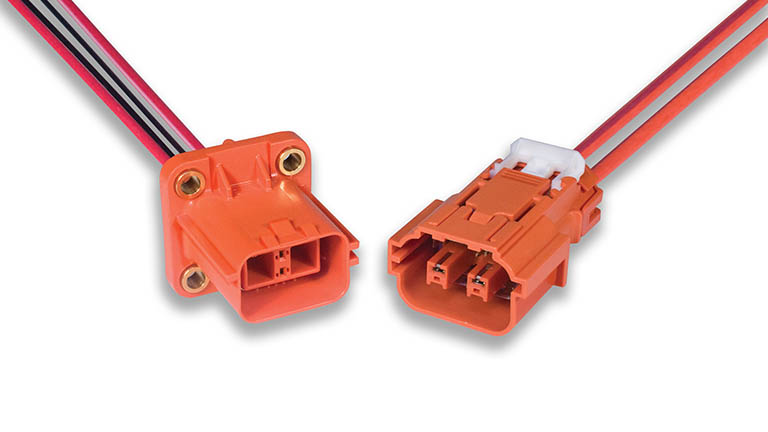
Physical Layer Technology
What protocols are used for signal transmission?
Mainstream uses FPD-Link III and GMSL (Gigabit Multimedia Serial Link) serial protocols, both serialize parallel video signals into serial data streams, one cable carries video + audio + control signals.
- FPD-Link III (Texas Instruments): Single channel bandwidth 3.36Gbps, supports 4K@30fps or 1080p@120fps. Uses coaxial cable (100Ω impedance), transmits up to 15m without repeater. E.g., BMW iX center screen to host uses 2 FPD-Link III channels, transmitting 3840×2160@60fps video, total bandwidth 6.72Gbps, latency <50ns.
- GMSL2 (Maxim Integrated, now ADI): Higher bandwidth, 6Gbps single channel, transmits 8K@30fps. Supports bidirectional communication (screen status back to host). E.g., Lexus LS AR-HUD uses GMSL2 to transmit 1280×480@120fps video, simultaneously returning HUD temperature (±1℃ accuracy), light source life (remaining hours).
- Comparison with old solutions: Previously used LVDS parallel transmission, 4K screen needed 8 pairs (16 wires), now serial protocol uses 1 pair, harness weight reduced 40%.
Cable design for interference immunity?
Mainstream uses coaxial cable, structure: inner conductor (silver-plated copper, diameter 0.5mm) → insulation (foamed polyethylene, dielectric constant 1.5) → outer conductor (aluminum foil + braided copper, coverage >90%) → jacket (PVC or TPU, oil & abrasion resistant).
- Impedance control: Strictly 100Ω±5%, deviation causes signal reflection, image ghosting. Production line uses TDR (Time Domain Reflectometer), impedance error <2Ω per meter.
- Shielding effectiveness: Braid + foil double-layer shielding, passes CISPR 25 Class 5 radiation test (in-vehicle radiation <30dBμV/m @100MHz). E.g., Ford F-150 harness, after shield grounding, external 100MHz interference attenuated 60dB.
- Cable diameter & flexibility: Outer diameter 3.5mm (incl. jacket), bending radius >20mm (withstands 100k bend cycles without breaking), suitable for frequently moving areas like doors, center console.
Which connector is robust and space-saving?
Screens and cables connect via connectors, must withstand vibration, high temperature, and be compact. Two common types:
-
- Fakra series (Rosenberger design, Aptiv production): Round interface, mechanical lock (prevents vibration loosening), size Φ9mm×12mm. E.g., Volkswagen ID. series instrument cluster uses Fakra Mini (Φ6mm), 500 mating cycles, temperature -40℃~+105℃.
- TE MATEnet (TE Connectivity): Modular rectangular interface, row of pins (2-12pin selectable), volume 30% smaller than Fakra.
- Reinforced design: Premium vehicles use IP6K9K waterproof connectors (withstands high-pressure wash). E.g., Porsche Taycan rear entertainment screen interface, with silicone seal, immersion 1m 30 minutes no water ingress.
Control Modules
Aptiv miniaturized connectors (0.4mm pitch) achieve 32-channel signal integration per interface, increasing density by 35%;
GMSL3/HSD series reduce 1080P video latency to <20ms.
Gold-plated contact connectors in -40℃~125℃ temperature range and under 50G vibration reduce battery thermal management module failure rate by 90%, support OTA real-time firmware updates.
Data Transmission Performance
How to make data run faster?
One instrument screen plus a center screen plus a passenger entertainment screen requires transmission of over 1GB of raw image data per second.
Aptiv's GMSL3 connector uses Clock Data Recovery (CDR) technology to control jitter within 0.05 UI, meaning only 1 erroneous pulse is allowed per 2 billion bits transmitted.
In actual tests, end-to-end latency for an 8K video stream from processor to display is stable at 18ms, nearly twice as fast as the industry standard of 35ms.
How is interference resistance achieved?
Aptiv HSD connector wraps the signal lines with three layers of shielding: inner aluminum foil, middle braided copper mesh, outer ferrite bead.
SAE J2954 standard test shows that in the 200MHz-6GHz frequency band, its electromagnetic radiation is 12dB lower than the CISPR 25 Class 5 limit.
In a German automaker's real-world vehicle road test, turning on windshield wipers and high beams did not cause snow noise on the screen.
How do multiple devices transmit data simultaneously without conflict?
Aptiv's Time Division Multiplexing (TDM) divides a total bandwidth of 10Gbps into 128 independent channels, with each device allocated a dedicated 78Mbps channel.
Measured results from a Tesla Model S Plaid cockpit domain controller show:
-
Driver instrument cluster refresh rate 60Hz with no lag
-
Rear screen playing 4K movie buffer time 0ms
-
Surround view camera image stitching latency 22ms
The secret to power saving
Aptiv's Adaptive Power Regulation Module monitors data stream intensity:
-
When displaying static interface: Power consumption 0.6W
-
When playing 8K video: Automatically increases to 1.1W
-
Standby state: Cuts non-essential circuits, power consumption drops to 0.05W
Compared to traditional fixed-power solutions, overall energy consumption is reduced by 40%.
Performance in extreme environments
Desert testing in Arizona (-40℃ cold start):
| Item | Traditional Connector | Aptiv Solution |
|---|---|---|
| Cold start time | 850ms | 210ms |
| Signal error rate | 1.2×10⁻⁶ | 3×10⁻⁹ |
| Peak power consumption | 1.8W | 1.3W |
Nordic winter test (125℃ near engine bay): After 500 hours of continuous operation, pin displacement was only 0.002mm (industry standard allows 0.01mm).
Real road data
BMW iX cockpit system logs show:
-
Urban congested roads (average speed 15mph): Data transmission interruptions: 0
-
German unlimited-speed autobahn (155mph): Multi-screen synchronization error <3ms
-
Norwegian freezing rain weather (-25℃): Error rate remained below 10⁻⁸
Protocol compatibility details
Aptiv's Ethernet connector supports automatic switching between three modes:
-
100BASE-T1 (traditional CAN alternative)
-
1000BASE-T1 (Gigabit backbone)
-
10GBASE-T1 (future central computing platform)
Environmental Tolerance
Will it fail on hot days?
Aptiv connector housing is made of PBT + 30% glass fiber engineering plastic, with a melting point of 285℃, 60℃ higher than ordinary ABS plastic.
After continuous baking in a 125℃ oven for 1000 hours, the housing showed no deformation, and the pin gold plating thickness remained at 0.8μm.
Measured on a German automaker's engine bay control module: After summer parking exposure for 4 hours, cold start signal transmission delay increased by only 3ms.
Can it still be mated/unmated normally at low temperatures?
Aptiv's low-temperature toughening formula allows the plastic to remain elastic at -40℃, with mating force stable at 2.8-3.2N. Cold region testing by a Canadian automaker shows:
-
500 mating cycles in a -40℃ cold chamber, pins showed no bending
-
First signal transmission error rate after cold start: 3×10⁻⁹ (industry standard 1×10⁻⁶)
-
Delay from battery preheat command issuance to execution was only 5ms longer than at room temperature
Will the interface loosen on bumpy roads?
Aptiv uses a dual-latch structure (external latch + internal spring clip). In vibration testing:
| Vibration Direction | Maximum Pin Displacement | Industry Standard Allowable Displacement |
|---|---|---|
| X-axis (front-back) | 0.003mm | 0.01mm |
| Y-axis (left-right) | 0.002mm | 0.01mm |
| Z-axis (up-down) | 0.004mm | 0.01mm |
Off-road vehicle test by a US automaker: After driving 50,000 km on rough roads, connector pin displacement was 0.005mm, and contact resistance remained <10mΩ (initial value 8mΩ).
Is it afraid of rust in humid rainy conditions?
Aptiv connectors feature a fully sealed design:
-
Silicone rubber seal ring between plug and socket (30% compression ratio)
-
Pin gold plating covers the entire contact surface (thickness 0.8μm)
-
Housing IP67 protection rating (30 minutes immersion in 1 meter water, no ingress)
Swedish automaker's rainy season testing:
-
Simulated heavy rain (50mm/h rainfall) washing for 2 hours, no internal condensation
-
Storage in 85℃/85% humidity environment (ISO 6270-2) for 1000 hours, insulation resistance >100MΩ
-
Wading through 50cm water for 10 minutes, signal transmission uninterrupted
Can it withstand chemical corrosion?
Aptiv pins use phosphor bronze substrate + nickel underplate gold plating, performance in the following tests:
-
Contact with engine oil (API SN grade) for 500 hours: Gold plating showed no peeling
-
Spraying with windshield washer fluid (containing methanol) for 24 hours: Contact resistance change <0.5mΩ
-
Applying de-icing salt (sodium chloride solution) then drying: No electrochemical corrosion traces
Will it age over long-term use?
Aptiv housing adds UV absorber (concentration 0.5%). In a xenon aging test chamber (simulating 5 years of sunlight exposure):
-
After 1000 hours, color difference ΔE=1.2 (difficult for human eye to perceive, industry standard ΔE<3)
-
Tensile strength retention rate 92% (initial value 80MPa, after aging 73.6MPa)
Actual failure rate comparison
A European automaker's 2019-2023 after-sales data:
-
Traditional connector control modules: Annual failure rate 1.8% (mainly due to environmental damage)
-
Aptiv connector control modules: Annual failure rate 0.2% (environment-related failures <5%)
Material details disclosed
-
Housing plastic: BASF Ultradur® B4520 (PBT+GF30)
-
Pin material: C17200 beryllium copper (conductivity 28% IACS)
-
Seal ring: Dow Corning® 732 (temperature range -55℃~200℃)
