How Much Does a Custom Cable Harness Cost | Price Factors
The cost of a custom cable harness typically ranges from 100 to 5,000+, with complexity and quantity being key drivers. A simple, low-volume prototype might cost 300-500, while high-volume production of a complex harness can drop the per-unit price below $50. Key factors include design intricacy, materials, labor, and required certifications.
What is a Cable Harness?
A cable harness, also called a wiring assembly, is a organized set of wires, cables, and connectors designed to transmit electrical power or signals. It bundles multiple individual conductors into a single, structured unit for easier installation, better protection, and improved reliability. For example, a typical car might use over 1,200 individual wires stretching nearly 1 mile (1.6 km) in length. Bundling them into 15-20 harnesses drastically cuts installation time from ~20 hours to ~3 hours and reduces the risk of connection errors by over 70%. This organization is critical in complex systems like automobiles, industrial machinery, and aircraft, where space, weight, and reliability are measured precisely. A Boeing 747, for instance, uses a wiring harness network that weighs over 3,000 lbs (1,360 kg) and consists of over 100,000 individual parts and connections.
A cable harness is a fundamental component in electrical systems, acting as the central nervous system for everything from household appliances to advanced robotics. Its primary job is to consolidate a potentially messy web of dozens or even hundreds of loose wires into one secure, integrated bundle. This is achieved by binding the wires externally with materials like vinyl tie wraps, conduit, or woven polyester sleeving, and terminating them with connectors, which can range from simple 2-pin units to complex 48-pin multi-port blocks.
The real value of a harness lies in its pre-fabrication. Instead of an electrician or assembly line worker individually routing and connecting hundreds of separate wires—a process prone to human error rates of up to 5%—they install one pre-assembled and pre-tested unit. This reduces on-site labor time by approximately 85% and virtually eliminates connection mistakes, ensuring a system reliability rate often exceeding 99.95%. For a manufacturer, this translates directly into lower assembly costs and higher product quality.
The complexity of a harness is defined by its Bill of Materials (BOM), which includes the number of circuits (wires), their lengths, wire gauges (e.g., 18 AWG for 10-amp loads, 24 AWG for signal), and the types and quantities of connectors. A simple 5-wire harness for an industrial sensor might be 36 inches (0.9 meters) long, use 22 AWG wire, and feature two 4-pin plastic connectors, costing 25-40 to produce. In stark contrast, a harness for an MRI machine involves ~500 shielded wires with precise impedance requirements (e.g., 50 or 75 ohms ±5%), custom over-molded connectors rated for thousands of mating cycles, and must operate reliably in specific temperature ranges from -40°C to 105°C. Such a complex harness can easily cost 2,000-5,000+ per unit.
Main Cost Influencing Factors
For instance, a basic 10-circuit harness might cost 50, while a complex 200-circuit assembly for medical equipment can exceed 5,000. This 100x price difference isn't arbitrary; it's directly driven by specific, quantifiable factors that determine material, labor, and overhead expenses. Understanding these levers is key to budgeting effectively.
The final price of your harness is a function of four primary cost drivers: design complexity, materials, labor, and order volume. Their impact isn't linear; a 10% increase in complexity can sometimes lead to a 30% or higher cost increase due to compounding effects on assembly and testing time.
This is the biggest driver. It encompasses:
- Number of Circuits: Each additional wire adds material and labor. Adding 50 circuits to a harness typically increases its cost by ~40-60%.
- Wire Gauges and Types: Standard 20 AWG copper wire costs roughly 0.15 per foot. Specifying a shielded variant can double that to 0.30 per foot, while a high-temp Teflon-coated wire can cost $0.75+ per foot.
- Connector Types: A simple plastic 4-pin connector may cost 1.50. A metal, shielded, environmentally sealed connector with 24 pins can cost 35+. The number of terminations matters immensely; a connector with 50 pins can take a technician ~15-20 minutes to fully populate and crimp, compared to ~2 minutes for a 4-pin version.
- Tolerances and Testing: A harness requiring ±0.5 mm accuracy in wire length will cost more than one with a ±5 mm tolerance due to slower assembly and more meticulous inspection. Mandatory 100% hi-pot testing (e.g., 1500V AC for 60 seconds) adds ~5-10% to the unit cost.
A real-world example: An industrial robot harness might require 120 circuits, 12 different custom-length wires, 8 specialized connectors, and must withstand 10,000+ flex cycles. This complexity pushes its unit cost into the 800-1,200 range.
The bill of materials (BOM) is a major component. Beyond wires and connectors, this includes:
- Jacketing: Standard PVC sleeving might cost 0.10 per foot, whereas fire-retardant, chemical-resistant braided sleeving can cost 0.80 per foot.
- Terminals and Seals: Gold-plated contacts offer better conductivity and corrosion resistance but can be 5x the cost of tin-plated alternatives. Environmental sealing boots for connectors add 2-8 per connector.
Manual assembly is time-consuming. A harness taking 2 hours (40 labor) to build in a US facility will have a significantly different labor cost than one built in a region with a 15 hourly rate. However, this is often balanced by higher shipping costs and import tariffs, which can add 5-15% to the total landed cost.
This is where economies of scale apply dramatically. Setup costs (CAD design, prototyping, test fixture programming) are amortized over the entire production run. Ordering 50 units might see ~30% of the cost allocated to setup. Ordering 5,000 units spreads that same fixed cost so thinly that the per-unit price can drop by 50% or more.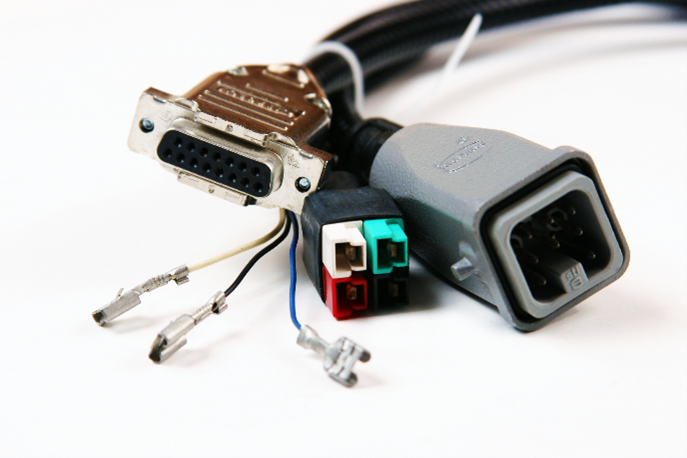
Material and Parts Expenses
While labor is a major factor, the physical components that make up a harness—the wires, connectors, and protection materials—often constitute 40% to 60% of its total cost. A simple harness using basic components might have a 25 material cost, while one requiring specialized, high-performance parts can rocket to over 1,000. These expenses are not static; they fluctuate based on global commodity prices, order volume, and specific technical requirements that dictate the grade and source of every single item.
The core material expense is the wire itself. The choice of conductor, insulation, and shielding creates a massive price range. Standard 20 AWG stranded copper wire with PVC insulation is a common workhorse, costing approximately 0.12 to 0.18 per foot in bulk purchases. However, if an application requires a wire that can withstand extreme conditions, the cost escalates quickly. Specifying a shielded variant adds a foil or braid layer, increasing the price by 40-60%. For environments with high temperatures, Teflon (FEP or PTFE) insulation is often mandated. This premium material can cost 0.70 to 1.20 per foot, a 500% increase over standard PVC. The wire gauge also directly impacts cost; a thicker 10 AWG power wire costs significantly more per foot than a finer 24 AWG signal wire due to the increased raw copper content, which itself is a commodity whose price can vary by ±15% quarterly.
Connectors and terminals are the next major cost center. A simple, injection-molded plastic connector housing with tin-plated brass terminals might cost 0.50 per mating pair. However, demanding applications require far more robust solutions. A metal-bodied connector with environmental seals (IP67 or IP68 rating) to protect against dust and water immersion will start at 8.00 and can exceed $50 per pair. The plating on the contacts is a critical detail: while tin plating is standard, gold flash plating (typically 0.5 to 1.0 microns thick) is used for high-reliability applications to ensure low resistance and prevent corrosion. This gold plating can increase the cost of a single terminal by 200-300%. The number of pins is a massive multiplier; populating a 50-pin connector requires 50 terminals and 100 crimps, drastically increasing both part and labor costs compared to a 4-pin connector.
Beyond wires and connectors, ancillary materials add up. Polyester braided sleeving for abrasion resistance might add 0.30 per foot to the harness. Heat-shrink tubing varies in price based on its diameter and material, with adhesive-lined, waterproof versions costing 5x more than simple polyolefin tubes. Even the method of bundling affects cost: standard nylon zip ties are inexpensive at 0.02 each, but if a harness requires lacing cord tied in a specific pattern for aerospace approval, the labor time to apply it increases the effective cost tenfold. Every material specification is a trade-off between performance, durability, and budget, and each choice has a quantifiable impact on the final price per unit.
Labor and Assembly Charges
Labor is the most variable cost in cable harness manufacturing, typically accounting for 30% to 50% of the final price. Unlike materials, which have a fixed unit cost, labor is a time-based expense. A highly skilled technician in North America or Europe might command an hourly rate of 40-60, including overhead. For a complex harness that takes 4 hours to assemble, this translates to 160-240 in labor alone. This cost is directly tied to the harness's complexity and the region where production occurs, creating a wide range of potential expenses for what might appear to be similar products.
The process of assembling a cable harness is almost entirely manual and requires significant precision. It begins with wire cutting and stripping. A technician using semi-automatic machines can cut and strip 150-200 wires per hour. However, if wires are of 20 different lengths instead of 5, the setup and changeover time between batches reduces this efficiency by ~25%. Each wire end must then be stripped to expose a precise length of conductor, typically with a tolerance of ±0.5 mm. This is often followed by crimping a terminal onto the end. A skilled operator can crimp 300-400 terminals per hour using a manual press. The complexity escalates when dealing with multi-pin connectors. Inserting 24 pins into a connector housing might take 5-7 minutes if done carefully to avoid misalignment. Now, imagine a harness with 10 of these connectors; that's over an hour dedicated solely to populating connectors.
The next major time sink is routing and bundling the wires onto a assembly board (a board with pegs laid out in the harness's exact pattern). For a large harness with 100 wires, this routing process can take 45-60 minutes. The chosen bundling method then adds more time. Securing the bundle with nylon zip ties is relatively fast, taking ~30 seconds per tie. Using cloth tape for a more refined finish is slower, adding ~2 minutes per taping point.
For the highest-end applications, like aerospace, manual lacing with waxed cord is required. This intricate process is meticulous and slow, taking ~5-7 minutes per knot, and can easily add 3-4 hours of labor to a single complex harness.
Order Size and Pricing
A prototype harness might cost 500 for a single unit. Ordering 100 units could drop the price to 150 each, and a production run of 10,000 units might see a final cost of $45 per unit. This 90% price reduction isn't just from material discounts; it's primarily driven by the drastic amortization of one-time setup and engineering costs.
| NRE Cost Component | Typical Cost Range |
|---|---|
| CAD Design & Documentation | 800-2,500 |
| Prototype Assembly & Rework | 500-1,500 |
| Test Fixture Programming | 1,000-3,000 |
| Total Estimated NRE | 2,300-7,000 |
This NRE is a fixed cost. If you only order one unit, its price must include the full 7,000 NRE, plus materials and labor. If you order 1,000 units, that same 7,000 is divided across the entire batch, adding just $7 to the cost of each harness. This is the most powerful effect of volume on price.
For example, a harness with a 25 material cost and 35 labor cost has a 60 recurring cost. For a 1-unit order with 5,000 NRE, the total is 5,060. For a 1,000-unit order, the NRE per unit drops to 5, creating a total unit cost of $70. The per-unit price is reduced by 98.6%.
Beyond NRE amortization, volume purchasing unlocks material discounts. A manufacturer buying 1,000 meters of wire might pay 0.20 per meter. Buying a 100,000-meter pool of ten reduces the price to 0.14 per meter, a 30% saving. Similarly, connectors bought in reels of 5,000 units can be 15-25% cheaper than those bought in bags of 100 units. These savings are directly passed on in the unit price.
Getting a Custom Quote
A vague request can result in a price variance of ±50% or more, while a detailed specification sheet allows for a firm, fixed quote. Most manufacturers can turn around a preliminary quote within 3-5 business days for standard requests, but highly complex designs requiring engineering review may take 7-10 days. Providing the right data upfront is the fastest way to get a precise cost estimate.
To receive an accurate quote, you must provide a comprehensive data package. The most critical element is a complete schematic or wiring diagram. This diagram must specify every connection, including wire gauges (e.g., 22 AWG for signals, 12 AWG for power), colors, and connector pinouts. Without this, any quote is merely an educated guess. Equally important is a Bill of Materials (BOM). This list should itemize every component, including part numbers, manufacturers (e.g., Molex, TE Connectivity, Amphenol), and quantities. For example, specifying 50 units of Molex 43025-0800 connector is definitive; stating "a 8-pin connector" is not and leads to pricing based on assumptions.
The operating environment dramatically influences material selection and cost. You must provide precise parameters:
- Temperature Range: Will the harness endure -40°C to 125°C under the hood of a vehicle or a stable 0°C to 70°C in an office device?
- Exposure: Will it encounter chemicals, oils, or constant UV radiation? This may require specific jacketing.
- Flexibility: Does the application require 50,000+ bend cycles? This necessitates highly stranded conductors.
- Voltage & Current: Is it carrying 5V/0.1A signals or 480V/30A power? This dictates insulation and wire gauge.
| Information Type | Low-Impact Example | High-Impact Example |
|---|---|---|
| Annual Volume | 100 units | 50,000 units |
| Target Price | $75(prototype budget) | $22(production target) |
| Regulatory Standards | None | UL, CSA, ISO 26262 |
Telling a manufacturer your target price per unit is $30 for an annual volume of 25,000 units is incredibly helpful. It allows their engineers to suggest potential design compromises or alternative components that can meet your cost goal without sacrificing critical performance. This collaborative approach often yields a 10-20% cost savings compared to a closed specification. Clearly stating your timeline—whether you need 50 prototypes in 4 weeks or first articles in 10 weeks—also affects pricing, as rush fees for expedited material procurement can add a 15-25% premium.
In summary, the cost of a custom cable harness is influenced by several key factors. The primary expenses include material and component costs, such as wires, connectors, and shielding, which form the bulk of the price. Labor charges for the complex manual assembly and testing process significantly impact the final quote. Furthermore, order size dictates economies of scale; prototypes are expensive, while large production runs drastically reduce the unit price. To get an accurate quote, manufacturers require detailed specifications, including schematics, quantities, and environmental requirements for precise calculation.
Support Custom Wiring Harness Assembly
- Connector: TE, Deutsch, AMP, Molex, JST, Amphenol, Hirose, Aptiv, Yazaki, Sumitomo, Lear, etc.
- Wire gauge: From 2/0 to 32AWG
- Wire length: as long as your needs
- Wire color: white, black, red, yellow, grey, blue, green, purple, orange, brown, etc.
- Custom type:
- wire to wire
- wire to tinned end
- wire to open end
- wire to any suitable connectors
- Minimum Order: 50 pieces per order.
Customize Your Wire Harness
Send us your sample or drawing/schematic for quote price→ Feedback with quotation(1~3 days) → Confirm quotation → Arrange sample you for approval→ [Make mold if needed (7 days) →Mold test] → Making samples(1~3 days)→Samples test(Approval) → place order for Mass production(2~3 weeks)→ Quality checking→ Packing → Delivery → After Service → Repeat Order.
