How Much Does Custom Cable Harness Cost in 2025
In 2025, custom cable harnesses cost 500+ per unit, depending on complexity, materials (e.g., shielded wires), and volume (bulk orders reduce costs). Factors like connector types, testing (Hi-Pot, continuity), and certifications (UL, CE) impact pricing. Lead times range from 2–6 weeks.
Basic Cost Factors
Custom cable harnesses in 2025 vary widely in price, typically ranging from 50 for simple designs to 5,000+ for complex industrial setups. The final cost depends on wire gauge (18AWG to 40AWG), conductor material (copper vs. aluminum), shielding requirements (foil, braid, or none), and connector types (MIL-SPEC, automotive, or consumer-grade). For example, a basic 10-wire harness with PVC insulation and no shielding averages 80–120, while a high-temperature silicone 50-wire harness with EMI shielding can exceed 1,200. Labor adds 20–$50 per hour, with assembly times ranging from 30 minutes for a simple harness to 20+ hours for aerospace-grade cabling.
Wire and conductor costs fluctuate based on material and market conditions. In 2025, bare copper wire costs 6.00 per pound, while tinned copper is 10–15% more expensive. Aluminum is cheaper at 2.50 per pound but has 40% lower conductivity, requiring thicker gauges. Shielded cables add 1.50 per foot, depending on shielding type—braided shielding (most durable) costs 25% more than foil.
Connectors and terminals impact pricing significantly. A standard 2-pin automotive connector costs 2.00, while military-grade circular connectors (MIL-DTL-38999) range from 80 each. High-density board-to-board connectors for electronics add 20 per pair.
Labor and assembly complexity scale with wire count and customization. A 10-wire harness takes 1–2 hours to assemble (100 labor), while a 100-wire harness with custom routing may require 8–15 hours (750). Automated crimping reduces labor by 30–50%, but manual soldering for precision applications adds 30 per connection.
| Cost Factor | Price Range (2025) | Impact on Total Cost |
|---|---|---|
| Copper wire (per lb) | 3.50–6.00 | 15–25% of material cost |
| Aluminum wire (per lb) | 1.20–2.50 | 8–15% of material cost |
| Shielding (per ft) | 0.30–1.50 | +5–20% per harness |
| Connectors (each) | 0.50–80.00 | 10–40% of total cost |
| Labor (per hour) | 20–50 | 30–60% of total cost |
Testing and certification add 5–15% to the final price. Basic continuity testing costs 20 per harness, while full EMI/EMC compliance testing runs 1,000+ depending on standards (FCC, CE, MIL-STD).
To save costs, bulk orders (100+ units) reduce per-unit pricing by 10–30%, and standardizing connector types cuts assembly time by 15–25%. If budget is tight, using pre-terminated cables instead of custom crimping can lower labor by 20–40%.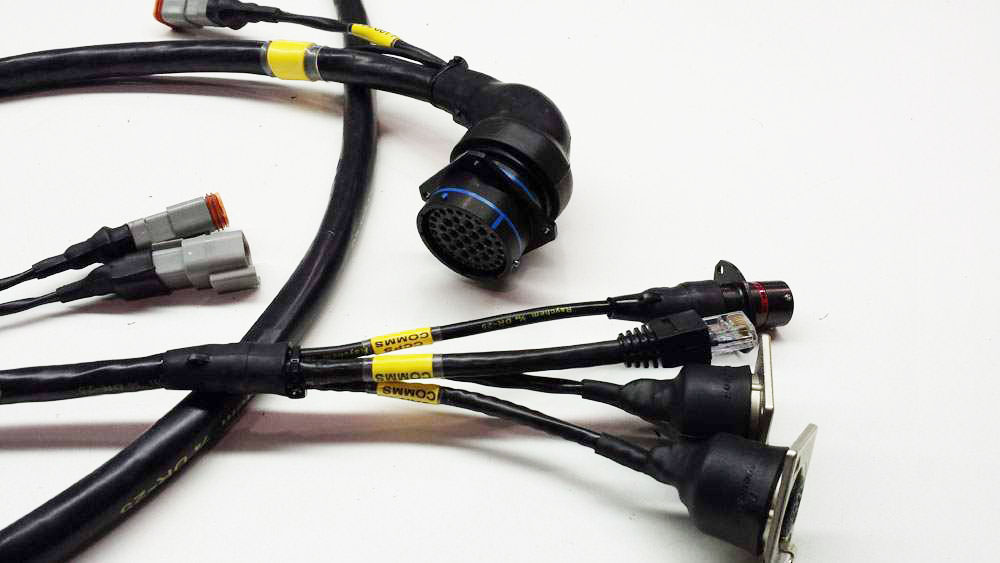
Material Types & Prices
The materials used in custom cable harnesses directly impact cost, durability, and performance. In 2025, copper remains the dominant conductor, priced at 6.00 per pound, while aluminum (2.50 per pound) is a budget alternative with 40% lower conductivity. For high-frequency applications, silver-plated copper (12 per pound) reduces signal loss by 15–30% compared to bare copper. Insulation materials vary widely—PVC (0.20 per foot) is the cheapest but degrades above 80°C (176°F), while silicone (0.80 per foot) withstands 200°C (392°F) and is 3–5x more flexible.
Key Material Costs & Trade-offs
Conductors:
- Bare copper (AWG 18–40): 0.50 per foot, ideal for general-purpose wiring (automotive, appliances).
- Tinned copper: 10–15% more expensive than bare copper, but resists corrosion in humid environments (marine, outdoor use).
- Aluminum: Costs 60–70% less than copper but requires thicker gauges (e.g., 14AWG aluminum = 18AWG copper) to match current capacity.
Insulation & Jacketing:
- PVC (Polyvinyl Chloride): 0.20 per foot, rated for -40°C to 80°C (-40°F to 176°F). Used in consumer electronics and low-cost automotive harnesses.
- Silicone Rubber: 0.80 per foot, flexible and heat-resistant (-60°C to 200°C / -76°F to 392°F). Common in aerospace, medical, and industrial equipment.
- Teflon (PTFE): 1.50 per foot, handles 260°C (500°F) and harsh chemicals. Used in military and high-temperature industrial applications.
Shielding & Protection:
- Foil Shielding: Adds 0.30 per foot, blocks 85–90% of EMI/RFI interference.
- Braided Shielding: 1.00 per foot, provides 95%+ EMI protection and better durability.
- Unshielded Cables: 20–40% cheaper, suitable for low-noise environments (e.g., home appliances).
| Material | Price (2025) | Key Properties | Best For |
|---|---|---|---|
| Bare Copper (18AWG) | 0.15–0.30/ft | 98% conductivity, oxidizes over time | Automotive, appliances |
| Tinned Copper (20AWG) | 0.18–0.35/ft | Corrosion-resistant, solder-friendly | Marine, outdoor electronics |
| Aluminum (14AWG) | 0.06–0.15/ft | Lightweight, 60% conductivity | Low-cost bulk wiring |
| PVC Insulation | 0.05–0.20/ft | Cheap, rigid, limited heat resistance | Consumer electronics |
| Silicone Insulation | 0.30–0.80/ft | Flexible, extreme temperature range | Aerospace, medical devices |
| PTFE (Teflon) | 0.50–1.50/ft | Chemical-resistant, high-temperature | Military, industrial |
Cost-Saving Tips:
- Use aluminum for non-critical, high-volume wiring (saves 30–50% vs. copper).
- PVC is sufficient for indoor, low-temperature applications (saves 60–80% vs. silicone).
- Skip shielding if EMI isn’t a concern (reduces cost by 20–40%).
Labor & Assembly Fees
Custom cable harness assembly costs in 2025 are heavily influenced by labor rates, complexity, and production methods. On average, manual assembly ranges from 50 per hour, while automated processes cut labor costs by 30–50%. A simple 10-wire harness with basic connectors takes 1–2 hours to assemble (100 total labor), whereas a 100-wire aerospace harness with custom routing can require 15–25 hours (1,250). Regions also affect pricing—labor in North America and Europe averages 65/hour, while Asian manufacturers charge 25/hour for similar work.
"Pre-terminated wires reduce assembly time by 20–40%, but custom crimping and soldering add 30 per connection for precision work."
Manual vs. Automated Assembly
Manual labor dominates low-volume (under 500 units) or highly customized orders. Each hand-crimped terminal adds 2.00, and soldered connections cost 8 each due to slower throughput (5–10 minutes per joint). Automated crimping machines process 200–500 terminations per hour at 60–80% lower cost per connection, but require 50,000 in equipment investment, making them viable only for high-volume (1,000+ units) production.
Complexity-Driven Costs
Harness complexity scales labor time exponentially. A basic 20-wire bundle with uniform lengths takes 3–5 hours (250), while a multi-branch 50-wire harness with varying wire gauges and shielding demands 8–12 hours (600). Adding testing and QC checks tacks on 50 per harness, depending on standards (e.g., MIL-STD-810G validation adds 300 per unit).
Regional Labor Variations
- North America/Europe: 65/hour, with ISO 9001-certified shops charging 15–25% premiums.
- China/Vietnam: 22/hour, but 3–6-week shipping delays can negate savings for urgent orders.
- Mexico/Eastern Europe: 30/hour, offering a balance of cost and proximity for US/EU buyers.
Hidden Labor Factors
- Design Time: 2–8 hours of engineering (600) for custom schematics.
- Rework: Fixing errors costs 1.5–3x the initial assembly time. A 60–$120 in rework.
- Certification: UL/CE compliance testing adds 200 per design, while FDA/medical-grade approval exceeds $500 per batch.
How to Reduce Labor Costs
- Standardize connectors/wire types to cut assembly time by 15–25%.
- Order pre-cut wires (saves 0.50 per termination).
- Batch testing (e.g., test 10% of units instead of 100%) lowers QC costs by 40–70%.
Order Size Impact
In 2025, the quantity of custom cable harnesses ordered directly affects unit pricing, with bulk purchases delivering 10–40% cost reductions. A single prototype harness might cost 1,200, while ordering 100+ units drops the price to 400 each, and 1,000+ units can push it below 250. This scaling works because fixed costs (design, tooling, setup) get distributed across more units, and labor efficiency improves with repetition. For example, a 50-wire automotive harness that takes 8 hours to assemble for the first unit may only require 3 hours per unit at 500+ pieces due to optimized workflows.
Material Purchasing Discounts
Suppliers offer volume-based price breaks on raw materials. Buying 1,000+ pounds of copper wire cuts the per-pound cost from 5.00 to 3.80, saving 24%. Similarly, connectors priced at 2.50 each for small orders drop to 1.20–$1.80 at 10,000+ units.
Labor Efficiency Gains
- First 10 units: Workers average 90 minutes per harness due to learning curves.
- 100–500 units: Time drops to 45–60 minutes (33–50% faster).
- 1,000+ units: Assembly stabilizes at 25–40 minutes (60–75% efficiency gain).
Tooling and Setup Amortization
- Custom crimping dies cost 3,000 but add just 3.00 per unit at 1,000+ pieces.
- Automated wire-cutting machines require 5–$12 per harness in large batches.
| Order Size | Unit Price | Cost Reduction vs. Prototype | Assembly Time per Unit |
|---|---|---|---|
| 1 (Prototype) | 500–1,200 | – | 6–10 hours |
| 10 | 300–700 | 30–45% | 3–5 hours |
| 100 | 150–400 | 50–70% | 1–2 hours |
| 500 | 100–300 | 60–80% | 45–90 minutes |
| 1,000+ | 80–250 | 70–85% | 25–40 minutes |
Hidden Volume Benefits
- Shipping: Bulk orders reduce per-unit freight costs by 20–60%. Air shipping 10 harnesses costs 20/unit), while sea freight for 1,000 units averages 1.50/unit).
- Testing: Certifying one harness for IPC/WHMA-A-620 costs 30–$50 each.
- Waste Reduction: Buying materials in bulk cuts scrap rates from 15% (small batches) to 5% (large orders).
When Small Orders Make Sense
- R&D prototypes needing frequent design tweaks.
- Niche applications with sub-100 unit demand (e.g., medical devices).
- Urgent orders where paying 2–3x for speed outweighs bulk savings.
Testing & Quality Costs
In 2025, quality validation adds 5–25% to custom cable harness prices, with basic continuity testing starting at 5 per unit and full military-grade certification exceeding 300 per harness. The gap comes from test rigor—while a consumer electronics harness might only need 30 seconds of automated continuity checks, an aerospace-grade unit undergoes 4–8 hours of thermal cycling, vibration, and EMI tests. Failed tests are expensive: a 10% rejection rate on a 200 harness batch means 2,000 in wasted materials plus 15–30% rework costs.
"IPC/WHMA-A-620 Class 3 inspection (medical/military) costs 150 per hour—3x more than Class 1 (consumer goods) at 50/hour."
Common Testing Methods & Costs
Continuity/hipot testing is the baseline at 20 per unit, checking for opens/shorts with 500V–1,500V dielectric withstand tests. Adding impedance validation for high-speed data cables (USB4, HDMI 2.1) pushes this to 60 using TDR (Time Domain Reflectometry) equipment. For harsh environments, thermal shock testing (-55°C to +125°C cycles) runs 200 per sample, while salt spray corrosion testing adds 250. The most expensive is MIL-STD-461G EMI/EMC testing, where a 10-day chamber rental alone costs 30,000, amortizing to 800 per harness for small batches.
Quality Tiers & Price Impact
- Class 1 (Consumer): 5–10% failure tolerance, 2.00/unit for visual inspection.
- Class 2 (Industrial): 3–5% tolerance, 8/unit for micrometer wire gauge checks.
- Class 3 (Medical/Military): 0.1–1% tolerance, 50/unit for X-ray wire routing verification.
Hidden Cost Factors
- False positives waste 2–5 hours per incident—a 500 loss per occurrence with Class 3 testing.
- Documentation for FDA/CE compliance adds 8–20 hours of paperwork at 120/hour engineering rates.
- Burn-in testing (powering harnesses for 100+ hours) consumes 10 in electricity per unit.
Cost-Saving Strategies
- Batch sampling tests 10–20% of units instead of 100%, cutting costs by 40–70% with minimal risk (assuming <2% defect rates).
- On-site testing avoids 500/day third-party lab fees for basic checks.
- Modular designs allow reusing pre-certified subcomponents, saving 5,000 per new variant.
Saving Money Tips
Custom cable harnesses don’t have to break the bank—smart design and procurement choices can slash costs by 20–50% without sacrificing quality. In 2025, standardizing components alone saves 3.50 per connector, while ordering 500+ units cuts per-harness prices by 30–65% compared to prototypes. Even small tweaks matter: switching from braided to foil shielding saves 1.20 per foot, and using pre-cut wires eliminates 0.30 per termination in labor.
Material Optimization
- Copper vs. Aluminum: For low-current (<5A) applications, aluminum wires cost 60% less than copper with only 1–3% voltage drop penalty.
- Insulation Downgrades: If operating below 60°C (140°F), PVC (0.30/ft)—saving $25 per 100ft harness.
- Shielding Elimination: In non-EMI environments, unshielded cables reduce costs by 4.00 per foot.
Labor & Assembly Hacks
- Automated Crimping: Machines process 200–500 terminations/hour vs. 60/hour manually, cutting labor by 18 per harness.
- Modular Designs: Using pre-assembled sub-harnesses reduces final assembly time by 40–60%.
- Bulk Testing: Sampling 10% of units instead of 100% lowers QC costs by 50–80% with minimal risk.
| Cost-Saving Tactic | Savings per Unit | Best For |
|---|---|---|
| Standardize connectors | 0.80–3.50 | All production volumes |
| Order 500+ units | 30–65% discount | Steady-demand applications |
| Use pre-cut wires | 0.15–0.30 | High-mix, low-volume builds |
| Switch to aluminum wiring | 60% material savings | Low-power systems |
| Eliminate unnecessary tests | 5–50 | Non-critical environments |
Procurement & Logistics
- Local Sourcing: Avoids 3–6 week delays and 25–40% import tariffs on Asian-made components.
- Just-in-Time Inventory: Reduces warehousing costs by 1.20 per harness/month.
- Negotiate MOQs: Some suppliers accept 100-unit minimums instead of 500+ for 5–15% price premiums.
Design Efficiency
- Tolerance Relaxation: Changing from ±0.5mm to ±1.0mm wire length tolerance cuts trimming waste by 12–18%.
- Color Coding: Replacing printed labels (0.03 each) saves $22 per 100-term harness.
- Fewer Custom Parts: Every unique connector adds 200 in design/tooling fees.
Hidden Savings
- Rejected units cost 2.5x more to rework than to build correctly—investing 2,000 in scrap per 100 units.
- Energy-efficient machines reduce 1.50/hour in electricity during production.
- Recycling copper scrap recoups 2.80 per pound (5–8% of material costs).
In short,in 2025, custom cable harness costs range from 50 for simple designs to 5,000+ for industrial setups, driven by materials, labor, and complexity. Copper wire (18-40AWG) averages 3.80-5.00/lb, while EMI-shielded silicone harnesses exceed 1,200 due to high-temperature specs. Labor adds 20-50/hour, with assembly taking 30 minutes to 20+ hours. Bulk orders slash costs—1,000+ lbs of copper saves 24%, and 10,000+ connectors drop to 1.20-1.80/unit. Testing (e.g., continuity checks at 50/test) ensures reliability. To save, standardize designs, negotiate volume discounts, and avoid over-specifying shielding unless critical for performance.
