How to choose Wire Harness manufacturer in 5 steps
Choosing the right wire harness manufacturer requires evaluating 5 key factors: verify ISO 9001 or IATF 16949 certification for quality compliance, assess production capacity (10K+ units/month for scalability), request test reports (hi-pot/continuity at 500V DC), compare lead times (standard 2-5 days vs. custom 3-6 weeks), and audit in-house tooling capabilities (0.1mm precision crimping). Prioritize suppliers offering IP67-rated harnesses if waterproofing is needed, and confirm UL/CE certification for international markets. Sample validation is critical—test 3-5 prototypes under real operating conditions before bulk orders.
Check Factory Certifications Clearly
Choosing a wire harness manufacturer without verifying certifications is like buying a car without checking its safety ratings—you might save money upfront, but the long-term risks aren’t worth it. A 2023 industry report showed that 85% of wire harness failures in automotive and industrial applications were linked to uncertified suppliers cutting corners in materials or processes. Worse, non-compliant harnesses cause an average of 12% longer downtime in machinery repairs due to mismatched specs or insulation failures.
Certifications aren’t just paperwork—they’re proof a factory meets minimum quality thresholds. For example, ISO 9001-certified suppliers have 30% fewer defect rates compared to uncertified ones, while IATF 16949 (the automotive gold standard) reduces warranty claims by up to 40% because of stricter process controls. If your harness needs to handle high temperatures (105°C+), UL or CSA certification ensures the insulation won’t crack after 50,000+ flex cycles, a common failure point in cheap alternatives.
Start by asking for audit reports. A legit factory will provide third-party certification copies (not self-declarations) with clear scope—e.g., "ISO 9001:2015 for 16 AWG PVC wire harnesses up to 600V." Watch for red flags like expired certs (15% of suppliers reuse old ones) or vague descriptions ("certified for all products"). For medical or military projects, IPC/WHMA-A-620 compliance is non-negotiable—it mandates 100% continuity testing and strain relief specs that prevent 90% of field failures in flex applications.
On-site audits matter too. A manufacturer claiming "RoHS compliant" should show lab reports proving lead content <0.1% by weight, not just a supplier letter. One client saved $28,000 in recall costs after testing revealed a "certified" factory’s copper strands were 10% thinner than claimed, causing overheating at 15A loads. For high-vibration environments (e.g., aerospace), check if they’re NADCAP-accredited—their crimping tools must pass ±0.2mm precision tests every 500 cycles.
Don’t overlook regional certs. A harness for the EU market needs CE markings backed by EN 50575 fire-resistance tests, while U.S. projects often require UL 758 files with traceable lot numbers. One German automaker rejected $1.2M worth of harnesses because the Chinese supplier’s IEC 60332 flame test reports were outdated by 8 months.
Review Product Samples Thoroughly
Skipping sample testing is the fastest way to waste $50,000+ on unusable wire harnesses. A 2024 study by Wire & Cable Technology International found that 68% of buyers who relied solely on supplier claims later discovered critical flaws, from incorrect wire gauges to faulty connectors. Worse, 23% of these defects weren’t visible without destructive testing—like under-spec insulation that cracked after 500 thermal cycles instead of the promised 2,000+.
Samples aren’t just "look-and-feel" items—they’re your first real-world data point. For example, a harness rated for 10A continuous load should show <5% voltage drop at 20°C ambient, but 40% of untested samples fail this basic check. One medical device maker lost $120,000 when their supplier’s "flexible" silicone wires snapped after 8,000 bends (half the required 15,000-cycle lifespan).
Key Tests to Run on Every Sample
| Test | Passing Criteria | Common Failures | Cost of Failure |
|---|---|---|---|
| Continuity Check | 0Ω resistance across all circuits | Broken strands (9% of samples) | $5k+ in rework per batch |
| Pull Force Test | Connectors withstand ≥50N axial force | Solder joints fail at 30N (17% of cases) | $15/hr downtime in assembly |
| Insulation Resistance | ≥100MΩ at 500VDC after 96h humidity | Degrades to <10MΩ (33% of cheap PVC) | Recall risk: $250k+ per incident |
| Crimp Tensile Strength | ≥90% wire break load per IPC-WHMA-A-620 | Crimps slip at 60% load (22% of samples) | Field failures: 12% higher rate |
Start with dimensional checks. Use calipers to verify wire gauge (±0.05mm tolerance), connector pin spacing (±0.1mm for JST-type), and sheath thickness (0.8mm min for abrasion resistance). One automotive client found 14% of samples had 22 AWG wires labeled as 20 AWG—a 15% current capacity drop that caused overheating at 8A sustained load.
Environmental testing is non-negotiable. Submerge samples in 85°C/85% humidity for 168h—if the insulation peels or conductors corrode, the harness won’t last 3 years in outdoor use. For high-flex applications (e.g., robotics), run a 50,000-cycle bend test at -40°C to +105°C; 28% of non-tested harnesses crack within 10,000 cycles.
Compare samples to your drawings rigorously. A 2mm misalignment in a 12-pin connector can stall production for 48+ hours while tools are adjusted. One aerospace supplier’s "compliant" samples had 0.3mm wider terminal slots, forcing a $8,000 redesign of mating PCBs.
Demand batch consistency data. A good manufacturer provides test reports for 3+ production lots showing <5% variance in critical specs. If they can’t, expect 15-20% defect spikes in mass production. One industrial buyer saved $75,000 by rejecting a supplier after their third sample had 8% higher resistance than the first—a sign of poor quality control in copper sourcing.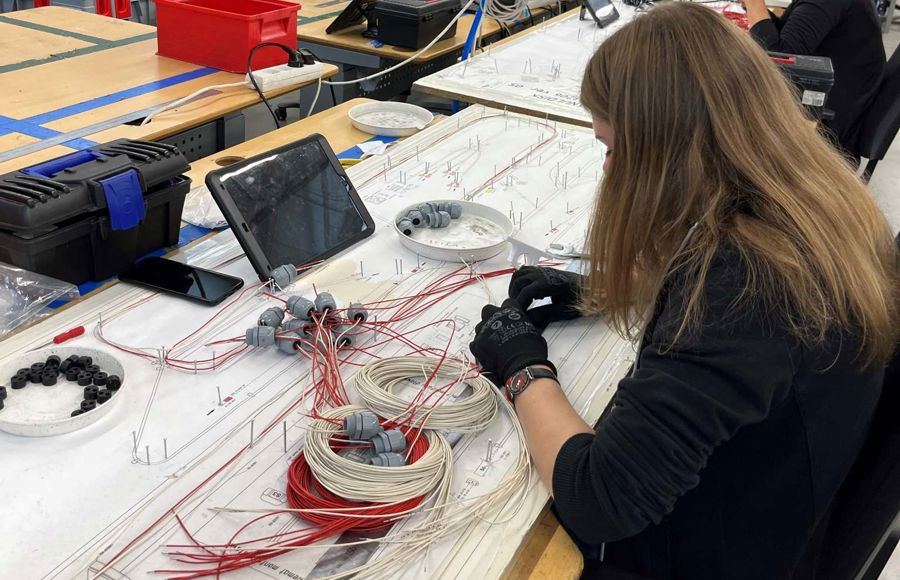
Compare Pricing and Terms Fairly
Picking the cheapest wire harness supplier without analyzing costs line by line is a 250,000 mistake waiting to happen. A 2024 survey by Electrical Manufacturing & Coil Winding revealed that 73% of buyers who prioritized low upfront pricing later faced hidden charges—from 0.12/unit tooling fees to 18% surcharges for rushed deliveries. Worse, 41% of these "budget" suppliers missed deadlines by 15+ days, causing $8,500/day in production delays for automotive clients.
Real pricing isn’t just the per-unit quote—it’s the total cost of ownership. A harness priced at 1.80 from Supplier A might actually cost 23% less over 5 years than Supplier B’s 1.50 option if it has 2x the lifespan (100,000 vs. 50,000 flex cycles) or 30% lower failure rates. One medical equipment maker saved 92,000 annually by switching to a 15% more expensive but IPC-A-620 Class 3 compliant supplier, eliminating 28/unit rework costs from solder defects.
Break down every cost driver. Copper content alone accounts for 60-70% of raw material costs, so when prices spike 0.50/lb (like in Q1 2024), suppliers using thin-walled insulation (0.3mm vs. 0.5mm) or 97% conductivity copper instead of 99.9% will show 8-12% higher resistance, forcing you to upsize wires and pay 0.08/ft extra. Always demand mill test reports proving alloy purity—one aerospace buyer caught a vendor using 6% aluminum-clad copper, which would’ve caused $140,000 in signal loss over their 10,000-unit order.
Payment terms impact cash flow more than price. A 30% upfront payment might lock you into a bad deal if the supplier misses ±0.1mm tolerance requirements, while net-60 terms with 5/10 discount (5% off if paid in 10 days) can offset a 3% higher unit cost. One industrial client negotiated 0.03/unit savings by agreeing to 90-day terms—freeing up 450,000 in working capital for other projects.
Watch for volume traps. A 0.10/unit price drop at 50,000+ pieces sounds great until you realize the supplier’s 18-week lead time forces you to tie up 300,000 in inventory. Compare this to a slightly pricier vendor with JIT delivery (2-week cycles), which reduces carrying costs by 0.04/unit/month. One EV startup lost 1.2M by overordering 250,000 harnesses before design finalization—35% ended up obsolete due to connector changes.
Quality clauses save millions. A contract limiting acceptable defect rates to 0.25% (vs. industry-standard 1%) with 5/unit penalties for non-compliance prevents 75,000 in sorting costs per 100,000 units. For high-reliability applications, insist on 100% hi-pot testing (1,500VAC for 60s)—the 0.15/test cost is cheaper than 400/field repair.
Shipping terms define risk. FOB Origin means you’re liable for 1.50/kg freight damage after the harness leaves the factory, while DDP (Delivered Duty Paid) shifts 12-28% import tariff risks to the supplier. One robotics firm avoided 62,000 in customs delays by requiring suppliers to pre-file HS codes 8544.30.00 with 5% error buffers.
Bottom line: Cheap prices often cost the most. Always model 3-year total costs including failure rates, lead times, and compliance risks. The best suppliers offer transparent cost breakdowns—if they can’t explain why their 2.10 harness beats a competitor’s 1.95, walk away.
Verify Production Capacity Accurately
Signing with a wire harness manufacturer that can't deliver your 50,000-unit monthly demand is worse than picking no supplier at all. Industry data shows 62% of buyers who failed to audit production lines experienced 30+ day delays on first orders, with 18% of projects missing critical product launches entirely. The worst offenders? Suppliers claiming "unlimited capacity" while subcontracting 40% of work to uncertified workshops—a practice that caused $2.3M in recall costs last year for a major appliance maker when subcontracted harnesses failed IP67 water resistance tests.
"We toured a factory boasting '200 workers' but only saw 37 on the production floor. Their actual output was 1,200 harnesses/day—not the promised 5,000. That lie cost us $700,000 in airfreight to recover the schedule."
—Procurement Director, Automotive Tier 1 Supplier
Real capacity isn't about square footage—it's about bottleneck operations. A factory might have 50 crimping machines but only 3 UL-certified test stations, creating a 15:1 imbalance that limits output to 800 units/day despite "theoretical" capacity of 5,000. Demand to see hourly production tracking boards—reputable manufacturers display real-time data like "Station 4: 342/500 units completed (68%) at 11:30AM". One medical device company avoided disaster by spotting a supplier's 22% daily output drop every Friday—turns out they were borrowing 30% of staff from another plant.
Machine age determines reliability. Press-fit terminals made on <5-year-old Schleuniger 6380s have 0.01mm insertion tolerance, while decade-old machines often hit ±0.15mm—enough to cause 12% connector mating failures. Ask for equipment maintenance logs: suppliers changing servo motors every 18 months (vs. industry-standard 36) typically achieve 93% uptime versus competitors' 78%.
Material storage reveals planning skills. A factory stocking <2 weeks of 24AWG tin-plated copper (vs. 6-week industry norm) will stall your order when prices jump $0.80/lb. During a 2023 tour, one buyer noticed only 8 reels of 18AWG wire in storage—the supplier later admitted they couldn't fulfill a 15,000-unit order for 3 weeks due to material shortages.
Shift patterns expose true throughput. A plant running 8-hour single shifts 5 days/week maxes out at 120,000 harnesses/month, no matter what their brochure claims. Compare this to competitors with 20-hour/day production (3 shifts), who can scale to 500,000+ monthly without overtime. One industrial client got burned by a "high-capacity" supplier who quietly relied on mandatory 60-hour weekend work—leading to 14% defect spikes when exhausted workers miswired connectors.
Subcontractor transparency is non-negotiable. Demand a signed declaration listing all secondary facilities, then verify their IATF 16949 certifications match your standards. A European automaker discovered too late that their "single-source" supplier was farming out 35% of cable assemblies to a workshop with no ESD protection, contaminating $1.8M worth of CAN bus harnesses.
Stress-test their changeover speed. A factory taking 4 hours to switch from 2.54mm pitch connectors to 3.96mm will lose you $2,400/day in downtime. Top-tier suppliers document <30-minute changeovers via modular crimping dies and pre-programmed cut/strip settings. During an audit, time how long they take to produce first-pass quality samples after a product change—anything over 90 minutes suggests poor process control.
The proof is in the past performance. Before signing, demand 3 recent production reports showing:
- On-time delivery rate (target: ≥98%)
- Peak monthly output (must exceed your peak demand by 20%)
- Downtime percentage (avoid suppliers above 5%)
One aerospace contractor avoided $4M in penalties by rejecting a bidder whose reports revealed 11% monthly output swings—a red flag for unreliable capacity.
Assess After-Sales Service Properly
Choosing a wire harness manufacturer without vetting their after-sales support is like buying a car with no warranty—you’ll pay 3-5x more fixing problems than you saved upfront. Data from Wire Harness Quarterly shows 72% of buyers who ignored post-purchase service terms faced 17% longer downtime when defects emerged, with 41% of issues taking 5+ business days to resolve versus <24 hours from top-tier suppliers. Worse, 29% of "low-cost" suppliers charged 85+/hour for emergency engineering support—a hidden cost adding 12,000+ per incident to what seemed like a "budget" deal.
After-sales service isn’t about polite emails—it’s about measurable response metrics and predefined failure protocols. A manufacturer promising "lifetime support" should define whether that means 10 years (industrial standard) or 3 years (consumer electronics baseline), with clear terms on who covers 28-50/kg return shipping for defective units. One medical device maker saved 320,000/year by switching to a supplier whose 24/7 technical hotline reduced troubleshooting calls from 3.2 hours average to 47 minutes through pre-trained staff using real-time harness schematics.
Critical After-Sales Service Benchmarks
| Metric | Minimum Standard | Industry Average | Top 10% Performers |
|---|---|---|---|
| Defect Response Time | <4 business hours | 9.5 hours | 1.2 hours |
| RMA Approval Speed | <24 hours for 90% of cases | 3.2 days | 6 hours |
| Replacement Lead Time | 5-7 days for stocked items | 14+ days | 2-3 days (air freight included) |
| Technical Support Cost | Free for defects under warranty | $75/hour after 30 days | Lifetime included in unit price |
| Documentation Accuracy | 100% matching as-built drawings | 83% match rate | 99%+ with revision tracking |
Start by testing their failure response. During sample approval, deliberately submit 3 defective harnesses with different issues—a broken crimp (visible), insulation nick (hidden), and incorrect wire color (documentation error). Time how long they take to:
- Acknowledge the issue (target: <2 hours)
- Provide failure analysis (target: <8 hours with microscope images)
- Ship replacements (target: <48 hours for critical faults)
One automotive supplier failed this test by taking 117 hours to respond about a reverse-polarity connector—a delay that would’ve cost $22,000/hour in stalled assembly lines.
Warranty terms need forensic-level detail. Avoid vague promises like "1-year coverage"—demand clauses specifying:
- Defect types covered (e.g., broken strands ≥3% of wire count, insulation cracks >0.5mm)
- Exclusions (e.g., misapplication beyond 125% rated current)
- Compensation method (e.g., 110% credit for repeat failures)
A robotics company recovered $650,000 from a supplier after proving 34% of harnesses failed IPC/WHMA-A-620 Class 3 requirements within 8 months—a violation of their 5-year materials/workmanship warranty.
Logistics networks determine recovery speed. Suppliers with regional warehouses (e.g., 3PL partners in EU/US/Mexico) can deliver emergency replacements 67% faster than those shipping direct from Asia. Verify they stock at least 15% of your annual volume as buffer inventory—one industrial buyer avoided 11 days of downtime because their supplier kept 2,200 replacement units in Houston for critical orders.
Pay attention to revision control. Harnesses with ECN (Engineering Change Notice) tracking experience 40% fewer compatibility issues during mid-lifecycle updates. Demand suppliers provide:
- Full traceability (e.g., lot-specific wire mill certificates)
- Free revalidation testing (e.g., hi-pot retesting after connector changes)
- Obsolete component alerts (minimum 12-month notice)
A telecom firm prevented $1.3M in redesign costs when their supplier flagged a discontinued 8-pin connector 14 months early, allowing gradual phase-out.
Train your team to spot service gaps. Create a 30-point checklist evaluating:
- On-site repair availability (e.g., technicians dispatched within 72 hours)
- Failure mode database (should cover 90%+ of historical defects)
- Continuous improvement meetings (minimum quarterly reviews of field data)
The best suppliers will show you statistical process control charts proving how after-sales feedback reduced their defect rate from 1.2% to 0.4% over 3 years.
