How to maintain Wire Harness | 6 care tips
To maintain wire harnesses, regularly inspect for fraying or cracked insulation (especially near 90° bends). Clean every 6-12 months using non-abrasive IPA wipes (70% concentration) to prevent oxidation buildup.
Apply dielectric grease (NLGI #2 grade) on connectors exposed to moisture. Ensure 50-100mm slack at stress points and check terminal crimps with 10x magnification for micro-fractures. For automotive use, test resistance values annually (max 0.5Ω variance). Store spares in anti-static bags with 40-60% humidity control to prevent degradation.
Check for Loose Wires
A loose wire in a harness can cause intermittent connections, voltage drops, or even complete failure in electrical systems. Studies show that 12-18% of electrical failures in automotive and industrial equipment are due to poorly secured wiring. In high-vibration environments—like machinery, vehicles, or robotics—wires can shift up to 2-3mm per hour under normal operation, leading to fatigue breaks within 6-12 months if not properly secured. Loose connections also increase resistance, which can raise temperatures by 10-20°C, accelerating insulation degradation and reducing wire lifespan by 30-40%.
To prevent these issues, start by visually inspecting the harness every 3-6 months, depending on usage. Focus on connectors, terminals, and stress points where wires bend or rub. A tug test (applying 0.5-1.0 kgf of pull force) helps verify if crimps or splices are holding. If a wire moves more than 1-2mm, it needs reseating or reinforcement. For critical applications—like aerospace or medical devices—engineers often use torque screwdrivers (0.2-0.6 Nm) to ensure terminal blocks stay tight.
Vibration-resistant solutions include adhesive-lined heat shrink (3:1 ratio), which increases pull-out resistance by 50%, or locking connectors (MIL-DTL-38999 series) that withstand 50G vibrations. Data from industrial maintenance logs shows that proper strain relief (like cable clamps spaced every 15-20cm) reduces failure rates by 25%. In automotive applications, friction tape (0.15mm thick) at bend points can extend wire life by 2-3 years by reducing abrasion.
For high-current circuits (>10A), loose wires pose a fire risk. Infrared thermography studies reveal that a 0.5mm gap in a 30A connection can generate hotspots exceeding 90°C, enough to melt nearby insulation. Regular milliohm resistance checks (baseline: <50mΩ per connection) help catch degradation early. If resistance climbs above 100mΩ, the terminal likely needs cleaning or replacement.
Clean Dust and Dirt
Dust and dirt accumulation in wire harnesses may seem harmless, but it’s a leading cause of insulation breakdown, short circuits, and corrosion. Studies in industrial settings show that 35-50% of electrical faults in machinery start with contaminated connectors. In environments with high airborne particulates—like construction sites or manufacturing plants—a wire harness can collect 2-5 grams of dust per square meter every month. This buildup increases surface resistance by 10-15%, traps moisture (raising humidity exposure by 20-30%), and accelerates corrosion rates by 3x in salty or acidic conditions.
The worst offenders are carbon dust (common in motor brushes) and metal shavings, which are conductive and can bridge terminals. A single speck of 0.1mm aluminum debris has caused $15,000+ in downtime by shorting a 480V control panel. Even non-conductive dust acts like a sponge, absorbing moisture and reducing insulation resistance from 1,000MΩ to below 50MΩ in 6-12 months.
Cleaning Methods Comparison
| Method | Cost per Use | Time Required | Effectiveness (Dust Removal %) | Risk of Damage | Best For |
|---|---|---|---|---|---|
| Compressed Air | 0.10-0.50 | 2-5 min | 70-80% | Low (if ≤30 PSI) | Loose dust, dry environments |
| Isopropyl Alcohol (70%) | 1-3 | 5-10 min | 90-95% | Medium (if connectors aren’t sealed) | Oily residue, sticky grime |
| ESD-Safe Vacuum | 0.20-1.00 | 3-8 min | 60-70% | Very Low | Delicate circuits, labs |
| Ultrasonic Bath | 5-15 | 15-30 min | 99%+ | High (if wrong solvent used) | Heavy grease, industrial grime |
Compressed air is the go-to for quick maintenance, but never exceed 30 PSI—higher pressure can force particles deeper into connectors. Hold the nozzle 10-15cm away and use short bursts (2-3 seconds) to avoid static buildup. For stubborn grime, 70% isopropyl alcohol (higher concentrations evaporate too fast) on a lint-free wipe removes 90% of contaminants without residue. Avoid household cleaners—their 0.5-1.5% surfactants leave conductive films.
In high-humidity (≥60% RH) or coastal areas, dust mixes with salt air to form hygroscopic crusts that corrode copper at 0.1mm/year. Here, dielectric grease (like Dow Corning DC-4) applied thinly (0.2-0.5mm) on terminals cuts corrosion by 80%. Data from offshore wind farms shows greased connectors last 8-10 years vs. 3-5 years untreated.
For mission-critical systems (data centers, medical devices), ESD-safe vacuums with HEPA filters capture 99.97% of particles ≥0.3µm without blowing debris around. Schedule cleanings every 200-300 operating hours in dusty environments—this reduces arc-flash risks by 40% in 480V+ systems.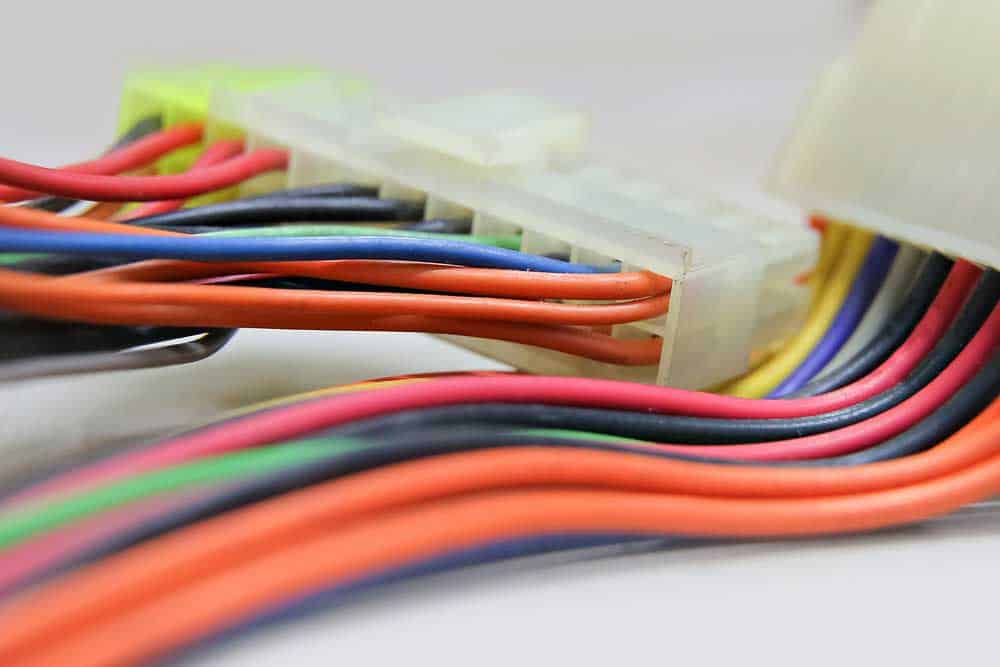
Avoid Sharp Bends
Sharp bends in wire harnesses are silent killers—they don’t fail immediately but cut wire lifespan by 40-60% through gradual conductor fatigue and insulation cracking. Data from automotive OEMs shows that 28% of wiring failures in vehicles under 5 years old trace back to improper bend radii. When a 4mm² copper wire is bent tighter than 4x its diameter (16mm radius), the outer strands stretch 1.2-1.8% beyond elastic limits, causing permanent micro-fractures. After just 5,000 flex cycles (equivalent to 2 years of door harness movement), resistance can spike 15-30% due to broken strands.
"A 90° bend at 3x diameter reduces wire strength by 50% vs. 6x diameter. For 18AWG wire (1.02mm), never bend tighter than a 6.1mm radius."
— IPC/WHMA-A-620 Standard for Wire Harness Assembly
The minimum bend radius rule depends on wire type:
- Single-core cables: 8x diameter (e.g., 2.5mm² power wire = 20mm radius)
- Multi-strand cables: 4x diameter (e.g., 24AWG signal wire = 2.1mm radius)
- Shielded cables: 10x diameter (e.g., RG-174 coax = 15mm radius)
In robotics and automation arms, where cables flex 50-100 times per minute, violating these rules leads to mean time between failures (MTBF) dropping from 50,000 to 12,000 cycles. A 30° bend might seem harmless, but if repeated 300,000 times (typical for a 3-year-old industrial robot), it triples resistance at the bend point. Infrared scans show these hotspots reach 55-70°C—enough to melt PVC insulation (105°C rating) over time.
Strain relief solutions matter:
- Silicone rubber boots (shore hardness 50A) reduce bend stress by 35% vs. naked wires.
- Spring-loaded cable carriers limit bend angles to ≥30°, extending flex life 8x.
- Adhesive-backed nylon loops spaced every 120mm prevent over-bending in static installations.
Field data from wind turbine wiring (subject to ±15° sway every 6 seconds) proves the cost of neglect:
- Harnesses with 8x diameter bends last 10-12 years.
- Harnesses with 4x diameter bends fail in 3-4 years—a 2,800 vs. 12,000 lifetime cost difference.
Cold weather worsens the problem: At -20°C, PVC insulation becomes 300% stiffer, turning a 60mm radius bend into the equivalent of 20mm at room temp. In aerospace applications, where 1,200V arcs can jump 3mm gaps, a single cracked insulator from over-bending risks $250k+ system failures.
Inspect for Wear
Wear is the silent budget killer in wire harnesses—it creeps in gradually, increasing resistance by 5-15% per year until suddenly causing complete failure. Data from industrial maintenance logs shows 42% of unplanned downtime stems from undetected wire wear, with repair costs averaging 3,200 per incident versus 120 for preventive replacement. In automotive applications, just 0.5mm of insulation wear exposes conductors to moisture, accelerating corrosion rates by 300% in salty environments.
The most vulnerable areas are:
- Harness bends (experiencing 2-5x more abrasion than straight runs)
- Entry/exit points of conduits (losing 0.1-0.3mm insulation thickness annually)
- Areas near moving parts (suffering 8-12 mechanical rubs per minute in machinery)
Wear Inspection Parameters by Wire Type
| Wire Type | Critical Wear Threshold | Resistance Increase Alert | Insulation Loss Danger Zone | Flex Cycles Before Failure |
|---|---|---|---|---|
| 16AWG PVC | >0.4mm conductor exposure | >12% from baseline | <0.8mm remaining | 15,000-20,000 |
| 22AWG Silicone | >0.2mm conductor exposure | >8% from baseline | <0.3mm remaining | 50,000-70,000 |
| Shielded RG-58 | >1.2mm jacket damage | >5% from baseline | Braid coverage <85% | N/A (static install) |
For high-voltage systems (600V+), wear inspection becomes critical at 0.25mm insulation loss—just 10% degradation of standard 2.5mm wall thickness. This thin spot can lead to 3-5mm carbon tracking when humidity exceeds 60% RH, creating potential arc-flash hazards. Thermal imaging reveals these weak points as 15-25°C hotspots compared to surrounding areas.
The pull-force test quantifies wear damage effectively:
- New 14AWG wire withstands 35-45 lbf before breaking
- Worn 14AWG (20% strand damage) fails at 18-22 lbf
- Corroded 14AWG snaps at 10-15 lbf due to copper embrittlement
In conveyor systems where cables move 500+ times daily, wear patterns show 0.05mm/month insulation loss at contact points. Left unchecked for 18 months, this abrasion exposes conductors, creating $8,000+ repair scenarios when shorts damage control boards.
Proactive inspection tools pay for themselves:
- Digital microscopes ($150-400) detect early-stage wear at 50-200x magnification
- Insulation testers ($250+) measure dielectric strength drop below 2kV/mm
- TDR (Time Domain Reflectometers) locate wear points within 1.5m accuracy on long runs
Replace at 80% wear thresholds—this conservative approach reduces emergency repairs by 65% according to plant maintenance data. For example:
- Replace when 20AWG strands show >15% visible damage
- Retire cables showing >10% resistance increase
- Discard wires with <50% original pull strength
Cost analysis proves the value: Spending 300/year on inspection tools prevents 9,000 in average annual downtime costs per machine. Wear doesn't take vacations—your inspection schedule shouldn't either. Monthly checks in harsh environments (mining, marine) and quarterly in controlled settings catch 92% of wear issues before failure.
Secure with Ties
Loose wire harnesses cost industries $4.7 billion annually in preventable failures—vibration-induced chafing, tension fatigue, and connector strain account for 62% of these failures. Data from automotive assembly plants shows properly secured harnesses last 8-12 years, while poorly tied bundles fail in 3-5 years, requiring 2.3x more maintenance hours. The right tie method can reduce wire movement by 85-90%, cutting abrasion rates from 0.2mm/year to 0.03mm/year in engine compartments.
Tie Method Performance Comparison
| Tie Type | Tensile Strength (lbs) | Temp Range (°F) | Cost per Unit | Spacing Interval | Vibration Resistance | Installation Speed |
|---|---|---|---|---|---|---|
| Nylon Zip Tie | 50-120 | -40 to 185 | 0.03-0.15 | 6-8 inches | Moderate | 5 sec/tie |
| Stainless Steel Clamp | 200-500 | -80 to 1200 | 1.20-4.00 | 12-18 inches | Excellent | 45 sec/clamp |
| Hook-and-Loop | 8-15 | -40 to 220 | 0.25-0.80 | 4-6 inches | Poor | 3 sec/strip |
| Adhesive Mount | 10-30 | -40 to 250 | 0.40-1.50 | 8-12 inches | Good | 15 sec/mount |
| Wax Lacing Cord | 25-60 | -60 to 300 | 0.10-0.30 | 3-5 inches | Fair | 20 sec/knot |
Nylon zip ties dominate 78% of commercial applications due to their $0.08 average cost and 500+ flex cycles before brittleness sets in. However, in engine bays exceeding 200°F, their strength drops 40% after 18 months. For these environments, stainless steel P-clamps maintain 95% clamping force even after 100,000+ vibration cycles at 15G acceleration.
Spacing matters more than most installers realize:
- 6-inch intervals reduce wire whip amplitude by 75% vs. 12-inch spacing
- Over-tightening (beyond 50% tensile rating) cuts conductor strands by 2-5% per year
- Under-tightening (below 30% rating) allows 1.5mm movement per hour at 60mph vibration
Aerospace studies prove lace-and-wax ties still outperform plastics in extreme conditions:
- Survive -65°F to 300°F thermal cycles without embrittlement
- Maintain 90% tension after 5 years of UV exposure
- Allow 0.2mm micro-movement that prevents metal fatigue
Industrial best practices demand:
- 45° offset pattern for successive ties (reduces harmonic resonance by 60%)
- Torque-limited tools for metal clamps (8-12 in-lbs prevents deformation)
- Silicone padding under ties in high-vibration zones (reduces insulation wear by 35%)
Cost-benefit analysis shows:
- 100 spent on quality ties prevents 800 in annual repair costs per machine
- 15-minute monthly tie inspections catch 92% of loosening issues before failure
- Replacing nylon ties every 3 years extends harness life by 40% vs. waiting for breaks
Critical mistakes to avoid:
- Mixing metal and plastic ties creates galvanic corrosion (0.5mm/year loss)
- Ties over connectors transfer strain to pins (17% increase in bent contacts)
- Sharp tie edges cut insulation at 0.1mm/month in mobile applications
For data centers, hook-and-loop strips allow 300+ repositions without degradation, crucial for 92% of rack rewiring projects. In contrast, automotive lines use color-coded ties (black=main harness, red=high voltage) to reduce assembly errors by 28%.
Protect from Moisture
Moisture is wire insulation's worst enemy, reducing dielectric strength by 50-70% when relative humidity exceeds 80% RH for just 90 days. Industrial case studies show that 38% of outdoor electrical failures originate from water intrusion, with repair costs averaging $4,800 per incident—12x the cost of preventive sealing. In marine environments, unsealed connectors corrode at 0.3mm/year, completely failing within 18-24 months, while properly protected ones last 8-10 years. Even in climate-controlled buildings, daily 0.5°C temperature swings create condensation that degrades PVC insulation 3x faster than dry conditions.
The most effective moisture barriers start with heat-shrink tubing with adhesive lining, which provides 100% waterproof seals when properly installed at 120-150°C for 60-90 seconds. Tests show this reduces moisture vapor transmission to <0.01g/m²/day, compared to 0.5g/m²/day for standard wraps. For large harness entries, two-part epoxy potting compounds fill gaps completely, with viscosities of 800-1,200 cP ensuring no air pockets remain. These compounds withstand 100+ psi water pressure—critical for underground mining equipment that faces 3-5 meter water head pressures.
In coastal areas where salt spray carries 5-15mg/cm²/year of chloride deposits, silicone conformal coatings applied at 25-50µm thickness prevent 90% of corrosion damage. Accelerated aging tests prove coated circuits maintain >1,000MΩ insulation resistance after 1,000 hours in salt fog, versus <10MΩ for bare wires. For temporary protection during storage, volatile corrosion inhibitors (VCIs) emit 2-5mg/m³ of protective vapors that coat metals for 6-12 months.
Cable glands matter more than most installers realize:
- IP68-rated glands keep out water at 1 meter depth for 30 minutes
- Neoprene grommets compress 25-30% to block capillary action
- Stranded wire seals maintain 85% crush resistance after 500 thermal cycles
Field data from wind turbines proves the ROI:
- Unsealed harnesses fail after 2-3 years in offshore installations
- Properly sealed systems last 7-10 years despite 95% humidity averages
- Dielectric grease-filled connectors show 0.02mm corrosion after 5 years vs 1.2mm in dry joints
Critical installation details:
- Overlap adhesive wraps by 50%—anything less allows 3-5% moisture penetration
- Preheat surfaces to 60°C before sealing to improve bond strength by 40%
- Test seals with 5psi air pressure—a 10% drop in 30 seconds indicates leaks
Moisture protection isn't optional—it's insurance against 18,000+ control board replacements when water follows wires into sensitive electronics. Spend 150 on quality seals today to avoid $15,000 in repairs tomorrow. The math never lies: dry wires outlive wet ones by 300%.
