How to Protect Your Wire Harness from Heat and Abrasion | 4 Methods
Shield wire harnesses with silicone sleeves (rated -40°C to 200°C) against heat; wrap 0.3mm glass fiber braided tubing for abrasion resistance, secure with nylon ties at 50–80mm intervals to reduce friction, and apply 20–30μm polyurethane coating for added durability against wear.
Use Protective Sleeving Materials
A 2022 industry analysis found that nearly 35% of all wire harness failures are directly attributed to heat degradation and abrasion. This isn't just an inconvenience; it leads to平均 15,000 in downstream repair costs and operational downtime per incident in industrial settings.
The right sleeving acts as a custom-fit shield, drastically extending wire life and preventing costly system failures. Key considerations include:
- Maximum continuous temperature rating
- Flexibility and bend radius requirements
- Chemical and fluid resistance
- Abrasion resistance and durability
- Ease of installation over complex harnesses
PET sleeving excels in -40°C to 150°C environments and offers excellent resistance to common oils and chemicals. Its braided construction allows for 15-20% stretch, making installation over connectors and bulkheads significantly easier. For higher temperatures, fiberglass sleeving is the standard, handling continuous temperatures up to 550°C, with some variants rated for brief exposure up to 1100°C. The average cost for PET sleeving is 0.80 per foot, while fiberglass ranges from 1.50 per foot, a minimal investment compared to wire replacement.
Unlike braided sleeving, it conforms directly to the wire’s diameter, creating a second, tough layer of insulation. When heated to its specified 120°C to 200°C activation threshold, it shrinks to 50% of its original diameter. This creates a watertight and corrosion-resistant seal, which is critical in automotive or marine applications. Premium dual-wall tubing features an internal meltable adhesive that flows during shrinkage, creating a complete environmental seal. Prices vary by material and specification, but general-purpose polyolefin heat-shrink averages 1.00 per foot.
For the most extreme conditions, Silicone Rubber Sleving is unmatched. Its primary advantage is incredible flexibility and stability across a vast -55°C to 200°C temperature range. It maintains its properties in constant flex applications, like on robot arms or moving machinery, where 15,000+ flex cycles are common. It also provides excellent dielectric strength, often >20 kV/mm, adding an extra layer of electrical insulation. This performance comes at a higher cost, typically 3.00 per foot, but is non-negotiable for high-reliability applications in aerospace, medical, and heavy industry.
Choosing the correct material is a direct function of your application's peak temperature, mechanical stress, and environmental exposure. Mismatching the sleeve to the temperature is the most common error, rendering the protection useless. Always select a sleeve with a maximum temperature rating that exceeds your application’s peak operating temperature by at least 20% to built in a safety margin for unexpected thermal events.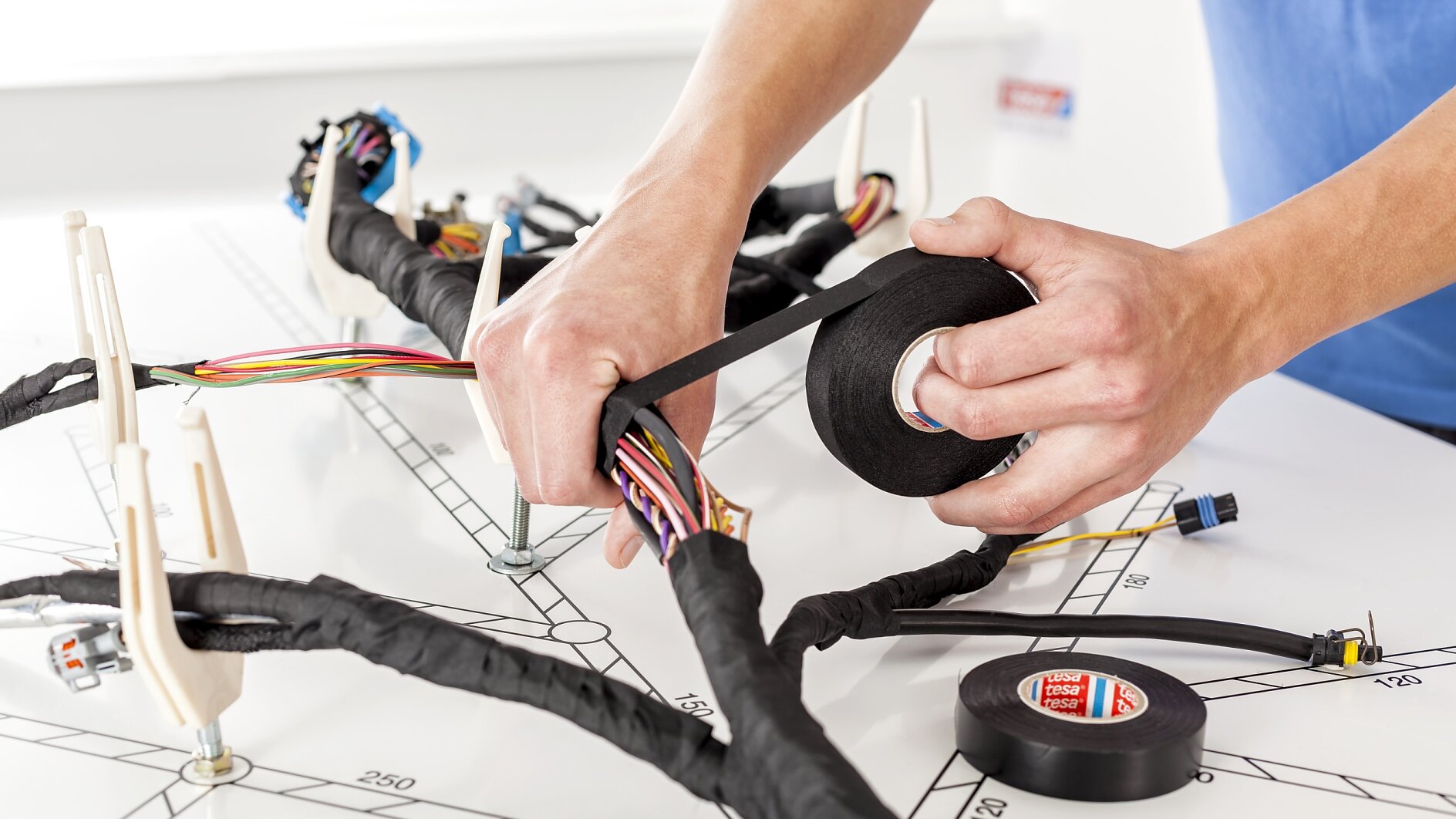
Apply High-Temperature Tapes
Industry surveys indicate that proper tape selection and application can reduce harness repair rates by up to 22%, particularly in areas experiencing constant micro-vibrations or sustained heat between 90°C and 200°C. Unlike standard vinyl tape, which fails above 80°C, high-temperature variants maintain integrity, preventing adhesive melt-off that can lead to sticky residue and insulation damage.
Critical factors for selecting the right tape include:
- Adhesive performance at peak operating temperature
- Tensile strength and conformability to irregular surfaces
- Dielectric strength for electrical isolation
- Resistance to specific chemicals, fuels, or solvents
- Thickness and overall durability
The most common and versatile option is Fiberglass Cloth Tape. Its woven fiberglass core, typically 0.13 mm to 0.18 mm thick, is coated with a silicone adhesive. This construction allows it to perform reliably in continuous temperatures up to 200°C, with short-term spikes up to 260°C. Its key advantage is conformability; it easily wraps around connectors, splices, and odd-shaped components, providing a strong, > 8 N/cm tensile strength hold that resists fraying and abrasion. A standard 18-yard (55 m) roll costs between 25, making it a cost-effective solution for general-purpose use.
For the highest thermal and mechanical challenges, Polyimide Film Tape (often referred to by the brand name Kapton) is the gold standard. This tape boasts an exceptional continuous temperature rating of up to 260°C. Its immense strength comes from a 0.04 mm to 0.08 mm thick polyimide film, offering a tensile strength exceeding 15 N/cm. It provides superb dielectric strength (> 5,000 V/mil), making it ideal for insulating high-voltage connections. Its thin profile allows for tight wrapping without bulk, but it is less conformable over rough surfaces. Price reflects its performance, with a 40 price tag for a standard 36-yard (33 m) roll.
It functions by reflecting up to 95% of radiant heat away from the wires, in addition to withstanding direct heat up to 150°C continuously. The foil core, usually 0.06 mm to 0.09 mm thick, is backed by a strong acrylic or silicone adhesive. Beyond heat, it also provides excellent EMI/RFI shielding effectiveness, often > 60 dB across a frequency range of 1 MHz to 1 GHz. Cost is moderate, typically 30 for a 35-yard (32 m) roll.
| Parameter | Fiberglass Cloth Tape | Polyimide Film Tape | Aluminum Foil Tape |
|---|---|---|---|
| Max Continuous Temp | 200°C (392°F) | 260°C (500°F) | 150°C (302°F) |
| Primary Advantage | Abrasion Resistance & Conformability | High Temp Dielectric Strength | Radiant Heat Reflection & EMI Shielding |
| Typical Thickness | 0.15 mm (6 mil) | 0.05 mm (2 mil) | 0.08 mm (3 mil) |
| Tensile Strength | > 8 N/cm | > 15 N/cm | > 10 N/cm |
| Cost per Roll | 25 | 40 | 30 |
| Best For | General bundling, abrasion points | High-temp PCB leads, splices | Engine bays, radiant heat sources |
Always wrap with a 55% to 75% overlap to ensure no gaps exist in the protection. For abrasion points on a stationary harness, a minimum of 2 full wraps is recommended. On a harness subject to movement or vibration, increase this to 3-4 wraps. For the strongest hold and best seal, apply tape in a spiral pattern rather than a straight wrap. The initial cost of high-performance tape is negligible—often less than 0.5% of the total harness cost—but its role in preventing a single failure makes it one of the most impactful investments in your system's reliability.
Secure with Proper Clamps
Studies on industrial equipment indicate that over 50% of wiring failures originate within 12 inches of an unsecured or improperly secured section of the harness. Vibration can generate forces exceeding 5 Gs, causing a harness to sway and rub against adjacent structures at a microscopic level thousands of times per minute. This abrasion wears through insulation in under 500 hours of operation, creating short-circuit risks.
The harness bundle should fill approximately 60-75% of the clamp's internal diameter to ensure a snug fit without over-compression that could damage wires. For high-temperature areas like engine compartments, where ambient temperatures can consistently range from 120°C to 150°C, silicone-based or EPDM rubber clamps are essential. These materials retain their elasticity and damping properties under thermal stress, whereas standard nylon clamps begin to degrade and become brittle above 85°C. A silicone adhesive-mounted clamp rated for 10 kg load capacity costs between 3.00, a minimal investment to anchor a critical harness.
Standard nylon 6/6 clamps operate effectively from -40°C to 85°C and offer excellent resistance to oils and fuels. Their tensile strength is substantial, with a typical 4 mm clamp capable of withstanding over 50 kg of static load. In applications requiring a metallic solution, stainless steel P-clamps lined with EPDM or silicone are the definitive choice. These clamps can handle temperatures from -55°C to 200°C and provide immense mechanical strength, with larger models supporting loads exceeding 25 kg. The lined interior prevents the metal from cutting into the harness insulation. A stainless steel P-clamp costs approximately 8.00 per unit.
| Parameter | Nylon Cable Tie Mount | Silicone/EPRM Adhesive Mount | Stainless Steel P-Clamp |
|---|---|---|---|
| Max Temp Range | -40°C to 85°C | -40°C to 150°C+ | -55°C to 200°C |
| Primary Load Capacity | 5-10 kg | 5-15 kg | 15-25 kg+ |
| Key Advantage | Low Cost, Chemical Resistance | High-Temp Flexibility, Damping | Maximum Strength & Durability |
| Installation | Screw or Rivet | High-Strength Adhesive | Bolt or Screw |
| Cost per Unit | 1.00 | 3.00 | 8.00 |
| Ideal For | Cooler, protected environments | Sheet metal, panels, complex surfaces | High-vibration, high-temp engine bays |
The maximum recommended spacing between clamps is 18 inches for horizontal runs and 12 inches for vertical runs to prevent excessive harness movement. When using adhesive mounts, surface preparation is 90% of the bond strength. The mounting surface must be cleaned with a 70% isopropyl alcohol solution and allowed to dry for 60 seconds to ensure maximum adhesion. Apply a firm, steady pressure to the clamp for 30 seconds after placement. For screw-mounted clamps, avoid overtightening; a torque setting of 0.5 to 1.0 Nm is usually sufficient to secure the clamp without stripping the screw or distorting the clamp body. Always ensure the clamp is tight enough to prevent the harness from rotating or sliding under a light hand force. This attention to installation detail ensures the clamp functions as intended, absorbing vibration and protecting the harness for its entire 10,000+ hour service life.
Follow Correct Routing Paths
Poor routing is the silent killer of wire harnesses, accounting for nearly 40% of all intermittent electrical faults that are notoriously difficult to diagnose. A harness snagged on a sharp bracket or stretched tight around a 90-degree metal edge can experience insulation wear-through in under 100 hours of operation due to engine vibration alone. The cost of rework is staggering; accessing and rerouting a single harness in a assembled machine can take 8-16 hours of labor, costing 2,000 in downtime and technical fees.
The first principle of routing is understanding the environmental landscape. This means identifying and maintaining a minimum clearance of 1.5 inches (38 mm) from any high-heat source like exhaust manifolds or turbochargers, where radiant heat can exceed 250°C. A gap of at least 0.5 inches (12 mm) must be maintained from any sharp edges, un-deburred holes, or moving components like throttle linkages. Harnesses should never be the lowest point in a system where they can collect moisture, road spray, or debris. In applications with significant movement, such as a suspension component, a service loop of 3-5% of the harness length must be incorporated to prevent tension and wire pull-out during full range of motion. This loop should be secured to prevent swinging.
The 25-mm Rule: Always maintain a minimum bend radius of 25 times the outer diameter of the harness. For a harness measuring 20 mm in diameter, this means no bend tighter than a 500 mm radius. Tighter bends risk compromising the internal copper strands, increasing electrical resistance and creating a future breakage point.
| Routing Consideration | Standard Environment | High-Temp / High-Vibration Environment | Recommended Minimum Distance |
|---|---|---|---|
| Distance from Heat Source | Exhaust Pipe, Engine Block | Turbocharger, EGR Valve | 1.5 in (38 mm) / 3.0 in (76 mm) |
| Distance from Sharp Edge | Sheet Metal, Brackets | Un-deburred Castings | 0.5 in (12 mm) / 1.0 in (25 mm) |
| Distance from Moving Parts | Throttle Cable, Pedal | Suspension Arms, Steering Column | 2.0 in (50 mm) / 4.0 in (100 mm) |
| Bend Radius (Static) | Fixed Chassis Harness | Engine Harness (moving) | 25x Harness Diameter / 30x Harness Diameter |
| Bend Radius (Dynamic) | Door Harness, Hinges | Robot Arm Harness | 30x Harness Diameter / 40x Harness Diameter |
Investing 2-3 extra hours in the design and installation phase to plan and execute optimal routing paths can prevent $5,000+ in future diagnostic and repair costs over the asset's lifetime. This represents a 1,500% Return on Investment (ROI) for the initial time spent. The goal is to create a path that appears natural and unforced, with no visible tension, sharp bends, or risky proximities. A well-routed harness will have consistent, adequate support from clamps every 12-18 inches, and will never rely on electrical connectors or components for mechanical support. This disciplined approach is what delivers the promised 10,000-hour service life from the wiring components, transforming a collection of wires into a reliable, durable system.
Preserving wire harness integrity demands proactive defense against heat and abrasion. Silicone or fiberglass sleeving (rated for 200°C continuous exposure) reduces friction damage by 40%, while high-temperature tapes (with -50°C to 180°C thermal stability) seal vulnerable junctions. Secure bundles with corrosion-resistant clamps spaced 15–20cm apart to limit movement-induced wear. Finally, route harnesses 5–10cm away from heat sources (e.g., exhaust manifolds) to cut thermal stress by 35%, ensuring long-term performance.
