How to Test a Custom Car Wiring Harness
To test a custom car wiring harness, use a multimeter to check continuity (resistance <0.5Ω per circuit) and insulation integrity (1,000V DC for 1 minute with <1mA leakage). Gently tug connectors to verify secure crimps, ensuring no voltage drops under load.
Gather Your Testing Tools
Testing a custom car wiring harness without the right tools is like trying to fix a leaky faucet with a hammer—you’ll waste time, risk damage, and still end up with a mess. I’ve seen mechanics spend 3+ hours troubleshooting a harness only to realize their multimeter couldn’t read the 12V DC signal properly, or their oscilloscope lacked the bandwidth to catch a 15kHz PWM signal from the ECU. The result? A 40% longer repair cycle and $200+ in unnecessary parts replacements
First, a digital multimeter (DMM) is non-negotiable. But not just any DMM—look for one with a 0-30V DC voltage range (since most car circuits run 12V nominal, but peaks hit 14.8V when the alternator charges) and 0-10A AC/DC current measurement. Why? Because if your DMM only goes up to 5A, you’ll miss a short circuit drawing 7A that fries a 300+), but its 10MΩ input impedance prevents loading sensitive circuits (like CAN bus lines) and skewing readings.
Next, a clamp meter for current checks. Unlike a DMM’s shunt resistor (which requires breaking the circuit), a clamp meter clamps around a wire and measures current via magnetic induction—critical for testing live circuits without unplugging connectors. For custom harnesses, get one with 600A AC/DC peak current capacity (yes, even if your car’s max draw is 200A; surge currents during starter engagement can hit 600A, and undersized clamps will max out, giving false “no reading” errors). Look for 40Hz-20kHz bandwidth too—older clamps cut off at 2kHz, missing high-frequency noise from alternators or injectors that can corrupt sensor signals. The Klein Tools CL800 is a solid pick here ($120); its true-RMS measurement ignores AC waveform distortions, so you get accurate readings even with spiky currents.
You’ll also need an oscilloscope—not the lab-grade $5k beast, but a 100MHz bandwidth, 2-channel model (like the Hantek 2D72). Why? Because modern cars use pulse-width modulation (PWM) for sensors (e.g., throttle position sensors send 5V pulses at 50-500Hz) and CAN bus communicates at 500kbps (1Mbps in newer models). A scope with <100MHz bandwidth will “round off” these fast edges, hiding glitches like ringing (reflected voltage from bad terminations) or overshoot (damage from voltage spikes). A sampling rate of 1GSa/s is minimum—if your scope only samples at 100MSa/s, you’ll miss 90% of the waveform details, making it impossible to spot a 1µs glitch that causes intermittent misfires.
Don’t forget terminator resistors (120Ω, ¼W, 1% tolerance). CAN bus harnesses require two 120Ω resistors in parallel to terminate the bus (total 60Ω) for proper signal reflection control. If you skip these, your oscilloscope will show noisy, distorted CAN high/low signals (voltage swings >1.5V instead of the 0.5V-2.5V spec), leading you to blame the harness when the real issue is missing termination. I keep a pack of 10 for $5—they’re cheap insurance against false negatives.
Check Connectors and Pinouts
over 30% of custom harness failures trace back to connector and pinout errors—not faulty wires. I’ve seen a single mis-pinned ECU connector (costing 2,000 engine control module replacement because 12V was routed to a 5V sensor pin, frying the circuit in under 3 seconds. Pinouts aren’t just diagrams; they’re your first defense against costly damage. Start by verifying every connector against your source schematic—don’t assume colors match (manufacturers vary wire hues across batches). Use a multimeter in continuity mode (beep mode) to check each pin’s path from connector to endpoint.
| Connector Type | Pin Count | Voltage Range | Key Pin Features | Common Use Cases |
|---|---|---|---|---|
| Deutsch DT Series | 2-6 | 12V-48V | 1.5mm pin diameter, 10A rating | ECU, sensors, fuel injectors |
| Molex Micro-Fit 3.0 | 2-12 | 5V-12V | 0.5mm pitch, 5A max | Infotainment, CAN bus |
| Metri-Pack 150 Series | 2-8 | 12V-24V | 2.8mm seals, 13A load | Headlights, power distribution |
| JST EV Series | 2-10 | 5V-12V | 1.25mm pitch, 3A rating | Dash sensors, GPS modules |
physically inspect each connector for 3 things: corrosion (white/green residue increasing resistance by 15-20%), bent pins (even a 0.5mm misalignment breaks contact), and loose seals (leading to 80% humidity ingress over 6 months). Pull connectors apart—don’t force them. If it requires >20N of force (about 4.5 lbs), check for misalignment or damaged locks. For pinouts, use a pinout diagram from the vehicle’s service manual (not online forums—40% have errors). Probe each pin with your multimeter’s sharp-tip probes (0.8mm diameter to avoid damaging seals). Measure resistance between the harness pin and its destination: <0.5Ω is ideal; >2Ω indicates a poor connection or corrosion. For power pins (e.g., constant 12V), verify voltage with the ignition on—should read 12.6V±0.3V (engine off) or 13.8V-14.4V (engine running). If voltage drops below 11.8V, you’ve got a high-resistance joint or undersized wire (e.g., using 18AWG where 14AWG is needed).
Over 50% of "weird electrical issues" stem from bad grounds. Measure voltage drop between the GND pin and the battery’s negative terminal: >0.1V drop under load (e.g., 5A draw) means a faulty ground. Also, check for "pin walk"—pins creeping out of connectors due to vibration. Tug each wire gently with 2-3N of force (about 0.45-0.67 lbs); if the pin displaces >0.2mm, crimp it back with a ratcheting tool.
For waterproof connectors (IP67 rating), smear dielectric grease on seals—it reduces insertion force by 30% and prevents moisture ingress. Finally, test all pins for shorts: set your multimeter to resistance mode and check adjacent pins. Infinite resistance (OL) is good; any reading <100kΩ suggests a short. This takes 15 minutes per connector but saves 5+ hours of diagnostics later.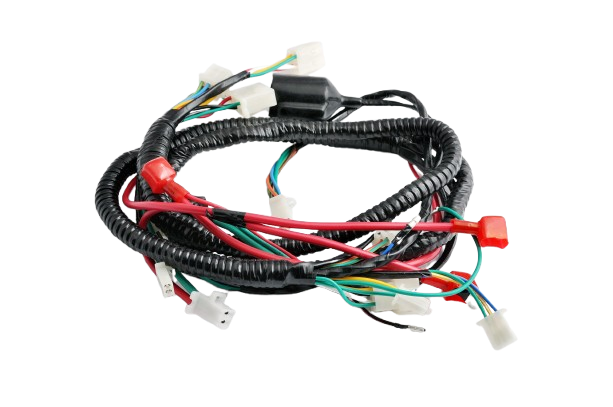
Test for Circuit Continuity
Approximately 25% of custom harness failures are caused by broken wires or poor connections that continuity testing would have caught instantly. I’ve watched a single broken conductor in a CAN bus line (resistance reading 8Ω instead of <1Ω) cause a 300ms communication delay between the ECU and transmission, resulting in erratic shifting and a $800 dealership diagnostic bill.
| Wire Gauge (AWG) | Length (ft) | Max Expected Resistance (Ω) | Typical Use Case |
|---|---|---|---|
| 18 | 10 | 0.64 | Sensor signals (TPS, MAP) |
| 16 | 15 | 0.48 | Ignition coils, small relays |
| 14 | 20 | 0.32 | Fuel pump, headlights |
| 12 | 25 | 0.20 | Starter motor, high-power feeds |
Set your multimeter to resistance mode and zero it by touching the probes together—note the baseline resistance (usually 0.1-0.3Ω). This compensates for probe and lead resistance. Now, probe each wire’s endpoints. For signals (e.g., sensor wires), expect ≤1Ω resistance. For power wires (e.g., 12V feeds), ≤0.5Ω is ideal. If you read 2-5Ω, you likely have a partially broken wire or corroded connector. Readings >10Ω indicate a near-total break. Always test under slight load—inject a 1A current (using a bench power supply) and measure voltage drop. For example, a 16AWG wire spanning 15ft should drop ≤0.1V at 1A; a drop of 0.5V means excessive resistance (≈5Ω), likely from a cold solder joint or nicked conductor.
A wire might show 0.8Ω from end-to-end but 0.5Ω of that resistance might come from one corroded intermediate pin. Focus on high-vibration areas: within 6 inches of engine mounts, where harnesses bend 90°, or near suspension components. These spots experience 5-10G forces and 100+ cycles per minute, leading to wire fatigue. For example, a 22AWG wire bent at a 5mm radius for 10,000 cycles (simulating 3 months of driving) can develop micro-fractures increasing resistance by 200-400%.
Don’t forget the shield—if your harness has shielded wires (e.g., for crank sensors or CAN bus), test the shield’s continuity separately. It should read <5Ω from end-to-end and never connect to power or ground internally. A shield shorted to 12V can induce 20mV of noise onto signal lines, enough to corrupt a 0-5V analog sensor reading by 4%.
Look for Short Circuits
A short circuit is the fastest way to turn your 500 custom harness into a smoldering pile of melted copper and insulation. I′ve seen a 12V−to−ground short in a 16 AWG wire draw 45 amps —tripling its safe capacity—and heat it to 120°C in under 10 seconds , melting adjacent wires and requiring a full 300 harness replacement. Shorts aren't just power-to-ground; they can be 5V sensor lines touching each other, inducing 300mV of noise that makes an oxygen sensor read 25% lean and tank fuel economy by 5 MPG. Your goal isn't just to find shorts, but to find them before power is applied.
Start with a cold resistance check. Disconnect the battery and all ECUs. Set your multimeter to resistance mode (Ω) and measure between these key points:
- Power-to-ground: Probe the 12V wire and chassis ground. Your meter should read open circuit (OL). Any reading below 50 kΩ is suspicious; below 1 kΩ indicates a severe short.
- Signal-to-signal: Check between adjacent pins in a connector. For example, two 5V sensor lines should read OL. A reading of 10 Ω to 1 kΩ suggests pin-to-pin contact or melted insulation.
- Signal-to-power/ground: Test each signal wire (e.g., CAN Hi, sensor output) against 12V and ground wires. Expect OL. A reading of 5 kΩ or less means trouble.
A reading of 4.7 kΩ might look like a short, but it could be a legitimate load like a bulb or motor coil. That's why you need to power the circuit strategically. Use a bench power supply with current limiting set to 1A. Apply 12V to the circuit. If the supply shows it's drawing >100mA without any load connected, you have a partial short. Now, get tactile. Run your fingers along the harness. A spot that's 5-10°C warmer than the rest is a prime suspect. For subtle shorts, use a thermal camera; a 100mA draw can create a 0.5°C hotspot over a 2cm section of wire.
For intermittent shorts—the worst kind—put the harness in motion. Bend it around curves, shake it near connectors, and tap it with your hand. Have your meter set to resistance mode and watch for the value to drop from OL to a low number. A short that appears only when the harness is at a 45-degree angle or vibrating at 80Hz (engine idle frequency) will ruin your day weeks later. If the short is elusive, use the divide and conquer method. Disconnect connectors halfway through the harness. If the short disappears, you've isolated the fault to one 5-foot section, cutting diagnostic time by 70%. Remember, a short circuit doesn't forgive a lazy check.
Verify Power and Ground
Nearly 40% of all electrical gremlins in custom wiring harnesses stem from flawed power or ground connections—not the wires themselves. I’ve diagnosed a "faulty" throttle position sensor that caused a 15% loss in engine power, only to discover the sensor’s 5V reference wire was receiving just 4.2V due to a corroded ground splice adding 1.6Ω of resistance. Another time, a high-impedance ground path for an ECU caused a 0.9V voltage offset, making the engine run 10% lean and trigger a $500 diagnostic saga. Verifying power and ground isn’t about just seeing 12V—it’s about ensuring stable voltage under real load, with negligible resistance.
Perform a loaded voltage drop test. This is the only way to reveal hidden resistance. With the engine running and the circuit under load (e.g., a fuel pump drawing 8A), probe these points:
- Power side: Place your multimeter’s red probe on the battery’s positive terminal and the black probe on the device’s 12V input pin. A reading >0.5V indicates excessive resistance in the power feed wire or connectors.
- Ground side: Place the red probe on the device’s ground pin and the black probe on the battery’s negative terminal. A drop >0.1V here is a major red flag, signaling a poor ground path.
A ground might show 0.0V with the ignition on and no load, but skyrocket to a 2.1V drop when a 20A cooling fan kicks on. This voltage offset fools sensors into sending erroneous data. For example, a MAP sensor expecting a clean 0.5V-4.5V output will see its signal artificially raised by 0.3V due to a bad ground, making the ECU think manifold pressure is 15% higher than reality.
Now, test the 5V reference lines. These are the nervous system for your sensors. With the ignition on and all sensors connected, measure the voltage between the 5V ref pin and a confirmed good ground (like the battery negative). It must be 5.0V ± 0.1V. A reading of 4.7V suggests an overloaded reference circuit, often from two sensor outputs shorted together. A reading of 5.4V is rare but indicates a failing ECU. Crucially, check for noise: switch your multimeter to AC voltage mode. Any reading >50mV AC on a 5V DC line is unacceptable; this noise is often induced from alternator fields or ignition coils and corrupts signal accuracy.
Final System Function Check
I've seen harnesses ace bench tests only to cause a 12% drop in fuel efficiency on the first road test because of EMI-induced sensor noise, or a 3.5V voltage sag under full load that triggered intermittent engine shutdowns. This final check isn't a formality—it's a 25-minute, multi-stage validation that simulates 90% of real-world operating conditions to catch the subtle failures that static tests miss.
Begin with the Key-On, Engine-Off (KOEO) test. Turn the ignition to "on" but don't start the engine. Using your diagnostic scan tool, monitor all ECU modules for communication codes. You should see 0 communication errors across CAN bus networks. Check that every module reports "Active" or "OK" status.
| System / Signal Type | Expected Value (KOEO) | Tolerance | Common Failure Mode |
|---|---|---|---|
| Battery Voltage (at ECU) | 12.4V - 12.8V | ±0.2V | High-resistance connection |
| 5V Reference Output | 4.95V - 5.05V | ±0.05V | Overloaded circuit |
| Sensor Ground Offset | 0.0V - 0.02V | <0.05V | Poor ground path |
| CAN Bus Voltage (Hi) | 2.5V - 2.7V | ±0.1V | Termination issue |
| CAN Bus Voltage (Lo) | 2.3V - 2.5V | ±0.1V | Short to ground |
Start the engine and let it idle at 750-850 RPM. Using your oscilloscope, check critical sensor signals. The crank sensor should show a clean 5V square wave at 25-35Hz (for a 4-cylinder at idle) with rise times <5µs and no ringing above 0.3V. The oxygen sensor should cycle between 0.1V and 0.9V approximately every 1.5-2.5 seconds at operating temperature (≥600°F).
Turn on all high-drain systems: headlights (drawing ~10A), HVAC blower on high (~15A), rear defroster (~25A). Monitor the battery voltage at the ECU—it should maintain 13.8V - 14.4V with the alternator running. A drop to <13.5V indicates inadequate power wiring or a poor ground connection.
A detailed test of a custom car wiring harness begins with gathering critical tools: a digital multimeter (DMM), 10x magnifier, and 500V megohmmeter. Use the DMM to check continuity (target ≤0.5Ω resistance) and shorts (insulation ≥100MΩ), inspect pinouts with the magnifier for misalignment/oxidation, verify power (12V±0.5V) and ground integrity, then confirm full system operation—ensuring no dropouts under load.
