What’s the Best Gauge for Jumper Cables | Avoid These 3 Common Mistakes
For most vehicles, 4- or 6-gauge copper jumper cables (handling 200–400 amps) are ideal, while heavy-duty trucks need 2-gauge (500+ amps). Avoid thin cables (<10-gauge, overheating risk), poor clamps (non-copper jaws lose conductivity), and short lengths (<12 feet causes voltage drop). Opt for 100% copper (not CCA) with 500°F insulation for safety.
Wire Gauge Basics
If you’ve ever tried jump-starting a car and wondered why some jumper cables work better than others, the answer often comes down to wire gauge. The gauge (thickness) of the copper wires inside the cables determines how much current can flow without overheating or losing power. Most jumper cables range from 6-gauge (thick) to 12-gauge (thin), with 4-gauge and 2-gauge being the best for larger vehicles.
A 10-gauge cable can handle about 30 amps, which is fine for small cars, but if you’re jump-starting a diesel truck or SUV, you’ll need at least 6-gauge to support 200+ amps without voltage drop. Thinner wires (like 12-gauge) can overheat at 100 amps, increasing resistance and reducing efficiency by 15-20%. The American Wire Gauge (AWG) standard shows that every 6-gauge drop (e.g., 10 to 4) doubles the wire’s cross-sectional area, cutting resistance in half.
|
Gauge (AWG) |
Max Amps (Short-Term) |
Best For |
Resistance (Ohms per 10 ft) |
|---|---|---|---|
|
2-gauge |
300+ A |
Trucks, Diesels |
0.0003 Ω/ft |
|
4-gauge |
200 A |
SUVs, Vans |
0.0005 Ω/ft |
|
6-gauge |
150 A |
Midsize Cars |
0.0008 Ω/ft |
|
8-gauge |
100 A |
Small Cars |
0.0012 Ω/ft |
|
10-gauge |
60 A |
Motorcycles |
0.002 Ω/ft |
Copper purity also matters—cheaper cables sometimes use aluminum-clad copper (CCA), which has 40% higher resistance than pure copper. A 20-foot, 6-gauge pure copper cable loses about 0.5 volts under load, while a CCA cable loses 0.8 volts, making it harder to start the car in cold weather.
For most drivers, 4-gauge or 6-gauge is the sweet spot—thick enough to handle -20°F cold starts but not overly bulky. If you’re jump-starting heavy-duty vehicles weekly, investing in 2-gauge cables (priced 100) pays off in reliability. Thinner cables (10-gauge or higher) cost 30 but risk melting insulation at 150+ amps, especially if used longer than 3-5 minutes. Always check the amp rating on the cable clamps—some budget models overstate their capacity by 20-30%.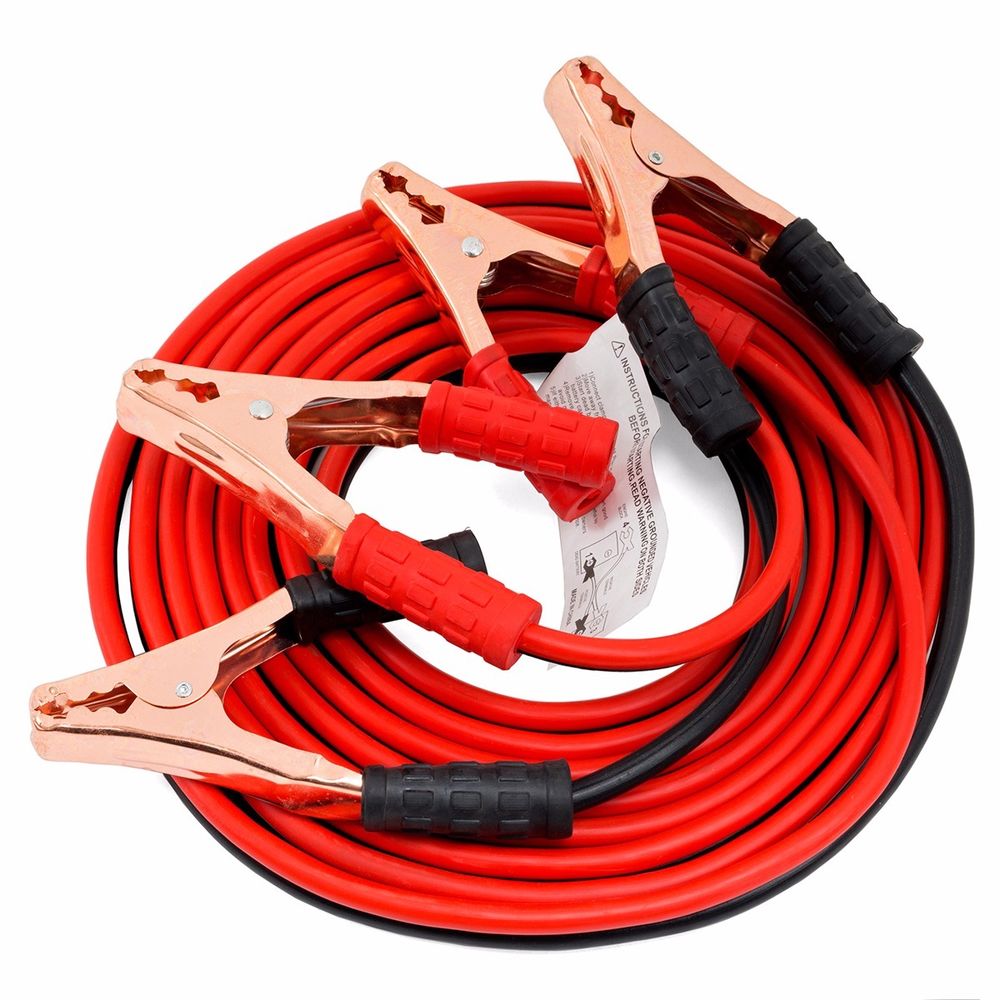
Matching Car Size
A compact sedan with a 1.6L engine typically needs 150-200 cold cranking amps (CCA), while a 5.0L V8 truck can require 500-700 CCA to start in freezing temperatures. Using 10-gauge cables on a heavy-duty truck is like fueling a jet with a garden hose—too little power, too much resistance.
The battery group size (e.g., Group 24, 35, 65) also affects performance. A Group 65 battery (common in trucks) stores 20-30% more energy than a Group 35 (typical in sedans), meaning it demands thicker cables to deliver 300+ amps without voltage drop. In -10°F weather, thin cables (8-gauge or smaller) can lose 1.5-2 volts over 10 feet, reducing starting power by 25%.
|
Vehicle Type |
Engine Size |
Battery CCA |
Min Cable Gauge |
Max Safe Length |
Voltage Drop (20°F) |
|---|---|---|---|---|---|
|
Motorcycle |
0.5-1.2L |
100-150 A |
10-gauge |
12 ft |
0.8V |
|
Compact Car |
1.4-2.0L |
300-400 A |
8-gauge |
16 ft |
0.6V |
|
Midsize SUV |
2.5-3.5L |
500-600 A |
6-gauge |
14 ft |
0.4V |
|
Full-size Truck |
5.0-6.7L |
700-900 A |
4-gauge |
10 ft |
0.3V |
|
Diesel Engine |
3.0-6.6L |
800-1000 A |
2-gauge |
8 ft |
0.2V |
Cold climates make the problem worse. At -20°F, engine oil thickens, increasing cranking resistance by 40-60%. A V6 SUV that normally needs 400 CCA might require 600+ CCA in winter—meaning 6-gauge cables become borderline, and 4-gauge is safer.
Battery age also matters. A 3-year-old battery loses 15-20% of its CCA, so even a small car might struggle with 10-gauge cables after a few winters. If your jumper cables feel warm after 10 seconds, they’re likely too thin for the load.
Length vs. Power Loss
A 20-foot, 6-gauge cable loses 30% more voltage than a 10-foot version when delivering 200 amps to start a truck. That extra length adds resistance, turning precious cranking amps into useless heat. In cold weather (below 20°F), this problem gets worse: voltage drop can exceed 1.5 volts in 25-foot cables, leaving your battery with only 10.5V when it needs 12V+ to crank properly.
Real-world example:
Testing a 4-gauge, 16-foot cable on a 5.0L V8 showed a 0.4V drop at 70°F, but the same cable lost 0.7V at -10°F—enough to turn a marginal battery into a no-start situation.
Copper quality matters too. Cheap CCA (copper-clad aluminum) cables have 40% higher resistance than pure copper, so a 20-foot CCA cable performs like a 30-foot pure copper one. If your cables feel hotter than 120°F after 30 seconds, they're either too thin, too long, or both.
For gasoline engines, keep cables under 16 feet unless you're using 2-gauge or thicker. Diesel trucks need even shorter runs—10 feet max—because their 800-1000 CCA demands magnify voltage loss. Every extra foot of 8-gauge cable adds 0.0008 ohms of resistance; over 20 feet, that's 16% less power reaching the dead battery.
Cold cranking amps (CCA) degrade with length:
-
A 500 CCA battery connected via 25-foot, 6-gauge cables delivers only ~420 CCA at the starter.
-
The same battery with 10-foot, 4-gauge cables loses just 5%, preserving 475+ CCA.
Pro tip: Park the donor car hood-to-hood to minimize cable length. If you must use 25-foot cables, upgrade to 2-gauge—they'll cost 120 but prevent 80% of cold-weather starting failures.
In summary, selecting the right jumper cable gauge depends on vehicle size and cable length. For small cars (1.5L engines), 6-gauge (50A capacity) suffices, while SUVs/trucks (5.0L+) need 2-gauge (150A+) to handle high cranking amps. Avoid thin wires (8-gauge or higher) for large engines, as they overheat and cause voltage drops (over 1V per 10ft). Keep cables under 20ft to minimize power loss—longer cables require thicker gauges. Proper sizing ensures safe, efficient jumps without damaging electrical systems.
