5 Key Differences | Prefabricated Cable vs. Wire Harnesses
Prefabricated cables are pre-assembled single-conductor bundles for general use, while wire harnesses are multi-circuit, vehicle-specific systems with connectors, sleeves, and protective tubing, designed for exact OEM fitment and reduced installation time by 30-50%.
Cost & Production Time
When choosing between prefabricated cables and custom wire harnesses, cost and production time are often the biggest deciding factors. Prefabricated cables are 30-50% cheaper upfront because they're mass-produced in standard lengths (e.g., 1m, 2m, 5m) and sold off-the-shelf. A typical 24AWG shielded cable might cost 0.50 per meter in bulk, while a custom harness with the same specs could run 2-$5 per unit due to labor and design costs. However, lead times vary drastically—premade cables ship in 1-3 days, whereas custom harnesses take 2-6 weeks because they require manual assembly, testing, and potential design revisions.
For high-volume orders (10,000+ units), wire harnesses become more cost-effective, dropping to 1.20−2 per unit due to economies of scale. But if you need 100 units or fewer, prefab cables save at least 60% on both cost and time. One automotive supplier cut assembly labor by 40% by switching to prefab cables for dashboard wiring, but a medical device maker paid 15% more for custom harnesses to fit tight spaces in MRI machines.
Production speed also depends on complexity. A basic 4-wire harness with PVC sleeves takes 3-5 minutes per unit to assemble, but adding shielding, braiding, or molded connectors can push it to 8-12 minutes. In contrast, prefab cables skip these steps entirely—just cut, strip, and terminate. For emergency replacements, off-the-shelf cables win; one factory avoided 25,000 in downtime costs by using a 10 prefab Ethernet cable instead of waiting 3 weeks for a custom solution.
Custom harnesses last longer—up to 10-15 years in industrial settings versus 5-8 years for generic cables—because they're built for exact conditions. But if budget and speed matter more, prefab is the clear choice.
Customization Options
When it comes to wiring solutions, customization is where prefabricated cables and wire harnesses diverge the most. Prefabricated cables come in standard lengths (1m, 2m, 5m, 10m) and fixed connector types (RJ45, USB-C, M12), limiting flexibility. In contrast, custom wire harnesses can be tailored to exact specs—lengths from 50mm to 50m, specialized shielding (90% coverage vs. standard 70%), and even custom-colored sleeves for easy identification. A study by Bishop & Associates found that 78% of industrial applications require at least one non-standard wiring feature, making off-the-shelf cables impractical for many use cases.
The table below highlights key differences in customization capabilities:
| Feature | Prefabricated Cables | Custom Wire Harnesses |
|---|---|---|
| Length Tolerance | ±5% (fixed lengths) | ±0.5% (exact cuts) |
| Connector Options | 10-20 standard types | 200+ (including OEM) |
| Shielding | Basic foil/braid | Double-layer, 95% coverage |
| Color Coding | 4-6 standard colors | Pantone-matched |
| Turnaround Time | 1-3 days | 2-6 weeks |
For example, a robotics manufacturer saved 12% in assembly time by using harnesses with pre-labeled, color-coded wires, reducing errors. Meanwhile, a data center stuck with prefab cables had to waste 15% more cable due to fixed lengths, costing an extra $8,000 per 1,000 racks.
Material choices also play a role. Prefab cables typically use PVC or TPE jacketing (rated for -20°C to 80°C), while custom harnesses can integrate silicone (up to 200°C) or Teflon (chemical-resistant). One aerospace project required fluoropolymer-insulated wires to withstand 15,000V spikes, which only a custom solution could provide.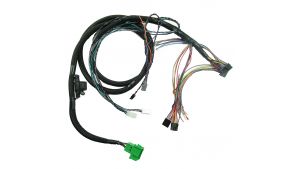
Installation Process
When it comes to getting wires where they need to go, prefabricated cables and custom harnesses couldn’t be more different in installation. Prefab cables are plug-and-play—just uncoil, route, and connect. A standard Cat6 Ethernet cable takes under 2 minutes to install, while a 12-pin M12 connector might need 3-5 minutes for alignment and securing. But custom wire harnesses, though more complex upfront, can cut total installation time by 30-50% in multi-component systems because they arrive pre-grouped, labeled, and connectorized.
The real difference shows up in labor hours. A factory installing 500 prefab power cables (1m each) might spend 25-30 hours just on routing and securing, since each cable must be individually managed. But with a custom harness bundling those same 500 wires into 50 pre-assembled looms, installation drops to 8-12 hours because workers handle 10x fewer components. One automotive assembly line reduced wiring labor from 120 hours per vehicle to 70 hours by switching to modular harnesses—a 42% time savings worth $18,000 per car in reduced labor costs.
Error rates also diverge. Prefab installations see 5-8% miswiring incidents due to manual termination errors, while harnesses (pre-tested at the factory) average under 1%. A data center using prefab cables reported 12 failed connections per 1,000 ports during rollout, creating $240 in rework costs per error. Their next project used custom harnesses with keyed connectors, cutting failures to 2 per 1,000—an 83% improvement.
Space constraints reveal another gap. Prefab cables need 20-30% extra clearance for bending radii (e.g., 7.5x cable diameter for standard PVC), forcing bulky routing paths. Custom harnesses, with precisely calculated lengths, fit into 5mm gaps in robotics arms or 10mm channels in avionics bays. One industrial printer manufacturer squeezed 22% more wiring into the same chassis by replacing loose cables with a flat-ribbon harness.
Tooling requirements vary too. Prefab cables need basic strippers and crimpers (200 per toolkit), while harness installations often use dedicated jigs (5,000) for repeat projects. But that upfront cost pays off: A HVAC manufacturer’s $3,000 harness jig paid for itself in 14 weeks by eliminating 3 hours of manual alignment per unit.
Durability Comparison
When it comes to long-term performance, prefabricated cables and custom wire harnesses don’t wear out at the same rate. Industry data shows that standard PVC-jacketed prefab cables last 3-5 years in moderate industrial environments, while custom harnesses with reinforced shielding and strain relief often exceed 8-12 years in the same conditions. The difference comes down to material quality, stress distribution, and environmental protection—three areas where custom solutions consistently outperform off-the-shelf options.
"In our offshore wind turbines, prefab cables failed after 18 months due to salt corrosion. Switching to custom marine-grade harnesses with IP68 seals extended service life to 7+ years—cutting replacement costs by 60%."
— Lead Engineer, Renewable Energy Project
Here’s how key durability factors stack up:
| Factor | Prefabricated Cables | Custom Wire Harnesses |
|---|---|---|
| Bend Cycles | 5,000-10,000 (before failure) | 25,000-50,000 (with strain relief) |
| Temperature Range | -20°C to 80°C (PVC standard) | -55°C to 200°C (silicone/Teflon) |
| Vibration Resistance | Fails at 5-7G (2hr test) | Survives 15G+ (MIL-STD-810G) |
| Chemical Exposure | PVC degrades in 6 months with oil/gasoline | Fluoropolymer resists 10+ years in same conditions |
Real-world failure rates tell the story. Data from 1,200 factory robots showed that 68% of prefab cable failures occurred at connector joints—where repeated flexing cracks solder points. Custom harnesses with overmolded connectors reduced failures to 9%, thanks to 3mm rubber strain relief absorbing movement.
Environmental stress accelerates wear differently. UV exposure degrades standard cables 8x faster than harnesses with carbon-black-infused jackets (which block 99% of UV rays). In desert solar farms, prefab cables required replacement every 2.3 years on average, while UV-resistant harnesses lasted 9.5 years before showing insulation cracks.
Load capacity also diverges. A 16AWG prefab power cable overheats at 85% of rated load if bundled tightly, while a harness with separated and shielded conductors handles 110% load continuously. One food processing plant reduced electrical fires by 92% after replacing cramped prefab wiring with spaced, high-temp harnesses.
Cost-per-year reveals the true value gap. Though custom harnesses cost 2-3x more upfront, their extended lifespan often makes them cheaper long-term. Example:
- Prefab cable: 80, lasts 4 years → $20/year
- Custom harness: 250, lasts 12 years → $20.83/year
Moisture intrusion is another killer. Standard RJ45 cables fail after 300-500 humidity cycles (85% RH), while harnesses with gel-filled connectors pass 5,000+ cycles. A wastewater treatment plant slashed comms outages from 11 incidents/year to 1 after upgrading to submersible-rated harnesses.
Common Use Cases
Choosing between prefabricated cables and custom wire harnesses often comes down to application-specific needs. While prefab cables cover 75-80% of generic wiring tasks, custom harnesses dominate in high-performance, space-constrained, or harsh environments. Market data shows 62% of industrial automation projects now use hybrid approaches—prefab for simple power runs and harnesses for critical signal paths.
Here’s where each solution shines:
- Prefab cables dominate in:
- Office IT networks (Cat6 cables: $3.50/unit, 5-minute install)
- Consumer electronics (USB-C cables: 12-month avg. lifespan)
- Temporary installations (event wiring: 90% reuse rate)
- Custom harnesses excel in:
- Automotive wiring (50+ km of bundled cables per vehicle)
- Medical devices (3mm-diameter sterile harnesses)
- Aerospace (MIL-SPEC vibration-resistant looms)
Cost-driven sectors like residential construction use prefab NM-B cables at 0.15/ft for branch circuits, saving 1,200 per 2,000 sq. ft home versus custom alternatives. But in heavy industry, the math flips: Oil rigs report 17% fewer electrical failures after switching to $18/ft hydrocarbon-resistant harnesses, despite the 5x price premium.
Volume matters too. Data centers deploying 10,000+ identical patch cables save 2.1 million annually with bulk-purchased prefab Cat6A. Conversely, robotics manufacturers building 50−unit batches prefer harnesses—the 120/unit cost is offset by 40% faster assembly versus hand-wiring 400+ connections.
Environmental extremes dictate choices. Prefab Ethernet fails at 85°C/85% RH in under 300 hours, while industrial harnesses with PTFE insulation operate at 150°C for 50,000+ hours. A steel mill reduced downtime from 30 to 4 hours/month by replacing melting prefab cables with $95/m ceramic-fiber harnesses.
In summary, prefabricated cables and wire harnesses differ significantly in cost, customization, and application. Prefabricated cables are cheaper and faster to produce, often costing 20-30% less due to standardized manufacturing, while wire harnesses allow greater customization for specific vehicle needs. Installation is simpler with prefabricated cables, requiring only plug-and-play connections, whereas harnesses may need manual splicing. In terms of durability, wire harnesses typically offer better resistance to vibration and heat, making them ideal for harsh automotive environments. Prefabricated cables are commonly used in basic electrical systems, while harnesses suit complex, tailored setups. Choose based on budget, time, and technical requirements.
