Top 3 Industries That Rely on Professional Cable Harness Manufacturers
Automotive leads with ~40 custom harnesses per vehicle, driving demand for manufacturers using automated testing to meet ISO 26262 safety standards. Aerospace relies on them for avionics and engines, requiring AS9100-certified precision to handle extreme temperatures. Medical devices, like MRI machines, depend on low-noise harnesses compliant with ISO 13485, necessitating rigorous EMI shielding during assembly.
Automotive Custom Wiring
A premium car now contains over 1,500 individual wires, totaling more than 5,000 meters in length and weighing up to 60 kilograms. This intricate web carries data and power to everything from 10-15 advanced driver-assistance system (ADAS) sensors to over 100 electronic control units (ECUs). The design and manufacturing precision of these harnesses directly impact vehicle performance, safety (affecting 5-star NCAP ratings), and manufacturing efficiency. A single fault can cause a cascade of failures, making the role of professional harness manufacturers not just important, but critical to the entire automotive supply chain, which spends an estimated $25-30 billion annually on these components.
| Metric | Standard Vehicle | High-End/EV Vehicle | Impact of Professional Manufacturing |
|---|---|---|---|
| Total Wire Length | ~3,000 meters | ~5,000+ meters | Optimized routing reduces weight and material use by 10-15%. |
| Number of Connectors | 300 - 500 | 800 - 1,200 | 99.99% mating accuracy prevents assembly-line errors. |
| Harness Weight | 25 - 40 kg | 50 - 60+ kg | Weight reduction directly increases EV range by 0.5-1 km per kg saved. |
| Error Rate (per 1,000 units) | 5 - 10 (generic) | < 0.1 (professional) | Near-zero defects cut warranty and repair costs by up to 40%. |
Professional cable harness manufacturers bring a level of precision and scalability that is indispensable to automotive OEMs. Their value is not in simple assembly but in engineering-for-manufacturability. They use automated wire-cutting and stripping machines that process 5,000-10,000 wires per shift with micron-level precision, ensuring every 0.35 mm² or 4.0 mm² cross-section wire is stripped to the exact length required without damaging the 19/0.32 mm or 126/0.2 mm stranding. This eliminates over 95% of the manual errors typical in low-volume operations. For a single vehicle platform producing 500,000 units annually, this precision prevents an estimated 25,000 potential field failures, saving the OEM millions in recall campaigns and warranty claims.
Every single harness is subjected to 100% electrical testing on a custom-programmed test rig that applies 500V to 1000V for hi-pot (dielectric strength) tests to check for insulation breaches and performs continuity checks on every single circuit (over 2,000 points per harness) in under 60 seconds. This test cycle verifies resistance is below 5 milliohms at connection points and ensures no short circuits (< 1 MΩ resistance) or open circuits (> 10 Ω resistance) exist. This rigorous process catches flaws before the harness ever leaves the factory, boosting first-pass yield rates to 99.8% and virtually eliminating faulty parts from disrupting the OEM's 60-90 second per vehicle takt time on the assembly line.
They specify cross-linked polyethylene (XLPE) or fluoropolymer insulation for engine bays where temperatures consistently exceed 125°C, and they select sealed connectors with IP6K9K ratings for exposure to high-pressure water and dust. For battery electric vehicles (BEVs), they handle high-voltage cables (60V to 900V) requiring orange-colored, double-walled insulation with a 10-12 mm diameter to safely manage powers exceeding 150 kW. Their expertise in material selection ensures a harness lifespan that matches the vehicle's 15-year or 250,000-mile design life, preventing costly failures of critical systems like braking or steering. This deep knowledge of SAE, ISO, and OEM-specific standards transforms a bundle of wires into a reliable, automotive-grade system.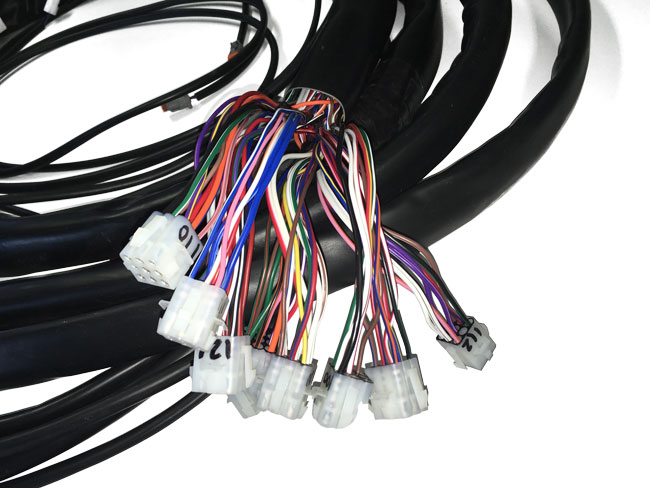
Aerospace High-Spec Applications
A single commercial airliner, such as a Boeing 787 or Airbus A350, utilizes over 140 kilometers of wiring, connecting more than 25,000 individual sensors and components across the aircraft. The failure rate for these systems is measured in probabilities of less than 1x10⁻⁹ failures per hour, a standard that demands perfection. Every gram of weight saved in harness design translates directly into fuel savings; for a fleet of 50 aircraft, a 20-kilogram reduction per plane can save an airline over $1 million annually in fuel costs. This extreme emphasis on mass optimization, signal integrity, and flawless performance under pressures ranging from sea level to 40,000 feet is why aerospace OEMs partner exclusively with specialized harness manufacturers.
The core differentiator in aerospace wiring is the unforgiving adherence to standards like AS5087 and MIL-STD-202. Every process, from selecting a 22-AWG Teflon-insulated wire rated for -65°C to 200°C to crimping a gold-plated pin with a force of 50-60 pounds, is governed by a documented, verifiable procedure. This isn't just about quality; it's about traceability. Each component, down to a 2mm diameter solder sleeve, must be traceable to its manufacturing lot, allowing for forensic investigation of any anomaly. This level of control reduces the probability of a wiring-related incident to a statistically near-impossible event, which is non-negotiable when the system controls fly-by-wire actuators or engine fire suppression systems.
This includes thermal shock cycling between -55°C and 125°C for over 500 cycles to simulate years of rapid ascent and descent. They undergo vibration testing at frequencies from 10 Hz to 2000 Hz for 24-96 hours per axis to ensure no chafing or fatigue will occur from constant engine and airframe resonance. Crucially, they are placed in altitude chambers where pressure is dropped to simulate 70,000 feet to check for corona discharge, a phenomenon where electricity arcs through thin air, which can be catastrophic. Only harnesses that pass these 100% validation checks without a single failure are approved for installation.
The development and certification cycle for a new aircraft harness can span 24-36 months and represent an investment of 5-15 million in engineering and tooling alone. However, this up front cost is justified by the production of harnesses that will remain in service for 30+ years. The mean time between failures (MTBF) for these systems is measured in hundreds of thousands of hours. For an OEM, the risk of a 500,000 harness recall or, infinitely worse, a grounding of its fleet over a wiring issue, makes the partnership with a manufacturer that guarantees 100% compliance and provides full data packs for every single unit not a luxury, but a fundamental requirement for doing business.
Medical Precision Assemblies
A single diagnostic imager like an MRI or CT scanner contains over 20 kilometers of specialized cabling, responsible for transmitting microvolt-level signals with zero interference to create sub-millimeter resolution images. The failure tolerance for these systems is often measured in fractions of a percent, with target uptime exceeding 95% over a 15-year operational lifespan. Regulatory compliance isn't optional; it's embedded in every step. Adherence to ISO 13485 and FDA 21 CFR Part 820 standards requires complete component traceability and validates every process, from the selection of biocompatible, USP Class VI-rated silicone insulation to the precise application of 5-10 nm of gold plating on connectors to ensure >10,000 mating cycles without corrosion. This absolute demand for signal integrity, reliability, and biocompatibility makes the role of specialized harness manufacturers non-negotiable.
- Material Compliance: Every material, from wire insulation to solder, must be certified for medical use, often requiring USP Class VI or ISO 10993 biocompatibility testing to ensure no toxic off-gassing or reactions within the controlled environment of a 68°F (20°C) operating room.
- Cleanroom Assembly: Many assemblies are built in ISO Class 7 (10,000 particles per cubic foot) or cleaner environments, with technicians in full gowning to prevent contamination from particulates or skin cells that could compromise device function or patient safety.
- Electrical Performance: Shielding effectiveness is paramount, with requirements often specifying >90 dB attenuation against electromagnetic interference (EMI) to protect sensitive signals from external noise and prevent the device from emitting noise that disrupts other equipment.
Automated laser stripping machines remove insulation from 36 AWG magnet wires (thinner than a human hair) with a precision of ±0.05 mm, ensuring no nicks to the 7-42 strand copper conductor. This prevents a >50% reduction in break strength and potential future failure. Each termination, whether a crimp connection rated for 2A continuous load or a solder joint with a pull strength requirement of 5-8 newtons, is performed following a validated procedure. The entire assembly undergoes 100% electrical testing, including hipot tests at 1500V AC for 60 seconds to ensure isolation and insulation resistance checks exceeding 100 MΩ. For a patient monitor cable, this means testing all 128+ data lines for continuity and shorts in under 45 seconds to maintain production flow without sacrificing quality.
A 250,000 surgical robot cannot be taken offline for a 500 cable harness repair; the downtime cost from lost procedures can exceed 15,000 per hour. Furthermore, a single field failure can trigger an FDA-reportable event, potentially leading to a Class I recall costing the manufacturer >50 million in direct costs and incalculable brand damage. Professional manufacturers mitigate this by building harnesses with a mean time between failures (MTBF) exceeding 100,000 hours and providing the full device history record (DHR) required for audit trails.
In today’s tech-driven manufacturing ecosystem, professional cable harness manufacturers are indispensable, particularly in three sectors. Take automotive: the 300B EV market demands 50+ custom harnesses per vehicle, integrating high-voltage systems. Aerospace? 90% of OEMs rely on DO-160G-certified harnesses for avionics, avoiding 500k+ rework. Medical? Biocompatible harnesses with ±0.05mm precision are critical for MRI scanners, ensuring 99.9% signal accuracy.
