Top 5 Cable Harness Testing Methods You Should Know
Here are five essential cable harness testing methods: continuity tests verify wire connections using a multimeter, while hipot testing applies high voltage (e.g., 1500V AC) to check insulation strength. Insulation resistance tests measure leakage current (e.g., >100MΩ), and mechanical tests validate durability through flexing. Finally, functionality testing under real-world conditions ensures overall performance.
Continuity Testing Basics
Continuity testing is the first and most fundamental check for any cable harness, acting as a basic "health scan" for electrical connections. It verifies that current flows uninterrupted along the intended path, ensuring there are no unexpected opens or shorts. Industry data reveals that over 15% of wiring faults in new harnesses are simple continuity issues—often due to crimping errors, broken strands, or misrouted wires. A single failed continuity check, such as a >1 ohm resistance reading where it should be <0.5 ohms, can save hours of downstream troubleshooting. For a typical 50-circuit harness, a full continuity test takes less than 2 minutes with modern test equipment, making it a high-return investment in quality assurance. This quick check prevents more expensive, time-consuming diagnostics later.
The test involves applying a small, safe DC voltage (usually <10V) between two points in a circuit and measuring resistance. The acceptable resistance range is typically very low, confirming a good connection.
-
A good circuit shows a continuous path with resistance below a set threshold, often <1 ohm.
-
An open circuit shows infinite resistance (OL on multimeters), indicating a broken wire or failed termination.
-
A short circuit shows unexpected low resistance (<0.1 ohm) between two points that should be isolated, like adjacent pins in a connector.
Modern automated cable testers can perform these checks on entire harnesses with 100-5000+ points in under 60 seconds, providing a simple pass/fail report.
Precision is key. While a simple beep from a multimeter confirms continuity, professional testing requires measuring exact resistance values. This quantifies the quality of the connection.
|
Connection Type |
Target Resistance |
High-Resistance Fault Threshold |
Common Cause of High Resistance |
|---|---|---|---|
|
Standard Copper Wire (22 AWG, 1m) |
< 0.05 Ω |
> 0.5 Ω |
Loose crimp, corrosion, partial break |
|
Multi-Strand Wire Termination |
< 0.02 Ω |
> 0.1 Ω |
Insufficient wire in crimp barrel |
|
Gold-Plated Contact (Mated Pair) |
< 0.01 Ω |
> 0.05 Ω |
Contact contamination, insufficient mating force |
Why precise values matter: A resistance reading of 0.8 ohms might still "beep" on a basic tester, but it signals a potential problem. Over a 10-amp circuit, this fault would generate 8 watts of wasted heat (P = I²R), leading to potential overheating and connector degradation over time.
For reliable results, use a calibrated 4-wire (Kelvin) measurement method. This technique eliminates the inherent resistance of the test leads themselves, which can be 0.1-0.3 ohms—enough to mask a developing fault. For example, if your test leads add 0.2 Ω of error, you cannot accurately measure a 0.25 Ω connection. A 4-wire setup provides accuracy down to 0.001 Ω (1 mΩ), ensuring you catch degrading connections before they cause system failures. Always test at the operating current or slightly above (100mA to 1A) to detect faults that may only appear under electrical load.
Insulation Resistance Checks
While continuity testing verifies connections, insulation resistance (IR) testing checks for isolation. It ensures no unwanted current flows between wires that should be separate, a critical safety and reliability check. Poor insulation is a leading cause of short circuits, equipment damage, and even fire hazards. In humid environments (e.g., >60% relative humidity), insulation faults can increase by up to 40%. A standard test applies a high DC voltage—typically 500 VDC for low-voltage systems—between a conductor and ground or an adjacent conductor, then measures the resulting leakage current. This is converted into a resistance value measured in megohms (MΩ). For most commercial applications, a minimum acceptable value is 100 MΩ, but critical systems often require 1,000 MΩ or higher. Catching a weak spot with 5 MΩ of resistance today prevents a dead short at 0 Ω tomorrow.
The test is defined by a simple equation: Insulation Resistance (R) = Test Voltage (V) / Leakage Current (I). You apply a known voltage and precisely measure the tiny current that leaks through or across the insulation. This is why specialized IR testers or megohmmeters are used; a standard multimeter cannot accurately measure these extremely high resistances. The applied test voltage is crucial and is selected based on the wire's rated operating voltage. A common rule is to use 500 VDC for systems rated up to 250 VAC and 1,000 VDC for systems up to 600 VAC. Applying the correct voltage for a 60-second duration is key to getting a stable, meaningful reading.
Interpreting the results requires understanding the context. A reading of 50 MΩ might seem high, but for a 10-meter long cable, it could indicate a problem. Industry standards often specify minimum values per unit length, such as 100 MΩ per 100 meters. A more useful metric is the Dielectric Absorption Ratio (DAR) or Polarization Index (PI), which track resistance over time (e.g., 30 seconds vs. 60 seconds). A PI value of less than 1.0 indicates seriously degraded insulation, while a value greater than 2.0 is generally considered healthy. This time-based test is far more revealing than a single spot measurement.
Environmental factors dramatically influence readings. Temperature is a major variable; for every 10°C increase, insulation resistance can decrease by approximately 50%. A reading taken at 30°C must be interpreted differently than one taken at 20°C. Humidity and contamination (dirt, oil, moisture) on connector surfaces are also significant factors, often causing a 80-90% drop in measured IR. Always clean terminals and consider environmental conditions before deeming a harness faulty. For a reliable baseline, test under consistent conditions, ideally at a standard 20°C to 25°C and with humidity below 70%.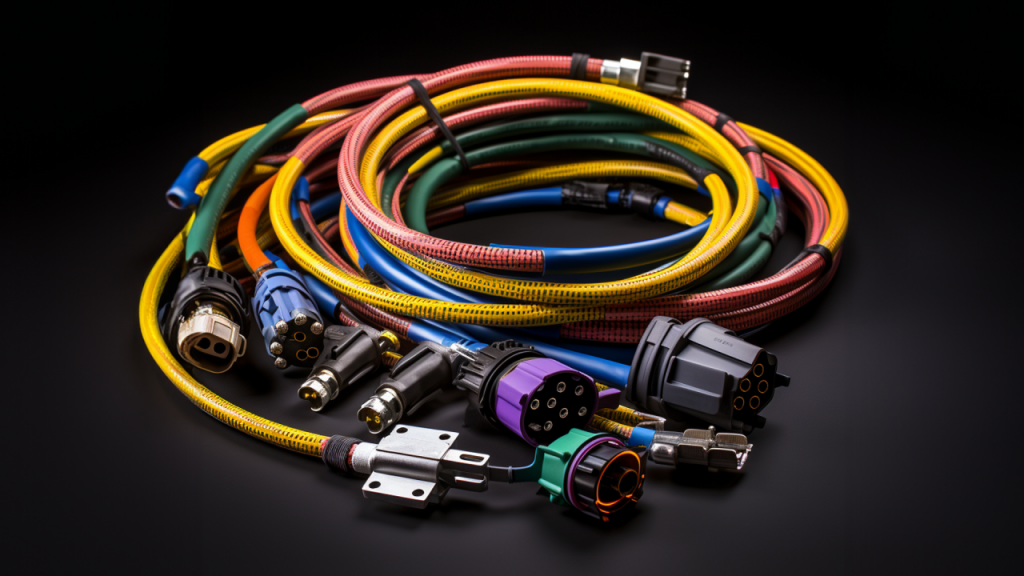
High-Potential (HiPot) Testing
HiPot testing is a stringent dielectric withstand test that verifies the insulation integrity of a cable harness can safely handle extreme electrical stress. Unlike insulation resistance testing which uses lower voltages to measure leakage, HiPot applies an AC or DC voltage significantly higher than the normal operating voltage—typically 1000 VAC plus twice the operating voltage for 60 seconds—to intentionally stress the insulation. This pass/fail test is designed to find latent defects like pinched insulation, poor spacing, or contaminant bridges that weaker tests might miss. In safety-critical applications (medical, aerospace, industrial control), a 100% HiPot test is mandatory. It is estimated that HiPot testing can detect approximately 95% of potentially catastrophic insulation flaws that would lead to immediate failure under high-voltage transients or overvoltage conditions, preventing field failures and ensuring user safety.
The core of HiPot testing is applying the correct voltage level without causing damage to good insulation. The test voltage is not arbitrary; it is defined by international safety standards (e.g., UL, IEC). For a harness rated for 120 VAC operation, a common HiPot test voltage is 1000 VAC or 1400 VDC applied for 60 seconds. For 240 VAC systems, this rises to 1500 VAC or 2100 VDC. The DC test voltage is typically √2 (approximately 1.414) times the AC test voltage. The key is to stress the insulation at a level that will cause marginal insulation to break down (fail) without over-stressing and degrading healthy insulation. The applied voltage must have a low total harmonic distortion (THD <5%) for AC tests and a ripple factor of <3% for DC tests to ensure accuracy.
During the test, the instrument monitors the leakage current flowing through the insulation. The pass/fail decision is based on whether this current exceeds a preset limit or shows a sudden increase (ramp). A typical failure current limit for a commercial wire harness is 0.5 mA at the applied test voltage.
|
Test Type |
Typical Test Voltage (for 120V Rated Harness) |
Standard Duration |
Max. Leakage Current (Typical Limit) |
Key Purpose |
|---|---|---|---|---|
|
AC HiPot |
1000 VAC |
60 seconds |
0.5 mA |
Simulates real-world overvoltage stress, best for finding weak spots. |
|
DC HiPot |
1400 VDC |
60 seconds |
0.5 mA |
Less stressful on good insulation, allows for slower ramp-up to find breakdown voltage. |
A failure is not just exceeding a current limit. A sudden exponential increase in current (a spike) indicates an immediate dielectric breakdown—an arc has occurred. A gradual but steady increase (ramping) over the 60-second test period indicates the insulation is breaking down under stress, often due to contamination or moisture. The leakage current must remain stable within a ±10% band for the test duration to indicate a true pass. For example, a reading that starts at 0.15 mA and drifts to 0.18 mA is stable; one that starts at 0.2 mA and climbs to 0.4 mA is failing.
Mechanical Connection Validation
A cable harness is only as reliable as its physical connections. Mechanical Connection Validation moves beyond electrical metrics to physically verify that every terminal, connector, and latch is securely mated and properly seated. Studies in automotive and aerospace industries show that up to 25% of warranty returns for electrical issues are traced back to mechanical connection failures—incomplete mating, broken locks, or improperly crimped terminals. A connector that is 0.5 mm short of full engagement can pass a basic continuity check but will fail under vibration, leading to an intermittent fault that is 10x more expensive to diagnose and repair in the field. This process involves a combination of visual inspection, tactile feedback, and precise force measurement to ensure connections can withstand real-world stresses like 15 G vibration or 50 N of pull force for a minimum of 10 seconds.
The primary goal is to apply measurable, repeatable standards to physical attributes. This isn't about a "tug test"; it's about validating to a precise specification. For a standard 0.64 mm² (20 AWG) wire with an insulated crimp terminal, a proper pull force requirement might be 70 Newtons (N) minimum. A test result showing 50 N indicates an immediate failure—the crimp will likely loosen over time. For the wire itself, manufacturers specify a minimum tensile strength; a 22 AWG copper wire should withstand at least 45 N before breaking. Testing the wire break strength ensures the crimping process hasn't mechanically weakened the conductor.
Connector mating cycles are precisely defined. A common automotive connector must withstand 25 complete mating and unmating cycles without any significant degradation in performance. The force required to mate it should remain consistent.
|
Connection Type |
Minimum Pull Force (N) |
Maximum Mating Force (N) |
Minimum Unmating Force (N) |
Validation Method |
|---|---|---|---|---|
|
0.64 mm² Crimped Terminal |
70 N |
40 N |
15 N |
Destructive pull test on sample batch |
|
15-pin Plastic Connector |
N/A (Latch Strength) |
60 N |
20 N |
Force gauge measurement during engagement |
|
Coaxial Connector (SMB) |
50 N (Axial Pull) |
25 N |
5 N |
Dedicated fixture measuring insertion loss under strain |
The mating force for a 15-pin connector should not exceed 60 N; a higher reading indicates misalignment, damaged pins, or debris. Conversely, the unmating force must be high enough to prevent accidental disconnection—often a minimum of 15 N—but low enough to allow for serviceability. A force gauge is used to measure these values during a simulated mating cycle, providing a quantitative pass/fail metric.
Signal Performance Verification
For modern cable harnesses carrying high-speed data, power integrity is not enough. Signal Performance Verification ensures the harness can transmit data accurately without corruption, a critical test for networks, video, and control systems. A harness that passes continuity and insulation can still fail with a 5 Gbps data stream due to impedance mismatches, crosstalk, or attenuation. In automotive Ethernet applications, a 100-meter channel must have a total insertion loss below -19.5 dB at 100 MHz, and a return loss better than -12 dB. A single poorly twisted pair or a crushed cable can degrade performance by 30%, causing a 10% packet error rate that cripples system throughput. This testing moves beyond DC checks to validate the harness in its actual operating frequency range, from 50 Hz power lines to 1 GHz+ data lines, ensuring signals arrive intact and on time.
Signal verification requires a network analyzer or specialized cable tester to measure how a high-frequency signal behaves as it travels through the harness. The three most critical quantitative metrics are Insertion Loss, Return Loss, and Near-End Crosstalk (NEXT).
-
Insertion Loss (IL): This measures signal power lost due to cable resistance and dielectric absorption. It's frequency-dependent. For a 20-meter Category 6A cable, the insertion loss must be less than -19.8 dB at 500 MHz. A reading of -22 dB indicates excessive loss, likely from a high-resistance connection or inferior cable, which would reduce the effective range of a data link by 15%.
-
Return Loss (RL): This measures signal reflections caused by impedance mismatches at connectors or cable damage. A high negative number is better. A minimum return loss of -20 dB is required for many standards. A poor value of -8 dB means 15% of the signal is reflecting back, causing data errors and jitter that can crash a real-time control system operating with a 1-millisecond cycle time.
-
Near-End Crosstalk (NEXT): This measures how much signal bleeds from one pair to an adjacent pair at the same end of the cable. It's the primary cause of noise. For a 1-meter HDMI cable, NEXT must be better than -45 dB at 100 MHz. If testing reveals crosstalk of -35 dB, the noise level is 10 dB (or 3.16 times) higher than acceptable, which would manifest as visual artifacts on a high-resolution display.
The test setup itself introduces variables that must be controlled. Cable length is the primary factor; insertion loss increases by approximately 0.2 dB per meter at 100 MHz for a typical data cable. Test results are only valid if compared against a baseline for that specific length. The impedance profile must also be stable. A standard 100-ohm differential pair should maintain that impedance within ±15% (85 to 115 ohms) along its entire length.
A deviation outside this 15% tolerance band, measured by a Time Domain Reflectometry (TDR) instrument, pinpoints the exact location of a crush, kink, or bad connector to within 5 centimeters. For a 0.5-nanosecond rise-time signal, a 10-ohm impedance discontinuity at a connector can create a 3% voltage reflection that significantly distorts the signal shape. This quantitative, location-specific data transforms debugging from a guessing game into a precise repair operation, saving an average of 2 hours of diagnostic labor per faulty harness.
In summary, cable harness integrity is verified through five critical methods. Continuity testing uses a multimeter to check for open or short circuits, ensuring electrical paths are complete. Insulation resistance testing, performed with a megohmmeter applying up to 1000V, confirms resistance values exceed 100 MΩ. HiPot testing applies a high voltage, typically 1500V AC, to stress dielectric strength without breakdown. Mechanical checks involve pull tests on connectors to validate retention. Finally, signal integrity tests use network analyzers to quantify crosstalk and attenuation, ensuring data transmission meets specifications.
