Top 7 Factors to Consider for Custom Wire Harness Design
When designing a custom wire harness, prioritize wire gauge (16-28 AWG for most applications), connector types (e.g., Deutsch, Molex), and shielding (braided vs. foil for EMI protection). Ensure UL/CE certification, environmental resistance (IP67 for moisture/dust), and testing protocols (Hi-Pot, continuity checks). Lead times (2-6 weeks) and minimum order quantities (MOQs) also impact cost and scalability.
Wire Size Selection
Choosing the right wire size is one of the most critical decisions in custom wire harness design. A 10% undersized wire can cause a 15-20% voltage drop, leading to overheating, reduced efficiency, and even premature failure. On the other hand, oversized wires increase material costs and weight unnecessarily—a 22 AWG wire costs 0.35/ft, nearly 3x more. The key is balancing current capacity, voltage drop limits, and cost.
The American Wire Gauge (AWG) system defines wire diameters, with lower numbers indicating thicker wires. For example, a 12 AWG wire handles up to 20A in chassis wiring, while 18 AWG is limited to ~7A. If your application runs 5A continuously, an 18 AWG wire (7A max) is sufficient, but if ambient temperatures exceed 30°C (86°F), derating by 20% means you should step up to 16 AWG (10A capacity).
Voltage drop is another major factor. The NEC (National Electrical Code) recommends ≤3% drop for branch circuits. For a 12V system with a 10ft run, a 16 AWG wire (4.016Ω/1000ft) drops ~0.38V (3.2%) at 10A, which is borderline. Switching to 14 AWG (2.525Ω/1000ft) reduces the drop to 0.24V (2%), improving efficiency.
"A 1mm² (17 AWG) wire in a 24V system carrying 5A over 5 meters loses ~0.65V (2.7%), but at 12V, the same setup drops ~1.3V (10.8%)—unacceptable for sensitive electronics."
Mechanical strength also matters. Thin wires (e.g., 24 AWG, 0.2mm diameter) can break under 5-10N of tension, while 16 AWG (1.3mm) withstands 50N+. In automotive or industrial applications with vibration, stranded wire (e.g., 26 AWG x 7 strands) lasts 3-5x longer than solid core due to better flex resistance.
Connector Types Explained
Choosing the right connector for a wire harness is like picking the right plug for an outlet—get it wrong, and nothing works. Connectors influence durability (50,000+ mating cycles for high-end types), current capacity (5A for micro-USB vs. 13A for industrial screw terminals), and cost (from 50 for ruggedized military-grade plugs). With over 100+ standardized connector families, selecting the best fit requires balancing electrical needs, mechanical stress, and budget.
Circular connectors (e.g., M12, M8) dominate industrial and automotive applications because they’re IP67-rated (submersible up to 1m for 30 mins) and handle 12A+ at 250V. A M12-5 pin connector costs 22. These are ideal for sensors, motors, and outdoor equipment exposed to -40°C to 85°C temperatures.
Rectangular connectors (e.g., Molex Mini-Fit, JST) are cheaper (2.00 per pair) and used in consumer electronics. A 2.54mm pitch JST-XH supports 3A per pin, but Mini-Fit Jr. handles 9A—critical for PC power supplies. However, their plastic housings degrade above 105°C, making them unsuitable for engine bays.
| Connector Type | Current/Pin | Voltage Max | Mating Cycles | Cost/Pair | Best For |
|---|---|---|---|---|---|
| USB-C | 5A | 20V | 10,000 | $0.80 | Phones, laptops |
| Deutsch DT | 13A | 600V | 500+ | $8.00 | Heavy trucks, agriculture |
| TE AMP Superseal | 7A | 250V | 50+ | $1.20 | Automotive lighting |
| Hirose DF63 | 1A | 50V | 30 | $0.25 | Drones, wearables |
Board-to-board connectors (e.g., Mezzanine, FPC) are for high-density PCB links, with pitches as tight as 0.4mm. A 30-pin FPC cable costs $0.60, but misalignment during assembly causes 15% of field failures. For vibration-prone environments, locking clips (e.g., TE Micro-MaTch) reduce disconnects by 90%.
Terminal blocks (e.g., Phoenix Contact) simplify wiring in control panels, supporting up to 76A with screw or spring clamps. A 5.08mm pitch block costs $1.50 per pole, but spring-loaded versions cut installation time by 40% vs. screws.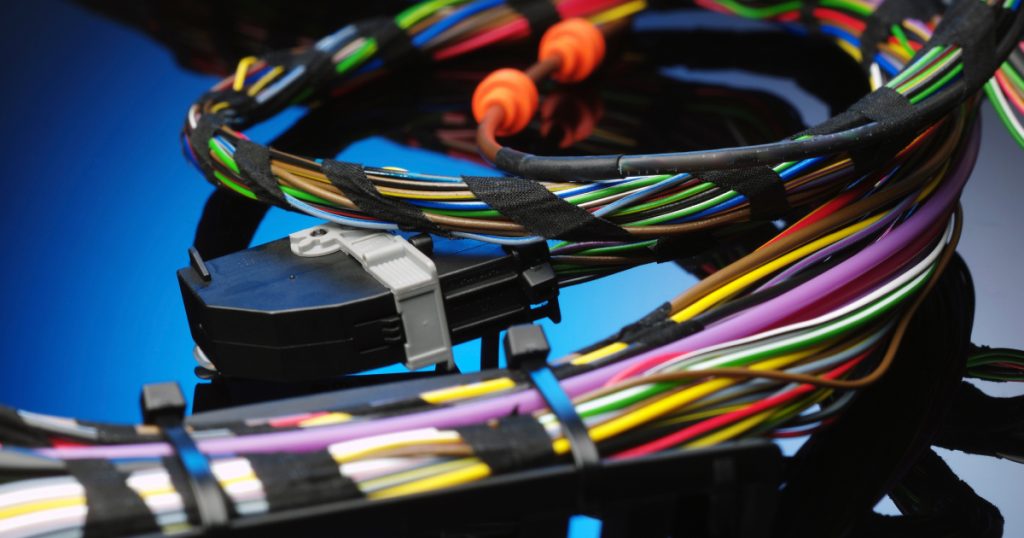
Shielding for Noise Protection
Electrical noise can wreck sensitive signals—a 10mV interference spike is enough to corrupt a 5V digital signal, causing false triggers or data errors. In industrial settings, 60% of signal integrity issues stem from poor shielding, leading to 15-20% longer troubleshooting time and $5,000+ in annual downtime costs per machine. The right shielding cuts noise by 90% or more, but only if you pick the correct type and implement it properly.
Braided shielding (85-95% coverage) is the go-to for flexible cables in robotics or moving machinery. A 24 AWG shielded cable with 90% braid coverage reduces RF interference by 40dB at 100MHz, but costs 0.50/ft versus 0.30/ft for unshielded. The trade-off? Braids weaken after 50,000+ bend cycles, making them a poor fit for high-flex applications like cable carriers, where spiral shields (70% coverage, 0.40/ft) last 2x longer despite slightly worse noise rejection.
Foil shielding (100% coverage) is cheaper (0.25/ft) and better for static installations like control panels or fixed wiring. A double-layer foil shield can block 60dB of noise up to 1GHz, critical for Ethernet (Cat6A) or servo motor feedback cables. However, foil tears easily—just 5N of force can rip it during installation. That's why hybrid foil-braid shields (0.60/ft) dominate in automotive CAN bus systems, balancing 95% coverage with 200% better crush resistance than foil alone.
Grounding matters just as much as shielding material. A floating shield (no ground connection) reduces noise rejection by 50%, while a poorly grounded shield can act as an antenna, amplifying interference. For analog sensors (4-20mA, thermocouples), single-point grounding prevents ground loops, cutting signal drift by 75%. In high-frequency digital lines (USB3, HDMI), 360° connector grounding is mandatory—a 2mm gap in shield contact can increase EMI by 20dB.
Shield termination is another weak spot. Crimp-style connectors maintain <1Ω resistance up to 10,000 insertions, but solder joints fail 3x faster under vibration. For harsh environments (salt spray, -40°C to 125°C), conductive epoxy-sealed terminations boost lifespan by 5x versus basic crimps.
Bend Radius Limits
Ignoring bend radius rules is the fastest way to turn a $5,000 cable run into scrap. A single tight bend can reduce a cable's lifespan by 80%, with failures showing up in as little as 500 flex cycles instead of the rated 50,000+. The industry-standard rule is 8x the outer diameter (OD) for fixed installations and 15x OD for dynamic flexing, but real-world conditions often demand adjustments.
Fixed vs. Dynamic Applications matter tremendously. A 10mm OD power cable in a factory conduit needs just 80mm bend radius (8x OD), but the same cable in a robot arm requires 150mm (15x OD) to survive 1 million cycles. Go tighter, and copper strands start fracturing at 90° bends, increasing resistance by 15% after just 1,000 movements.
| Cable Type | Static Bend Radius | Dynamic Bend Radius | Max Flex Cycles | Cost/ft | Failure Mode if Overbent |
|---|---|---|---|---|---|
| Standard PVC Control | 6x OD | 10x OD | 50,000 | $0.80 | Jacket cracks at 5,000 cycles |
| Robot Cable (TPE) | 5x OD | 8x OD | 3M+ | $3.50 | Strand breakage at 500K cycles |
| Fiber Optic (Tight Buffered) | 15x OD | 20x OD | N/A (one-time install) | $2.20 | Signal loss >0.5dB per sharp bend |
| Shielded Ethernet (Cat6) | 4x OD | 8x OD | 1,000 | $1.10 | Crosstalk increases by 30% |
Temperature changes everything. A -40°C freezer cable needs 2x the bend radius of the same cable at room temperature because cold makes jackets 3x more brittle. Conversely, high-temperature silicone cables (200°C rated) can bend 20% tighter at heat but become stiff when cold.
Multi-conductor cables are especially vulnerable. A 20-pair 8mm OD cable with 24 AWG strands fails 10x faster when bent at 6x OD versus 10x OD because internal wires shear against each other. Separator tapes help, but add $0.15/ft to the cost.
Environmental Resistance Needs
Wire harnesses don't fail because of bad design—they fail because real-world conditions are harsher than lab tests. A standard PVC-jacketed cable rated for -20°C to 80°C will crack in under 6 months when exposed to daily -40°C to 105°C swings in a solar farm. Meanwhile, salt spray corrosion can eat through unshielded connectors in 90 days near coastlines, causing 30% higher failure rates versus properly sealed alternatives. Environmental resistance isn't optional; it's insurance against $15,000+ in premature replacement costs per machine.
Temperature extremes demand material science. Standard PVC insulation softens at 105°C, sagging and shorting against adjacent wires, while cross-linked polyethylene (XLPE) handles 150°C continuously for 10+ years in engine bays. For ultra-cold environments like freezer warehouses (-60°C), silicone rubber stays flexible down to -90°C, whereas TPU jackets shatter at -55°C. The trade-off? Silicone costs 3x more (0.70/ft for PVC) but lasts 5x longer in thermal cycling tests.
Chemical exposure is a silent killer. In wastewater plants, hydrogen sulfide (H₂S) gas degrades standard nylon cable ties in 8 weeks, leading to harness collapse. Stainless steel banding ($0.30 per strap) resists H₂S indefinitely but adds 15% assembly time. Similarly, hydraulic fluid dissolves PVC in months, but chlorinated polyethylene (CPE) jackets lose just 0.1mm thickness per year when soaked in oil—critical for CNC machines with 10-year lifespans.
Moisture protection isn't just about IP ratings. A IP67 connector (1m underwater for 30 mins) might survive a rainstorm, but daily condensation inside enclosures causes 80% of corrosion failures. Potting entire harnesses in epoxy (12 per unit) blocks moisture ingress completely but makes repairs impossible. A smarter balance? Heat-shrink tubing with adhesive liners (0.20 per foot) seals splices to IP68 standards while allowing rework.
UV radiation destroys cheap materials fast. Unprotected polyethylene cable jackets crack after 2 Arizona summers, exposing wires. Carbon-black-filled PVC lasts 5 years in direct sunlight, but for 25-year solar farm installations, only UV-stabilized ETFE ($4.50/ft) delivers <5% tensile strength loss per decade.
Vibration kills connections gradually. In wind turbine nacelles, 20Hz vibrations snap unsecured wires in 18 months. Solutions? Silicone-rubber cable glands reduce movement by 60%, while Kevlar-reinforced harness wraps ($1.10 per foot) distribute stress across 50% more surface area.
Testing Methods Overview
Skipping wire harness testing is like driving blindfolded—90% of field failures could be caught with proper pre-deployment checks. A 50,000 in recall costs, yet 40% of small manufacturers still rely on "power-on" as their sole test. From continuity checks (1-second per circuit) to high-potential tests (5kV for 60 seconds), the right method depends on failure consequences, budget, and production volume.
Continuity testing is the bare minimum. A $3,000 automated tester can verify 500 connections per minute with 99.9% accuracy, while manual multimeters take 5 minutes per harness. But continuity alone misses intermittent shorts—that's why wiggle testing (applying 50N side force while measuring resistance) catches 25% more defects in automotive harnesses.
| Test Method | Defects Caught | Cost per Harness | Time per Harness | Best For |
|---|---|---|---|---|
| Continuity Check | Open circuits | $0.10 | 15 sec | Low-cost consumer goods |
| Hi-Pot (Dielectric) | Insulation flaws | $1.50 | 2 min | Medical/military grade |
| Insulation Resistance | Moisture damage | $0.80 | 45 sec | Outdoor/industrial use |
| Signal Integrity Test | Crosstalk/EMI | $6.00 | 5 min | High-speed data cables |
| Mechanical Flex Test | Strand fatigue | $3.00 | 10 min/1,000 cycles | Robotics/automotive |
Hi-pot testing stresses insulation beyond operating limits. Applying 1.5kV to 5kV for 60 seconds finds microscopic cracks that would cause arc faults at 400V within 6 months. But overtesting destroys good harnesses—more than 10% of units fail if tested at 2x rated voltage. For 300V-rated automotive harnesses, the sweet spot is 1kV for 60 sec, catching 95% of latent defects without collateral damage.
Environmental stress testing replicates real-world abuse. A 72-hour salt spray test (5% NaCl at 35°C) predicts 10-year coastal performance, while thermal cycling (-40°C to 125°C, 500 cycles) mimics 15 years of engine bay heat swings. These tests add $120 per harness but slash warranty claims by 75% in harsh applications.
Signal integrity tests are non-negotiable for CAN bus, Ethernet, or USB3 harnesses. A 3dB loss at 100MHz might seem minor, but it causes 12% packet errors in gigabit networks. Time-domain reflectometry (TDR) tests ($8 per harness) pinpoint impedance mismatches within 2cm accuracy, while eye diagram analysis reveals jitter >0.3UI that corrupts high-speed data.
Cost vs Performance Balance
Wire harness design is a constant tug-of-war between saving 0.30 per unit and preventing 30,000 field failures. A 10% cost cut on connector plating might save 5,000 annually, but cause 120 in labor and downtime. The sweet spot? Spend 20% more upfront on critical components to slash lifetime costs by 50%.
Material choices drive 70% of cost-performance tradeoffs. Standard tin-plated copper costs 0.08 per contact, but gold-flashed (0.2μm) versions at 0.22 per contact last 10x longer in high-cycle applications (>50,000 insertions). For indoor electronics, tin works fine, but automotive or marine systems demand gold's <5mΩ contact resistance stability despite the 175% price premium.
"A 2.50 silicone-jacketed cable lasts 8 years in an engine bay, while a 1.20 PVC version fails in 18 months—net savings: $14 per meter over a vehicle's lifespan."
| Component | Budget Option | Cost | Performance | Premium Option | Cost | Performance Gain |
|---|---|---|---|---|---|---|
| Wire Insulation | PVC | $0.70/ft | 105°C max, cracks at -20°C | Silicone | $2.10/ft | 200°C/-90°C, 5x flex life |
| Connector Contacts | Tin-plated | $0.08 | 5,000 cycles, 15mΩ drift | Gold-flashed | $0.22 | 50,000 cycles, <5mΩ stable |
| Shielding | Foil-only | $0.25/ft | 40dB noise rejection | Foil+braid | $0.60/ft | 70dB rejection, 3x durability |
| Strain Relief | Nylon tie | $0.05 | Fails at 50N pull | Kevlar sleeve | $0.80 | Holds 300N, vibration-proof |
Labor vs. reliability math is brutal. A hand-soldered joint costs 0.12 in labor versus 0.03 for a crimp, but fails 3x less often under vibration. For low-volume medical devices, soldering wins, but automotive harness makers automate crimping to 1,200 terminations/hour with <0.1% defect rates—justifying $50,000 crimp machines at 10,000+ units/year.
Testing intensity scales with risk. A 0.10 continuity test suffices for desktop peripherals, but avionics harnesses need 25 in hi-pot + signal integrity tests to prevent $1M+ liability claims. The break-even? Spend 1-3% of unit cost on testing for 10-30x ROI in avoided recalls.
Volume discounts change the game. Ordering 10,000+ connectors cuts Molex Mini-Fit Jr. prices from 0.28 each, while custom tooling for molded harnesses pays back after 5,000 units. But overstocking risks $8,000 in dead inventory if designs change—just-in-time buys at 15% premium often beat bulk for prototypes or mid-volume runs.
In summary,custom wire harness design requires balancing seven critical factors to ensure optimal performance. Wire gauge selection (16-28 AWG) must match current loads while considering voltage drop limits (3% max). Connector choices (MIL-DTL-38999 vs. RJ45) impact durability, with IP67-rated versions adding 15-20% cost but preventing moisture ingress. For EMI protection, 90% braided shielding reduces interference by 40dB at 100MHz, though foil shields work better for static installations. Minimum bend radii (8x cable diameter) prevent conductor damage, while high-flex cables withstand 50,000+ cycles. Environmental testing should include 500 thermal cycles (-40°C to 150°C) and 1,000-hour humidity exposure. UL certification adds 5-25% cost but prevents $250k+ recall risks, proving essential for automotive/aerospace applications where 0ppm defects are mandatory.
