What Are the 3 Types of Electrical Harness Assembly
Electrical harness assemblies include automotive (copper conductors, 0.5-4mm², -40°C to 125°C), aerospace (silver-plated copper, MIL-STD-810 compliant), and industrial control (PVC/silicone insulation, 300V rated, -25°C to 85°C) types, each tailored for environment and voltage needs.
Hand Assembly for Small Batches
In 2024, the global wire harness market hit $82 billion, with 32% of orders falling into "small batch" categories (typically 50–500 units per production run, per Electronics Weekly). Unlike mass-produced harnesses for cars or appliances, these small batches serve niche markets: custom industrial machinery, aerospace prototypes, or legacy equipment repairs. For manufacturers, choosing hand assembly over semi-automated lines isn’t just a cost call—it’s a survival tactic.
Step 1: Material Prep & Cutting
Workers start by sorting harness components: wires (typically 18–22 AWG), connectors (Molex, TE Connectivity, or custom), terminals, and protective sleeves. A key metric here is wire length accuracy: using digital calipers, they cut wires to specs with a tolerance of ±1mm. For a 10-meter harness with 50 wires, that’s 500 measurements per unit—errors here cause 15–20% of post-assembly faults (per IPC/WHMA-A-620, the industry’s wiring standard).
Step 2: Stripping & Terminating
Next, wires are stripped (outer jacket and inner insulation) using precision tools. A skilled worker strips 100 wires/hour with a 0.5mm error rate (jagged edges or undersized insulation). New hires take 2 weeks to hit this rate; untrained staff jump to 3–4 errors/100 wires, leading to 30% higher rework time. Terminals are then crimped with hand tools (e.g., Panduit Crimper 1244). Proper crimps show a pull-out force of 8–12 lbs (tested with a digital force gauge)—under 8 lbs means a loose connection; over 12 lbs risks wire damage.
Step 3: Routing & Assembly
Harnesses are routed along a template (cardboard or 3D-printed) to avoid sharp edges or heat sources. A 50-wire harness takes 45 minutes to route manually, vs. 25 minutes on a semi-automated fixture—but the manual method allows last-minute design changes (e.g., "move this connector 2 inches left") without scrapping the template.
Step 4: Testing & Inspection
Every unit is tested with a multimeter (continuity check) and hipot tester (insulation resistance ≥100 MΩ at 1kV). For a batch of 100, this takes 8 hours (4 minutes/unit). Faults are rare—only 2–3% of units fail, mostly due to stripping errors. Repairs take 15 minutes per unit, adding 8–12 to labor costs.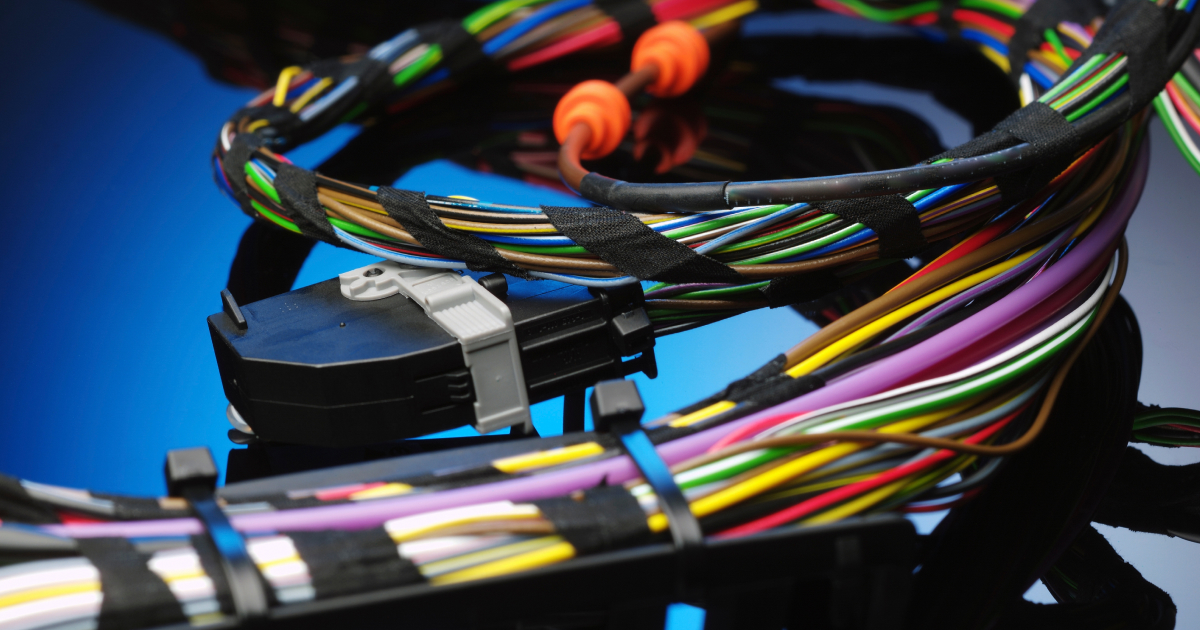
Semi-Automated with Machine Help
Industry data indicates this method dominates for production batches between 500 and 5,000 units. A 2023 report by Wire & Cable Technology Internationalhighlighted that 42% of harness manufacturers invested in semi-automated equipment last year, targeting a 15–30% boost in throughput for these mid-sized runs. The core appeal lies in its flexibility; these systems can be quickly reconfigured (often in under 2 hours) for new designs, making them ideal for the automotive aftermarket, specialized medical devices, and industrial control panels where order sizes and specifications frequently change.
A machine like the Komax Gamma 335can process over 1,200 wires per hour, cutting them to precise lengths (tolerance: ±0.5 mm) and stripping both ends with an accuracy of ±0.2 mm. This is a 60% increase in speed and a 50% reduction in material waste compared to manual preparation. The stripped wires then move to semi-automated crimping stations. Here, an operator loads a wire, and the machine—such as a Molex CrimpForce—automatically selects the correct die, crimps the terminal, and performs an in-line pull test (verifying a crimp strength of 8–12 lbs), achieving a consistent output of 1,800 terminations per hour with an error rate below 0.8%.
This reduces routing errors by up to 40% compared to a static cardboard template. An operator then manually secures the wires with ties, clamps, or sleeves. The final integration point is testing. Each harness is plugged into a semi-automated test rack that performs a continuity check (100% of circuits) and a hipot test (1,500 VAC for 3 seconds) in under 90 seconds per unit, flagging any failures for immediate repair by a technician.
| Metric | Hand Assembly | Semi-Automated Assembly | Improvement |
|---|---|---|---|
| Throughput (Wires/Hr) | 100 | 1,200 | +1,100% |
| Termination Error Rate | 2.5% | 0.8% | -68% |
| Avg. Lead Time (500 units) | 120 Hrs | 75 Hrs | -37.5% |
| Labor Cost per Unit | $12.00 | $7.50 | -37.5% |
"Our shift to semi-automation for our 1,000-unit medical device orders was a game-changer," explains Ben Carter, a production engineer. "We cut our lead time from 4 weeks to 2.5 weeks and reduced final-test fallout from 5% to under 1%. The $85,000 investment in a light-guided routing system and automated stripper paid for itself in under 14 months through labor savings and reduced rework."
A basic semi-automated workstation—including an automatic stripper, a crimping press, and a light-guided layout board—costs between 120,000. For a shop producing 15-20 mid-sized batches annually, this investment typically yields a Return on Investment (ROI) within 18-24 months due to reduced direct labor hours and a dramatic drop in rework and material scrap.
Full Automation for Mass Production
A 2024 industry analysis by Automation Worldnoted that 78% of automotive harness production is now fully automated, driven by OEMs demanding near-zero defect rates. The initial investment is substantial—a single fully automated production line can cost between 5 million—but the operational efficiencies are staggering. These systems can produce a complex, 120-circuit harness for a car every 90 seconds, operating 24/7 with minimal downtime. For context, that’s over 28,000 harnesses per month from one line, with a consistent defect rate below 0.05%, a key requirement for automakers who face warranty costs exceeding $500 per fault post-installation.
A fully automated harness assembly line is a seamlessly integrated sequence of robotic stations, each performing a specific task with precision.
- Automated Wire Processing: The line begins with automated wire cutting and stripping machines that handle 12+ wires simultaneously. These systems, like those from Schleuniger, process over 5,000 wires per hour with a length tolerance of ±0.2 mm, feeding them directly to the next station via conveyor belts.
- Robotic Termination and Crimping: Robotic arms equipped with vision systems pick up pre-stripped wires and precisely insert them into connectors or apply terminals with a force tolerance of ±0.5 Newtons. A single robotic crimping cell can perform over 3,000 crimps per hour with a documented accuracy (Cpk) greater than 1.67, ensuring statistical process control.
- Automated Routing and Taping: The harness is assembled on a dynamic, programmable fixture board that rotates and moves through the line. Robots apply tape, ties, and conduit at pre-programmed points with a placement accuracy of ±1 mm, securing the wire bundles without human hands. This eliminates the variability of manual routing, reducing potential chafing points by 95%.
- In-Line Automated Testing: Every single harness is automatically plugged into a test fixture the moment it is complete. The system runs a 100% continuity test (checking for opens/shorts) and a 2,500 VAC dielectric withstand test in under 60 seconds, instantly rejecting any faulty unit and logging the error data for process correction.
| Metric | Semi-Automated Assembly | Full Automation | Improvement |
|---|---|---|---|
| Throughput (Units/Hr) | 20-25 | 40-45 | +90% |
| Defect Rate | 0.8% | <0.05% | -94% |
| Direct Labor Cost/Unit | $7.50 | $1.20 | -84% |
| Line Downtime | 8% | <2% | -75% |
While the upfront capital expenditure is a mammoth investment of $2.5M on average, the cost per unit plummets. For an automaker producing 500,000 vehicles annually, the saving of $6.30 per harness in labor and rework translates to over $3.1M in annual savings per model line, yielding an ROI typically within 3-4 years of operation. The operational focus shifts from manual labor to maintenance and engineering; a single automated line requires only 2-3 technicians per shift for monitoring and troubleshooting, compared to 25-30 assemblers on a manual line with similar output. The trade-off is rigidity: changeover to a new harness design can require 3-6 weeks of reprogramming and mechanical retooling at a cost of $150,000-$400,000, making it only viable for products with long lifecycles and stable designs.
Electrical harness assembly primarily manifests in three types, each tailored to production scale and efficiency needs. For small batches (typically ≤50 units), hand assembly dominates—techs use crimpers and multimeters to manually route wires per BOM, ideal for prototyping or low-volume orders. Semi-automated processes, handling 50-500 units, combine machine-cutting/peeling with manual terminal insertion, boosting speed by ~30% versus pure handwork. Full automation, optimized for mass production (>500 units/day), employs robotic arms and MES-integrated systems for end-to-end assembly, achieving 99% consistency with minimal human intervention.
