What are the 4 Main Components of a Standard Cable Harness
A cable harness comprises conductors (22-18 AWG tinned copper), insulation (PVC/XLPE, -40°C to 125°C), connectors (4-24 pins, IP67-rated), and terminals (crimped/soldered, 5-15N force), ensuring reliable signal/power transmission in automotive/electronics.
Wires and Conductors
Over 1,200 individual wires snake through the system, totaling 3–5 km in length. Each wire isn’t just a random strand of metal; its design—material, thickness, insulation, and structure—directly impacts performance, cost, and reliability. Take conductivity: pure copper conducts electricity at ~58 million siemens per meter (MS/m), but most harnesses use oxygen-free copper (OFC)—its conductivity hits 58.5 MS/m, a 1% jump that slashes resistive losses by 3–5% in high-current circuits (like alternators or power windows). Aluminum? Cheaper, but only 61% as conductive as OFC, so you need thicker wires (e.g., a 10 AWG aluminum wire vs. 14 AWG copper for the same 30A load), adding 20–25% weight per circuit. That’s why 95% of automotive and industrial harnesses stick with OFC.
-
Material specs matter more than you think:
OFC isn’t just “copper”—it has <0.003% oxygen content (vs. 0.02–0.04% in standard ETP copper), which prevents brittleness at high temps (critical for under-hood harnesses that bake at 80–120°C). For extreme environments (e.g., marine or aerospace), tinned copper dominates: tin plating (5–10 microns thick) reduces oxidation by 90% compared to bare copper, extending service life from 5 to 15+ years in salt-heavy air. -
Insulation type dictates temperature and flexibility:
PVC is the budget pick—cheap (0.15–0.25 per meter) and flexible, but it melts at 160°C and cracks below -20°C. Cross-linked polyethylene (XLPE)? Pricier (0.30–0.40/m), but handles 90°C continuously and -40°C cold without stiffening. For high-vibration areas (like engine mounts), silicone rubber insulation shines: it’s 3x more flexible than PVC (bend radius down to 6x diameter vs. 10x for PVC) and survives 200°C peaks—common in turbochargers or EV battery packs. -
Stranding and gauge directly affect current and durability:
A 16 AWG wire (1.29 mm² cross-section) carries ~10A continuously, but if it’s “solid” (non-stranded), it’ll snap after 500 bend cycles. Stranded wire? 7-strand or 19-strand designs boost flexibility: 19-strand 16 AWG can handle 5,000+ bend cycles (the industry standard for automotive harnesses). Thicker wires (e.g., 4 AWG, 21.15 mm²) handle 100A+—think starter motors—but they’re stiffer, so harness designers often use “flex cores” (braided Kevlar strands wrapped around the conductor) to keep bending radius under 8x diameter, preventing cracks. -
AWG isn’t arbitrary—it’s a math problem:
The American Wire Gauge (AWG) system is logarithmic: each 3 AWG steps halve the wire diameter (e.g., 18 AWG → 15 AWG = 0.823 mm → 1.45 mm). More critical: resistance drops by 50% every 3 AWG steps. A 14 AWG copper wire (2.08 mm²) has 2.525 ohms per kilometer; 12 AWG (3.31 mm²) drops to 1.588 ohms/km. For a 10A circuit over 5m, 14 AWG loses 0.126V (I²R = 10² × 0.002525 × 5 = 1.26W); 12 AWG loses 0.079V (10² × 0.001588 × 5 = 0.79W)—a 37% efficiency gain. That’s why EV makers overspec AWG by 1–2 steps: lower resistance means less heat, longer battery range (every 1% voltage drop reduces motor efficiency by ~0.5%).
Terminals and Connectors
A single automotive harness can contain over 100 individual connectors and 300+ terminals, creating every electrical interface. A poor connection isn't just an inconvenience; it's a primary failure point. A terminal with just 0.5 milliohms of excess resistance can generate 5 watts of waste heat under a 100A load (common in EV battery connections), leading to thermal runaway. The industry-standard USCAR-2 specification mandates that connectors must survive 10,000 complete mating cycles with a maximum contact resistance increase of only 2 milliohms.
The base metal is typically phosphor bronze (C5191) for its spring properties, offering a tensile strength of 650-780 MPa. However, the plating is what defines the interface. Tin plating is the economical workhorse at 0.5-3.0 microns thick. It provides good corrosion resistance but has a higher friction coefficient, leading to a 20-30% higher insertion force compared to gold. For high-reliability applications (data, sensors, power), selective gold plating is used. A mere 0.2-0.8 microns of gold over 1-2 microns of nickel plunder reduces contact resistance to a stable 1-3 milliohms and can withstand over 100,000 cycles. The nickel barrier beneath is non-negotiable; it prevents zinc from the brass housing from migrating into the gold, a phenomenon called "porosity corrosion," which would increase resistance by over 500% in less than 1,000 hours in an 85°C/85% humidity environment.
Crimp quality is everything. The force applied during crimping must deform the metal terminal barrel enough to cold-weld to the wire strands without cutting them. An under-crimped connection can have 50% less tensile strength and double the electrical resistance. A proper crimp for a 20 AWG wire requires a force of approximately 500-700 Newtons, creating a gas-tight seal that prevents oxidation. Pull-out force must exceed 70 Newtons per USCAR-2. This is why automated crimping machines are calibrated to a precision of ±0.1mm in applicator stroke length; a 0.3mm deviation can reduce conductivity by 15%.
Connector housings are more than plastic shells. They are typically made from PBT (Polybutylene Terephthalate) plastic with a 20-35% glass fiber fill to achieve a UL94 V-0 flammability rating and a heat deflection temperature of 180-210°C. The geometry of the cavities and the polarization features are critical. A single misaligned pin during mating can generate 500 psi of concentrated stress on a pin 0.5mm in diameter, permanently deforming it. Sealing is paramount for external connectors: most use silicone rubber seals rated at IP67, meaning they must withstand being submerged in 1 meter of water for 30 minutes. The force required to fully mate a 24-pin sealed connector with all seals engaged can be as high as 60 Newtons, often requiring a lever-assist or slider mechanism.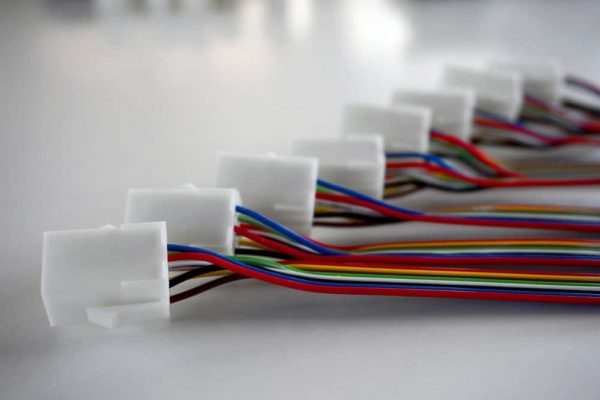
Protective Sleeving
In a typical engine bay harness, wires face constant abrasion from chassis parts, temperature swings from -40°C to 150°C, and exposure to oils, fuels, and salt spray. A single unprotected wire chafing against a sharp edge can lead to a short circuit in under 100,000 vehicle miles. Sleeving mitigates this. It can account for 5-10% of the total harness cost, but it prevents failures that are 50x more expensive to repair post-production.
| Sleeving Type | Common Material(s) | Primary Use Case | Key Limitation |
|---|---|---|---|
| Braided Sleeve | Polyester, Nylon 6/6 | Abrasion protection, flex areas | Limited chemical resistance |
| Split Loom | PP (Polypropylene), PA (Nylon) | General routing, OEM harnesses | Can brittle at low temps (-25°C for PP) |
| Heat Shrink | Polyolefin, PTFE | Environmental seals, strain relief | Requires heat tool (~120°C to activate) |
| Conduit | PVC, Nylon | Heavy abrasion, industrial machinery | High weight (e.g., 50g/m for 10mm dia.) |
| Spiral Wrap | PET (Polyester) | Service access, frequent adds/changes | Less crush resistance |
Braided polyester sleeving is the go-to for general protection, costing 0.30 per meter. It offers excellent abrasion resistance, surviving over 50,000 rub cycles (ASTM D4966) before failure. For higher temperatures near exhaust manifolds, fiberglass sleeving treated with silicone coating is used. It withstands continuous 550°C and peaks of 1200°C for short durations, but it's brittle and can crack if bent below a 25mm radius. In chemical-rich environments (e.g., near fuel lines), PTFE (Teflon) sleeving is king. It’s nearly inert, handling pH levels from 2 to 12, but it costs 8 per meter—a 50x premium over polyester.
A 6mm diameter nylon loom has a typical crush resistance of 150 Newtons and a flex life of over 50,000 cycles. However, nylon absorbs moisture, which can reduce its impact strength by 40% in 85% humidity environments. For a completely sealed system, heat shrink tubing is essential. It shrinks radially by 50% when heated to 120°C, creating a seal with IP67 protection. Dual-wall adhesive-lined heat shrink is the premium option; its internal layer melts at 90°C, forming a waterproof seal that can withstand 30 psi of pressure and 1000 hours of salt spray.
In aerospace and automotive applications, every gram matters. Thin-wall PET spiral wrap weighs just 15g per meter, compared to 45g/m for a comparable nylon split loom. This 67% weight reduction across a 50kg vehicle harness adds up, contributing to better fuel efficiency. For the tightest bundles, expandable braided sleeving made from texturized polyester can stretch its diameter by 200% (e.g., from 10mm to 50mm) for easy sliding over multi-branch connectors, then contract to form a snug, 2mm-thick protective layer.
Labels and Markings
In a complex cable harness with over 2,000 wires, labels and markings are the non-negotiable navigation system. They are the primary interface between the physical hardware and the technical documentation, directly impacting assembly time, diagnostic speed, and long-term maintenance. A single missing or unreadable label can turn a 10-minute repair into a 3-hour diagnostic nightmare, costing hundreds of dollars in labor. The automotive industry standard (e.g., LV214) mandates that wire markers must remain legible for the vehicle's 15-year service life, enduring exposure to engine oil, brake fluid, and temperatures from -40°C to 125°C.
Core Functions of a Marking System:
- Circuit Identification: Unique alphanumeric codes (e.g.,
BK/YL-0.75-12V-IGN) for every wire. - Routing Instructions: Directional arrows, sequence numbers for connector cavities.
- Hazard Communication: High-voltage warnings (orange labels for >60VDC).
- Compliance & Traceability: UL recognition numbers, date codes, lot numbers.
The majority of high-performance wire labels use 1.0 to 2.0 mil (25-50 micron) thick polyester film as a base substrate. This material provides a tensile strength of >20,000 psi and minimal stretch (<1.5% elongation), ensuring the label won't tear or distort during installation. For the most extreme environments, such as under-hood applications near exhaust manifolds, polyimide film (Kapton) is standard. It can withstand a continuous 260°C and short-term peaks up to 400°C without melting or becoming brittle. The adhesive is just as engineered as the film. Acrylic-based permanent adhesives are common, requiring a >30 N/25mm peel strength bond to the wire's insulation after 24 hours. For silicone-insulated wires, which have a low-surface energy, a specialized silicone adhesive is necessary to achieve a bond strength exceeding 15 N/25mm.
A standard TTP system produces print resolution of 300 dpi with a 3-5% print contrast ratio (how dark the print is), which is sufficient for most applications. However, for permanent marks that must resist solvents, laser etching is used. A 20-watt fiber laser can ablate the top layer of a specially coated polyester label to create a permanent, high-contrast mark that is immune to isopropyl alcohol, glycol, and diesel fuel. The process is fast, taking <0.5 seconds per mark, but the initial equipment cost is 5x higher than a TTP system. The most durable option is embossed tape, where characters are physically raised 0.2mm above the surface. This method survives >100,000 abrasion cycles (ASTM D4966) because the text can't be worn away—only the top layer of the tape itself.
The minimum recommended character height for a wire label is 1.5mm to ensure readability in poor lighting conditions. The label length must be at least 150% of the circumference of the wire it's applied to, ensuring a minimum of 3mm of overlap for a secure bond. For a 2mm diameter wire, this means a label length of >10mm. In tight bundles, labels must be staggered by at least 15mm to allow technicians to read each one without disassembling the entire harness. This simple practice reduces installation errors by 25% and cuts troubleshooting time by 50% compared to a randomly labeled bundle. Barcode labels (Data Matrix or QR) are increasingly used for traceability, containing up to 100 bytes of data in a 5mm x 5mm area, which can be scanned in under 0.3 seconds to pull up the full wire specification from a database.
In standard cable harness assembly, wires (e.g., 18-22 AWG copper conductors) form the core, paired with terminals/connectors (IP67-rated for dust/water resistance) via precise crimping (50-70N force). Protective sleeving (PVC/silicone, -40°C to 125°C) shields against abrasion, while labels (ASTM D1308-compliant) ensure traceability—each step critical for reliability in automotive/aerospace applications.
