What Does a Harness Cable Assembly Include | 6 Essential Components
A harness cable assembly integrates six core components: 18-24 AWG wires, precision connectors (often gold-plated at 5μm), durable PVC sleeving, strain relief boots, EMI shielding with 85-100% coverage, and secure latching mechanisms. Each assembly undergoes rigorous continuity (0.5Ω max) and 1500V dielectric testing for reliability.
Wires: Core Conducting Elements
In fact, a typical automotive wiring harness has over 400 individual wires, totaling up to 2 miles in length per vehicle, and those wires carry anywhere from 0.1A (for a seat heater sensor) to 30A (for a power window motor). The specs of these wires—conductor material, insulation thickness, even how they’re twisted—directly impact how reliably your devices work.
At the heart of every wire is the conductor, usually copper (though aluminum pops up in cheaper, lower-power applications). Why copper? Because it’s insanely conductive—its conductivity rating of 58.5 million siemens per meter (MS/m) hits 100% of the International Annealed Copper Standard (IACS). Aluminum, by comparison, sits at just 37.7 MS/m, so you’d need a thicker aluminum wire to carry the same current as copper. For example, a 10A circuit in a home appliance might use 18 AWG (0.823mm²) copper wire, but switching to aluminum would require upgrading to 16 AWG (1.309mm²)—thicker, stiffer, and pricier in the long run because aluminum oxidizes faster, increasing connection resistance over time.
Most harness wires use either PVC (polyvinyl chloride) or XLPE (cross-linked polyethylene) for insulation. PVC is cheap—about $0.15 per foot for 18 AWG—but it tops out at 75°C (167°F), making it a no-go for hot spots like near engines. XLPE, on the other hand, handles up to 90°C (194°F) and resists oil better, but costs 15-20% more. Automakers know this: they’ll use XLPE in engine compartments (where temps can hit 125°C during operation) but stick to PVC for interior lights or infotainment systems.
A 90% copper-braid shield (common in industrial control cables) can knock down EMI by 80dB, meaning it reduces interference to 1/10,000th of its original strength. Cheaper harnesses might skip shielding or use aluminum foil (only 60dB attenuation), which works for low-noise environments but fails in places like a factory floor with welding robots or variable-frequency drives.
Connectors: Attachment Points
In a typical automotive harness, you’ll find over 100 connectors, ranging from simple 2-pin units for a door switch to complex 48-pin modules for an ECU. These components account for up to 30% of a harness’s total cost, and their failure rate—if poorly designed—can spike to 15% in high-vibration environments.
Most terminals are made from phosphor bronze or brass, then plated with tin or gold to reduce resistance. Tin plating is cheap (about $0.002 per terminal) but works only for low-load applications like interior lights, where currents stay under 5A. For signals or data lines—like CAN bus networks—gold plating is mandatory. A 0.5μm gold layer boosts cost by 20% per terminal but drops contact resistance from 20mΩ to just 2mΩ. That’s critical when you’re transmitting data at 500kbps: even a small resistance jump can corrupt packets.
In engine bays, temperatures hit 125°C, and oil exposure is constant. A standard nylon 6/6 housing warps at 140°C, but PBT handles 155°C and resists oil swell. A PBT connector costs 15% more than nylon but lasts 3x longer in harsh conditions. Sealing is another big factor. Connectors rated IP67 (dust-tight and waterproof to 1m depth) use silicone grommets and seals that add $0.50 per unit. Skip them, and moisture ingress causes corrosion, spiking resistance by 500% within 300 cycles.
A simple friction latch holds up to 50N of force—fine for dashboard lights. But in off-road vehicles or industrial robots, you need a positive lock (like a lever or screw-type) that withstands 100N+ forces. Mating cycles also matter. A USB-C connector is rated for 10,000 insertions, but a cheap automotive connector might only handle 500.
| Connector Type | Typical Use | Current Rating | Temp Range | Cost (per unit) | Key Feature |
|---|---|---|---|---|---|
| Deutsch DT | Automotive, Industrial | 13A | -55°C to 125°C | $4.50 | IP67 sealed, vibration-proof |
| Molex Micro-Fit | Consumer Electronics | 3A | -40°C to 105°C | $0.80 | High-density (up to 24 pins) |
| JST SH | Drones, PCBs | 1A | -25°C to 85°C | $0.30 | Compact, light (0.5g) |
| AMPSEAL 16 | Heavy Equipment | 20A | -40°C to 125°C | $6.00 | High-current, chemical resistant |
A poorly designed backshell stresses wires, causing breaks in 6 months under vibration. Strain relief clamps (costing $0.20 extra) reduce failure rates by 80% by distributing force over a 20mm area. For data cables, shielded backshells—like metal braids or ferrites—cut EMI by 40dB, ensuring signals stay clean.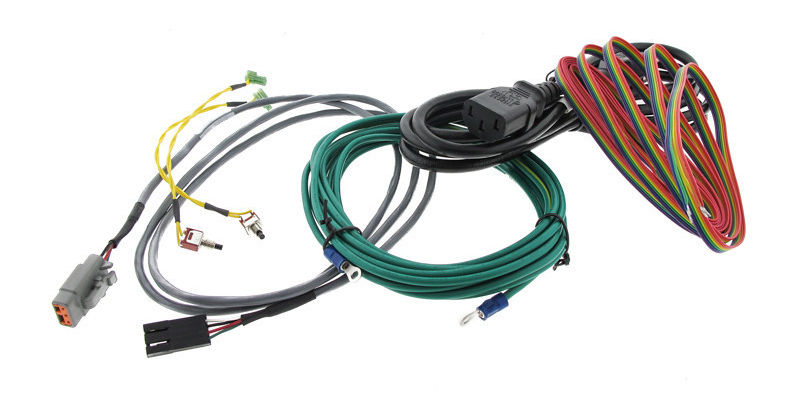
Terminals: Wire End Connections
In a standard vehicle, you might find over 500 of these connections, each carrying a specific load. A single faulty terminal with a resistance spike of just 0.5Ω can generate enough heat to melt its plastic housing when carrying 10A, following the P = I²R (22W) power dissipation principle.
The base material is the first decision. Most terminals are made from electrolytic copper (C11000) for its balance of conductivity and cost, achieving 101% IACS. For higher strength applications, like in a vibrating engine block, copper alloy C51900 (phosphor bronze) is used. It has a slightly lower conductivity at 50% IACS but a tensile strength of 700 MPa, compared to pure copper's 250 MPa. This means the phosphor bronze terminal can withstand 2.8x more mechanical stress before deforming.
For a 16 AWG wire, the crimp force must be around 2,000 Newtons. Under-crimping (below 1,800 N) leaves air pockets, leading to oxidation and resistance increase. Over-crimping (above 2,200 N) severs strands, reducing the wire's effective cross-section by up to 30% and creating a hot spot. A proper crimp should have a pull-out strength of at least 150 Newtons for that 16 AWG wire, meaning it should withstand a 15kg static load without failing.
A cross-section of a perfect crimp shows three distinct zones: the inner serrations piercing the oxide layer, the core where strands are compacted to 90% density, and the outer barrel providing mechanical strength. The resistance of this joint should be less than 0.1mΩ, which is negligible compared to the wire's inherent resistance.
Terminal design must also account for thermal expansion. The terminal and the wire it connects often have different coefficients of thermal expansion. For example, an aluminum wire terminated with a copper lug will experience significant stress over a 100°C temperature swing. This is why bimetallic lugs are used in such cases, featuring a aluminum sleeve for the wire and a copper pin for the connection, with a friction-welded joint in between. Without this, the connection loosens as it heats and cools, increasing resistance by over 50% within 100 cycles. For the most critical applications, welding or soldering is used. A laser-welded terminal joint has a fatigue life 10x greater than a crimped one in high-vibration tests, but it adds $0.80 per connection in equipment and time.
Seals: Environmental Protection
In an off-road vehicle, a single unsealed connector can lead to a 50% failure rate within 1,000 hours of operation in muddy, wet conditions. Seals might represent only 5% of the harness cost, but they prevent over 80% of environmental-related failures. From silicone rubber grommets that endure -55°C to 150°C temperature swings to IP67-rated connector seals that withstand 1m submersion for 30 minutes, these components are meticulously engineered.
A typical static seal requires 15-30% compression to form a reliable barrier. For a 2mm cross-section O-ring, this means the gland depth must be precisely 1.4mm to 1.7mm. Too little compression (under 10%) and it leaks; too much (over 40%) and the material extrudes, cutting its service life by 70%. For dynamic seals—like where a wire passes through a vibrating bulkhead—a lip seal design is used. It maintains constant contact pressure under movement, with a typical lip force of 0.5N per mm of circumference.
A harness seal rated IP67 must keep out dust entirely and prevent water ingress when immersed at 1m depth for 30 minutes. To achieve this, the seal must have a durometer (hardness) between 50 and 70 Shore A. A softer seal (50 Shore A) conforms better to rough surfaces but wears faster. A harder seal (70 Shore A) lasts longer but requires a smoother surface finish below 1.6μm Ra to avoid leaks. Pressure testing is critical: during validation, seals are tested with a 0.5 bar pressure differential for 60 seconds with no more than a 0.1 bar drop.
- Chemical Compatibility: A seal's material must resist swelling. For example, standard silicone swells 20% in gasoline, reducing sealing pressure by 50%. Fluorosilicone swells less than 5%.
- Compression Set: This measures permanent deformation. A high-quality seal should have a compression set below 20% after 22 hours at 125°C, meaning it rebounds to 80% of its original height.
- Aging: Seal life is finite. Silicone seals typically have a 15-year service life at 100°C, but this halves for every 10°C increase in temperature. At 150°C, the life drops to just 3-4 years.
Strain Relief: Cable Support
A printer cable might flex 50 times a day, while a robot arm's cable can experience over 10,000 cycles daily. Without proper support, copper strands work-harden and snap, and insulation cracks open. Strain relief components, which often cost less than $0.50 per unit, can extend a cable's lifespan from 3 months to over 10 years in dynamic environments.
- Bend Radius: The minimum safe curvature a cable can handle without damage. A 5mm diameter cable typically requires a 25mm bend radius. Forcing a tighter 10mm bend reduces its flex life by 90%.
- Stress Distribution: A good strain relief spreads pulling force over a 40-60mm area, reducing peak stress at the termination point from 50 MPa to below 5 MPa.
- Flex Cycles: The number of bends until failure. An unsupported cable might fail after 5,000 cycles; a properly supported one can exceed 1,000,000 cycles.
The most common strain relief is a simple overmolded collar made from thermoplastic polyurethane (TPU) or PVC. TPU is the go-to for flexibility and durability, with a Shore A hardness of 80-90 that provides stiffness without being rigid. It can withstand a pull force of 50 Newtons on a 6mm cable, distributing that load over a 30mm length.
A well-designed part doesn't have sharp edges; it uses a gradual curvature with a minimum bend radius of 7.5x the cable's diameter. For an 8mm cable, this means the internal curve must be at least 60mm. This reduces the stress on the outermost conductors by a factor of 10. The clamp mechanism is equally critical. A stainless steel clamp band exerts a consistent 5 N/cm² pressure, enough to grip the cable jacket without crushing the insulation inside. A plastic clamp might only provide 2 N/cm², which can allow the cable to slip under a 40N pull force.
For the most demanding applications, like on a robotic end-effector, strain relief becomes a spring-loaded mechanical system. These assemblies use coiled steel springs or tension-relief yarns integrated into the cable. The spring absorbs kinetic energy during rapid movement, reducing peak acceleration forces on the terminations from 15 G to 2 G. This simple addition boosts mean time between failures (MTBF) from 5,000 hours to over 50,000 hours.
Sleeving: External Protection
In an industrial robot, a harness without adequate sleeving can be destroyed in under 6 months from constant rubbing against metal surfaces. The right sleeving can reduce downtime by 80%, extending harness life from 2 years to over 10. From cheap PVC spiral wrap costing 5.00 per meter, the choice is a direct trade-off between cost and durability in specific environments.
- Abrasion Resistance: Measured by the number of cycles until failure on a standardized test bed. Braided polyester sleeving can withstand over 50,000 cycles against steel, while unjacketed wires fail in under 1,000.
- Temperature Range: The minimum and maximum operating temperatures. Standard polyethylene sleeving melts at 90°C, while fiberglass sleeving handles continuous temperatures up to 500°C.
- Chemical Resistance: A sleeve's weight increase after 24-hour immersion in fluid signals swelling. PET sleeving shows less than 5% swelling in oil, while nylon can swell up to 15%, compromising its abrasion resistance.
The most common type is braided polyester (PET) sleeving. It's a workhorse because it's cheap ($0.30/m), flexible, and provides solid protection. It has an average abrasion resistance of 50,000 cycles on the ASTM D4966 Martindale test and a continuous temperature rating of 125°C. For higher heat, like in engine bays near exhaust manifolds, fiberglass sleeving is the standard. It handles 500°C continuous and up to 1,200°C peak for short durations. Its downside is brittleness; it can crack if flexed repeatedly, with a minimum bend radius of 5x its diameter. A 10mm diameter fiberglass sleeve shouldn't be bent tighter than a 50mm radius.
For the toughest chemical environments—like in food processing or chemical plants—PTFE (Teflon) sleeving is the gold standard. It resists virtually every chemical, has a low coefficient of friction, and operates from -70°C to 260°C. The cost is high, at 8.00 per meter, but it prevents failures where other materials dissolve. When oils and hydraulic fluids are present, nylon sleeving is a cost-effective choice at $0.40/m. However, it absorbs moisture (up to 3.5% by weight in 95% humidity), which can slightly reduce its insulation resistance.
In modern harness cable assemblies, six components deliver robust functionality. 18-24AWG multi-core copper wires (2-4 conductors typical) form the core, with gold-plated connectors (8-12 contacts per terminal) requiring precision crimping (0.02mm tool tolerance) for low-resistance links. Silicone/EPDM seals (IP67-rated) block dust/water via laser-welded edges, while nylon strain reliefs (≥50N pull-tested) anchor cables at entry points. Finally, TPU/PVC jackets (-40°C to 125°C rated) resist abrasion with textured surfaces.
