What is Electrical Harness Assembly | A 3-Point Overview
Electrical harness assembly integrates wires, connectors, and terminals into a unified system, often using 22AWG copper wires (10A-rated) with 3:1 braiding. It involves precise crimping (0.5-0.7N·m torque) to terminals and testing insulation resistance (≥100MΩ) for reliable power/data transmission in automotive/industrial use.
Key Parts Explained
Over 90% of modern vehicles rely on wire harnesses, with a mid-size sedan containing 15–30 meters of wiring and 400–800 individual connections; in aerospace, a single fighter jet’s harness can weigh over 500 pounds and include 20,000+ wire segments.
Take automotive wiring: most use 12-24 AWG (American Wire Gauge) sizes, where a lower AWG number means thicker wire. For example, a 10 AWG wire can carry 30 amps continuously, while a 22 AWG wire maxes out at 7 amps—critical for avoiding overheating in high-power circuits like starters. The insulation around these wires is equally deliberate: cross-linked polyethylene (XLPE) insulation, common in industrial harnesses, handles 125–150°C (257–302°F) continuously, compared to PVC’s 80–105°C (176–221°F) limit. That temperature resistance isn’t accidental—engine compartments can hit 120°C during operation, so using the wrong insulation risks melting and short circuits.
A typical automotive connector has 2–12 pins, but heavy-duty industrial harnesses might use 40+ pin connectors with gold-plated contacts. Why gold? Because it reduces contact resistance to less than 50 milliohms (vs. 100+ milliohms for tin-plated), which cuts power loss by 15–20% in high-current circuits. Vibration resistance is another key spec: MIL-DTL-38999 connectors, used in military aircraft, are rated for 5–20 Gs of vibration (depending on class) and -65°C to +200°C operating temps—their circular design and locking mechanisms prevent loosening under extreme conditions.
Phosphor bronze, for instance, offers a tensile strength of 60,000–80,000 PSI and a conductivity of 15–20% IACS (International Annealed Copper Standard)—enough to handle 20–30 amps per terminal without deforming. Plating thickness matters too: a nickel undercoat (5–10 microns) followed by a gold flash (0.5–1 micron) prevents corrosion, extending terminal life by 3–5x in salt-heavy environments (like coastal vehicles).
Harnesses in washing machines, for example, use polyvinyl chloride (PVC) with a 0.8–1.2 mm thickness to resist water and abrasion. In EV battery packs, though, you’ll find thermoplastic elastomers (TPE) with UL94 V-0 flame retardancy (self-extinguishing in <3 seconds) and -40°C to +125°C flexibility. The difference? TPE costs 2–3x more than PVC but reduces fire risk by 90% in high-energy systems—a trade-off manufacturers happily make for safety.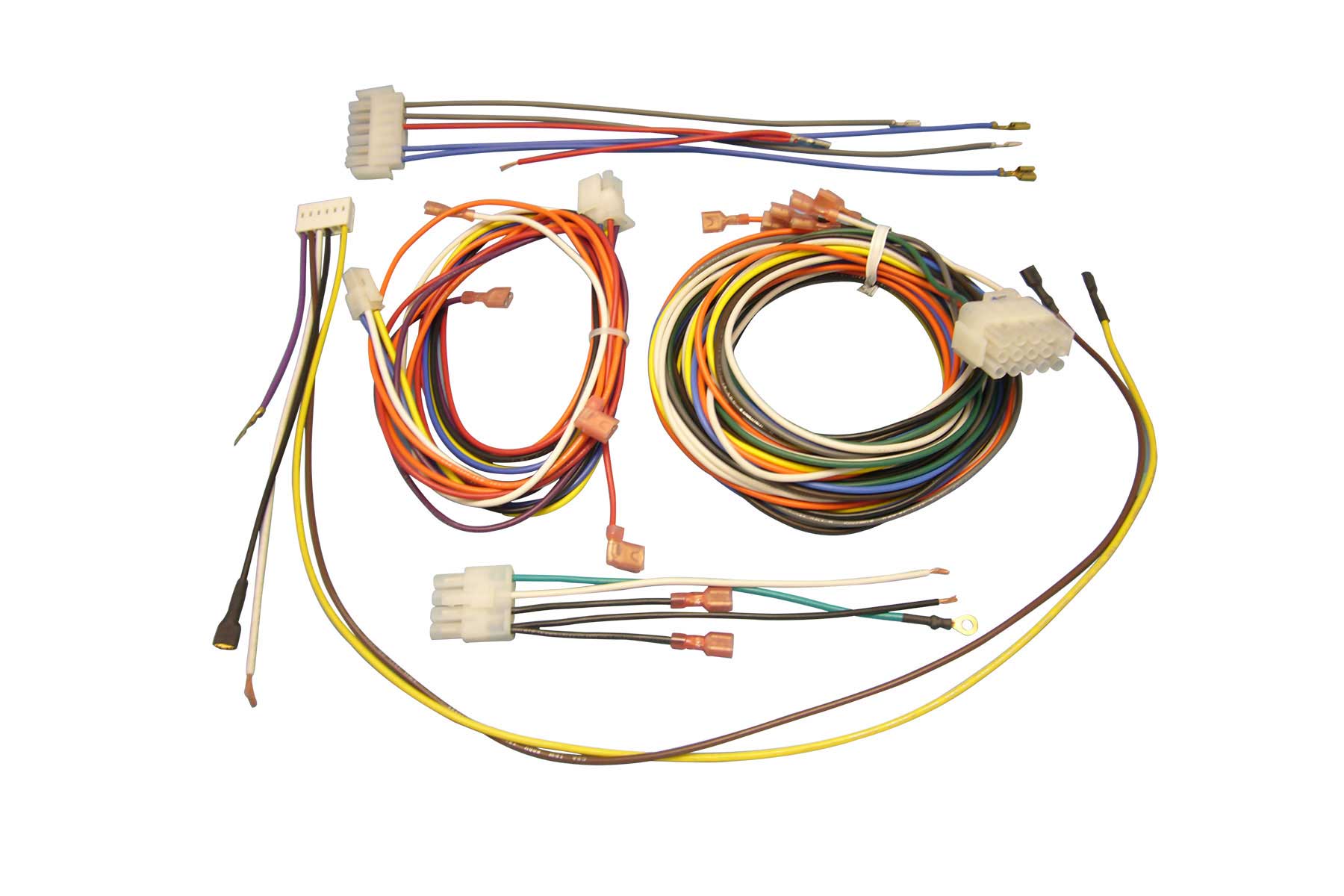
Assembly Process Walkthrough
In high-volume automotive plants, fully automated lines can produce 1,200–1,500 harnesses per shift, with each harness containing 300–500 distinct components. Yet, even with automation, 15–20% of steps still require manual assembly for complex routing or delicate connections. The entire process—from cutting wires to final testing—typically takes 45–90 minutes per harness for a standard automotive application, but that time can skyrocket to 8–12 hours for aerospace or industrial harnesses with 3,000+ wires and rigorous quality checks.
Automated machines feed wire reels at speeds of 1.5–2.5 meters per second, cutting wires to lengths ranging from 0.1 to 15 meters with a tolerance of ±1 mm. Laser stripping systems remove insulation with 0.05 mm accuracy, exposing precisely 8–10 mm of conductor for terminals or connectors. For a harness with 500 wires, this stage takes 12–18 minutes—but a single misstrip can cause a 10–15% voltage drop downstream, so calibration happens every 200 cycles.
Hydraulic or pneumatic presses attach terminals to wire ends under 2,000–6,000 Newtons of force, depending on the wire gauge. A 16 AWG wire might require a crimp force of 4,500 N to achieve a cold weld—a bond so tight it reduces resistance to <2 milliohms. Automated optical inspection (AOI) systems check each crimp at 60 frames per second, measuring parameters like pull-off strength (must exceed 50 Newtons for 16 AWG) and insulation grip length (1.5–2.0 mm). Reject rates here are kept below 0.1%; anything higher triggers machine recalibration.
Technicians follow 1:1 diagrams printed on 3-meter-long boards, often using 100–200 plastic clips to hold wires in place during routing. For a mid-size automotive harness, this manual routing takes 25–35 minutes per harness. Twist ratios matter here: paired wires for CAN bus or Ethernet signals are twisted at 4–6 twists per meter to reduce electromagnetic interference by 20–25 dB. Miss a twist, and signal integrity drops by 30%.
Workers use semi-automatic insertion tools to seat terminals into housings at 200–300 insertions per hour. Each connector has a 20–40 Newton insertion force requirement—too low, and it might vibrate loose; too high, and pins bend. Backforce (the force needed to extract a terminal) is tested sporadically: >15 Newtons is the industry standard for most applications. For sealed connectors (IP67+), workers add silicone gel or rubber grommets with 0.3–0.5 mm compression tolerance to block water ingress.
|
Process Step |
Key Parameters |
Tolerance |
Speed/Cycle Time |
Common Issues |
|---|---|---|---|---|
|
Wire Cutting |
Length: 0.1–15 m |
±1 mm |
1.5–2.5 m/sec |
Length deviation >1 mm |
|
Insulation Strip |
Strip length: 8–10 mm |
±0.05 mm |
500 strips/hour |
Conductor nicking |
|
Terminal Crimp |
Force: 2,000–6,000 N |
Pull-off >50 N |
1,200 crimps/hour |
Under-crimp (<40 N) |
|
Connector Insertion |
Insertion force: 20–40 N |
±5 N |
250/hour |
Pin misalignment |
|
Harness Taping |
Tape tension: 2–4 N |
50% overlap |
10 m/min |
Over-tension (>5 N) |
Machines or workers apply non-adhesive PVC tape or corrugated conduit at 10 meters per minute, with 50% overlap between wraps for consistent abrasion resistance. Tension is critical: 2–4 Newtons ensures snugness without deforming wires. In high-vibration environments (e.g., engine bays), harness sections are wrapped with fiberglass sleeving rated for 180°C and 50 Gs of vibration.
Automated test benches apply 500 V DC for hipot (high-potential) tests to detect insulation breaches—leakage current must stay below 1 mA. Continuity tests check for opens or shorts with 10 mA test current and 0.01 Ohm resolution. For CAN bus harnesses, impedance is verified at 120 Ohms ±10%. A single harness might undergo 200–300 electrical checks in 3–5 minutes. Failures here cost 100 in rework time, so testing accuracy is kept at 99.95%.
To clarify electrical harness assemblies—an organized bundle of 22AWG copper wires, AMPSEAL 1-480395-1 connectors, and crimped terminals—assembly involves stripping wires to 10-12mm, crimping with ≥50N pull-out force, and bundling at ≤6x diameter. Post-build, verify continuity (<0.5Ω) and insulation (>10MΩ) for reliability.
