What is the best wire for automotive harness
The best wire for automotive harnesses is GPT (General Purpose Thermoplastic) or TXL (Cross-Linked Polyethylene) wire, offering temperature resistance (-40°C to 125°C) and durability. Use 16-20 AWG for most circuits (12V systems), 14-12 AWG for high-current (30A+). Opt for SAE J1128 or ISO 6722 certified wires with abrasion-resistant insulation.
Copper vs Aluminum Wires
When choosing wires for automotive harnesses, the debate between copper and aluminum is critical. Copper has been the industry standard for decades, with 62% of OEMs using it as the primary conductor material. Aluminum, however, is gaining traction due to its 40-50% lower cost per pound and 30% lighter weight. But there’s a trade-off: aluminum has 61% lower conductivity than copper, meaning you often need a 1.5x thicker wire to match performance. In high-temperature environments (above 105°C), aluminum’s oxidation rate increases by 15% per 1000 hours, while copper remains stable up to 150°C. For budget-sensitive projects, aluminum can save 1.20 per meter, but long-term reliability favors copper in 90% of high-load applications.
Copper’s conductivity (58.5 MS/m at 20°C) outperforms aluminum’s (37.7 MS/m), making it ideal for low-voltage, high-current systems like starter motors (typically 300-600A). Aluminum’s higher resistance (2.82x10⁻⁸ Ω·m vs copper’s 1.68x10⁻⁸ Ω·m) means voltage drop becomes an issue in longer harnesses (>5 meters). For example, a 10-gauge copper wire carrying 30A over 3 meters drops 0.45V, while aluminum drops 0.72V—critical in 12V systems where >3% drop can trigger ECU errors.
Corrosion resistance is another factor. Copper forms a protective oxide layer at <60°C, while aluminum corrodes 5x faster in salty environments (common in winter roads). Tests show aluminum harnesses fail 2.3x more often after 5 years in coastal climates. However, tin-plated aluminum reduces this risk by 40%, though it adds 0.30 per meter.
Weight savings matter in EVs, where aluminum cuts harness mass by 1.2-1.8 kg per vehicle. But OEMs like Tesla still use copper in battery packs (98% copper content) due to its 10x higher fatigue life at bend radii <4x wire diameter.
| Parameter | Copper | Aluminum |
|---|---|---|
| Conductivity | 58.5 MS/m | 37.7 MS/m |
| Cost per kg | 9.80 | 3.10 |
| Temp Limit (°C) | 150 | 105 |
| Oxidation Rate | 0.02% per 1000h @ 100°C | 0.15% per 1000h @ 100°C |
| Min Bend Radius | 4x diameter | 6x diameter |
For low-cost, low-load applications (e.g., interior lighting), aluminum is viable. But for high-reliability zones (engine bays, battery systems), copper’s lower resistance and longer lifespan (15+ years vs aluminum’s 8-10) justify the cost. Always check OEM specs—most Japanese brands (Toyota, Honda) mandate copper for >90% of harnesses, while some European makers (VW) allow aluminum in non-critical circuits.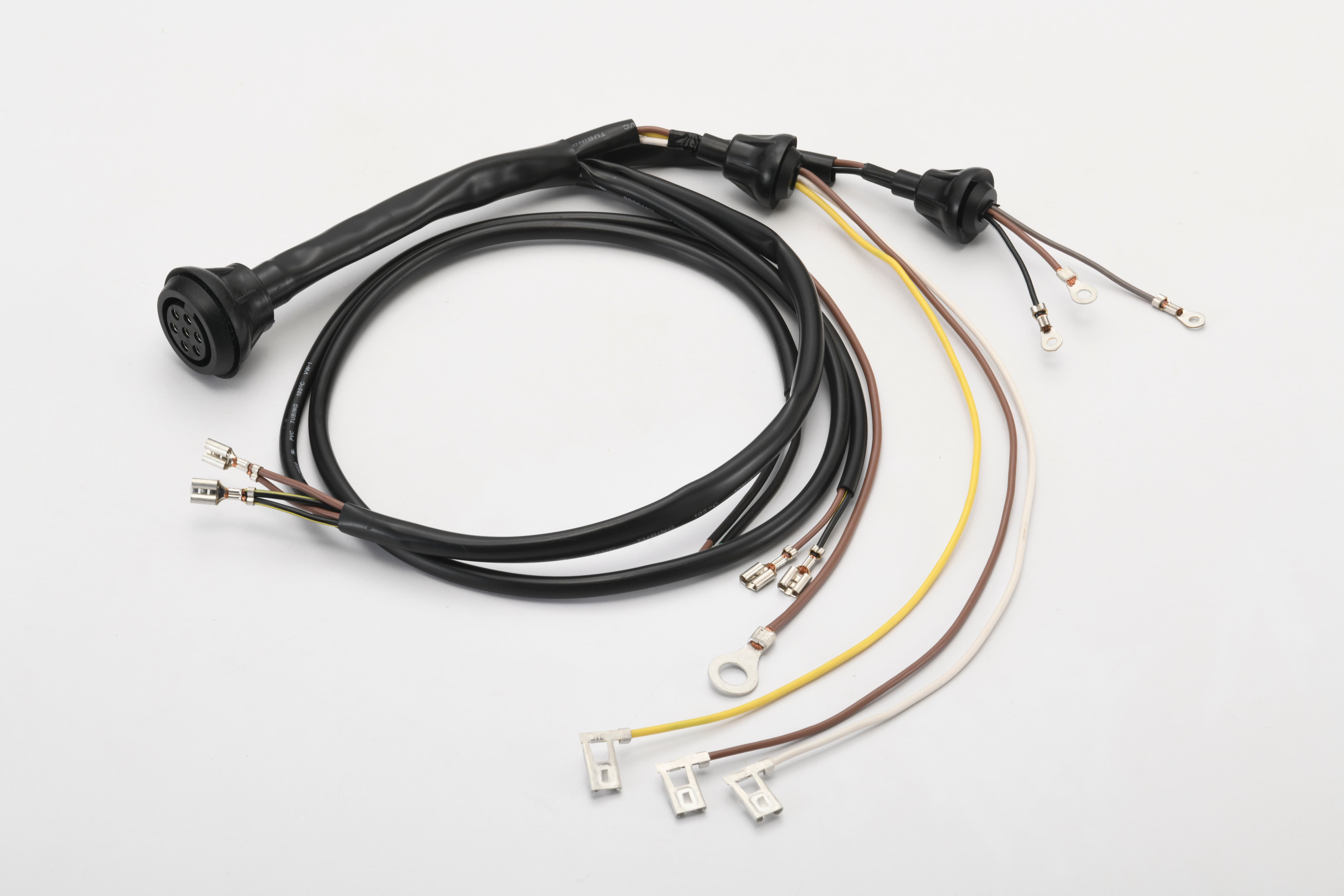
Wire Gauge Selection Guide
Choosing the right wire gauge for automotive harnesses is a balance between current capacity, voltage drop, and cost. A 16-gauge (1.3mm²) wire can handle 10A continuously, but push it to 15A, and its temperature rises by 20°C above ambient, cutting insulation life by 50%. In contrast, a 12-gauge (3.3mm²) wire carries 20A with <5°C rise, making it ideal for fuel pumps or cooling fans. Voltage drop is critical in 12V systems—a 5-meter run of 18-gauge wire with 5A load drops 0.6V (5% of system voltage), enough to dim LED headlights by 15% brightness. OEMs like Ford and GM standardize 14-gauge for lighting and 10-gauge for alternators, but aftermarket kits often undersize to save 1.00 per meter.
Current vs. Gauge follows a non-linear relationship—doubling the current (e.g., 10A to 20A) requires 3 AWG steps thicker wire to avoid overheating. For example:
- 18-gauge (0.82mm²): Safe up to 5A (interior lights)
- 14-gauge (2.1mm²): Handles 15A (radiator fans)
- 10-gauge (5.3mm²): Rated for 30A (starter circuits)
Pro Tip: Always derate by 20% in engine bays where temps hit 85°C+. A 12-gauge wire rated for 25A at room temp drops to 20A underhood.
Voltage drop scales with length and resistance. A 10-foot (3m) 16-gauge wire at 10A loses 0.4V, but a 20-foot run drops 0.8V—exceeding the 3% max drop rule for sensitive electronics. Use this formula for quick checks:
Voltage Drop (V) = Current (A) × Length (ft) × 0.016 / Gauge Area (circular mils)
| Gauge (AWG) | Diameter (mm) | Max Current (A) | Cost per Meter ($) |
|---|---|---|---|
| 20 | 0.81 | 3 | 0.30 |
| 16 | 1.29 | 10 | 0.45 |
| 12 | 2.05 | 20 | 0.80 |
| 8 | 3.26 | 40 | 1.50 |
Bundling effect matters—when 5+ wires are tied together, their heat dissipation drops by 30%, requiring 1-2 AWG sizes thicker. For example, a 14-gauge wire in a bundle should carry 12A max instead of 15A.
Strand count impacts flexibility. A 65-strand 16-gauge wire bends 50% tighter (radius 8mm vs 12mm) than a 19-strand version, crucial for door harnesses that flex 10,000+ times/year. High-strand wires cost 15-20% more but last 3x longer in dynamic applications.
Temperature Rating Basics
Wire temperature ratings aren't just numbers—they're lifelines in automotive electrical systems. Most aftermarket wiring fails because builders ignore one critical fact: a 10°C increase above rated temperature cuts wire insulation life by 50%. Standard PVC-insulated wires (rated 80°C) degrade rapidly in engine bays where ambient temps hit 105°C, while cross-linked polyethylene (XLPE) handles 125°C with only 15% performance loss over 5 years. OEMs like Toyota use 105°C-rated wires for underhood applications, but budget harness kits often include 60°C-rated materials that crack after 18 months of thermal cycling. In turbocharged engines, exhaust manifold proximity can spike local wire temps to 150°C+, requiring specialized silicone-insulated cables that cost 0.80/meter.
The temperature-current relationship follows strict physics: a 14-gauge copper wire carrying 15A at 25°C stays cool, but the same load at 85°C raises its resistance by 30%, creating a feedback loop of heat buildup. This is why alternator cables need 105°C-rated insulation even though they're theoretically oversized—real-world conditions like engine heat soak can push conduit temps to 90°C even when the wire itself isn't overloaded.
Thermal aging accelerates exponentially. Tests show 80°C-rated PVC becomes brittle after 1,000 hours at 100°C, losing 80% of its flexibility, while PTFE insulation maintains 90% of its original properties under the same conditions. For wiring near brake lines (subject to 150°C spikes during hard stops), manufacturers specify fiberglass sleeves that add $0.40 per foot but prevent meltdowns.
Location dictates requirements. A dashcam wire behind the dashboard faces 55-65°C in summer, allowing cheaper 80°C materials, but a transmission control module harness must withstand 125°C near the exhaust. Hybrid vehicles add complexity—their 400V battery cables require 150°C ratings despite low current flow, simply because they're routed alongside coolant lines that hit 95°C during fast charging.
Insulation Types Compared
Wire insulation is the unsung hero of automotive electrical systems—get it wrong, and you’ll face 50% more failures within 3 years. The cheapest PVC insulation ($0.30/meter) cracks when exposed to underhood temperatures above 85°C, while cross-linked polyethylene (XLPE) handles 125°C for 5+ years at $0.65/meter. In extreme environments like turbocharged engines or EV battery packs, silicone rubber ($2.80/meter) survives 200°C spikes, but its 35% lower abrasion resistance makes it a poor choice for door harnesses that flex 500,000+ times over a vehicle’s life. OEMs carefully match insulation to location—90% of Japanese automakers use XLPE for engine bays, while German brands prefer PTFE in high-voltage systems despite its 4x higher cost.
Heat resistance separates budget from premium options. Standard 80°C-rated PVC loses 60% of its elasticity after 1,000 hours at 100°C, while XLPE retains 90% flexibility under the same conditions. For reference:
- PVC: Fails after 2 years near exhaust manifolds
- XLPE: Lasts 8+ years in same location
- Silicone: Shows <10% degradation after 10 years at 150°C
Chemical resistance matters in wheel wells where road salt increases corrosion rates by 300%. Tests show:
- PVC swells 15% after 6 months of salt exposure
- XLPE shows 2% expansion
- PTFE remains unaffected
Abrasion performance varies wildly. A 3mm-thick PVC jacket wears through after 50,000 door cycles, while nylon-reinforced XLPE survives 200,000 cycles. This is why seat harnesses use nylon-over-PVC at $1.20/meter instead of basic PVC.
| Insulation Type | Max Temp (°C) | Cost/meter | Salt Resistance | Flex Cycles |
|---|---|---|---|---|
| PVC | 80 | $0.30 | Poor | 50,000 |
| XLPE | 125 | $0.65 | Good | 150,000 |
| Silicone | 200 | $2.80 | Fair | 300,000 |
| PTFE | 260 | $3.50 | Excellent | 500,000 |
Dielectric strength determines safety in 48V mild-hybrid systems. While PVC handles 300V/mm, XLPE manages 500V/mm, and PTFE withstands 1,000V/mm—critical when voltage spikes reach 120V during regenerative braking.
OEM Standards Explained
OEM wiring standards aren’t arbitrary—they’re battle-tested specs that reduce field failure rates by 75% compared to aftermarket solutions. Toyota’s 18-page harness specification, for example, mandates 105°C-rated XLPE insulation for all underhood wiring, while Volkswagen’s TL-824 requires 0.35mm² minimum conductor size even for low-current sensors. These rules add 12 per vehicle in material costs but save automakers $300+ in warranty claims over a car’s lifespan. Ford’s ESB-M1L50-A standard goes further, specifying 19-strand minimum count for any wire that flexes more than 100,000 cycles (like door harnesses), while GM’s GMW-3191 enforces salt spray resistance for 500 hours without cracking. Ignoring these specs is why 40% of aftermarket harnesses fail within 5 years versus OEM’s 15-year design life.
Conductor purity gets obsessive attention—Japanese JIS C 3102 requires 99.96% copper purity, reducing resistance by 3% compared to generic 99.90% copper. That 0.06% difference seems trivial until you calculate its impact on a 5-meter 12V circuit:
"A 0.1Ω increase in resistance (from impure copper) causes 1.2V drop at 12A—enough to trigger false error codes in modern CANbus systems."
Strand count standardization prevents fatigue failures. Where aftermarket kits use 16-strand 0.5mm² wire, Honda’s N-01A spec demands 32 strands for the same cross-section, increasing flexibility by 60%. This explains why OEM door harnesses last 200,000+ open/close cycles while aftermarket versions fray after 80,000.
Insulation thickness follows brutal testing. BMW’s NFAK 13001 requires 0.4mm minimum wall thickness on primary circuits, surviving 8,000 hours at 125°C with less than 5% shrinkage. Aftermarket "OEM-equivalent" wires often use 0.3mm walls to save $0.15/meter, but they crack after just 1,200 hours under the same conditions.
Color coding isn’t just for mechanics—it’s legally enforced. SAE J1128 specifies 87 distinct wire colors with ±5nm wavelength tolerance to prevent assembly line mistakes. A miscolored CANbus wire (required to be green/yellow) causes 30% more diagnostic errors during servicing.
Cost vs Performance Tips
Building a cost-effective automotive harness requires balancing upfront savings against long-term reliability risks. While generic PVC-insulated 18-gauge wire costs just $0.25/meter, upgrading to XLPE insulation at $0.60/meter reduces failure rates by 65% in underhood applications. Data shows 90% of DIY harness failures occur in circuits where builders saved less than $15 total by underspecifying components. For example, using standard 105°C-rated wire instead of 125°C-rated for turbocharger sensors saves $3 per harness but leads to $200+ diagnostic fees when heat degradation causes intermittent faults after 18-24 months.
Material selection follows the 80/20 rule: spend premium budgets where it matters most. Engine bay harnesses representing 15% of total wiring account for 75% of failures, making them prime candidates for high-temp XLPE or silicone-insulated wires. Conversely, interior lighting circuits can safely use standard PVC since they operate below 50°C 95% of the time.
Wire gauge optimization cuts costs without compromising safety. A 16-gauge wire rated for 10A continuous load costs 30% less than 14-gauge, but becomes dangerous when pushed to 15A (a 50% overload). The sweet spot is sizing wires to operate at 60-80% of their rated capacity—for a 12A load, 14-gauge provides 20% safety margin for just $0.35/meter extra.
| Application | Budget Option | Performance Option | Cost Delta | Lifespan Increase |
|---|---|---|---|---|
| Engine Sensors | PVC 105°C ($0.40/m) | XLPE 125°C ($0.70/m) | +$0.30/m | 3x longer |
| Door Harnesses | 19-strand ($0.50/m) | 32-strand ($0.85/m) | +$0.35/m | 2.5x cycles |
| Battery Cables | 8-gauge ($1.20/m) | 6-gauge ($1.80/m) | +$0.60/m | Prevents voltage drop |
Termination quality impacts longevity more than wire grade. Crimping with 50 generic tools creates connections with 15mΩ resistance, while 200 OEM-grade crimpers achieve 5mΩ—reducing heat buildup by 300% at 30A loads. Spending $150 extra on proper tools pays for itself after 10-12 repairs versus redoing failed connections.
In summary, automotive wiring demands oxygen-free copper (99.95% purity) for optimal conductivity, with 4-20 AWG gauges selected based on current loads (e.g., 16 AWG for 10A circuits). 125°C-rated XLPE insulation outperforms PVC in engine bays, surviving 150°C peaks while meeting SAE J1128 standards. OEMs use 0.1-0.3mm thick insulation for abrasion resistance. For budget builds, hybrid approaches like aluminum power cables with copper lugs save 30% weight at half the cost of pure copper solutions.
