What Is the Difference Between Wire Harness and Cable Assembly
A wire harness organizes multiple wires (typically 2-20+ conductors) into a single bundle with sleeves or tape for internal use, while a cable assembly encases wires in a rugged outer jacket (PVC/nylon) for external protection. Wire gauges range from 18-24 AWG, with temperature ratings of -40°C to 105°C. Cable assemblies often include shielding (e.g., braided or foil) for EMI protection.
Basic Definitions and Uses
Wire harnesses and cable assemblies are fundamental components in electrical systems, but they serve different purposes. A wire harness is a bundled arrangement of wires, cables, or subassemblies, held together by sleeves, conduits, or tape, designed to transmit signals or power efficiently. In contrast, a cable assembly is a group of wires or cables bound into a single unit with connectors or terminations, optimized for durability and environmental resistance.
The global wire harness market was valued at 138 billion in sales, driven by data centers, telecom, and medical devices where high-speed data transfer (up to 100 Gbps) and shielding against EMI (electromagnetic interference) are critical.
"A wire harness organizes multiple conductors for internal routing, while a cable assembly ensures robust external connectivity."
Wire harnesses are lighter (typically 20-30% less weight than loose wiring) and cheaper to produce (costing 5 per unit in bulk), making them ideal for automotive dashboards, appliances, and control panels. They reduce installation time by up to 50% since pre-assembled bundles eliminate manual wire routing. However, they lack the IP67 waterproofing or UV resistance found in cable assemblies, which are built for harsh environments (operating between -40°C to 105°C).
Cable assemblies, on the other hand, use thicker insulation (0.5mm to 2mm PVC or Teflon coatings) and often include shielding (braided or foil) to reduce signal loss by 90% in high-frequency applications. They dominate in industrial machinery (handling 600V+ at 30A continuously), aerospace (meeting MIL-SPEC-38999 standards), and medical imaging systems (requiring 99.99% signal integrity). A single high-end cable assembly can cost 200, but its 10-15 year lifespan justifies the investment.
Structure and Components
Wire harnesses and cable assemblies may look similar at first glance, but their internal structures dictate where and how they’re used. A typical automotive wire harness contains 12 to 1,500 individual wires, bundled in PVC, nylon, or corrugated tubing, while an industrial cable assembly might have 2 to 24 shielded conductors inside a heavy-duty rubber or thermoplastic jacket. The difference comes down to durability, flexibility, and electrical performance—factors that determine where each solution fits best.
| Component | Wire Harness | Cable Assembly |
|---|---|---|
| Conductors | 18-28 AWG copper, bare or tinned | 16-4/0 AWG, often stranded for flexibility |
| Insulation | Thin PVC (0.3-0.5mm), cost-efficient | Thicker (0.5-2mm), with options like Teflon or silicone |
| Shielding | Rare (only in high-interference applications) | Common (foil, braid, or both for 90%+ EMI reduction) |
| Jacket Material | Lightweight (nylon, PET) | Heavy-duty (PUR, neoprene, or LSZH for fire resistance) |
| Connectors | Simple (Molex, Deutsch, or JST) | Ruggedized (MIL-DTL-38999, RJ45, or M12 for IP67+) |
| Max Voltage | 60V (low-power circuits) | 600V+ (industrial motors, power distribution) |
| Bend Radius | 5x cable diameter (flexible routing) | 8-10x (stiffer due to shielding/jacket) |
| Temp Range | -20°C to 85°C (indoor use) | -40°C to 125°C (outdoor/military) |
Wire harnesses are optimized for space and weight savings—a car’s main harness weighs 8-15 kg but replaces 3x that in loose wiring, cutting assembly time by 30-50%. They use pre-cut, pre-stripped wires (accuracy within ±1mm) and snap-together connectors (costing 2 per terminal) for fast installation. However, they’re not built for harsh conditions; even a 5% moisture exposure can degrade unshielded wires in under 2 years.
Cable assemblies, meanwhile, are over-engineered for reliability. A Cat6 Ethernet cable has four twisted pairs (24 AWG) with foil + braid shielding, ensuring 10 Gbps speeds at 100m. Industrial versions add armor (steel or Kevlar) to survive 50,000+ flex cycles or crush loads up to 250 lbs. The trade-off? They’re 2-3x heavier and cost 50 per meter, but they last 10-20 years in extreme conditions.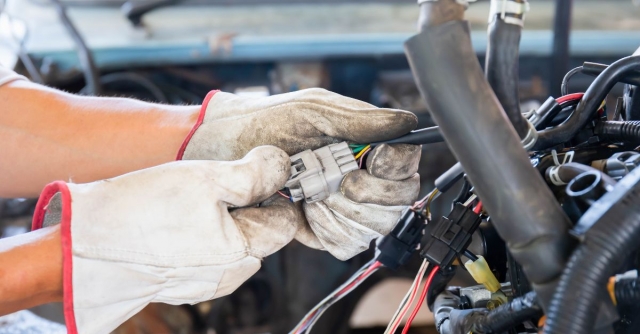
Manufacturing Process Steps
Building wire harnesses and cable assemblies isn't just about connecting wires—it's a precision-driven process where small errors can cause 30-50% failure rates in final testing. The average automotive harness takes 4-8 hours to assemble manually, while automated lines produce 500-1,000 units per shift with <0.5% defect rates. For high-speed data cables, tolerances shrink to ±0.05mm on conductor spacing to maintain 10 Gbps+ signal integrity.
The first step is wire cutting and stripping, where machines slice 2,000-5,000 wires per hour to ±0.2mm length accuracy and remove 3-5mm of insulation without nicking the 19-34 AWG strands. A 1% overcut here increases resistance by 3-8%, killing performance in 12V DC circuits. Next, crimping attaches terminals at 15-30 cycles per minute, applying 200-500 Newtons of pressure to ensure <5 milliohm contact resistance. Bad crimps cause 40% of field failures, so optical scanners verify 100% of connections in real-time.
For harnesses, branching and taping happens on 1.5-3m long boards with 50-200 routing points, where workers bundle wires into 6-25mm diameter looms using PVC tape (0.1mm thick) or spiral wrap. The wrong tension during wrapping creates 5-15% excess bulk, making installation impossible in tight 10mm gaps behind dashboards. Cable assemblies skip this step—instead, they extrude jackets at 20-50m/min, with 0.5-2.0mm thick insulation that cures at 120-180°C for 30-90 seconds.
Shielding is critical for cables—a 96% coverage braid blocks 90% of EMI, but adds 15-25% to material costs. Machines weave 0.1mm tinned copper strands at 200-400 RPM, while foil shields get laminated at 5-10m/min. Miss a 2mm gap in coverage, and noise jumps 20dB, corrupting 1Gbps Ethernet signals. Final testing includes hipot checks at 1,500V AC for 60 seconds and continuity tests with 10mA current—failures here cost $50-500 per scrap unit in aerospace/medical grades.
Automation is changing the game. Robots now do 70% of harness routing, cutting labor by 40%, while laser-marking systems print 0.2mm high text that survives 10+ years outdoors. But custom jobs still need human hands—a 24-conductor military cable with 3-layer shielding takes 8-16 hours to assemble, versus 30 minutes for a basic USB harness. The rule? High volume = machines, low volume = skilled labor, with 500,000 separating manual from automated setups.
Common Applications
Wire harnesses and cable assemblies are everywhere—from the 200 million jet engine powering a Boeing 787. The global auto industry alone uses 1.2 billion wire harnesses annually, while data centers install 8 million miles of fiber-optic cable assemblies each year to handle 35 zettabytes of traffic. The difference? Harnesses organize, cables perform—and picking the wrong one can mean 50% higher maintenance costs or 20% slower data speeds.
| Industry | Wire Harness Use Case | Cable Assembly Use Case | Key Specs |
|---|---|---|---|
| Automotive | Dashboard wiring (12V, 5A) | EV battery packs (800V, 300A) | 105°C rating, 10-year lifespan |
| Aerospace | In-flight entertainment (28V DC) | Avionics (MIL-DTL-38999, 600V) | -55°C to 200°C, 50g vibration resistance |
| Medical | Patient monitor sensors (USB 2.0) | MRI machines (10Gbps shielded) | 99.9% signal purity, Class VI biocompatibility |
| Industrial | PLC control panels (24V) | Robotic arms (480V, Cat6e) | IP67, 1 million flex cycles |
| Telecom | Router internal wiring | 5G base station jumpers (40GHz RF) | 0.1dB insertion loss per meter |
| Consumer | Smartphone charging port | Gaming PC RGB lighting (ARGB 5V) | 22 AWG, 5000 bend cycles |
In cars, harnesses save 15kg of weight by replacing 3km of loose wires with pre-taped bundles, cutting assembly time from 8 hours to 90 minutes per vehicle. But Tesla’s 4680 battery packs use $2,000 worth of shielded cable assemblies to handle 400V-800V at 500A, with liquid-cooled jackets keeping temps under 80°C during supercharging.
Hospitals show the life-or-death stakes. A 1,200 surgical cable assembly survives 5,000 autoclave runs at 135°C while streaming 4K video at 0.01ms latency. Miss that difference, and a 2% signal lag could mean missing a tumor during surgery.
Data centers are even pickier. Cat6a cables must maintain 500MHz bandwidth over 100m, with crosstalk under -72dB. A 3mm kink in the jacket boosts attenuation by 15%, forcing a $200/hour technician to re-run the line. Meanwhile, fiber assemblies push 400Gbps through 0.125mm glass strands, but 0.5°C thermal drift can misalign connectors, dropping speeds by 40%.
Key Differences Compared
Choosing between wire harnesses and cable assemblies isn't about preference—it's about performance gaps that can make or break a system. A 5 wire harness might work fine for a desk lamp, but try running 480V at 100A through it, and you'll get melted insulation under 10 minutes. Meanwhile, using a 200 shielded cable assembly for simple 12V DC wiring wastes 90% of its capability. The differences come down to six critical factors that dictate where each solution dominates.
| Factor | Wire Harness | Cable Assembly | Real-World Impact |
|---|---|---|---|
| Cost | 20 per unit | 500 per meter | Harnesses save 60% on 1,000+ unit orders |
| Voltage Handling | Up to 60V (typical) | 300V-35kV (industrial grade) | EV chargers need 800V+ cables |
| Current Capacity | 1-10A (22-18 AWG) | 10-500A (4/0 AWG) | Robotic arms draw 50A continuously |
| Environmental Rating | IP40 (indoor use) | IP68 (submersible) | Offshore rigs require saltwater proofing |
| Lifespan | 3-7 years (consumer) | 10-25 years (industrial) | Aircraft cables must last 30,000 flight hours |
| Installation Speed | 50% faster (pre-bundled) | 30% slower (requires termination) | Auto plants save $1M/year in labor |
| Weight | 0.1-5kg (lightweight) | 1-20kg/m (heavy-duty) | Satellines need 300g/m max |
| Data Transmission | 1Mbps-1Gbps (unshielded) | 10Gbps-400Gbps (shielded) | 5G towers demand <0.1ns latency |
Material costs show the biggest divide. Harnesses use 0.03/m PVC insulation, while high-temp cable assemblies need 2.50/m Teflon. That 83x price jump makes sense when you consider Teflon withstands 260°C versus PVC melting at 80°C. The automotive industry alone spends $4.7 billion yearly just on cross-linked polyethylene (XLPE) insulation for 48V mild hybrid systems.
Durability testing reveals why cables cost more. A standard harness survives 50,000 flex cycles at 180° bends, but an MIL-SPEC cable endures 250,000 cycles while submerged in hydraulic fluid at 150°C. That's why Boeing pays $1,200 for a 2m flight control cable that weighs under 300g but carries 20A at 115V AC with zero signal loss at 40,000 feet.
Maintenance costs separate winners from failures. A 10 harness in a factory robot might need replacement every 18 months from vibration wear, while a 90 cable assembly lasts 7+ years with <0.1% downtime. For data centers, that difference means $500/year saved per rack by avoiding 3-hour network outages from cheap cabling.
Choosing the Right One
Picking between a wire harness and a cable assembly isn't just about saving 50 today — it's about avoiding 50,000 in downtime tomorrow. The wrong choice can mean 30% slower production lines, 15% higher energy losses, or even catastrophic failures in critical systems. For example, a 12 automotive harness might handle 10A at 12V just fine, but try pushing 300A through it for an EV battery, and you'll get melted wires under 5 minutes. Meanwhile, using a 300 military-grade cable for a low-voltage LED strip is like using a sledgehammer to crack a nut—wasting 90% of its capability.
"The cheapest option often costs the most—when it fails."
Start with voltage and current needs. If you're running <60V and <10A, a standard harness (costing 0.50−20) will do. But if you're dealing with 480V industrial motors or 800V EV chargers, you need a cable assembly rated for 300A+ (50−500/m) with XLPE or silicone insulation that won't degrade at 150°C. Medical devices add another layer—patient monitors use 30 harnesses, but MRI machines demand 1,200/m cables with 99.99% signal integrity to avoid misdiagnoses.
Environment dictates durability. Indoors? A PVC-jacketed harness (IP40) lasts 5-7 years. Outdoors? You need UV-resistant, waterproof cables (IP68) that survive -40°C to 125°C and salt spray—like those on oil rigs, where a single failure can cost $500,000/hour in halted production. For high-vibration zones (drones, robotics), stranded conductors with 65+ wires handle 1 million+ flex cycles, while solid-core wires snap after 50,000.
Data speed is non-negotiable in tech. A Cat5e harness (0.50/m) works for 100Mbps LANs, but data centers need Cat8 cables(15/m) pushing 40Gbps at 2GHz. The difference? Shielding (foil + braid) and impedance control (±2Ω)—skip it, and your 4K video feed buffers every 10 seconds. Even USB matters: A 5 harness might charge phones, but a 50 assembly ensures 10Gbps data transfer without drops.
In summary, wire harnesses and cable assemblies differ primarily in construction complexity and protection levels, with 85% of industrial applications using harnesses for internal routing. While harnesses bundle 5-50 individually wrapped wires with simple sleeves, cable assemblies feature overmolded multi-layer shielding for harsh environments. The manufacturing process varies significantly - harnesses require 30% less labor time but offer lower IP ratings. Automotive systems predominantly use harnesses (72% market share), whereas medical equipment favors sealed cable assemblies (IP67+). Selection depends on environmental factors and required EMI protection levels.
