What Is Wire Harness Assembly | 5 Essential Components
A wire harness assembly is a structured set of cables and wires bound together to transmit signals and power. Its five essential components include wires (often 20-22 AWG for low current), connectors (like Deutsch DT series for secure mating), protective sleeving (such as braided PET or corrugated conduit), terminals (crimped onto wire ends), and relays or fuses (e.g., a 10A blade fuse) to protect circuits from overcurrent.
Wires and Cables: The Core
Acting as the central nervous system of any device, they are responsible for transmitting power (e.g., 12V, 5A) and data signals (e.g., 100 Mbps Ethernet). Selecting the correct type is critical, as it dictates the assembly's current capacity, voltage rating (like 300V or 600V), and flexibility. Industry data shows that improper wire selection accounts for over 30% of harness failures in the first 5 years of a product's life, making this choice a primary factor in long-term reliability and performance.
A wire tasked with carrying a 10A continuous current in an automotive application, for instance, will typically require a thicker 16-gauge (AWG) cross-section to prevent overheating and voltage drop, whereas a low-power sensor signal under 500mA might only need a thin 24-gauge wire.
Beyond current, the operating voltage defines the necessary insulation thickness and material. Applications in 240V AC industrial equipment demand thicker, more robust insulation compared to the 5V DC lines inside a consumer electronic device.
For data transmission, the signal frequency is the key driver. Standard CAN bus networks in vehicles run at 1-2 MHz, requiring twisted pair cables to reduce electromagnetic interference (EMI). In contrast, high-speed Gigabit Ethernet (1000BASE-T) operates at a frequency of 125 MHz, necessitating meticulously engineered Category 5e or 6 cables with specific impedance (100Ω) and twist rates to maintain signal integrity over distances of up to 100 meters.
Temperature resistance is paramount; standard PVC insulation softens at around 105°C, while silicone or Teflon-based jackets can withstand temperatures exceeding 200°C, making them essential in under-hood automotive or aerospace applications. Flexibility is another major consideration. A harness in a industrial robot arm may need to endure over 1 million flex cycles throughout its 10-year service life, requiring highly stranded copper conductors and special elastomeric insulation to prevent fatigue and breaking.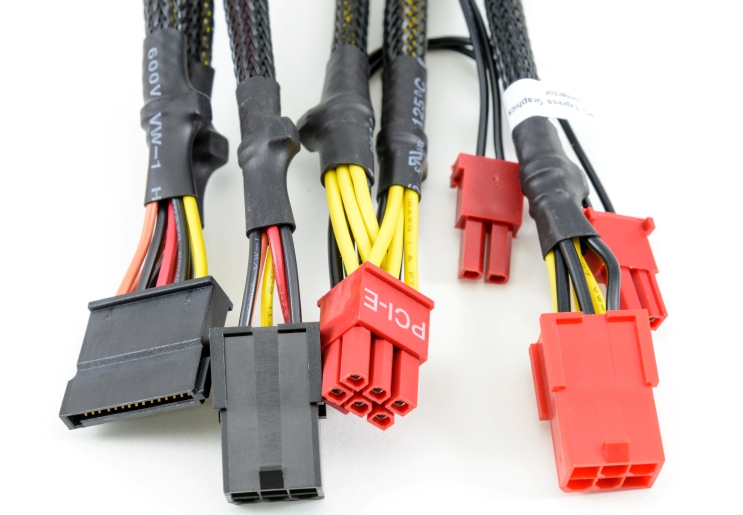
Terminals and Connectors: The Ends
A single poor connection, with a resistance increase of just 0.05 Ohms, can cause a 2.5W power loss (at 5A) and a 5°C temperature rise, leading to potential failure. With a typical harness containing 50 to 500+ termination points, the choice of connector system directly impacts the assembly time, repair rate, and overall 10-year reliability of the final product.
| Parameter | Low-Consumer Example | High-Reliability Example | Impact of Mismatch |
|---|---|---|---|
| Current Rating | 1-3 A (USB-C) | 13 A (Anderson SB50) | Overheating, Melting |
| Voltage Rating | 50 V (Header) | 1000 V (Solar MC4) | Arcing, Short Circuit |
| Contact Resistance | 20 mΩ | < 2 mΩ (Gold Plated) | Voltage Drop, Power Loss |
| Mating Cycles | 25 cycles (USB) | 500+ cycles (Circular) | Wear, Intermittency |
| IP Rating | IP40 (Unsealed) | IP67/IP69K (Sealed) | Corrosion, Water Damage |
| Cost per Pair | 0.50 | 25.00+ | Final Assembly Budget |
The heart of any connection is the terminal-to-wire crimp. A proper crimp is not about crushing the wire, but forming a gas-tight, cold-weld connection. The tensile strength of a correctly crimped 16-gauge wire should withstand a pull force of over 70 Newtons (N) before the wire breaks, not the terminal. Achieving this requires precise tooling; an 5,000 calibrated press achieves ±0.02mm, directly impacting consistency. Crimp height, often specified to within ±0.1 mm, is the primary quality control check—a deviation of just 0.15 mm can increase resistance by 30%.
Plating material is a major cost and performance driver. Tin plating is standard for most applications, with a surface resistance of < 10 mΩ, but it can oxidize over 5-10 years. For critical data or low-voltage signals (< 1V), gold flash plating (0.2-0.5μm) is essential, offering a stable 1-3 mΩ resistance and preventing fretting corrosion over hundreds of mating cycles. The cost jump is significant: gold plating can add 0.30 per contact.
The physical interface is equally crucial. Sealed connectors, rated IP67 (submersion to 1m for 30 min), use silicone grommets and complex housings that can be 40% more expensive than unsealed versions but are non-negotiable in automotive or outdoor applications. Locking mechanisms—from simple latches to screw-on threads—prevent vibration-induced disconnection. A connector without a lock in a vibration environment of 5-2000 Hz can work loose in under 100 hours of operation.
Protective Sleeving: The Shield
Studies on industrial equipment show that abrasion damage accounts for over 40% of wiring failures in the first 3 years of service. A simple 5,000+ control systems from costly downtime and $150/hour repair calls. This low-cost component delivers a massive return on investment by preventing damage.
The primary threat is abrasion resistance, measured by tests like the Taber Abrasion test (ASTM D3389). A standard PVC spiral wrap might withstand 1,000 cycles before failure, while a heavy-duty nylon braided sleeve can endure over 7,500 cycles. In applications with constant motion, like on a CNC machine's axis, this difference translates to a 5-year service life versus a 12-month replacement cycle.
Real-World Consideration: "The minimum bend radius is a non-negotiable spec. Forcing a 10mm diameter harness into a 15mm radius bend inside a robot arm will crush the sleeving and chafe the wires within 6 months. Always sleeve for the application's tightest bend, plus a 20% safety margin."
Common polyethylene split loom becomes brittle and cracks at temperatures below -40°C and softens at 90°C. For under-hood automotive applications, where ambient temperatures can reach 125°C and splash onto 200°C exhaust components, fiberglass or silicone rubber sleeving is mandatory. These materials maintain flexibility from -60°C to 200°C+, ensuring protection throughout the vehicle's 10-year/150,000-mile design life.
Chemical resistance is vital in many settings. In food and beverage plants, harnesses are frequently exposed to caustic sanitizers with a pH of 12-14. Standard sleeves degrade quickly. Instead, PTFE (Teflon) or cross-linked polyethylene sleeves are used, which can withstand over 1,000 hours of immersion in harsh chemicals without losing protective properties. The cost premium is significant—0.50 for PVC—but it prevents a 50% higher annual failure rate.
Strain Relief: For Durability
Without proper strain relief, flexing at a 45-degree angle just 5 mm from the termination can cause copper strands to fatigue and break in under 5,000 cycles. This is a leading cause of intermittent electrical faults, accounting for nearly 25% of warranty returns in consumer electronics. A well-designed strain relief system, costing as little as $0.10 per unit, can extend the mechanical life of a connection by over 400%, preventing failures and ensuring the product lasts for its intended 7-10 year lifespan.
This forms a permanent, watertight seal (IP67 rating) that distributes stress over a 15-25 mm area. The key metric here is pull strength. A standard USB-C connector overmold must withstand a 50 N (11.2 lbf) pull force for 30 seconds without any damage to the internal solder joints, as per IEC 60512-4. For heavier industrial cables, this requirement jumps to 250 N (56 lbf) or more.
For applications requiring flexibility and serviceability, clamp-style strain reliefs are the go-to solution. These devices, typically made from nylon or steel, physically grip the cable's outer jacket.
- Vibration Resistance: A properly torqued clamp (0.6 N·m) can reduce vibration-induced wire fatigue at the termination point by 90%, crucial in automotive or aerospace applications where vibration frequencies range from 5 Hz to 2000 Hz.
- Bend Radius Control: They enforce a minimum bend radius, often 5x the cable diameter. For a 10 mm cable, this means preventing bends tighter than 50 mm, which would otherwise crush conductors.
- Load Distribution: The clamp spreads tensile load over a 50-100 mm section of the cable jacket, preventing a single point of stress concentration.
The following table compares the performance and cost of common strain relief types:
| Type | Typical Cost | Max Pull Force | Key Advantage | Ideal Application |
|---|---|---|---|---|
| Overmolded Plastic | 0.50 | 50 - 100 N | Excellent Seal (IP67) | Consumer Devices, Sensors |
| Nylon Cable Clamp | 2.00 | 150 - 250 N | Field Serviceable | Control Cabinets, Machinery |
| Spring Strain Relief | 4.00 | 30 - 70 N | Superior Flex Life | Test Equipment, Cords |
| Metal Cord Grip | 8.00 | 400 - 1000 N | Extreme Durability | Heavy Industry, Mining |
For the highest durability in flexible applications, spring-style strain relievers are unmatched. These helical springs, often made from stainless steel or PVC, are designed to be bent over 1 million times at a 90-degree angle without failing. They achieve this by ensuring the bend occurs across the entire 150 mm length of the spring, reducing the stress on any single point of the cable to less than 2 MPa.
Labels and Markings: For Identification
In a complex wire harness containing 250 wires across 35 different circuits, a single misconnection during installation or repair can cause 15,000+ in downstream damage and require 40+ hours of diagnostic labor to locate. Proper identification is not an aesthetic choice; it is a critical risk mitigation tool. A0.05 printed label or a $0.001 laser mark can reduce assembly errors by over 70% and cut troubleshooting time by 90%, from an average of 45 minutes per fault to under 5 minutes. This direct correlation between clear identification and operational efficiency makes it a cornerstone of quality manufacturing.
The core function of any marking is to remain legible for the entire 10-15 year service life of the product, enduring harsh conditions. This demands careful selection of materials and methods based on the operating environment.
- Heat Resistance: Standard vinyl labels with acrylic adhesive degrade at 90°C (194°F) and can curl or fall off. In engine compartments where ambient temperatures reach 125°C (257°F) and radiant heat from exhausts can hit 200°C (392°F), labels made from polyimide (Kapton) or polyester with silicone adhesive are required. These materials withstand continuous temperatures of 150-200°C while maintaining adhesion.
- Chemical Exposure: Harnesses in food processing or chemical plants are frequently exposed to alkaline sanitizers (pH 12-14), oils, and solvents. Standard inkjet printing will smear after 10-20 exposure cycles. Thermal-transfer printed labels with a 2 mil thick PET face stock and a permanent rubber-based adhesive resist hundreds of cycles, while laser-etched markings are virtually impervious to chemical wear.
- Abrasion and Weather: For exterior applications on agricultural or construction equipment, markings must survive UV radiation, rain, and physical abrasion. A UV-stable topcoat increases material cost by 15% but prevents the legend from fading to illegibility after 5,000 hours of direct sunlight exposure.
The method of applying identification directly impacts long-term readability and initial cost. The three primary methods are:
- Printed Labels: The most versatile option. Thermal transfer printing produces a high-resolution, durable mark that lasts 5-7 years outdoors. The cost is approximately 0.08 per label, including material and printer amortization. Inkjet printing is faster for short runs but offers lower durability, with prints often fading after 1-2 years and smearing when exposed to moisture.
- Heat-Shrink Tubing: Provides both insulation and identification. Printing on polyolefin heat-shrink creates a permanent, abrasion-resistant legend that becomes integral to the wire. The material shrinks by a 50% diameter ratio at 120°C, forming a tight seal. While more expensive at 0.30 per marker, it is ideal for high-vibration environments where a adhesive label might fail.
- Direct Laser Marking: The most permanent solution. A CO2 or fiber laser burns a legend directly onto the wire's insulation. It has no consumable cost after the 50,000 initial equipment investment, making the per-mark cost negligible at high volumes (<$0.001). It creates a mark that will not fade, peel, or smear for the wire's entire life, even surviving temperatures up to the insulation's melting point (often 150°C).
The content of the marking must be standardized to be useful. A best practice is to include:
- Wire Number: A unique 6-digit alphanumeric code (e.g., 102A15).
- Circuit Function: A 3-5 character abbreviation (e.g., +12VIN, CAN_H).
- Destination: The connector cavity number or terminal block position (e.g., J4-12).
A minimum character height of 1.5 mm (0.06 inches) is recommended for most factory lighting conditions. Reducing this to 1.0 mm might save 5% on label material but can increase reading errors by 30%, especially for technicians over 40 years of age. The return on investment for a comprehensive labeling system is calculated in reduced labor hours and prevented errors, delivering a 300-400% ROI over the product's lifecycle by ensuring accuracy and speed in every interaction with the harness.
In summary, a wire harness assembly is an integrated system that organizes and protects groups of wires for efficient transmission of data and power. Its five essential components begin with wires and cables, which form the core conductive pathways. These are terminated with connectors and terminals to interface with other systems. The bundle is then bound and shielded by protective sleeving like conduit or split loom tubing. Critical additions include strain reliefs at connection points to prevent wire pull-out and labels for clear identification, ensuring reliable operation in applications from vehicles to industrial machinery.
