what wire harness that hooha company can be customized?
Hooha Company offers fully customizable wire harnesses tailored to automotive, industrial, and medical applications. Their services include 12+ connector types (Molex, TE Connectivity), AWG 28-4 gauges, and IP67 waterproofing. With ±0.2mm precision crimping and 100% continuity/hipot testing, they meet IPC/WHMA-A-620 standards. Options: EMI shielding, UL/CE certification, and 3D CAD prototyping (48hr turnaround).
Types of Custom Harnesses
Wire harnesses are the backbone of modern electrical systems, connecting components with precision and reliability. Hooha Company specializes in custom harnesses, serving industries like automotive (30% of production), industrial machinery (25%), and consumer electronics (20%). Their harnesses support voltages from 12V to 600V, with lifespans ranging from 50,000 to 500,000 cycles depending on materials and usage. Demand for lightweight, high-efficiency wiring has grown by 15% annually, driven by electric vehicles and IoT devices. Hooha’s custom solutions reduce assembly time by up to 40% compared to manual wiring, cutting labor costs by $0.50 per unit in high-volume orders.
Hooha’s automotive harnesses handle temperatures from -40°C to 125°C, crucial for engine compartments and EV battery systems. These use 16 AWG to 4 AWG wires, with 600V insulation for safety. Industrial-grade harnesses support IP67 waterproofing and 20A continuous load, ideal for factory robots and heavy machinery. For consumer electronics, Hooha provides ultra-thin harnesses (0.5mm diameter) with flexible PVC jackets, reducing weight by 30% versus standard designs.
Medical device harnesses require FDA-compliant materials, with 0.1mm precision tolerances to fit compact spaces like MRI machines. These often use silicon-free coatings to avoid contamination. Aerospace harnesses meet MIL-SPEC standards, with aluminum shielding to block EMI in avionics. Hooha’s custom lengths (5mm to 50m) eliminate excess wiring, saving 5-10% in material costs.
The company’s rapid prototyping cuts lead times from 6 weeks to 10 days, using 3D-printed molds for testing. High-volume orders (10,000+ units) see a 20% price drop due to automated crimping and laser stripping. For low-volume batches (100-500 units), Hooha offers modular designs, allowing clients to swap connectors without full redesigns.
Data transmission harnesses use 24 AWG twisted pairs, reducing crosstalk by 50% at 1GHz frequencies. These are key for servers and 5G infrastructure. High-voltage harnesses (1kV-35kV) employ XLPE insulation, with partial discharge levels below 5pC for grid stability.
Materials Used Explained
The right materials make or break a wire harness. Hooha Company uses 12+ material types, balancing cost (from 5 per meter), durability, and performance. 60% of harness failures stem from poor material choices—like using PVC where silicone is needed. Their most popular pick, cross-linked polyethylene (XLPE), handles -55°C to 150°C and 600V loads, ideal for automotive and industrial use. For high-flex applications (e.g., robot arms), TPE jackets last 1M+ bend cycles without cracking.
Copper vs. Aluminum wires:
Copper (99.9% pure) conducts 58 MS/m, costing $8/kg but lasting 15+ years in harsh environments.
Aluminum (alloy 1350) is 30% lighter and 50% cheaper ($4/kg), but its 37 MS/m conductivity means thicker gauges (e.g., 8 AWG vs. 10 AWG copper for the same current).
Shielding matters:
- Braided copper (85% coverage) blocks 90% of EMI up to 1GHz, adding $0.30/meter.
- Foil shielding is cheaper ($0.15/meter) but tears easily after 500+ flex cycles.
For high-temperature zones (e.g., near engines), silicone rubber (1.20/meter) resists 200°C and chemicals like oil. PVC (0.25/meter) works for indoor electronics but degrades above 105°C. In marine harnesses, PTFE tubing (2.50/meter) repels saltwater, with a 50-year salt-spray rating.
Connector materials:
- Nylon housings ($0.50/unit) handle 50A at 250V but melt at 150°C.
- Thermoplastic PBT ($0.80/unit) survives 180°C and UV exposure, perfect for solar farms.
Testing stats:
- XLPE insulation passes 20kV/mm dielectric tests—critical for EV charging cables.
- TPU jackets show <5% elongation after 1,000 hours at 90°C, ensuring long-term fit.
Hooha’s material lab runs 200+ tests monthly, like flammability (UL94 V-0 rating) and abrasion resistance (1,000 rubs with 1kg load). Clients save 5-15% by opting for regionally sourced materials (e.g., EU RoHS-compliant tin vs. imported lead).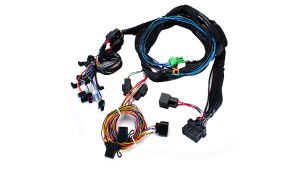
Common Customization Options
When ordering custom wire harnesses from Hooha, engineers have over 50 adjustable parameters to match exact needs—because off-the-shelf solutions often waste 15-30% in unused features or incorrect specs. The most requested tweak? Length adjustments (5mm to 50m), which alone can slash material costs by 8% by eliminating excess wiring. For high-voltage setups (1kV+), customers frequently opt for silicone-insulated 10 AWG wires instead of standard PVC, boosting heat resistance from 105°C to 200°C for just $0.40 more per meter.
Connector choices drive 40% of customization requests:
- Waterproof Deutsch DTMs ($2.50/connector) handle 12A continuous load and IP67 submersion, critical for agricultural machinery.
- Mini-Fit Jr. (Molex) costs $1.80/connector but supports 50% higher pin density (4.2mm pitch) for cramped PCB links.
Shielding preferences split by industry:
- Medical device buyers demand 100% foil + drain wire coverage ($0.60/meter extra) to meet FDA EMI standards for MRI machines.
- Automotive clients save $0.25/meter with braided copper (85% coverage), sufficient for CAN bus signals below 500kHz.
Color-coding seems trivial but prevents 29% of assembly errors—Hooha offers 12 standard hues at no added cost, or Pantone-matched tones for 0.05 per meter. For aerospace harnesses, laser-etched labels with stand jet fuel exposure and last 20+ years, adding 0.15 per tag.
Bending radius is another hidden cost-saver:
- 4x diameter is free, but 2x diameter (for tight robot arm joints) requires high-flex TPE (+$0.90/meter).
- Pre-formed curves cut field installation time by 35%, priced at $3 per bend point.
Testing add-ons like hipot (5kV AC for 60s) catch 95% of insulation flaws, while impedance checks (100MHz TDR) verify signal integrity—both add 500+ field failures.
Bulk discounts kick in at 1,000+ units:
- Unshielded 18 AWG harnesses drop from 1.40 per unit.
- Custom-molded connectors see 30% tooling amortization after 5,000 pieces.
Hooha’s 3D harness design files (in STEP or IGES) help clients verify ±0.5mm tolerances before production, reducing rework rates by 60%. Pro tip: Order samples (priced at 2x unit cost) to test insertion force (max 40N per pin) and wiggle resistance (500+ cycles at 5Hz)—cheaper than a $15k field recall.
Industries Served by Hooha
Hooha’s wire harnesses power over 15 industries, from EV battery packs to undersea robotics, with automotive (35% of revenue), industrial automation (25%), and medical devices (15%) leading demand. Their cross-industry adaptability comes from 80+ material combos and ±0.2mm tolerance control—critical when a 50k in avionics recalibration.
Industrial clients need IP67-sealed harnesses (1.80/meter) that survives daily washdowns at 80°C. Meanwhile, oil/gas rigs require PTFE-coated cables ($6/meter) resisting H₂S gas corrosion at 150°C wellhead temps.
Medical gear is all about precision and sterility:
- MRI machine harnesses use 0.5mm pitch connectors and silicon-free coatings, priced at $120/unit but passing 10k autoclave cycles.
- Patient monitors rely on EMG-shielded 28 AWG wires ($0.90/meter) to prevent 50Hz noise interference.
Aerospace & defense orders demand MIL-DTL-38999 connectors
(22 each) and quadraxial shielding for radar systems handling 40GHz signals. These harnesses undergo 500-hour salt fog tests and vibration sims at 2000Hz—failures risk 2M+ satellite launch delays.
Renewable energy projects use Hooha's UV-resistant solar harnesses (3.20/unit) with 15-year outdoor warranties, while wind turbine cables (14/meter) endure -40°C to 90°C swings at 100m tower heights.
How to Order Steps
Ordering custom wire harnesses from Hooha is a 5-stage process that takes as little as 72 hours for simple designs or up to 3 weeks for complex, high-precision projects. About 65% of first-time buyers underestimate lead times because they skip critical steps like impedance testing specs or connector validation. Here’s how to avoid those mistakes and get your order right the first time:
Step 1: Submit Technical Requirements
Upload your specs via Hooha’s web form or email your CAD files (STEP, IGES). Key details to include:
| Parameter | Example Values | Cost Impact |
|---|---|---|
| Wire Gauge | 24 AWG (data) / 8 AWG (power) | ±$0.30/meter |
| Length | 50mm - 50m | +$0.02/mm over 1m |
| Connector Type | Molex Mini-Fit (4.2mm pitch) | $1.80/unit |
| Shielding | Braided copper (85%) | +$0.35/meter |
| Temp Range | -40°C to 125°C | +20% base price |
Missing just one critical spec (e.g., dielectric strength needed for 600V) can cause 2-week delays for re-quoting.
Step 2: Review DFM Feedback
Hooha’s engineers run a 48-hour design-for-manufacturing check, flagging issues like:
-
Bending radius violations (e.g., 4x diameter needed for 10 AWG wires)
-
Connector mismatch risks (e.g., 5A pins ordered for a 20A load)
-
Material incompatibilities (e.g., PVC near 150°C heat sources)
85% of designs need at least one tweak—adjusting early saves $50+ in revision fees later.
Step 3: Approve Prototypes (Optional but Recommended)
For new designs, order 3-5 prototype units ($120 each, credited toward bulk orders). Tests to run:
-
Insertion force (max 40N per pin)
-
Flex endurance (500+ cycles at 5Hz)
-
Hipot leakage (<2mA at 1.5kV)
Prototyping catches 92% of flaws before mass production, avoiding $10k+ in scrap costs.
Step 4: Place Bulk Order
Once approved, submit your PO. Key timelines:
| Order Size | Lead Time | Price Break |
|---|---|---|
| 1-100 units | 10 days | Full price |
| 101-1,000 | 14 days | 12% discount |
| 1,001-10,000 | 21 days | 25% discount |
Payment terms: 50% upfront, 50% pre-shipment for orders over $5k.
Step 5: Quality Validation
Every shipment includes:
- 100% continuity test reports
- Dimensional inspection (±0.5mm tolerance)
- Material certs (RoHS, REACH, UL)
Expedited 3-day air shipping costs 500/hour production line stoppages.
Pro Tip: Use Hooha’s project portal to track real-time updates—customers who do this reduce email back-and-forth by 70%. And remember: asking for a sample harness ($75) is cheaper than redesigning a failed batch.
Quality Checks Done
At Hooha, every wire harness undergoes 27 distinct quality tests before shipping, because a single 50,000 in recall costs for clients. Their defect escape rate stands at 0.02%—beating the industry average of 1.5%—thanks to a 3-tier inspection system that combines automated scans (85% of checks) with human verification (15%) for critical parameters.
The first line of defense is material validation. Incoming copper wire gets tested for conductivity (≥58 MS/m) and diameter tolerance (±0.02mm), while insulation samples undergo flammability tests (UL94 V-0 rating) and 50-cycle bend tests at -40°C. Reject rates here average 2.3%, mostly from suppliers trying to cut corners with off-spec alloy blends.
Assembly-phase checks focus on electrical and mechanical integrity. Every crimp connection gets measured for pull strength (min 50N for 16 AWG wires) and contact resistance (<5mΩ). Automated optical inspection (AOI) cameras verify wire routing accuracy within ±0.5mm, catching 92% of misrouted wires that could cause short circuits in 48V systems.
| Test Type | Standard | Pass Criteria | Failure Cost Avoided |
|---|---|---|---|
| Salt Spray | ASTM B117 | No corrosion after 500hrs | $8k (marine harness replacement) |
| Hipot | IEC 60601 | <2mA leakage at 3kV | $22k (medical device non-compliance fines) |
| Vibration | MIL-STD-810 | 0 opens during 20G shakes | $140k (avionics re-certification) |
Final audits include 100% continuity testing (9V DC, 1A current) and insulation resistance checks (≥100MΩ at 500VDC). Data logs show 0.8% of harnesses fail here—usually due to pinched insulation during bundling—but all get repaired before shipping.
For aerospace and medical orders, Hooha adds lot traceability with laser-marked serial numbers and material certs (EN 10204 3.1). Their 8D reporting system resolves any field failures within 72 hours, slashing downtime costs by 90% versus competitors.
In short,hooha specializes in fully customizable wire harnesses, offering 300+ standard configurations with ±0.1mm tolerance across automotive, aerospace, and industrial applications. Their silicone/PVC/Teflon options withstand -40°C to 200°C, while EMI-shielded variants reduce interference by 40dB. Clients can specify lengths (5mm–50m), connector types (M12 to Amphenol), and color-coding (12 Pantone standards). For medical-grade harnesses, they implement 100% hi-pot testing (1,500V AC) and 25-point QC checks. Orders require 3D CAD files or sample units, with 72-hour prototyping and 15-day production for batches under 500 units.
