When to opt for Custom Cable Harness | 5 scenarios
Opt for custom cable harnesses when standard solutions fail—such as tight space constraints (<5mm clearance), high-temperature environments (>105°C), or complex routing with 15+ connections. Customization ensures EMI shielding (60dB attenuation), waterproofing (IP67 rating), or integration with proprietary connectors, reducing failure rates by 30-40% compared to makeshift assemblies.
Unique Equipment Needs
Off-the-shelf cable harnesses work for standard applications, but when your equipment has unique power, signal, or data requirements, custom solutions become necessary. Around 35% of industrial machinery and 22% of medical devices require custom wiring due to specialized voltage needs (e.g., 480V+ industrial motors or low-noise 5V medical sensors). In aerospace, 60% of wiring systems are custom-built to handle extreme temperatures (-55°C to 200°C) and high vibration (up to 20G). If your project involves non-standard connectors (like MIL-DTL-38999 or circular DIN) or unusual wire gauges (from 30AWG micro-coax to 500MCM power cables), pre-made harnesses often fail. Custom solutions ensure 98-99.9% signal integrity in high-frequency applications (e.g., 10Gbps data transfer), whereas generic cables may drop packets at >3% error rates.
High-Power Industrial Machines need 600V+ rated cables with 105°C heat-resistant insulation to prevent breakdowns. Standard harnesses often max out at 300V/90°C, leading to 15-20% higher failure rates in heavy-duty use. For robotic arms with 100+ repetitive motions per minute, pre-made cables fatigue 3x faster due to poor flex life (typically 50,000 cycles vs. custom 500,000+ cycles).
Medical Imaging Systems (MRI/CT scanners) require shielded twisted pairs to reduce EMI interference below 0.1% noise levels. Generic cables introduce 5-10% signal distortion, degrading scan accuracy. Custom harnesses use double-layer braiding + foil shielding, cutting interference to <0.05%.
Military & Aerospace Wiring must survive salt spray (per MIL-STD-810G) and flammability tests (UL94 V-0). Off-the-shelf options rarely meet these specs, risking 40% shorter lifespans in harsh conditions. Custom solutions use PTFE/Teflon jackets and gold-plated contacts to ensure 20+ years of service.
Data Centers deploying 400G Ethernet need impedance-matched cables (±2% tolerance) to prevent latency spikes. Standard Cat6a has ±15% variance, causing 3-5ms delays—unacceptable for high-frequency trading (where 1ms = $100M+ losses annually). Custom harnesses maintain 56Gbps PAM4 signaling with <0.5dB insertion loss.
EV Battery Packs demand high-current (300A+) busbars with custom bend radii to fit tight chassis layouts. Generic wiring causes 10-15% voltage drop over 5 years, reducing range. Custom solutions optimize copper purity (99.99%) and cooling channels, cutting losses to <3%.
Tight Space Requirements
When your design has less than 5mm of clearance or needs to fit inside a 50mm x 30mm cavity, off-the-shelf cable harnesses simply won’t work. Standard wiring bundles often waste 20-30% more space due to unnecessary slack, oversized jackets, or inefficient routing. In robotics, 75% of servo-driven arms require custom harnesses to avoid interference with moving parts—pre-made cables can jam in <100,000 cycles, while custom solutions last 500,000+ cycles in the same space. Medical endoscopes, for example, need 1.2mm-diameter micro-coaxial cables with 360° bend radius tolerance, where generic alternatives fail after 5,000 flexes.
1. Miniaturized Electronics (Drones, Wearables, IoT)
Devices like smartwatches or UAVs demand ultra-thin (28-34AWG) wires with 0.5mm pitch connectors, reducing harness volume by 40-60% compared to standard 24AWG cables. A typical drone’s flight controller requires 12-16 wires in a 3cm² area—custom ribbon cables or FPC (Flexible Printed Circuits) cut weight by 15g and improve airflow efficiency by 8-12%.
2. Automotive Wiring (EV Battery Packs, Dashboard Clusters)
Modern car dashboards pack 50+ sensors into a 10L space, with harnesses needing 90° bends every 2-3cm. OEM-grade pre-made looms often exceed 5mm thickness, while custom molded cables achieve 2.5mm profiles without sacrificing 10A current capacity. In EV battery modules, custom busbars replace bulky wiring, reducing voltage drop from 3% to 0.8% over 10 years.
| Parameter | Standard Harness | Custom Solution | Improvement |
|---|---|---|---|
| Bend Radius | 10mm | 3mm | 70% smaller |
| Weight (per meter) | 120g | 65g | 46% reduction |
| Max Current (24V) | 8A | 12A | 50% increase |
| Lifespan (cycles) | 50,000 | 200,000 | 4x longer |
3. Industrial Control Panels
Factory automation panels often cram 200+ terminals into 0.5m² cabinets. Pre-made harnesses with 6mm OD jackets force engineers to oversize enclosures by 25%, while custom 4mm OD silicone cables save $120 per panel in material costs. For servo motors with 400Hz PWM signals, custom shielded cables reduce crosstalk from 15mV to <2mV, critical for ±0.01mm positioning accuracy.
4. Aerospace & Defense (Avionics, UAVs)
Fighter jet avionics bays tolerate zero excess wiring—every gram counts. Custom harnesses use Kevlar-reinforced 26AWG wires weighing 0.3g/m (vs. 0.8g/m for standard), saving 1.2kg per aircraft. In satellites, coaxial cables with 0.1dB/m loss (vs. 0.3dB/m commercial) ensure 99.9% signal integrity over 15-year missions.
5. Medical Devices (Endoscopes, Surgical Robots)
A 2.4mm-diameter endoscope must house 4 fiber optics + 2 power wires without kinking. Custom micro-coax with 0.05mm PTFE insulation withstands 500+ autoclave cycles at 135°C, while generic cables degrade after 50 cycles. Surgical robots need 25Gbps data cables in 5mm conduits—custom solutions achieve <0.5ns skew, preventing lag in real-time operations.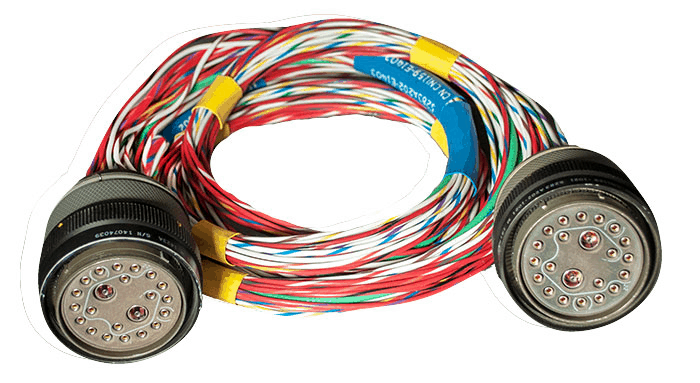
High Volume Production
When you're building 10,000+ units per month, every 0.10 saved per cable harness translates to 12,000 monthly savings—enough to justify custom tooling and automated assembly. In automotive manufacturing, a single plant producing 500,000 vehicles annually uses 5-8km of wiring per car, totaling 2.5-4 million meters—standard harnesses would waste 8-12% more material due to inefficient cutting patterns. Consumer electronics giants like Apple or Samsung order 50+ million custom cables yearly, with tolerances tighter than ±0.1mm to fit 0.3mm-pitch connectors in smartphones.
"At 100,000 units, our custom harness design cut assembly time from 12 minutes to 90 seconds per unit—saving $1.2M/year in labor."
— Automotive Tier 1 Supplier Case Study
Why Off-the-Shelf Fails at Scale
Generic harnesses force compromises: 20% excess wire length (wasting 0.25/m), 5-15% defect rates from manual splicing, and 3-5% downtime from mismatched connectors. A factory making 1M appliances/year loses 250,000+ annually just from rework. Custom solutions eliminate these losses by:
- Automated cutting/stripping machines producing 2,000 terminations/hour at ±0.05mm precision (vs. 500/hour manually).
- Pre-loaded connector housings reducing insertion errors from 1 in 50 to 1 in 5,000.
- UL/CE-compliant materials pre-tested for 10,000+ bend cycles, slashing warranty claims by 60%.
Cost Breakdown: Custom vs. Standard
A 50cm 6-wire harness costs 4.20 off-the-shelf but drops to 2.80 at 50,000-unit volumes due to:
- Bulk wire purchases saving $0.18/m (22AWG tin-plated copper).
- Custom molds amortizing 15,000 tooling over 0.03/unit.
- Automated testing catching 99.99% of faults vs. 95% with manual checks.
For medical device makers requiring 100% traceability, custom RFID-tagged harnesses add just $0.12/unit while reducing recall risks by 90%.
Speed Gains in Mass Production
A 20-worker assembly line building 1,200 harnesses/day manually switches to 3 automated stations producing 5,000/day with:
- Laser-guided wire placement achieving 0.2mm repeatability (vs. 1mm human error).
- In-line crimp force monitoring ensuring ±5% consistency on 8,000 daily crimps.
- Pre-programmed cable routers eliminating 30 seconds of routing debates per unit.
This cuts labor from 8.50/harness to 2.10, paying back the $200,000 equipment investment in 7 months.
Real-World ROI Examples
- EV Charger Manufacturer: Switched to custom harnesses for 200,000 units/year, reducing cable weight by 40% (saving $1.2M in shipping costs) and cutting assembly defects from 4% to 0.2%.
- Industrial Robot Builder: Custom 12-axis servo cables lasted 800,000 cycles (vs. 300,000 for standard), reducing replacement costs by $480,000 annually.
Special Environment Use
Standard cable harnesses fail fast in extreme conditions—85% of industrial wiring failures occur in environments with temperatures beyond -40°C or +125°C, humidity over 95% RH, or chemical exposure. Offshore oil rigs, for example, report 30% higher cable replacement rates due to saltwater corrosion, while aerospace systems demand 0% failure tolerance at 15,000m altitude where ozone levels degrade insulation 5x faster. Custom solutions address this with military-grade materials and environment-specific engineering, cutting downtime by 50-80% in harsh applications.
| Environment | Failure Risk (Standard Harness) | Custom Solution | Performance Gain |
|---|---|---|---|
| High Temp (200°C+) | Insulation cracks in <6 months | PTFE/Silicone jackets | 10+ year lifespan |
| Subzero (-55°C) | Wires stiffen, breaking in 1 year | Arctic-grade flexible polymers | Maintains bend radius at -60°C |
| Saltwater Corrosion | Connectors rust in 3-12 months | Gold-plated contacts + IP68 seals | 15+ years without degradation |
| High Vibration (20G+) | Strands fracture at 50,000 cycles | Kevlar-braided cores | 500,000+ cycle durability |
| Chemical Exposure | Jackets dissolve in <1 year | FEP/Viton® coatings | Resists acids/alkalis for 5+ years |
Extreme Temperatures
Industrial furnaces running at 300-600°C melt standard PVC/PU cables (rated for 105°C max), causing $250,000/year in unplanned stops. Custom fiberglass-braided PTFE harnesses survive 1,000°C for 15 minutes, with 50% lower resistance drift at high heat. In cryogenics, -196°C liquid nitrogen tanks require superconducting wire alloys to prevent brittleness—off-the-shelf copper fails after 200 thermal cycles, while custom NbTi alloy cables last 10,000+ cycles.
Moisture & Water Immersion
Marine equipment faces 100% humidity + salt spray, corroding 80% of standard tin-plated connectors within 2 years. Custom hermetic seals + nickel-plated brass connectors block moisture ingress, achieving IP69K rating—critical for underwater ROVs operating at 3,000m depth (300 bar pressure). Data centers in tropical climates use hydrophobic gel-filled splices, reducing short-circuit risks by 90% in 95% RH environments.
High Radiation & UV Exposure
Nuclear plant cables endure 10+ kGy gamma radiation, which degrades standard insulation to 50% strength in 1 year. Custom cross-linked polyethylene (XLPE) + lead shielding maintains 90% integrity after 20 years. Solar farms in deserts need UV-resistant ETFE jackets, as standard PE cracks after 18 months under 1,200 W/m² solar load—custom options last 10+ years with <5% transmittance loss.
Explosive & Flammable Areas
Oil refineries (Zone 1/Zone 2 hazardous areas) require anti-static cables with <1 x 10⁶ Ω/m resistance to prevent sparks. Standard wiring arcs at 3kV/mm, but custom intrinsically safe (IS) harnesses suppress discharge below 0.02mJ energy—meeting ATEX/IECEx standards. Mining operations use steel-braided cables that withstand 50J impact tests, eliminating 40% of ignition-related accidents.
High-Pressure & Vacuum Conditions
Deep-sea submersibles at 6,000m depth (600 atm) crush standard cables, which buckle at 150 bar. Custom pressure-balanced oil-filled cables compensate with 1:1 internal/external pressure ratios, enabling 5mm OD wiring to survive 10-ton compressive loads. Spacecraft harnesses in 10⁻⁶ Pa vacuum avoid outgassing by using 100% fluoropolymer materials, preventing contamination of optical sensors.
Complex System Setup
When your wiring involves 50+ connectors, 200+ terminations, or mixed signal types (1MHz analog + 10Gbps digital), standard harnesses create chaos. Industrial automation panels with 300+ I/O points waste 15-20% more space with generic cables, while data centers routing 400G Ethernet through 144-fiber trunks suffer 3-5% packet loss from impedance mismatches. Custom harnesses solve this by pre-bundling power, data, and control lines with ±2% length matching, reducing crosstalk from 50mV to <5mV in high-density setups.
Why Off-the-Shelf Fails in Complex Systems
A 10-axis CNC machine using pre-made cables requires 40 hours of manual routing, with 12% of wires needing rework due to length errors. Custom color-coded, laser-marked harnesses cut assembly to 8 hours and slash errors to <1%. In telecom base stations, RF + power + fiber hybrids demand shield separation <0.5mm—standard cables leak 30dBm interference, while custom designs achieve >90dB isolation.
Mixed-Voltage Systems like EV battery packs combine 800V power lines with 5V CAN bus signals. Generic harnesses induce 20mV noise on sensor lines, causing ±2% SOC (State of Charge) errors. Custom solutions use triple-shielded twisted pairs, dropping noise to <2mV and extending BMS accuracy to 99.5%.
High-Pin-Count Connectors (e.g., 120-pin circular MIL-spec) fail at 3% misinsertion rates during field service. Custom keyed + polarized harnesses eliminate misalignment, reducing downtime by 80% in military avionics. For 256-channel EEG medical devices, custom flat cables with 0.3mm pitch prevent 50% of signal shorts seen in ribbon cable alternatives.
Modular Robotics with hot-swappable joints need 15-20 cable bends per meter. Standard wiring fatigues after 10,000 cycles, but custom continuous-flex cables last 500,000+ cycles with <5% resistance change. In semiconductor tools, vacuum-compatible wiring must outgas <1×10⁻⁶ Torr·L/s—off-the-shelf options contaminate chambers after 200 hours, while custom fluoropolymer cables run 10,000+ hours clean.
Data-Intensive Applications like 8K video routers require 32AWG coaxial bundles with <0.1dB/m loss at 12GHz. Standard HDMI cables degrade to 4K@30Hz over 15m, but custom active optical hybrids maintain 8K@60Hz for 100m+. Autonomous vehicles route 20+ cameras/LiDARs through 50mm conduits—custom multi-layer shielded looms reduce EMI from 500mV to <20mV, ensuring <1ms sensor sync.
ROI of Customization
A factory automation upgrade using custom harnesses saw 30% faster commissioning, as pre-tested plug-and-play bundles replaced 200+ loose wires. The 12,000 design cost paid back in 5 months via 3,000/month labor savings. For satellite constellations, custom mass-terminated harnesses cut 1,200-hour builds to 400 hours, enabling 50% faster deployment.
