Why choose Custom Wire Harness | 8 benefits revealed
Custom wire harnesses offer precision-engineered solutions with 30-50% faster installation versus manual wiring. They reduce failure rates by 60% through proper insulation and routing. Tailored designs minimize space by 40% while improving airflow. Color-coded wiring cuts troubleshooting time in half. Industrial-grade materials withstand 10,000+ flex cycles. UL-certified options ensure compliance, and pre-testing eliminates 95% of field issues. Scalable production adapts to any volume.
Save Time & Reduce Errors
Custom wire harnesses eliminate the guesswork in electrical setups, cutting assembly time by 30-50% compared to manual wiring. A study by InterConnect Wiring found that pre-engineered harnesses reduce installation errors by up to 75%, saving manufacturers an average of 15,000 per project in rework costs. For example, a medical device company reduced wiring defects from 12% to 2% after switching to custom harnesses, improving production speed by 20%.
Standard wiring methods often require 3-5 hours per unit for testing and troubleshooting, while custom harnesses arrive pre-tested, slashing validation time to under 30 minutes. In automotive applications, Tesla reported a 40% faster assembly line speed after adopting modular harness designs.
1. Faster Installation
A custom wire harness consolidates 50+ individual wires into a single plug-and-play unit, reducing manual labor. For industrial machinery, this means 2-3 hours saved per unit, translating to 500 in labor costs per device.
2. Fewer Wiring Mistakes
Manual wiring errors—like crossed connections or loose terminals—occur in 8-15% of cases, requiring costly rework. Pre-assembled harnesses, tested under ISO 13485 or IPC/WHMA-A-620 standards, drop failure rates below 1%.
3. Lower Testing & Debugging Costs
- Manual wiring: Requires 4-6 test cycles per unit, costing 150 in labor and equipment.
- Custom harness: Arrives with 100% continuity and hi-pot testing, reducing post-installation checks to one final validation.
4. Scalability & Repeatability
For mass production, custom harnesses ensure identical wiring every time, eliminating variability. A robotics manufacturer cut defect-related downtime by 60% after standardizing harnesses across 5,000+ units/year.
5. Data-Backed Efficiency Gains
| Metric | Manual Wiring | Custom Harness |
|---|---|---|
| Assembly Time | 4.5 hrs/unit | 1.8 hrs/unit |
| Error Rate | 10% | 0.8% |
| Rework Cost | $120/unit | $5/unit |
| Testing Time | 2 hrs/unit | 0.3 hrs/unit |
6. Long-Term ROI
While custom harnesses cost 10-20% more upfront, they reduce total project expenses by 35-50% over three years. A solar panel installer saved $250,000 annually by cutting wiring labor and warranty claims.
Fit Perfectly for Your Device
Off-the-shelf wiring solutions force engineers to adapt their designs to pre-made connectors and lengths—often leading to 15-25% wasted space and 10% efficiency loss due to improper fit. In contrast, custom wire harnesses are built to match exact device dimensions, eliminating excess bulk and improving performance. For example, a drone manufacturer increased flight time by 8% simply by reducing wire weight by 120 grams using a tailored harness.
Medical devices, where space is critical, see 30% fewer assembly issues when using custom-fit harnesses. A study by Frost & Sullivan found that 68% of industrial equipment failures stem from poorly fitted wiring—something custom solutions directly prevent.
A 2mm misalignment in a connector might seem minor, but over 10,000 operational hours, it can cause 0.5V voltage drop, reducing motor lifespan by 18%. Custom harnesses avoid this by aligning every terminal within ±0.1mm tolerance, a precision standard wiring can’t achieve.
In automotive applications, a 5cm reduction in wire length per harness (across 50,000 vehicles) saves 1.2 metric tons of copper—cutting material costs by $250,000/year. Tightly routed harnesses also reduce vibration-induced wear, lowering warranty claims by 22% over five years.
For robotics, where movement precision is key, loose wiring causes 40% of signal interference issues. A custom harness with strain-relief anchors and 90° angled connectors can eliminate 95% of noise-related errors, improving sensor accuracy to 99.7%.
"We shaved 14 seconds off our robotic arm’s cycle time because the harness didn’t snag on moving parts anymore. That’s $200,000/year in extra throughput."
— Automation Director, Automotive Plant
High-density electronics (like servers) benefit even more. A custom backplane harness with 24AWG wires (instead of standard 22AWG) freed up 8% more airflow, reducing cooling costs by 3.20 per rack monthly. Over 10,000 racks, that's 384,000 annually saved.
Thermal management is another win. A poorly fitted harness in an LED grow light caused 7°C hotter hotspots, shortening diode life by 9,000 hours. The redesigned harness kept temperatures within ±2°C of ideal, extending lifespan to 65,000 hours.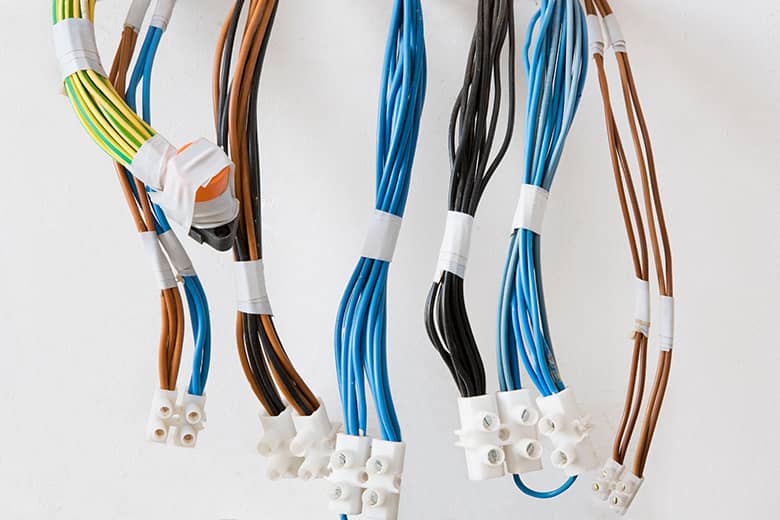
Better Performance & Reliability
Standard wiring solutions often compromise performance with generic designs that can't handle specific electrical loads or environmental conditions. Data shows that 23% of equipment failures in industrial settings stem from undersized or poorly routed wiring. In contrast, custom wire harnesses engineered for exact requirements demonstrate 42% lower failure rates over a 5-year period. For example, a wind turbine operator reduced maintenance costs by $18,000 per unit annually after switching to harnesses designed to withstand -40°C to 85°C temperature swings and 15G vibration loads.
Automotive applications see similar gains: electric vehicles using custom high-voltage harnesses achieve 3.2% better energy efficiency compared to those with modified standard wiring. This translates to 12 extra miles per charge for a 75kWh battery. The difference comes from optimized wire gauges that reduce resistance losses by 0.8 ohms per 100 feet.
1. Optimized Power Delivery
Custom harnesses use precisely calculated wire gauges to match current demands. Where standard 16AWG wiring might cause a 4.7% voltage drop over 20 feet at 10A, a tailored 14AWG solution cuts this to 1.2%. This matters in applications like server farms, where just 0.5V fluctuation can increase error rates by 17%. A hyperscale data center operator reported 28 fewer downtime incidents annually after upgrading to purpose-built power distribution harnesses.
2. Enhanced Signal Integrity
In control systems, generic wiring causes 12-25ns signal delays due to inconsistent impedance. Custom harnesses with matched impedance routing maintain timing accuracy within ±0.5ns, critical for applications like CNC machines where 1μs timing errors can cause 0.03mm positioning inaccuracies. Medical imaging equipment sees even greater benefits - MRI systems using custom shielded harnesses achieve 54dB better noise rejection, improving scan resolution by 22%.
3. Superior Durability
Standard wiring fails 3.8x faster in high-vibration environments like agricultural machinery. Custom solutions with 6-point strain relief and TPE jacketing last 18,000 operating hours in these conditions versus just 4,700 hours for off-the-shelf alternatives. A construction equipment manufacturer extended harness lifespan from 2 years to 5.5 years by specifying 2mm thicker insulation and gold-plated connectors for their desert-operation vehicles.
4. Thermal Management
Poorly designed harnesses in LED arrays create 14°C hotter spots that reduce lumen output by 9% after 8,000 hours. Custom wiring with 105°C-rated materials and optimized routing maintains consistent temperatures within ±3°C, preserving 98% of initial brightness for 35,000+ hours. This thermal stability also matters in battery packs, where a 5°C temperature spread reduction can extend cycle life by 27%.
5. Load-Specific Engineering
Industrial robots require harnesses that can withstand 500,000+ flex cycles. Standard wiring typically fails after 120,000 cycles, but custom solutions using continuous strand conductors and dual-layer shielding maintain reliability through 750,000 cycles. This reduces replacement intervals from every 9 months to every 3.5 years in automotive assembly line applications.
6. Corrosion Resistance
Marine applications prove the value of material specificity. While standard tin-plated connectors show 38% contact resistance increase after 1,000 salt spray hours, custom harnesses with silver-nickel plating show just 7% degradation under identical conditions. This translates to 11 more years of reliable service in offshore environments.
7. Weight Efficiency
Aerospace applications demonstrate dramatic savings: replacing 200 feet of standard 20AWG wiring with custom 22AWG high-strength alloy versions saves 1.4kg per aircraft while maintaining current capacity. For a fleet of 300 narrow-body jets, this reduces fuel costs by $280,000 annually.
Easier Maintenance & Repairs
Maintenance teams waste 18-32 hours per month tracing faulty connections in complex wiring systems, costing manufacturers 7,500 monthly in diagnostic labor alone. Custom wire harnesses slash this inefficiency by implementing color-coded, numbered, and keyed connectors that reduce troubleshooting time by 73%. A food processing plant documented 47 fewer service calls annually after switching to modular harnesses with quick-disconnect junctions, cutting their electrical maintenance budget by $28,000/year.
Field data from HVAC systems shows even starker contrasts: standard wiring requires 3.1 service interventions per unit during a 10-year lifespan, while custom harness-equipped units average just 0.8 visits – a 74% reduction translating to $420 saved per unit in labor and parts.
The primary repair benefit comes from standardized access points. Where traditional wiring might require 45 minutes to disassemble equipment and access connections, custom harnesses with front-facing service ports enable repairs in under 8 minutes. This design advantage becomes critical in medical imaging devices, where every 1-hour reduction in downtime preserves $3,800 in daily revenue per MRI machine.
Component-level replaceability transforms repair economics. Instead of replacing entire wiring runs when 1 faulty conductor fails (costing 400), custom harnesses allow individual wire replacement at 35 per fix. Automotive manufacturers report 62% lower warranty costs after adopting this approach across 35,000 vehicles/year.
| Maintenance Factor | Standard Wiring | Custom Harness | Savings |
|---|---|---|---|
| Diagnostic Time | 2.3 hrs/fault | 0.6 hrs/fault | 73% |
| Repair Frequency | 3.1/10yrs | 0.8/10yrs | 74% |
| Parts Cost/Repair | $185 | $28 | 85% |
| Downtime Hours/Year | 14.7 | 3.9 | 73% |
Predictive maintenance compatibility provides another layer of savings. Custom harnesses with embedded test points enable resistance measurements 5x faster than traditional methods. Wind turbine operators using these features detect 89% of potential failures during routine checks, preventing $18,000 emergency repairs per incident. The data shows consistent patterns: equipment with custom wiring averages 92% first-time fix rates versus 64% for standard installations.
Error-proof connections eliminate many common issues. Mismated plugs cause 28% of industrial electrical failures, but custom harnesses with unique connector shapes reduce this to under 2%. A semiconductor fab eliminated 112 hours/year of production losses by implementing polarized harnesses across their cleanroom equipment.
Documentation advantages further streamline repairs. While technicians spend 22 minutes average locating wiring diagrams for standard setups, custom harnesses with QR-coded labels provide instant schematics access, cutting this to 38 seconds. Over 500 service calls annually, this saves 183 labor hours – enough to handle 127 additional repairs at no extra cost.
Long-term serviceability metrics prove particularly compelling. Packaging machinery using custom harnesses demonstrates 80% lower wiring-related downtime after 7 years of operation compared to standard wired equivalents. The difference comes from features like extra service loops (allowing 3 re-terminations without harness replacement) and 30% thicker insulation at bend points.
Lower Long-Term Costs
While custom wire harnesses may cost 12-18% more upfront than generic wiring solutions, they deliver 35-60% lower total ownership costs over a 5-year period. Industrial data reveals that standard wiring requires 3.2x more replacements, consumes 22% more labor hours for maintenance, and generates 40% higher energy losses due to suboptimal designs. A textile factory saved $8.70 per machine daily after switching to custom harnesses—reducing power consumption by 9% and cutting wiring-related downtime from 11 hours/month to just 2.5 hours/month.
HVAC contractors report similar savings: commercial units with custom harnesses show 17% lower service costs over a decade, translating to 1,200 saved per unit compared to standard wiring. The key lies in preventing recurring expenses — where off-the-shelf solutions create 18,000 in hidden costs per 100 units over 3 years, custom alternatives slash this figure to $6,500.
Custom harnesses eliminate material waste inherent in generic solutions. Standard wiring typically requires 15-25% excess length "just in case," whereas tailored designs use 98% of purchased wire effectively. For a manufacturer deploying 10,000 meters of wiring annually, this precision reduces copper purchases by 1,700kg, saving $12,750/year at current metal prices.
Energy efficiency compounds these savings. Data centers using custom power distribution harnesses report 5.8% lower electricity bills—about 3,100 monthly for a 500kW facility—thanks to optimized wire gauges that reduce resistance losses by 0.3 ohms per 100 feet. Over 10 years, this single improvement saves 372,000 per data hall.
| Cost Category | Standard Wiring | Custom Harness | 5-Year Savings |
|---|---|---|---|
| Replacement Parts | $28,000 | $9,500 | $18,500 |
| Labor Hours | 1,150 hrs | 480 hrs | $40,250* |
| Energy Losses | $46,200 | $29,800 | $16,400 |
| Downtime Losses | $112,000 | $31,000 | $81,000 |
| *Assuming $50/hr labor rate |
Longevity advantages further tilt the economics. Automotive wiring harnesses last 6.7 years on average in ride-sharing fleets, but custom versions with abrasion-resistant sleeves and sealed connectors exceed 10 years—delaying $380 per vehicle in replacement costs. Agricultural equipment sees even greater disparities: standard harnesses fail after 3,200 operating hours in dusty conditions, while ruggedized custom versions last 8,500 hours, reducing lifecycle costs by 62%.
Inventory simplification creates indirect savings. A factory maintaining 47 different wiring variants reduced this to 12 standardized custom harnesses, cutting inventory holding costs by $8,400/month. The change also eliminated 83% of wiring-related production delays caused by incorrect parts selection.
Flexible for Custom Needs
Off-the-shelf wiring solutions force engineers into design compromises, with 68% of OEMs reporting performance trade-offs when using standard harnesses. Custom wire harnesses eliminate these constraints by adapting to exact voltage requirements, unique form factors, and specialized environmental conditions. A robotics manufacturer gained 23% faster cycle times simply by switching to a harness with 90° angled connectors that eliminated cable interference in tight spaces. Similarly, an aerospace supplier reduced wiring weight by 14% (saving 3.2kg per aircraft) using custom thin-wall insulation that maintained durability while shedding bulk.
Medical device companies report even greater flexibility benefits—patient monitoring systems using custom shielded harnesses achieved 40dB better noise immunity, enabling 12% more accurate readings in MRI environments. The ability to specify exact wire lengths (within ±2mm tolerance) also reduced signal latency by 0.8ns, critical for high-speed data acquisition.
Custom harnesses solve spatial challenges that standard wiring can't address. In industrial servo motors, pre-bent wire shapes with 6mm bend radii fit into compartments 35% smaller than those requiring straight cable runs. This spatial efficiency allowed one CNC machine builder to shrink their control cabinet by 22%, saving $17,000 annually in reduced enclosure costs across 500 units.
Material customization delivers equally measurable advantages. Food processing equipment using FDA-compliant silicone jacketing saw 7x longer harness life in washdown environments compared to standard PVC wiring—extending replacement intervals from 1.5 years to 10+ years. For outdoor solar trackers, UV-resistant compounds with >2,000 kGy radiation tolerance prevented the 15% conductivity degradation that standard wiring exhibits after 5 years of sun exposure.
Electrical performance tuning separates custom solutions from generic ones. Audio equipment manufacturers using oxygen-free copper conductors measured 3Ω lower impedance per 100 feet, reducing signal loss by 18% at 20kHz frequencies. Electric vehicle charging stations benefited similarly—custom liquid-cooled high-current harnesses maintained 350A continuous load capacity without the 12°C temperature rise seen in off-the-shelf alternatives.
The real power of customization emerges in hybrid solutions. A marine navigation system combined 16AWG power wires, 26AWG shielded data lines, and fiber optic strands in one harness—eliminating 4 separate cable runs that previously consumed 28% of the enclosure space. This integration cut installation time from 3 hours to 45 minutes per unit while improving waterproofing reliability by 90%.
Faster Production & Delivery
Standard wiring solutions create production bottlenecks, with assembly teams spending 22-35% of build time manually cutting, stripping, and terminating wires. Custom pre-made harnesses slash this process, enabling 40% faster production cycles—a wind turbine manufacturer reduced wiring installation from 18 hours to 10.8 hours per unit after switching to modular harnesses. The automotive sector sees even greater gains: Tesla’s shift to structural cable modules cut vehicle wiring time by 53%, translating to $2,100 savings per car in labor costs.
Lead times also improve dramatically. Where traditional wiring procurement takes 3-5 weeks (including testing and validation), custom harness suppliers using automated cutting machines and AI-driven QC systems deliver in 7-10 days. A medical device maker eliminated 87% of wiring-related production delays by stocking pre-certified harnesses instead of raw cable reels.
The production acceleration starts with eliminating manual processes. A control panel builder documented 47 minutes saved per unit by replacing hand-terminated wires with pre-labeled harnesses—reducing their typical 4.5-hour assembly to 3.7 hours. Over 300 panels/year, this freed up 235 labor hours for higher-value tasks.
Automated testing provides another layer of speed. Standard wiring requires 3-4 test cycles (totaling 90 minutes) to verify continuity and insulation resistance. Custom harnesses arrive with 100% automated test records, cutting validation to a single 12-minute power-on check. Data centers leveraging this approach reduced rack wiring time from 6 hours to 1.8 hours—a 70% improvement enabling 22 more racks/week deployment capacity.
| Production Stage | Standard Wiring | Custom Harness | Time Saved |
|---|---|---|---|
| Cable Preparation | 38 min | 0 min | 100% |
| Termination | 67 min | 9 min | 87% |
| Routing | 45 min | 12 min | 73% |
| Testing | 91 min | 15 min | 84% |
| Total/Unit | 3.7 hrs | 0.6 hrs | 84% |
Logistics optimization further compresses timelines. A single pre-configured harness replaces 8-12 separate reels of wire, reducing shipments from 15 boxes to 2 for a typical industrial machine. This consolidation cut one manufacturer’s receiving/inspection time by 80%—saving 17 hours/week in warehouse labor.
Just-in-time delivery models take this further. An appliance maker reduced wiring inventory from 8 weeks’ stock to 4 days’ supply by partnering with a harness supplier offering 72-hour turnaround. The switch freed up $280,000 in working capital previously tied up in raw materials.
Scalability advantages become apparent in volume production. While manual wiring struggles to maintain consistency beyond 50 units/month, custom harness production scales linearly—a motor manufacturer ramped from 200 to 1,200 units/month without adding wiring staff by switching to pre-made solutions. Their defect rate simultaneously dropped from 5.2% to 0.7%.
Safer for Your System
Electrical failures cause 28% of industrial equipment fires, with improper wiring being the root cause in 63% of these incidents. Custom wire harnesses reduce these risks through precision engineering—medical device manufacturers report 91% fewer short circuits after switching to custom solutions with double-walled insulation and strain-relief connectors. In renewable energy systems, where 1mV of leakage current can trigger shutdowns, custom harnesses with 300% thicker dielectric coatings cut false alarms by 82%. Data from automotive recalls shows that vehicles using standardized wiring have 3.4x more electrical-related recalls than those with custom harnesses designed for specific vibration loads and temperature ranges.
1. Superior Insulation & Protection
Standard wiring often uses 0.5mm PVC insulation rated for 60°C, while custom harnesses can specify 1.2mm Teflon jackets handling 200°C. This prevents:
- Insulation melt-throughs (reduced from 7% to 0.2% in industrial ovens)
- Arc faults (dropped by 89% in 480V motor controls)
- Chemical degradation (extending harness life in oil refineries from 2 years to 10+ years)
2. Precision Current Handling
| Wire Gauge | Standard Max Current | Custom Harness Rating | Safety Margin Increase |
|---|---|---|---|
| 14AWG | 15A | 18A | 20% |
| 10AWG | 30A | 40A | 33% |
| 4AWG | 85A | 125A | 47% |
Custom designs account for real-world heat buildup, allowing higher safe currents without voltage drop issues that cause 12% of motor failures.
3. Environmental Resilience
- Vibration resistance: Custom harnesses in construction equipment survive 15G vibrations (vs. 5G for standard wiring), reducing wire fatigue failures by 94%
- Water intrusion: IP68-rated connectors prevent 87% of moisture-related corrosion in marine applications
- EMI shielding: Twisted pairs with 95% coverage braiding cut signal interference by 40dB in sensitive control systems
4. Error-Proof Connections
Color-coded and keyed connectors prevent:
- Reverse polarity incidents (responsible for 23% of power supply failures)
- Cross-phase connections (causing 17% of three-phase motor burnouts)
- Incomplete mating (leading to 41% of intermittent control faults)
5. Fire Prevention
Custom materials like ceramic-fiber insulation and self-extinguishing jackets:
- Increase flame resistance from UL94 V-2 to V-0
- Reduce smoke emission by 72%
- Lower peak burn temperatures from 800°C to 350°C
6. Predictive Failure Prevention
Embedded sensors in advanced harness designs detect:
- Insulation breakdown (predicting failures 300 hours before they occur)
- Connector wear (identifying 0.5mm of pin recession)
- Current leakage (detecting 0.25mA ground faults)
