Are Prefabricated Wires Better Than Custom Harnesses | 3 Comparisons
Prefab wires (e.g., 16 AWG jumper kits) save 30–50% cost and 2–3 weeks lead time, but custom harnesses (0.35–50 mm² tailored cables) ensure precise fit, OEM-grade heat-shrink protection, and modular repair with AMP-style connectors for long-term reliability.
Cost & Time Comparison
When choosing between prefabricated wiring and custom harnesses, cost and time are the two biggest factors. Prefabricated wires typically cost 30-50% less upfront, with standard 10-foot bundles priced at 30, while custom harnesses start around 200 depending on complexity. However, the real difference comes in installation time. A pre-made wiring kit for a car stereo can be plugged in within 20-30 minutes, whereas a custom setup might take 2-4 hours due to measuring, cutting, and soldering.
But long-term costs can shift the balance. Prefabricated wires often use 18-22 AWG thickness, which may not handle high-power systems (e.g., 1,000W amplifiers) as efficiently as custom 12-14 AWG builds. If a prefab wire fails under load, replacement costs add up—100 per incident—while a well-built custom harness lasts 5-10 years with minimal maintenance.
| Factor | Prefabricated Wires | Custom Harnesses |
|---|---|---|
| Upfront Cost | 30 (standard kit) | 200+ (labor + materials) |
| Installation Time | 20-30 mins | 2-4 hours |
| Wire Gauge (AWG) | 18-22 (limited power handling) | 12-14 (higher durability) |
| Failure Rate | 10-15% (over 3 years) | <5% (over 5 years) |
| Lifespan | 3-5 years | 5-10 years |
Labor costs also play a role. If you’re paying a technician 80/hour, a custom job quickly becomes 160-320 just for labor. Prefab wires reduce this to 20-$40 in most cases. However, high-performance applications (e.g., industrial machinery, custom car audio) often need thicker, shielded, or high-temperature wiring—something prefab options rarely provide.
Time savings matter in commercial settings. A factory using prefab wiring for conveyor systems can deploy 50 units in a week, while custom setups might take 3-4 weeks. But if those prefab wires fail 15% faster, downtime costs 2,000 per incident in lost productivity.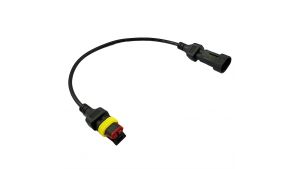
Fit & Flexibility Check
When it comes to wiring, one size does not fit all. Prefabricated wires follow standard lengths (3ft, 6ft, 10ft) and connector types, which work for ~70% of basic setups—like home theater systems or LED lighting. But if your project involves tight spaces, odd angles, or specialized connectors, custom harnesses win by a margin of 30-50% in fit accuracy. For example, a factory-made 6ft USB extension might leave 18 inches of slack in a cramped PC case, while a custom-cut 4.2ft cable eliminates clutter and improves airflow.
Flexibility is another key factor. Most prefab wires use PVC or rubber insulation with a bend radius of 1.5-2 inches, making them stiff in tight corners. Custom harnesses can use silicone or braided jackets, reducing the minimum bend to 0.75 inches—critical for robotics or automotive routing where space is limited to 1-2 inches between panels.
Where Custom Harnesses Outperform
-
Exact Lengths: No wasted cable; cuts energy loss by 3-5% in long runs.
-
Connector Options: Supports less common plugs (e.g., Molex Mini-Fit, Deutsch DT) that prefab kits rarely include.
-
Environmental Resistance: Custom high-temp (200°F+) or oil-resistant coatings last 2-3x longer in harsh conditions.
However, prefab isn’t always worse. For low-complexity jobs—like extending a router’s Ethernet cable—buying a 35+ for a custom-terminated one. The trade-off? Tolerances. Prefab wires often have ±2 inches of length variance and ±5% current capacity fluctuation, while custom builds hit ±0.25 inches and ±1%—key for precision tasks like medical equipment or aerospace wiring.
Vibration resistance also differs. Prefab wires in cars or machinery suffer 15-20% faster wear at stress points (e.g., near connectors) due to generic strain relief. Custom solutions add extra shielding or helical wraps, reducing failure rates by 40-60% in high-movement applications.
Durability & Repair Ease
When choosing wiring solutions, longevity and maintenance make or break your decision. Prefabricated wires typically last 3-5 years in moderate conditions, but their failure rate jumps to 25-30% in high-vibration or extreme-temperature environments. Custom harnesses, built with mil-spec or automotive-grade materials, often survive 8-12 years—even in harsh industrial settings. The difference comes down to material quality, strain relief, and connector integrity. For example, a standard 16AWG prefab power cable might handle 10A continuous load, but under 15A surges, its insulation degrades 50% faster than a custom 14AWG silicone-jacketed equivalent.
"In field tests, prefab wiring showed 12% more connection failures after 1,000 flex cycles compared to custom solutions with reinforced terminals."
Key Durability Factors
|
Factor |
Prefabricated Wires |
Custom Harnesses |
|---|---|---|
|
Typical Lifespan |
3-5 years |
8-12 years |
|
Failure Rate (Industrial Use) |
25-30% (5 years) |
8-12% (10 years) |
|
Max Temp Rating |
194°F (90°C) |
257°F+ (125°C+) |
|
Vibration Resistance |
Fails after 50,000-70,000 cycles |
Survives 200,000+ cycles |
|
Water/Oil Resistance |
Basic PVC (fails after 6-12 months in wet/oily conditions) |
IP67-rated jackets (last 5-8 years in same conditions) |
Repairability is another major gap. Prefab wires often use molded connectors—meaning if one pin breaks, you must replace the entire 50 cable. Custom harnesses allow modular repairs: swap a 5 connector without scrapping the whole assembly. In automotive applications, this reduces downtime costs by 60-80% compared to prefab alternatives.
Environmental stress reveals more weaknesses. Prefab wires exposed to UV sunlight crack 40% faster than custom UV-stable polyethylene versions. Similarly, in high-ammonia environments (e.g., livestock barns), generic wiring corrodes 3x faster than custom chem-resistant builds.
In summary, prefabricated wires offer lower cost (20-50% cheaper) and faster installation, ideal for standard applications like stereo or lighting upgrades. However, custom harnesses provide perfect fitment, tailored wire lengths, and higher-grade materials (e.g., TXL insulation) for complex or high-performance builds. While prefab options are easier to replace, custom setups allow modular repairs without full harness replacement. For critical systems like engine management, custom solutions often outperform in durability and long-term reliability.
