Wire Harness Cost Guide | 3 Factors for Budgeting Your Project
Typically 3-6 weeks, lead time for custom wiring harnesses varies: 150+ connections add 4-6 days, imported terminals face 3-5 day customs delays, IP67/vibration testing takes 2-3 days, peak-season backlogs extend 5-7 days, and each design tweak prolongs 2-4 days, dictating final delivery.
Material Choice and Cost
When you're budgeting for a wire harness, the materials you select aren't just a line item; they are the foundation of your project's cost, performance, and longevity. It's the single biggest lever you can pull to control your budget, with material costs typically accounting for 40% to 70% of the total harness price. A simple choice like opting for copper over aluminum for conductors can instantly double your raw material cost per meter, but it also reduces resistive losses by nearly 40% for the same current-carrying capacity, a critical trade-off for high-power applications. Understanding these trade-offs is essential.
While copper is the industry standard with a conductivity of about 100% IACS (International Annealed Copper Standard), aluminum is a common alternative at roughly 61% of copper's conductivity. This means you need an aluminum conductor with a 66% larger cross-sectional area to achieve the same electrical performance, which affects weight and flexibility.
|
Conductor Type |
Relative Conductivity (% IACS) |
Approx. Cost per Meter (12-10 AWG range) |
Key Consideration |
|---|---|---|---|
|
Bare Copper |
100% |
|
Industry standard, excellent balance of cost and performance. |
|
Tinned Copper |
100% |
|
Prevents oxidation, ideal for high-humidity (>60% RH) environments. |
|
Aluminum |
61% |
|
50% lighter and cheaper, but requires larger gauge for same ampacity. |
PVC (Polyvinyl Chloride) is the most economical choice, costing around and rated for temperatures up to 80°C to 105°C. For higher heat applications near engines or industrial machinery, Cross-Linked Polyethylene (XLPE) or Silicon Rubber can withstand temperatures from 125°C to 200°C, but at a 50% to 150% higher cost than PVC. Thin-wall insulation can reduce the overall diameter and weight of the harness by up to 15%, which is crucial in automotive and aerospace applications where every gram counts, but it may offer less abrasion resistance. The thickness of the insulation, often specified in millimeters, directly correlates with the voltage rating. A standard 300V rating for PVC might require 0.6 mm of insulation, while a 600V rating might need 0.8 mm, increasing material usage and cost.
A simple PVC sleeve for minimal bundling might cost or more. Shielding, critical for preventing electromagnetic interference (EMI) in data cables, involves weaving a braid of tinned copper around the conductors. This shielding can contain 60 to 144 individual strands and adds a minimum of 20% to the raw wire cost.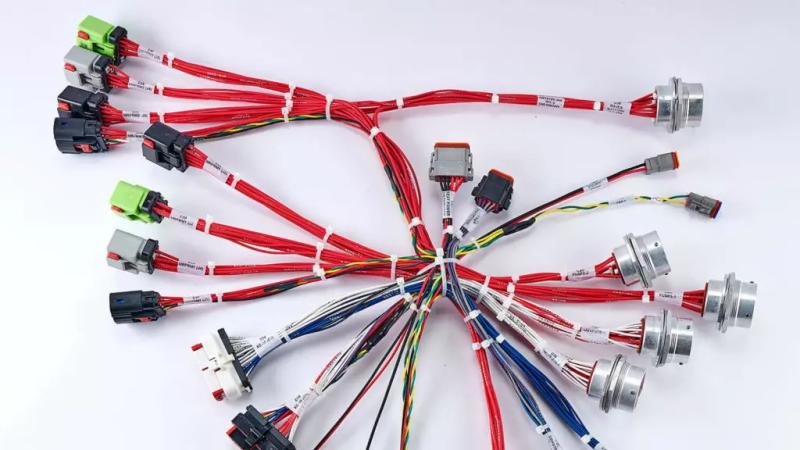
Design Complexity and Labor
Labor is not a fixed cost; it's a direct function of complexity, typically consuming 25% to 40% of the final unit price. A simple, single-branch harness with 5 wires of equal length might take an experienced technician only 8 to 10 minutes to cut, strip, crimp, and assemble. However, introduce just three additional branches of varying lengths, and the assembly time can easily triple to 30 minutes or more. This isn't just about adding parts; it's about the exponential increase in manual operations. Each new branch point requires a technician to carefully group wires, apply sleeving or tape, and often perform a complex taping pattern to ensure durability, adding 2 to 4 minutes of labor per splice. The choice between a one-piece molded connector and a hand-assembled, potted multi-pin connector can swing the labor investment from 3 minutes to over 30 minutes for that single component.
A basic 10-conductor harness might have 20 terminations (two ends per wire). If each crimp termination takes a skilled worker an average of 45 seconds to position, crimp, and tug-test, that's 900 seconds (15 minutes) dedicated solely to terminations. Now, consider a more complex assembly for industrial machinery with 50 conductors and 105 terminations (some wires may have multiple ground splices). The termination time alone balloons to 4,725 seconds, or nearly 79 minutes. This doesn't include the time to route these 50 wires through sleeves or looms, which can add another 20 to 30 minutes.
A fundamental rule in harness manufacturing is that labor costs tend to increase linearly with the number of terminations, but they can increase exponentially with the number of branches and the complexity of the routing.
A design with six branches radiating from a central point requires the technician to constantly rotate the entire assembly, applying tape or zip-ties at specific intervals. This intricate work can reduce the effective assembly speed by as much as 40% compared to a linear layout. Furthermore, the inclusion of complex components like fuses, relays, or diodes adds significant time. Integrating a simple in-line fuse holder might add 90 seconds, but wiring a relay with 5 terminals requires following a schematic diagram, testing each connection for continuity, and securing the relay to a mount, a process that can easily consume 5 to 7 minutes per unit. The tolerance for error is also a factor. Specifying that all wires must be cut to a length with a ±1.5 mm tolerance is a standard, efficient practice. Tightening that tolerance to ±0.5 mm forces the operator to measure each wire individually instead of using batch-cutting methods, potentially increasing cutting and stripping time by 200% or more.
Order Quantity and Pricing
Ordering 10 units of a custom harness will result in a price dominated by one-time setup (NRE) costs. Ordering 1,000 units of the exact same design allows those fixed costs to be diluted to almost zero, making the variable costs of materials and labor the primary drivers. The price difference can be staggering, with per-unit costs often dropping by 30% to 50% or more between a prototype batch and a full production run. The primary drivers of this cost change are:
-
The amortization of one-time setup fees.
-
The shift to more efficient, high-volume manufacturing processes.
-
Improved material pricing from bulk purchasing.
-
Increased negotiation leverage with the manufacturer.
When you place an order, the manufacturer incurs significant one-time setup costs regardless of whether you build 1 unit or 100 units. These include the cost of programming automated cutting and stripping machines, which can take a technician 2 to 4 hours at a rate of
For a batch of 50 units, a technician might work on a single harness from start to finish, taking 25 minutes per unit. For a run of 5,000 units, the process is broken down into an assembly line. One person operates a machine that cuts 100 wire lengths in 3 minutes (a per-wire time of 1.8 seconds), the next group specializes in terminal crimping, and another focuses on final assembly and taping. This specialization can reduce the touch labor time per harness from 25 minutes down to under 10 minutes, a 60% reduction in direct labor. This efficiency is reflected in the unit price. It's also the primary basis for negotiating. A manufacturer is far more likely to offer a 5% to 10% discount on an order of 5,000 units because their overall profit is secured by the sheer volume, and their production line can be dedicated to your project for a predictable 2-week period instead of being frequently reconfigured for smaller jobs. For ongoing projects, committing to an annual volume of 25,000 units, delivered in quarterly batches of 6,250 units, will almost always secure a better per-unit price than placing four separate orders of 6,250 units throughout the year, as it guarantees the manufacturer's capacity and simplifies their planning.
