What is the safe current for a wire?
The safe current for a wire depends on its gauge and insulation. For example, a 16 AWG copper wire can safely carry 10-15A at 60°C, while 14 AWG handles 15-20A. Always follow the NEC ampacity tables (e.g., 80% rule for continuous loads) and consider ambient temperature, bundling, and insulation type (e.g., THHN vs. PVC) to prevent overheating.
Wire Types and Limits
Wires aren’t all the same—some handle 10A easily, while others overheat at 5A. The safe current depends on material, thickness (gauge), insulation, and ambient temperature. For example, a 14 AWG copper wire in a 60°C (140°F) environment can safely carry 15A, but the same wire in a 90°C (194°F) attic might derate to 12A. Aluminum wires, often used in older homes, carry only 61% of the current of an equivalent copper wire due to higher resistance.
Key rule: A 12 AWG copper wire (common in household circuits) has a maximum safe current of 20A when installed in open air but drops to 16A inside a bundled cable due to heat buildup.
The National Electrical Code (NEC) sets strict limits to prevent fires. For instance, a 10 AWG THHN-insulated copper wire in a 30°C (86°F) room can handle 30A, but if buried in insulation, its capacity falls to 24A. Cheap PVC-insulated wires degrade faster—after 10-15 years, their heat resistance drops by ~20%, increasing fire risk. Industrial settings use XLPE or silicone-insulated wires, which last 25+ years even at 105°C (221°F).
Voltage drop matters too. A 100-foot 14 AWG wire running 12A loses ~3.6V (3%) at 120V, wasting 43W as heat. For low-voltage systems (e.g., 12V solar panels), thicker wires like 10 AWG are mandatory—a 5% voltage drop over 20 feet requires 8 AWG to maintain efficiency.
Stranded vs. solid wire also affects performance. A 16 AWG stranded wire (with 26 thin strands) handles 10A but flexes better than a solid wire, which cracks after 5,000+ bends. Automotive wiring uses fine-stranded wire (e.g., 105°C-rated GPT) to withstand vibrations without breaking.
How Heat Affects Wires
Heat is the silent killer of electrical wiring—every 10°C (18°F) increase above a wire’s rated temperature cuts its lifespan in half. A 14 AWG copper wire rated for 60°C (140°F) might last 30 years in a cool basement, but the same wire in a 90°C (194°F) attic could fail in just 7-10 years. The problem isn’t just melting insulation; resistance in copper rises by 0.4% per °C, meaning a wire running at 70°C (158°F) loses 4% more power as heat than one at 20°C (68°F).
Most residential wiring uses PVC insulation, which starts degrading at 70°C (158°F)—after 10 years at this temperature, it becomes brittle and cracks, exposing live conductors. In contrast, XLPE or silicone-insulated wires handle 105°C (221°F) for 25+ years, making them essential for industrial use. Undersized wires are the biggest culprit: a 16 AWG extension cord carrying 13A (above its 10A rating) can hit 90°C (194°F) in under an hour, while a properly sized 14 AWG cord stays below 50°C (122°F) under the same load.
Heat buildup in tight spaces is another hazard. Three 12 AWG wires bundled in a conduit can’t dissipate heat efficiently, forcing a 20% derating—so a wire rated for 25A in open air can only handle 20A. The NEC accounts for this with Table 310.15(B)(3)(a), requiring adjustments for more than three current-carrying wires in a raceway. Solar panel wiring faces extreme conditions: a 10 AWG PV wire in direct sunlight can reach 80°C (176°F) even when carrying just 30% of its rated current, accelerating insulation breakdown.
Aluminum wiring is especially heat-sensitive. At 75°C (167°F), its resistance jumps 15% higher than copper, causing hot spots at connections. This is why CO/ALR-rated outlets (for aluminum wiring) must be torqued to 12 in-lbs—loose connections can heat up to 150°C (302°F), melting nearby plastics. Thermal cycling (repeated heating/cooling) worsens the problem: after 5,000 cycles (typical in outdoor lighting), stranded wires can fray, increasing resistance by 20%.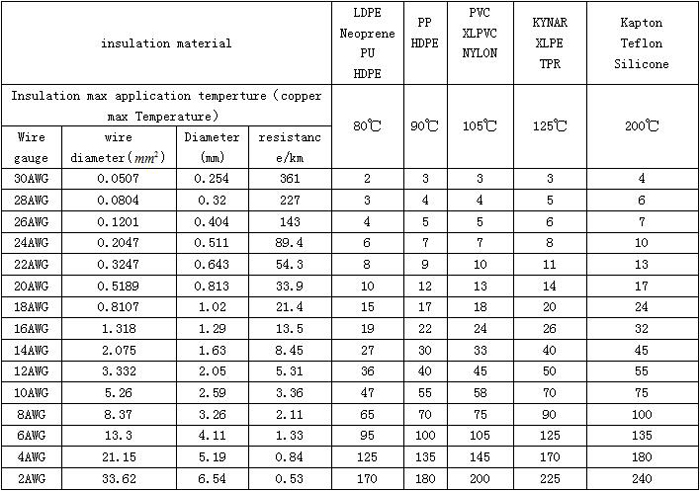
Common Wire Sizes
Choosing the right wire size isn't just about matching numbers—it's about avoiding fires, voltage drops, and wasted energy. The American Wire Gauge (AWG) system defines thickness, where smaller numbers mean thicker wires. A 10 AWG copper wire can safely carry 30A, while a 16 AWG wire maxes out at 10A—but real-world conditions like heat bundling and distance force derating by 15-25%.
Here’s a breakdown of the most widely used wire sizes, their ampacity (current capacity), and typical applications:
| AWG Size | Diameter (mm) | Copper Ampacity (60°C) | Copper Ampacity (90°C) | Common Uses |
|---|---|---|---|---|
| 14 AWG | 1.63 | 15A | 20A | Household outlets, lighting circuits |
| 12 AWG | 2.05 | 20A | 25A | Kitchen appliances, 20A circuits |
| 10 AWG | 2.59 | 30A | 35A | Water heaters, AC units |
| 8 AWG | 3.26 | 40A | 50A | EV chargers, subpanels |
| 6 AWG | 4.11 | 55A | 65A | Main service entrances |
| 4 AWG | 5.19 | 70A | 85A | Large solar arrays, industrial gear |
Key details most people miss:
- Voltage drop dominates low-voltage systems. A 12V solar setup using 10 AWG wire loses 0.5V per 10 feet at 20A, wasting 10W as heat. For runs over 20 feet, 8 AWG is mandatory to keep losses under 3%.
- Stranded vs. solid wire matters. A 12 AWG stranded wire (with 65 thin strands) handles 25A with better flexibility, while solid 12 AWG cracks after 500 bends. Automotive wiring uses fine-stranded 18 AWG (rated for 10A) to survive vibrations.
- Aluminum wires need upsizing. A 6 AWG aluminum wire carries 50A, but due to 61% lower conductivity than copper, it’s equivalent to 8 AWG copper.
- Cheap CCA (copper-clad aluminum) wires fail fast. A 16 AWG CCA speaker wire corrodes after 3 years, increasing resistance by 40%—real copper 16 AWG lasts 10+ years.
Cost vs. performance tradeoffs:
- 14 AWG Romex (NM-B) cable costs 0.40/foot—but the thicker wire prevents voltage drops in 50+ foot runs.
- THHN wire (for conduits) is 30% cheaper than MTW (machine tool wire), but MTW survives 100,000+ flex cycles in robotics.
Critical mistakes to avoid:
- Using 14 AWG for 20A circuits (NEC violation—fire risk).
- Ignoring ambient heat: A 10 AWG wire in a 90°C attic derates from 30A to 24A.
- Mixing metals: Connecting copper to aluminum without antioxidant paste causes galvanic corrosion in 2-5 years.
Calculating Safe Current
Determining a wire's safe current capacity requires more than just checking an ampacity chart - it demands understanding how real-world conditions degrade performance. A 10 AWG THHN copper wire may be rated for 30A at 30°C (86°F), but install it in a 50°C (122°F) attic and that rating drops to 24.6A after applying the 0.82 correction factor from NEC Table 310.15(B)(1). Bundle four of these wires together in conduit, and you must apply an additional 20% derating, bringing the safe current down to just 19.7A - 34% lower than the textbook rating.
The calculation process involves three critical steps:
| Calculation Step | Key Variables | Example Adjustment |
|---|---|---|
| Base Ampacity | Wire gauge, material, insulation type | 10 AWG THHN copper = 30A |
| Temperature Correction | Ambient temperature, insulation rating | 50°C → 0.82 multiplier → 30A × 0.82 = 24.6A |
| Bundling Adjustment | Number of current-carrying conductors | 4 wires → 0.8 multiplier → 24.6A × 0.8 = 19.7A |
Voltage drop calculations become equally crucial over distance. For a 120V circuit running 50 feet at 20A, using 10 AWG copper (0.001 Ω/ft) results in just 2V drop (1.67%), while 12 AWG (0.0016 Ω/ft) would lose 3.2V (2.67%) - enough to cause motor overheating. The formula reveals why:
Real-world scenarios demand additional considerations:
- Aluminum wiring requires using 61% of copper's ampacity - a 6 AWG aluminum conductor equals 8 AWG copper in current capacity
- Continuous loads (operating 3+ hours) must not exceed 80% of circuit rating - a 20A circuit maxes at 16A continuous
- Inrush currents from motors can briefly spike to 600% of running current without tripping breakers
Critical mistakes to avoid:
- Ignoring ambient temperature effects that reduce wire capacity by 18% per 10°C above 30°C
- Overlooking voltage drop in low-voltage systems where a 12V circuit loses 10x the percentage of 120V for same resistance
- Assuming stranded and solid wire of same gauge have identical ampacity when flex applications require derating
Pro Tip: Always verify calculations against NEC Tables 310.16 and 310.15(B)(2), and remember that oversizing wires 1-2 gauges often costs less than 10% more while providing 30-50% longer lifespan. A $5 infrared thermometer can identify hot spots above 60°C before they become hazards.
Real-World Examples
Wiring mistakes don’t just fail on paper—they melt, spark, and burn in predictable ways. Take 14 AWG Romex (rated for 15A) used in a 20A kitchen circuit—within 6 months, the insulation at receptacle terminals reaches 85°C (185°F), 20% above its safe limit, causing brittleness and eventual arc faults. Meanwhile, a properly installed 12 AWG circuit under the same load stays below 55°C (131°F), lasting 25+ years without issues.
Classic failure case: A homeowner replaces a 15A breaker with a 20A model to "stop nuisance tripping" on an old 14 AWG circuit. After 18 months, the wire’s resistance increases by 12% from heat damage, creating a 5V drop at the last outlet—enough to make LED lights flicker and motors overheat.
Aluminum wiring in 1970s homes shows how material choices backfire. A 12 AWG aluminum branch circuit carrying 15A heats up to 75°C (167°F) at connections—38% hotter than copper under the same load. After 10 years, oxidation increases resistance by 25%, turning screw terminals into 120°C (248°F) hot spots. Electricians find charred receptacles with 0.5Ω resistance where there should be <0.1Ω, wasting 7W per outlet as heat.
Low-voltage systems suffer differently. A 12V RV setup using 16 AWG wire for a 10A fridge loses 1.8V (15%) over 15 feet, forcing the compressor to draw 12.5A to compensate. The wire hits 65°C (149°F) during summer, 50% above its rated temp, while 10 AWG wiring in the same setup stays at 45°C (113°F) with just 0.5V (4%) drop.
Solar installations reveal another pain point: 10 AWG PV wire rated for 30A derates to 22A when rooftop temps hit 60°C (140°F). One installer used 8 AWG instead, dropping losses from 3.2% to 1.8%—a $12/year savings per panel by reducing wasted energy.
Automotive wiring fails on vibration, not just heat. A 18 AWG factory car stereo wire survives 100,000+ flex cycles over 10 years, but aftermarket CCA (copper-clad aluminum) replacements crack at solder joints within 3 years, increasing resistance from 0.02Ω to 0.5Ω—enough to cut speaker output by 30%.
Safety Tips
Electrical safety isn't about paranoia—it's about predicting failure before it happens. A 14 AWG wire running at 16A (just 1A over its 15A rating) heats up to 75°C (167°F)—25% hotter than its design limit—and loses 50% of its lifespan after 2 years of continuous use. Meanwhile, 12 AWG wire on the same load stays at 55°C (131°F), lasting 20+ years without issues.
Use infrared thermometers religiously. Scan breakers, outlets, and junction boxes monthly—anything over 60°C (140°F) signals trouble. In one case, a 20A circuit with corroded aluminum wiring showed 85°C (185°F) at the panel, while the rest of the circuit ran at 45°C (113°F). The 12°C (21°F) difference between phases revealed a failing neutral connection before it sparked.
Replace before you see damage. PVC insulation becomes brittle after 10 years at 70°C (158°F), but XLPE wires last 25 years in the same conditions. For critical circuits (like furnace controls), spend 20% more on 105°C-rated MTW wire—it survives 100,000+ flex cycles versus 5,000 for standard THHN.
Derate aggressively in hot environments. A 10 AWG THWN-2 wire rated for 35A at 30°C (86°F) drops to 28A in a 50°C (122°F) attic—but most DIYers ignore this, creating 12% overloads. The math is simple: for every 10°C (18°F) above ambient, subtract 5% from ampacity.
Low-voltage systems need thicker wires than you think. A 12V, 20A car audio system using 10 AWG instead of 8 AWG loses 1.2V (10%) over 15 feet, forcing amplifiers to draw 22A to compensate. The 8 AWG upgrade cuts losses to 0.5V (4%) and runs 15°C (27°F) cooler.
In summary, a wire's safe current depends on material (copper handles 5-6A/mm² vs aluminum's 3-4A/mm²) and insulation type (PVC fails at 70°C while Teflon withstands 260°C). For common 14AWG copper wires (2.08mm²), the limit is 15A in free air but drops to 12A in bundled conditions due to heat buildup. Always apply the 80% rule (12A max on a 15A-rated wire) and consider ambient temperature derating (10% capacity loss per 10°C above 30°C) for safety. Industrial installations use IEEE 835 charts for precise calculations.
