One article to know about wiring harness
What is a wire harness?
Wire harness, also called harness wire, cable harness, or wire loom, refers to a wire prefabricated by a combination of wires or cables, connectors, and other auxiliary materials, which can be used to assemble parts directly into the equipment.
From the definition of a wire harness, it is a combination of wires and connectors. To fully understand wire harnesses, we need to know what materials they are made of. The simplest wire harnesses consist of connectors and wires only. In contrast, more complex ones include insulation materials, and even more complex ones include various electronic components such as fuse boxes/fuses, relays, switches, sensors, ties, labels, etc. This article is organized by material type to help you understand all aspects of wire harnesses.
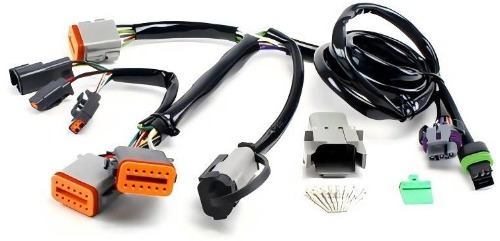
Wire Harness Applications
The wiring harness is widely used in production and daily life. It is required wherever there is a need for a power supply or signal transmission. For example, the USB cable, which consists of four cables (two for signal transmission and two for charging), serves as a common instance of a wiring harness assembled with a cable and USB connector. So, where else might we require a harness?
1. Automotive Industry
- Vehicles: Wire harnesses are crucial in automobiles, connecting different components such as the engine, lights, dashboard controls, and infotainment systems.
- Electric Vehicles (EVs): In EVs, wire harnesses manage connections for battery packs, electric motors, and charging systems.
2. Aerospace
- Aircraft: Wire harnesses are essential in airplanes, helicopters, and spacecraft for connecting flight control systems, navigation systems, communication devices, and other electronic components.
- Satellites: They are also used in satellites to manage connections in power distribution and communication systems.
3. Industrial Automation
- Robotics: Wire harnesses are used in robots to connect sensors, motors, and control systems, enabling precise movement and operation.
- Machinery: In industrial machines, they manage connections for power supply, control panels, and automation systems.
4. Medical Equipment
- Diagnostic Devices: Wire harnesses connect sensors, power supplies, and display units in medical devices like MRI machines, CT scanners, and patient monitoring systems.
- Surgical Instruments: They are used in advanced surgical tools to ensure reliable operation during procedures.
5. Consumer Electronics
- Home Appliances: Wire harnesses are found in refrigerators, washing machines, air conditioners, and other appliances, connecting various components for power and control.
- Computers & Peripherals: They manage internal connections within computers, printers, and other electronic devices.
6. Telecommunications
- Networking Equipment: Wire harnesses are used in servers, routers, and communication towers to connect power supplies, processors, and communication interfaces.
- Data Centers: They organize and manage connections in data centers, ensuring efficient data flow and power distribution.
7. Military & Defense
- Vehicles & Equipment: In military applications, wire harnesses are used in tanks, ships, drones, and communication equipment to ensure reliable operation in harsh environments.
- Weapons Systems: They are also used in missile systems, radar, and other defense technologies.
8. Renewable Energy
- Solar Power: Wire harnesses are used in solar panels to connect cells and inverters, managing the flow of electricity.
- Wind Turbines: They connect the various components of wind turbines, including generators, sensors, and control systems.
9. Railways & Transportation
- Trains & Metros: Wire harnesses are used in trains for communication, control, and power distribution.
- Public Transit: They are essential in buses and other public vehicles for connecting various electronic systems.
10. Home & Building Automation
- Smart Homes: Wire harnesses connect sensors, controllers, and devices in home automation systems, enabling control over lighting, security, and HVAC.
- Building Management Systems: They are used in commercial buildings to connect fire alarms, security systems, and energy management systems.
Now that we know that wire harnesses are so widely used in all aspects of our production and life, how are wire harnesses created, what materials are wire harnesses made of, what are the prices it is, and how do we make our wire harnesses? We will continue to explore the wiring harness in depth from the following aspects.
Wire harness components
- Wire and cables
- Connectors and Terminals
- Accessories
In simple terms, the wire harness is actually a wire or cable crimping terminal then inserted into the housing of the electronic assembly, if special needs, with a sleeve to protect the wire from damage.
1. Wire and cables
Although from a conceptual point of view, the wire harness is indeed very simple, when we in-depth understanding, in fact, it is not so simple, because there are many types of wire, and the types of connectors are also many, in the production and processing process due to the diversity of materials, the problems encountered will be diverse. Let's look at the wire and cable first.
- Electric single wire
- Power cable
- Flat cable
- Coiled cable
- Custom wire and cable
This is the classification of wires. Going back to the original concept, a wire harness is made up of wires or cables as the basic material. So what are wires and what are cables? There is no authoritative definition to distinguish between them, as we usually call them all wire and cable, or wire is also called cable, and cable is also called wire in practical use. For Hooha Harness, which has been in the industry for 20 years, we call a wire with only one set of conductors and insulation materials an electronic wire, also called a wire. We call a cable made up of multiple electronic wires a cable. There are many types of cables, such as the most commonly used household appliance power cord that connects to a 220V power supply.
What wire and cable do we use in our wire harness products?
- Wire gauges: 32 AWG to 2/0 AWG (0.03mm² to 67mm²)
- Wire Style in Stock: UL series: 1007, 1015, 1569, 1571, 3266, 1851, 1330, 1331, 1332, 1061, 1430, 3312, 1180, 3135, 2725, 2464, 2468, etc. Auto wires: AVS, AVSS, TXL, GXL, SXL, etc.
- Wire Color: red, black, white, yellow, green, blue, orange, brown, grey, and purple, also supports custom dual color wire.
- Wire and Cable Jacket: PVC, PU, TPE, TPU, TPEE, Teflon, Silicone, etc.
Notes:
- wire or cable are not listed here not mean we cannot do it, just send the drawing to us for customize.
- Each type of wire has a different size range, contact us to check details.
- Some power cables have limited certificates, contact us to check if it has been certified.
2. Connectors and Terminals
Connectors are an important component that connects wires and devices. In most cases, wires are not directly connected to devices because direct connection efficiency would be very low. Imagine if you were a car manufacturer and needed wires to connect various parts. Would you connect the wires directly for efficiency, or would you assemble the connectors first and then insert them into the device's socket for convenience? The answer is obvious - the latter. Therefore, connectors are a product of increased production efficiency, as they make it easy for us to quickly connect various electronic components together.
So, What are the types of connectors does it have?
- Butt connector
- Crimp connector
- Solder connector
- Data connector
What Auto Connector Brand it have?
In order to fully understand the connector, I suggest that you can look at the world-famous connector brand, from their website can fully understand the type of connector, specifications, parameters, and so on. Of course, the types of each brand listed on the website are not comprehensive, because no brand is a full category, which is also an important channel for me to deeply understand our products in the past 20 years as an industry practitioner.
Terminals
Sometimes, we also call the terminal a connector, it is pressed to the wire and can be directly inserted and removed. When multiple terminals are used together, the sheath can be separated from each other and is very convenient to use. According to the actual use, terminal manufacturers have invented various appearance terminals.
- Ring terminal
- Splice terminal
- Spot Welding terminal
- Fork-type terminal
- Bullet terminal
- 110 terminal
- 187 terminal
- 205 terminal
- 250 terminal
- 312 terminal
3. Accessories
The accessory materials for wiring harnesses are also very complex, but not all wiring harnesses use all of them. This will depend on the actual needs, such as the auto headlight wiring harness, which requires the use of switches, relays, fuse boxes, ties, labels, and wrapping materials. The engine wiring harness, on the other hand, will not use relays, fuse boxes, or switches, but it may use sensors. To facilitate understanding of the composition of wiring harnesses, we will try to list as many materials as possible that may be used.
- Fuse and fuse holder, fuse box
- Clips
- Relay
- Label
- Tie
- Switches
- PCB
- Sensors
- Wrapping materials
The various wire harness accessories listed here are each an industry in themselves, driven by innovation from industry practitioners. They provide a new classification system that allows you to easily search for their definition, classification, and manufacturer. Additionally, you can click on the provided link to access a separate page dedicated to this topic (if available).
Wiring Harness Costs
The price of wire harness consists of three parts, the price of wire harness raw materials, assembly and processing costs, and the profit required for business operation.
Why are there high and low prices quoted when we look for wire harness suppliers?
If the wire harness listed materials are commonly used, it is to see whose production efficiency is higher, the management cost is low, then the price is more advantageous.
If the wiring harness you need uses some special materials, the market is not very good to buy, then you need to see what kind of products the supplier focuses on, generally speaking, Focus on data cable (such as USB cable, VGA cable, HDMI cable) manufacturers, for automotive materials, especially the supply of connectors, they do not have any advantages, even if they can find suppliers to provide quotes, usually the final offer will be high. On the contrary, for manufacturers who are good at making car wiring harnesses, the price of data cables such as USB cables will be high.
In addition, the price of wiring harnesses will also be different by the amount of demand, the number is small, the price is high, the number is large, the price is low, and the factory also likes the number of orders, not only have more profits, but also have more orders. It is also because a large demand can require raw material suppliers to provide more favorable prices, on the other hand, mass production will also provide production efficiency, thereby reducing production costs, and ultimately reflected in the price.
Wire Harness Processing
As a wire harness manufacturer with 23 years of experience, we have also experienced the evolution of various processing equipment and spent countless costs to provide production efficiency and reduce production costs to meet customer requirements. During the production process, we have also accumulated rich experience to deal with various challenges, especially the problems encountered in the production process, such as how to correct the deformation of terminal crimping, how to avoid burrs in the overmolding process, how to adjust dimensional deviation in the assembly process, how to improve defective products in the testing process, etc. In the 23 years of operation, we have cooperated with more than 600 customers and completed over 5,000 projects, with an average of 8 projects per customer and some customers even exceeding 200 projects. some of them have worked with us for more than 10 years, which shows that customers continue to trust us.
- Wire or cable cutting
- Stripping
- Tinning
- Soldering
- Terminal crimping
- Overmolding
- Harness assembly
- Testing
- Packing
The above are the commonly used processing steps in the wiring harness manufacturing process. However, different types of wiring harnesses require different processing steps and equipment. Let's take our most common USB cable as an example: first, we cut the cable and peel both ends twice (removing the sheath layer first, then peeling the core wire inside). Next, we soldered 4 core wires to the USB connector. After that, we perform two moldings: firstly using TPE plastic injection molding to fix the solder joint, and then using 45P PVC molding. Following this is testing, quality inspection, and packaging - these are the production steps for a USB cable. There is no use of a cold crimping process here, like in an automotive wiring harness, the terminal is inserted into the housing after cold crimping and then assembly, testing, quality inspection, and packaging. With the complexity of the wiring harness, the processing steps, and the sequence will be different, which requires the wiring harness engineer to make a good processing flow chart for the production line.
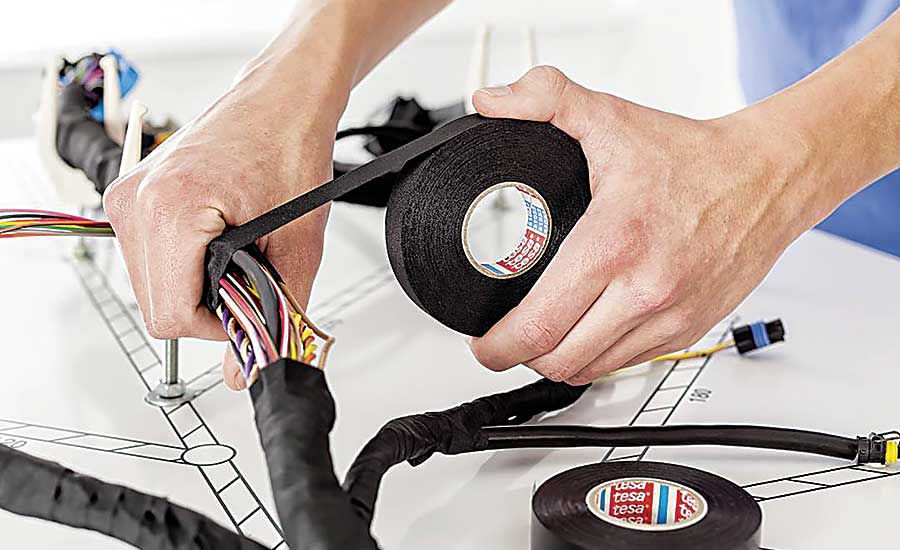
Wire Harness Assembly Standard
To ensure the highest quality and reliability of our wire harness products, we adhere to industry standards. Specifically, all our cables are meticulously built and rigorously tested following the IPC/WHMA-A-620 standard. This internationally recognized standard sets forth strict guidelines for the design, manufacture, and acceptance of cable and wire harness assemblies.
The IPC/WHMA-A-620 standard covers various aspects such as materials selection, soldering criteria, crimping techniques, insulation requirements, and overall workmanship. By following this comprehensive set of guidelines, we guarantee that our wire harnesses meet or exceed the industry's expectations for performance and durability.
Moreover, when it comes to automotive wire harness products specifically designed for use in vehicles, we go a step further by adhering to the IATF16949 standard. This stringent quality management system is specifically tailored for automotive suppliers and ensures that our manufacturing processes consistently meet customer requirements while continuously improving efficiency.
By implementing these standards throughout our production process from start to finish - including design verification, component sourcing, assembly procedures, and testing protocols - we can confidently deliver wire harnesses that not only comply with industry regulations but also surpass customer expectations.
At every stage of production within our facility – from incoming raw material inspection to final product validation – we have established robust quality control measures. These measures include regular audits conducted by internal teams as well as external certification bodies that verify compliance with both IPC/WHMA-A-620 and IATF16949 standards.
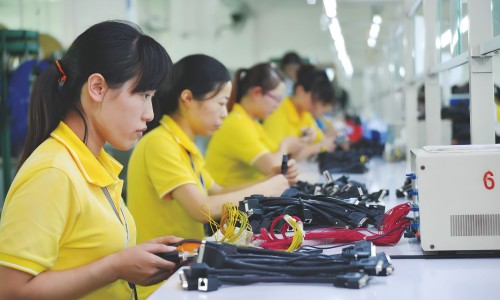
Wire Harness Production Equipment
A company's product range can be judged by its production equipment they have, and a factory's production capacity can be judged by the number of equipment they have.
Some of the company's sales tell you that they can do any type of wire harness products, but when you ask them to send a list of their equipment, there is no molding machine, then how to do USB cables? If there is no assembly board, how to assemble a complex car wiring harness? Therefore, this can also give you a side view of the true strength of a factory.
Click here to view our company's production and test equipment to understand our product range and production capacity.
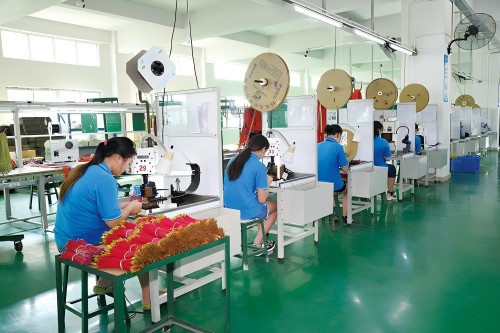
Customize Wire Harness Steps
- Send us your wire harness drawing/schematic for a quote price
- Feedback with quotation (1~3 days)
- Confirm quotation
- Arrange a sample to you for approval
- Make mold if needed (7 days)
- Mold test
- Making samples (1~3 days)
- Samples test (Approval)
- Place order for Mass production (generally 2~3 weeks)
- Quality checking
- Packing
- Delivery
- After Service
- Repeat Order.
Most wire harness cable assemblies are customized products, not standard items that can be used in any equipment. Therefore, it is necessary to communicate all the details of the cable assembly with the manufacturer so that they fully understand your requirements before starting mass production. We generally need to make a sample for testing before mass production, including the length of each branch of the cable assembly, whether the circuit is correct, whether the materials used are correct, whether the processing technology meets the IPC/WHMA-A-620 standard, etc. Only when the sample meets the customer's requirements will we know what product the customer needs. Also, the final tested sample will be used as a standard for subsequent mass production.
