Custom Engine Management Wiring Harness, China Manufacturer
Introduction
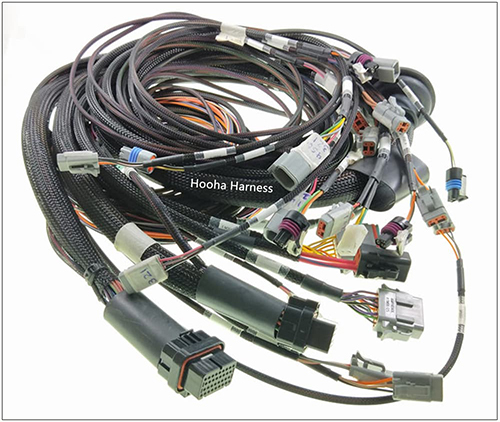
Classification of Engine Management Wiring Harnesses
Applications and Specific Use Cases
|
Application Category
|
Primary Function
|
Environmental & Technical Challenges
|
Recommended Harness Features
|
|---|---|---|---|
|
Gasoline Engines
|
Manages intake, fuel injection, and spark timing.
|
High heat near exhaust; EMI from coil packs.
|
Shielded wiring for crank/cam signals; high-temp resistant insulation.
|
|
Diesel Engines
|
Controls high-pressure common rail, EGR, and after-treatment (SCR).
|
Extreme vibration; exposure to diesel fuel and urea.
|
Heavy-duty connectors; robust strain relief; oil-resistant sheathing.
|
|
Hybrid Powertrains
|
Interfaces ICE ECU with Electric Motor Controllers.
|
High-frequency switching noise; 48V/400V isolation.
|
Enhanced braided shielding; twisted pair wiring; high-voltage safety standards.
|
|
Non-Road Mobile Machinery (NRMM)
|
Powers agricultural, construction, and industrial engines.
|
High-pressure washdown; dust ingress; severe vibration.
|
IP67/IP6K9K connectors; abrasion-resistant nylon conduit; wide temp range.
|
Gasoline Engine Management Systems
These harnesses are integral to the precise coordination of the Otto cycle. They connect the ECU to throttle position sensors, idle air control valves, and evaporative emissions purge solenoids. In naturally aspirated engines, the focus is on clean signal routing, whereas in turbocharged applications, the harness must incorporate shielding to protect MAP sensor signals from coil pack interference.
Diesel Engine Management Systems
Here, the harness complexity escalates due to stricter emissions regulations. Custom harnesses must support the high-pressure common rail fuel system, managing the precise timing of piezo or solenoid injectors. Additionally, they interface with Exhaust Gas Recirculation (EGR) valves and various after-treatment components, such as NOx sensors and heaters within the Selective Catalytic Reduction (SCR) system.
Hybrid Powertrains (MHEV/PHEV)
In these systems, the harness acts as a high-speed data and power bridge. A specific subset of the harness manages the communication between the traditional Internal Combustion Engine (ICE) controller and the Electric Motor Controller. These wires often require enhanced shielding (e.g., braided or foil shields) to prevent high-frequency switching noise from the inverter from corrupting the engine sensor data.
Non-Road Mobile Machinery (NRMM)
For applications in agriculture, mining, and construction, harnesses are built to withstand extreme vibration and environmental exposure. These custom solutions often feature extra-heavy-duty conduits and military-grade circular connectors to ensure equipment remains operational in dusty, muddy, and high-pressure wash-down environments.
Material Selection: Connectors, Wires, and Accessories
Material selection is the cornerstone of a reliable engine management harness.
|
Brand / Series
|
Key Feature
|
Temperature Rating
|
Typical Application
|
|---|---|---|---|
|
Rugged, sealed, vibration-resistant
|
Up to 125°C
|
Main ECU Interface
|
|
|
Deutsch DT / DTM
|
Wedgelock retention, silicone seals
|
Up to 125°C
|
Wheel Speed, Transmission Sensors
|
|
High current capacity, compact
|
Up to 150°C
|
Fuel Injectors, Ignition Coils
|
|
|
High-speed data, shielded options
|
Up to 125°C
|
CAN/LIN Bus Networks
|
|
Standard / Type
|
Insulation Material
|
Temp Rating
|
Key Characteristic
|
|---|---|---|---|
|
SAE TXL
|
Cross-linked Polyethylene
|
125°C
|
Thin wall, excellent chemical/oil resistance.
|
|
SAE SGX
|
Silicone Rubber
|
200°C
|
Extreme flexibility and heat resistance (Turbo/Manifold).
|
|
ISO FLRY-B
|
PVC (Thin-wall)
|
105°C
|
Space-saving, high flexibility (European OEMs).
|
|
Fluoropolymer (PTFE)
|
Teflon
|
200°C+
|
Low friction, high dielectric strength (Specialty Racing).
|
Wire & Cable Selection: The focus is on insulation resilience. SAE TXL is the go-to for under-hood applications due to its cross-linked properties. For extreme proximity to heat sources, SAE SGX (Silicone) is used. European builds often use ISO FLRY-B for its space-saving, thin-walled design.
Manufacturing Processes and Dimensional Control
|
Dimension Parameter
|
Typical Tolerance
|
Measurement Tool
|
Impact of Deviation
|
|---|---|---|---|
|
Overall Branch Length
|
±3mm to ±5mm
|
Steel Rule / Caliper
|
Too tight causes stress; too loose risks snagging.
|
|
Branch Point Location
|
±2mm
|
Formboard Pins
|
Misalignment prevents mounting to engine bosses.
|
|
Strip Length
|
±0.5mm
|
Go/No-Go Gauge
|
Affects crimp quality and insulation displacement.
|
|
Tape Spiral Pitch
|
25% Overlap
|
Visual Inspection
|
Insufficient overlap exposes wires to abrasion.
|
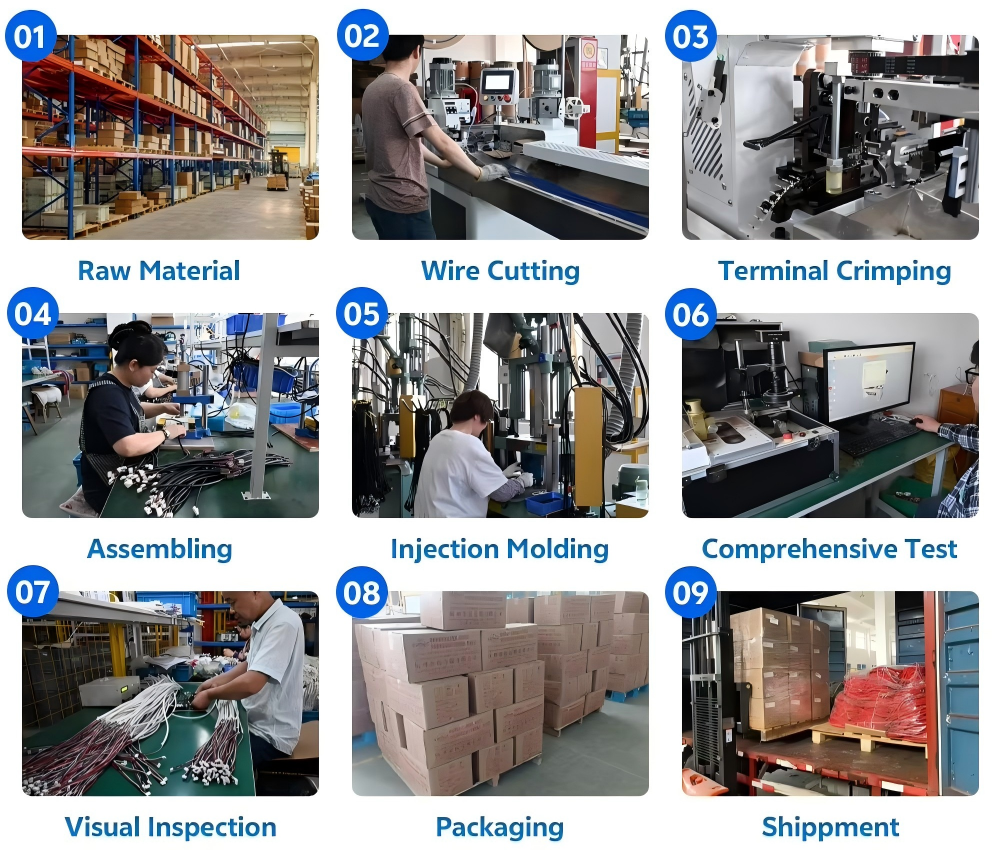
Before shipping, every custom harness undergoes 100% Electrical Testing, including continuity, hi-pot (dielectric strength), and short-to-ground checks, ensuring the physical dimensions match the electrical schematic.
Custom Engine Wire Harness Cases
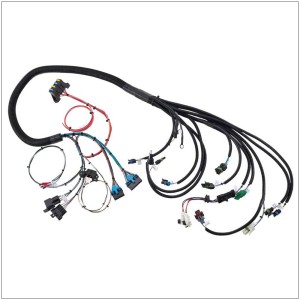
ECU Wire Harness
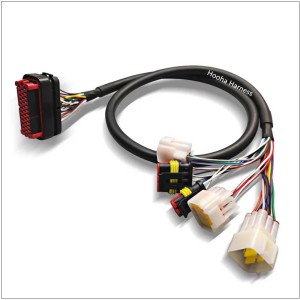
ECU wiring kit
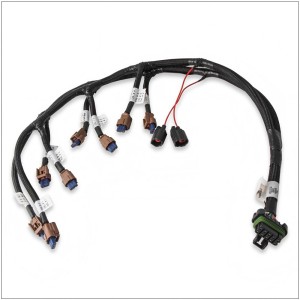
Engine Management Wire Harness
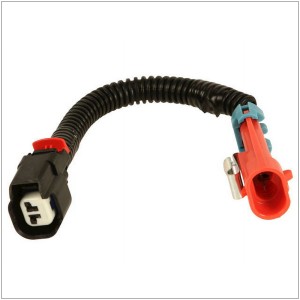
Engine Management Wire Harness
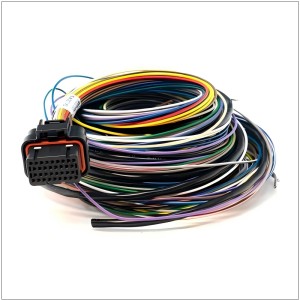
Engine Management Wire Harness
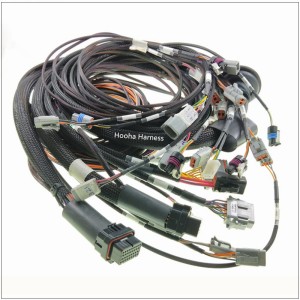
Engine Management Wire Harness
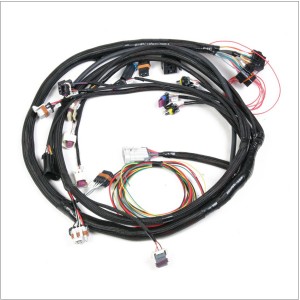
Engine Management Wire Harness
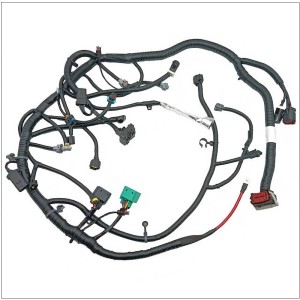
Engine Wiring Harness
We Support Custom Wire Harness Assembly
- Connectors: Support TE, Deutsch, Aptiv, Amphenol, Sumitomo, Yazaki, etc.
- Wire Gauge:
- depends on your needs
- recommended by us
- Wire Colors: Available in a wide range, including white, black, red, yellow, blue, green, brown, orange, purple, grey, and more.
- Wire Length: Fully customizable to your specifications.
- Wiring Diagram: Tailor-made to meet your project needs.
- Custom type:
- Send drawing to customize.
- Send a sample to customize.
- Tell us as many details as possible to customize.
- Minimum Order: 50 pieces per order.
Customize Your Wire Harness
Send your sample or drawing/schematic for quote price→ Feedback with quotation(1~3 days) → Confirm quotation → Arrange sample you for approval→ [Make mold if needed (7 days) →Mold test] → Making samples(1~3 days)→ Samples test(Approval) → place order for Mass production(2~3 weeks)→ Quality checking→ Packing → Delivery → After Service → Repeat Order.
